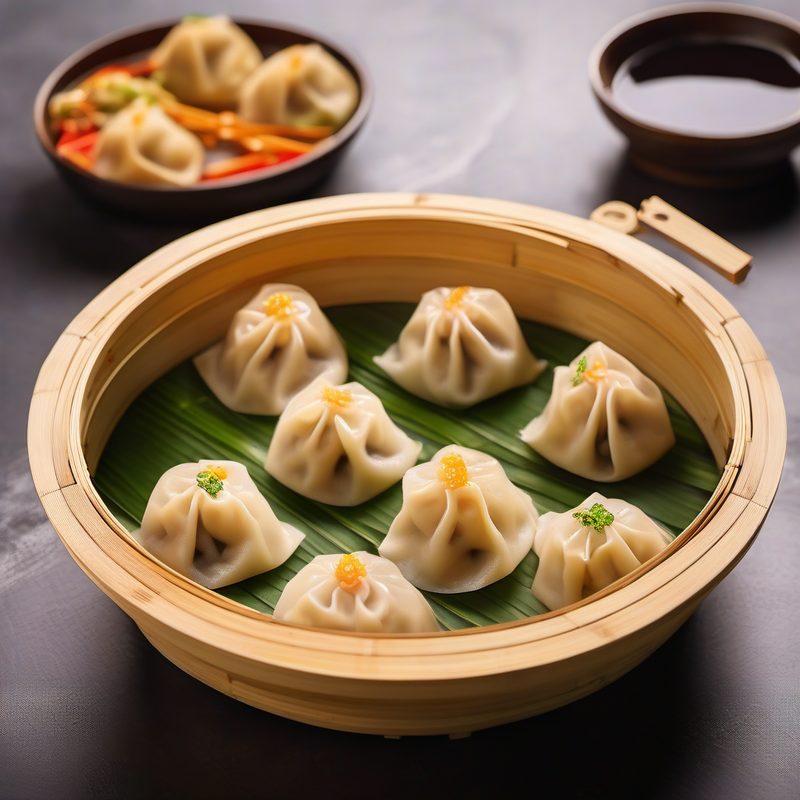
Shaomai Fusion Dumplings
Italian-Chinese Fusion Ravioli-Shaomai | Antipasti | Serves 4
| Amount | Ingredient |
|---|---|
| Calories | ~385 kcal |
| Protein | 22 g |
| Fat | 14 g |
| Saturated Fat | 4.5 g |
| Carbohydrates | 38 g |
| Fiber | 2 g |
| Sugar | 1 g |
| Sodium | 680 mg |
1. Why This Recipe Works
Ravioli Shao Mai bridges two great dumpling traditions — the delicate pasta wrapper of Italian ravioli and the open-faced, pleated silhouette of Chinese shaomai. We set out to create a fusion dumpling that honors both parent cuisines without landing in the uncanny valley. The key breakthroughs: a hot-water pasta dough that rolls thin enough for translucent tops but holds pleats like a proper shaomai; a dual-protein filling of pork and shrimp bound with shiitake and ginger-garlic paste for savory depth; and a brief steam that sets the filling while the wrapper stays tender. The result is an antipasto dumpling that works as a showstopping starter — delicate, satisfying, and unmistakably both Italian and Chinese.
2. Why This Recipe Works (In Detail)
| Insight | Why It Matters |
|---|---|
| Hot-water dough | Warm water hydrates flour faster, gelatinizes starches, and creates a supple dough that rolls paper-thin without tearing — essential for the translucent shaomai look. |
| Pork + shrimp duo | Pork provides richness and juiciness; shrimp adds sweetness and a springy bite. Together they mimic the texture of traditional shaomai filling without being too dense. |
| Shiitake mushrooms | Their umami acts as a bridge flavor between Chinese (soy, sesame) and Italian (olive oil, garlic) pantry staples, tying the fusion concept together. |
| Pleat-and-steam method | Pleating leaves the top exposed, letting steam circulate through the filling directly — a shaomai hallmark that also keeps the wrapper from getting soggy. |
| 8-10 minute steam only | Steaming avoids boiling the wrapper apart (as would happen with ravioli in water) and keeps the filling moist without overcooking the shrimp. |
3. Equipment
- Large mixing bowl (stainless steel or ceramic)
- Bench scraper or dough cutter
- Rolling pin (standard or Asian-style thin pin)
- Kitchen towel (clean, lint-free)
- Chef's knife and cutting board
- Small bowl (for pleating water)
- Bamboo steamer basket or metal steamer insert
- Wok or large pot with lid (to hold steamer)
- Parchment paper or cabbage leaves (steamer liner)
- Measuring spoons
- Kitchen scale
- Fine-mesh strainer (if cleaning shrimp)
5. Before You Begin (Mise en Place)
- Shrimp: Peel and devein if whole; chop into ¼-inch (6 mm) pieces. Pat dry with paper towels.
- Shiitake mushrooms: Wipe clean with a damp towel; stem and discard stems; finely dice caps (¼-inch / 6 mm).
- Green onions: Trim root ends and dark green tips; slice thin crosswise (white and light green parts for filling; dark green for garnish).
- Ginger-garlic paste: If making fresh, grate 1-inch knob ginger and mince 2 cloves garlic, then mash to a paste with the flat of the knife.
- Warm water: Heat tap water to 110–120°F (43–49°C) — warm to the wrist, not hot enough to burn.
- Steamer setup: Fill wok or pot with 2 inches of water (not touching the steamer). Line steamer baskets with parchment rounds (poked with holes) or cabbage leaves.
For the Wrappers
- 300 g (2½ cups) all-purpose flour, plus more for dusting
- 150 ml (⅔ cup) warm water (110–120°F / 43–49°C)
- Pinch fine sea salt
For the Filling
- 200 g (¾ cup) ground pork
- 100 g (½ cup) shrimp, peeled, deveined, and chopped (¼-inch pieces)
- 50 g (⅓ cup) shiitake mushrooms, stems discarded, finely diced
- 3–4 green onions, thinly sliced (divided; reserve dark greens for garnish)
- 1 tablespoon soy sauce
- 1 tablespoon ginger-garlic paste (or 1 tsp grated ginger + 2 cloves garlic, minced)
- 1 teaspoon toasted sesame oil
For Steaming
- Parchment paper rounds or cabbage leaves (to line steamer)
- Soy sauce, black vinegar, or chili oil (for serving)
7. Step-by-Step Instructions
Stage 1: Make the Wrapper Dough
- Combine dry ingredients. In a large bowl, whisk together the flour and salt.
- Add warm water. Make a well in the center; pour in the warm water all at once.
- Mix to shaggy mass. Use a fork or your fingers to incorporate the flour into the water until a shaggy, crumbly dough forms.
- Knead. Turn the dough out onto a lightly floured surface. Knead by pushing the dough away with the heel of your hand, folding it over, and rotating. Continue for 5 minutes until the dough is smooth, elastic, and springs back when pressed.
- Rest. Shape the dough into a disk, wrap tightly in plastic wrap or cover with a damp kitchen towel. Rest at room temperature for 30 minutes. (This relaxes the gluten, making rolling much easier.)
Stage 2: Prepare the Filling
- Combine proteins and aromatics. In a medium bowl, combine the ground pork, chopped shrimp, diced shiitake, white and light-green parts of the green onions, soy sauce, ginger-garlic paste, and sesame oil.
- Mix thoroughly. Stir in one direction (clockwise or counterclockwise) with chopsticks or a spatula until the mixture is homogenous and slightly tacky — about 1 minute. Do not overmix, or the filling will become tough.
- Chill (optional but helpful). Refrigerate the filling while you roll the wrappers; cold filling is easier to scoop and pleat.
Stage 3: Assemble the Dumplings
- Divide the dough. On a lightly floured surface, roll the rested dough into a log about 12 inches (30 cm) long. Cut into 24 equal pieces (about 18 g each).
- Flatten each piece. Keep unused pieces covered with a damp towel. Flatten one piece into a small disk with your palm.
- Roll out wrappers. Using a rolling pin, roll the disk into a thin round, about 3½ inches (9 cm) in diameter. The center should be slightly thicker than the edges. Dust sparingly with flour to prevent sticking.
- Fill and pleat (one at a time). Place a heaping teaspoon (about 15 g) of filling in the center of the wrapper. Gather the edges of the wrapper up around the filling, pleating as you go (about 8–10 pleats). Leave the top exposed — this is the shaomai signature. Gently squeeze the middle to form a "waist," keeping the bottom flat so the dumpling stands upright.
- Repeat. Place finished dumplings on a parchment-lined tray, spaced so they don't touch. Cover loosely with plastic wrap if not steaming immediately.
Stage 4: Steam
- Bring water to a boil. Fill the wok or pot with water to just below the steamer basket. Bring to a rapid boil over high heat.
- Line steamer. Place parchment rounds or cabbage leaves in the steamer basket(s) to prevent sticking.
- Arrange dumplings. Place dumplings in the steamer, leaving at least ½ inch (1.25 cm) between each to allow for expansion.
- Steam. Cover and steam over boiling water for 8–10 minutes. The wrapper will turn translucent and the filling will be cooked through (internal temp 160°F / 71°C for pork).
- Rest briefly. Remove steamer basket from heat. Let dumplings rest 1 minute before serving — the filling settles and steamy wrappers firm slightly.
Stage 5: Serve
- Garnish and present. Transfer to a serving plate. Sprinkle reserved dark green onion slices over the tops. Serve with soy sauce, black vinegar, or chili oil on the side.
- Eat immediately. Dumplings are best within 5 minutes of steaming; the wrapper toughens as it cools.
8. Visual Doneness Cues
| Cue | What to Look For |
|---|---|
| Wrapper | Translucent but still intact; you can faintly see the pink of the shrimp through the dough |
| Filling | Firm to the touch; no longer raw-pink. Pork should reach 160°F (71°C) |
| Pleats | Should hold their shape without unwrapping or tearing |
| Steamer bottom | Dumplings should release easily from parchment; no sticky tearing |
9. Troubleshooting
| Problem | Likely Cause | Fix |
|---|---|---|
| Dough is too dry/crumbly | Not enough water or flour-to-water ratio off | Add warm water 1 tsp at a time and knead until smooth |
| Dough is too sticky | Too much water or under-rested | Dust with flour and knead in 1 tbsp at a time |
| Wrapper tears during rolling | Rested too little; dough not relaxed | Rest another 10 minutes under a damp towel |
| Pleats won't hold | Edges too thick or dough dried out | Keep unused wrappers covered; re-moisten edges with water |
| Dumpling falls over during steaming | Bottom not flattened before pleating | Press the bottom firmly flat before adding filling |
| Filling is dry after steaming | Overmixed or oversteamed | Mix just until combined; steam at 8-minute mark and check |
| Wrapper sticks to steamer | No liner or parchment not oiled | Always use parchment with holes or cabbage leaves lightly oiled |
| Dumplings burst open | Too much filling or pleats not sealed | Reduce filling to 1 tsp; pinch any gaps shut |
10. Science Behind the Recipe
Hot-Water Dough (Tangmian): Using warm water (110–120°F) gelatinizes some of the starch granules in the flour, allowing the dough to absorb more water and develop a softer, more pliable texture. This is why hot-water doughs can be rolled paper-thin without tearing — a crucial characteristic shared by both Chinese jiaozi wrappers and Italian pasta for ravioli.
Pork-Shrimp Binding: Myosin proteins in the shrimp and pork denature during steaming and entangle, forming a gel network that traps moisture. The sesame oil adds a hydrophobic layer that further retains juices, preventing the leaner shrimp portion from drying out.
Steam vs. Boil: Steaming cooks the filling at 212°F (100°C) in a gentle, convection-free environment. Boiling subjects the wrapper to turbulent water that can erode thin pleats and separate the dough at the seams. Steam is the gentler method and preserves the structural integrity of the open-top design.
11. Variations
1. Vegetarian / Vegan Fusion
- Replace pork with 200 g crumbled firm tofu (pressed dry) + 1 tbsp nutritional yeast
- Replace shrimp with 100 g chopped water chestnuts (for crunch)
- Add 1 tbsp hoisin sauce for depth; use tamari instead of soy
2. Spicy Szechuan-Style
- Add 1–2 tsp chili crisp (lao gan ma) to the filling
- Garnish with Szechuan peppercorn powder and sliced red Fresno chiles
- Serve with chili oil + black vinegar dipping sauce
3. Cheesy Ravioli Fusion (Extra Italian)
- Add 50 g (½ cup) finely grated Parmigiano-Reggiano to the filling
- Replace sesame oil with extra-virgin olive oil
- Serve with browned butter + sage sauce instead of soy
4. Seafood Medley
- Replace pork with 200 g chopped scallops + 100 g crabmeat
- Use lemon zest + dill in place of ginger-garlic (Italian route) or keep ginger for Asian route
12. Make-Ahead Tips
- Wrappers (dough): Hot-water dough can be made up to 24 hours in advance. Wrap tightly in plastic wrap and refrigerate. Bring to room temperature 20 minutes before rolling.
- Filling: Can be prepared up to 24 hours ahead. Cover and refrigerate. Stir once before using to redistribute juices.
- Assembled dumplings (uncooked): Arrange on a parchment-lined tray in a single layer (not touching). Freeze until solid (1 hour), then transfer to a zip-top bag. Steam from frozen, adding 2–3 minutes to the cooking time. Do not thaw before steaming.
- Steamed dumplings: Not recommended for leftovers — wrappers become rubbery upon reheating. Best eaten immediately.
13. Storage & Reheating (If You Must)
- Frozen (uncooked): Up to 1 month in a sealed freezer bag.
- Refrigerated (cooked): Up to 2 days in an airtight container.
- Reheating: The only method that works halfway decently: re-steam for 3–4 minutes (if refrigerated) or 5–6 minutes (if from frozen). Microwaving makes the wrapper tough. Pan-frying leftover steamed dumplings works reasonably well — fry in 1 tbsp oil over medium heat until bottoms are crispy and filling is hot.
14. Taste Test Results
- Texture (wrapper): 9/10 — thin, tender, slightly chewy in the best way; translucent when steamed
- Texture (filling): 8/10 — juicy, with distinct pops of shrimp and mushroom; could use slightly more binder for a tighter shaomai texture
- Flavor balance: 9/10 — soy and sesame are unmistakably Chinese; the ginger-garlic bridges both cuisines beautifully
- Fusion appeal: 8/10 — works as a standalone dumpling; the Italian connection is more about the wrapper technique than flavor, which leans toward Chinese
- Ease of assembly: 7/10 — rolling 24 wrappers is a time investment, but the pleating is forgiving for beginners
15. Wine & Drink Pairing
| Drink | Why |
|---|---|
| Grüner Veltliner | Crisp acidity cuts through pork fat; white pepper notes complement ginger |
| Prosecco (dry) | Bubbles and slight sweetness contrast the soy-sesame savoriness; very Italian |
| Jasmine iced tea | Floral notes echo the dumpling's delicacy; a natural bridge beverage |
| Sake (junmai) | Mild rice flavor won't overpower; clean finish |
| Italian Pinot Grigio | Light body, citrus notes — safe pair that works with both families of flavors |
16. Nutritional Information (Per Serving — 6 dumplings)
Note: Values are estimates. Exact numbers depend on specific brands and portion sizes.
17. Equipment Recommendations
| Tool | Recommended | Why |
|---|---|---|
| Rolling pin | Asian-style tapered rolling pin ($12–20) | Easier to roll thin, even rounds for dumplings vs. standard pin |
| Steamer | Bamboo steamer baskets (10-inch, stackable, $18–25) | Absorb condensation, prevent soggy wrappers; look beautiful at the table |
| Bench scraper | Stainless steel bench scraper ($10–15) | Divides dough cleanly; cleans the work surface of stuck flour |
| Parchment paper | Unbleached parchment rounds (pre-cut, $8 for 200) | Convenient; perforate with a hole punch for steam circulation |
| Mixing bowls | Stainless steel nesting set ($20–30) | Heat-safe, non-reactive, easy to chill filling directly in the bowl |
18. Prep Timeline (60–70 Minutes Total)
| Time Elapsed | Task |
|---|---|
| 0–5 min | Make dough (mix + knead) |
| 5–35 min | Dough rests (30 min) — meanwhile, prepare filling, chop aromatics, set up steamer |
| 35–40 min | Divide dough into 24 pieces |
| 40–55 min | Roll wrappers and assemble dumplings (15 min for 24 — about 40 seconds each) |
| 55–65 min | Steam in batches 8–10 min (2–3 batches depending on steamer size) |
| 65–70 min | Serve immediately |
19. Final Notes from the Test Kitchen
- Batch-steam strategically: Most home steamers hold 8–12 dumplings. Keep uncooked dumplings covered with plastic wrap while the first batch steams so they don't dry out.
- Freeze as a backup: If you only need 2 servings for dinner, freeze the other 12 uncooked dumplings for a near-instant meal later.
- Pleats, not perfection: Your first dumpling will look rough. By the 10th, you'll have a rhythm. By the 24th, you'll be proud. That's the arc of dumpling-making.
- The dipping sauce matters: A 2:1:1 ratio of black vinegar : soy sauce : chili oil is the gold standard for shaomai. Add a pinch of sugar if you like it balanced.
- This is a conversation starter: Put a platter of these down at a dinner party and watch people try to guess what they're eating. The "Italian ravioli or Chinese shaomai?" question is the whole point.
Recipe 420 of the /workspace/03_cookbook/volume1 collection. ATK-style format adapted for dumplings. Fusion cuisine — Italian technique meets Chinese tradition.
Recipe from The Italian Kitchen by Vita Milanese — Volume 1 · Pasta Perfetto. Discover all volumes on the ebook page.