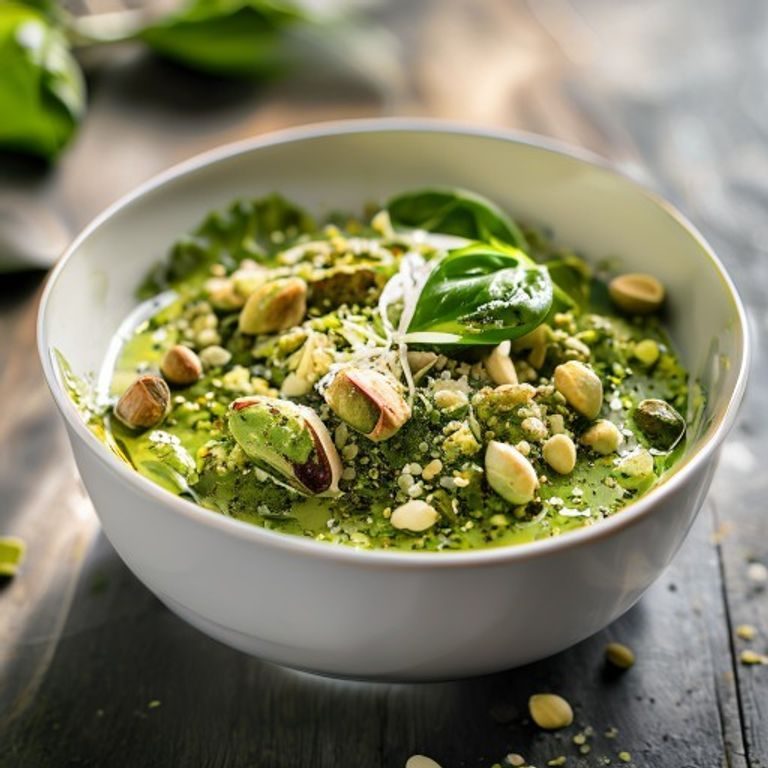
Pistachio Pesto
A vibrantly green, luxuriously creamy pistachio pesto — made from hand-peeled pistachios blended with seed oil, olive oil, and a touch of water — that transforms simple spaghetti into an unforgettable, emerald-hued pasta experience.
| Amount | Ingredient |
|---|---|
| Using all olive oil | Olive oil overwhelms the delicate pistachio flavor Use the 6:1 ratio of seed oil to olive oil as specified |
| Not reserving pasta water | No way to loosen the pesto if it's too thick Always reserve at least 1 cup of pasta cooking water before draining |
| Letting the leftover pesto oxidize | Surface turns brown and unappetizing Cover with a thin layer of olive oil before refrigerating; use within 1 week |
| Underseasoning | Pesto tastes flat despite the rich nuttiness Be generous with salt — the pesto needs it to bring out the pistachio flavor |
Most pestos are made with basil, pine nuts, and garlic — but this Sicilian-inspired creation turns that convention on its head. Here, shelled pistachios take center stage, their naturally sweet, rich, and slightly fruity flavor becoming the star of a sauce that's at once nutty, creamy, and surprisingly delicate. The pistachios are first soaked in hot water to loosen their skins, then patiently peeled by hand (yes, it takes a few minutes, but the resulting color and texture are unmatched). Blended with a combination of seed oil and olive oil — plus a little water to achieve a silky, spoonable consistency — the pesto emerges a brilliant, almost luminous green, with a smooth, velvety texture that clings to every strand of spaghetti. It's a revelation: nutty without being heavy, rich without being cloying, and so simple that you'll find yourself making it again and again. Serve it as a quick weeknight pasta, use it as a spread on bruschetta, or toss it with roasted vegetables for an instant upgrade.
Use level tablespoons. All produce is medium unless specified. The pistachios must be raw and unsalted — roasted or salted pistachios will throw off the flavor and salt balance. The combination of seed oil and olive oil is intentional: seed oil (grapeseed, sunflower) has a neutral flavor that lets the pistachio shine, while olive oil adds a fruity, grassy finish. Using all olive oil would overwhelm the delicate pistachio flavor.
🥘 Equipment
- Medium heatproof bowl (for soaking pistachios)
- Fine-mesh sieve or colander
- Small sharp knife (for peeling pistachios)
- High-speed blender or food processor
- Large pot (for cooking pasta)
- Colander (for draining pasta)
- Large bowl or serving platter
- Rubber spatula
- Measuring cups and spoons
📋 Preparation
Step 1 — Soak and Peel the Pistachios (15 minutes)
Place the shelled pistachios in a medium heatproof bowl. Pour hot water (just off the boil) over the pistachios until they are fully submerged — about 2–3 cups of water. Let them soak for exactly 10 minutes.
Drain the pistachios in a fine-mesh sieve. Rinse briefly with cool water so they're comfortable to handle.
Peel the pistachios: Using your fingers (and a small knife for stubborn spots), gently squeeze each pistachio to pop it out of its skin. The skins should slip off easily after the hot water soak — if they don't, return them to hot water for another 2 minutes. You should end up with a bowl of bright, vibrant green pistachio kernels and a separate pile of brown, papery skins. Discard the skins.
This step is the most labor-intensive part of the recipe, but it's also the most important. The skins are what give most pistachio products their dull, brownish-green hue — removing them reveals the brilliant emerald green kernel underneath and results in a pesto of stunning, vibrant color. If you're short on time, you can skip the peeling, but the pesto will be noticeably darker and slightly more tannic. For the best visual impact and smoothest texture, take the 10 minutes to peel.
Step 2 — Blend the Pesto (5 minutes)
Transfer the peeled pistachios to a high-speed blender or food processor.
Add the seed oil, olive oil, water, and salt.
Blend on high speed for 1–2 minutes, stopping to scrape down the sides with a rubber spatula as needed, until the mixture is completely smooth, creamy, and emulsified. The pesto should be the consistency of a thick, pourable cream — if it's too thick, add warm water 1 tablespoon at a time and blend again.
Taste and adjust — you may want a pinch more salt or a touch more olive oil for a fruitier finish.
The water is the secret to this pesto's silky texture. Without it, the oils and nut solids would form a thick paste rather than a smooth, sauce-like consistency. The water also helps create a stable emulsion that doesn't separate as it sits. If you prefer a chunkier pesto, pulse the blender rather than running it continuously.
Step 3 — Cook the Pasta (10 minutes)
Bring a large pot of well-salted water (about 1 tablespoon salt per 4 quarts / 4 liters of water) to a rolling boil.
Add the spaghetti and cook according to package directions until al dente (typically 8–10 minutes for dried spaghetti).
Reserve about 1 cup (240 ml) of pasta cooking water before draining.
Drain the spaghetti (do not rinse).
The starchy pasta water is liquid gold here — if you need to loosen the pesto further when tossing with the pasta, a splash of pasta water does double duty: it adds salt and helps the sauce cling to the noodles.
Step 4 — Toss and Serve (2 minutes)
Return the drained spaghetti to the pot or transfer to a large warm bowl.
Add about ¾ cup (180 ml) of the pistachio pesto — you may not need all of it. Start with less and add more as you toss, until every strand is evenly coated in a beautiful, bright green sheen.
Toss vigorously to combine. If the sauce seems too thick, add a splash of the reserved pasta water (about 2–3 tablespoons) and toss again.
Divide among 4 warmed bowls. Garnish with chopped pistachios, a sprinkle of flaky sea salt, and a drizzle of good olive oil if desired.
The leftover pesto keeps beautifully — store it in a jar with a thin layer of olive oil on top to prevent oxidation, and refrigerate for up to a week. Use it on pizza, bruschetta, roasted vegetables, or as a spread for sandwiches.
🧑🍳 Chef's Tips
- Don't skimp on the soaking time: A full 10-minute soak in hot water is what makes the skins slip off effortlessly. If you rush this step, you'll be fighting with stubborn peels for much longer than necessary.
- Use a high-speed blender for the smoothest texture: A food processor will work, but a Vitamix or similar high-speed blender will produce a noticeably silkier, more emulsified pesto. If using a food processor, blend for an extra minute and scrape down frequently.
- Make it in bulk: This recipe makes about 3 cups of pesto — far more than you need for one pasta dinner. Freeze the extra in ice cube trays (about 2 tablespoons per cube), then pop out and store in a freezer bag for quick single-serving portions.
- Toast some pistachios for garnish: Before blending, set aside a handful of peeled pistachios, give them a rough chop, and toast them in a dry skillet over medium heat for 2–3 minutes until fragrant. Sprinkle over the finished dish for a textural contrast.
- Add a squeeze of lemon: A tiny splash of fresh lemon juice (about 1 teaspoon per cup of pesto) brightens the flavor and helps prevent oxidation that would turn the pesto brown.
❌ Common Mistakes
| Mistake | Why It Hurts | The Fix |
|---|---|---|
| Skipping the skin-peeling step | Pesto turns brownish-green instead of vibrant emerald; slightly bitter/tannic flavor | Take the 10 minutes to peel — the color and taste payoff is enormous |
| Using roasted or salted pistachios | Overpowers the delicate flavor; makes pesto too salty | Use only raw, unsalted pistachios |
| Not adding enough water | Pesto is too thick and paste-like; won't coat pasta evenly | Add water 1 tablespoon at a time until the consistency of heavy cream |
🔗 Related Recipes
- Almond and Olive Pesto (#112) — another nut-based pesto; almonds and taggiasche olives blended into a bold, briny sauce for pasta
- Tagliatelle with Walnut and Fig Pesto (#173) — a sweet-savory pesto made with walnuts, dried figs, and Parmigiano; an autumnal counterpart to this bright spring-summer pistachio version
- Pasta with Sun-Dried Tomato Pesto (#221) — a tangy, umami-rich pesto made from sun-dried tomatoes, almonds, and basil; a completely different but equally delicious pesto pasta
- Pasta with Celery Pesto (#224) — an unexpected and refreshing pesto made from fresh celery, almonds, and pecorino; bright, herbaceous, and light
🏷️ Search Tags
Photo: `vol1_251.png` — A shallow white pasta bowl holds a generous nest of spaghetti coated in a brilliant, emerald-green pistachio pesto. The sauce clings to every strand, glossy and smooth. A sprinkle of roughly chopped toasted pistachios and a few flakes of flaky sea salt garnish the top, with a drizzle of golden olive oil catching the light. A fork is twisted into the pasta, lifting a portion to reveal the vibrant color beneath. The bowl sits on a dark stone countertop, with a small glass jar of the leftover pistachio pesto and a handful of shelled raw pistachios arranged beside it. Bright, clean daylight illuminates the scene from above.
Recipe from "The Italian Kitchen" by Vita Milanese — Volume 1: Pasta Perfetto
Recipe from The Italian Kitchen by Vita Milanese — Volume 1 · Pasta Perfetto. Discover all volumes on the ebook page.