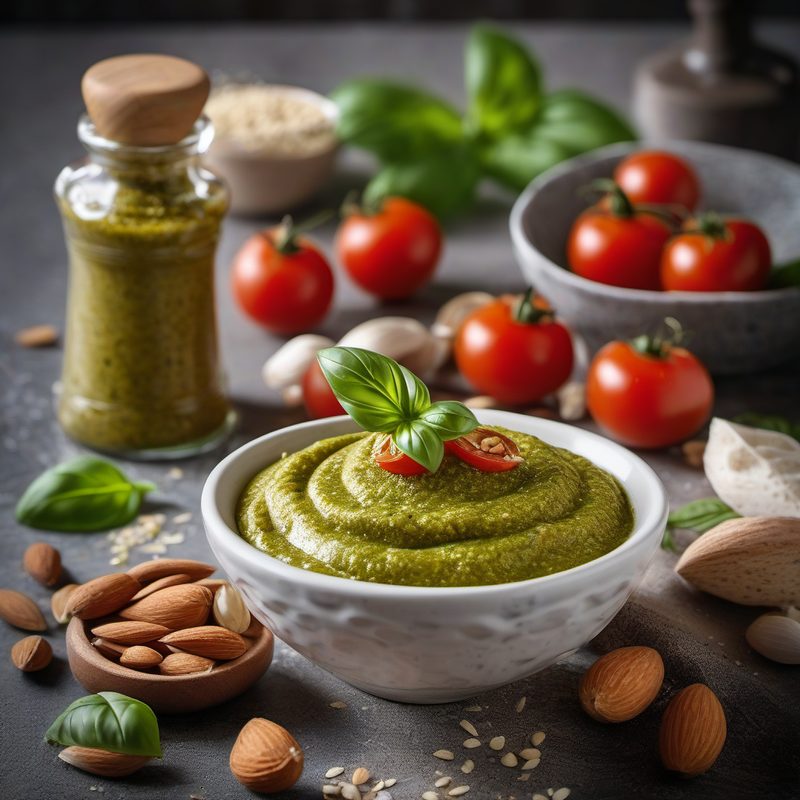
Pesto Trapanese
A vibrant Sicilian pesto from the port city of Trapani — sun-ripened tomatoes, toasted almonds, fresh basil, and Pecorino come together in a chunky, rust-red sauce that's fruitier, nuttier, and brighter than its Genovese cousin. No cooking required for the sauce; the heat of the pasta does all the work.
| Amount | Ingredient |
|---|---|
| 350 g | Busiate, trofie, fusilli, or other short, twisted pasta |
| 1/2 cup | Reserved pasta water |
> Note: Active prep is 15 minutes. The almonds need a quick toast, then everything comes together in a mortar or food processor.
For the Pesto
For the Pasta
🥘 Equipment
- Mortar and pestle (traditional) or food processor
- Large pot (6-qt)
- Colander
- Small skillet
- Large mixing bowl or the pasta pot itself
📋 Preparation
Step 1: Toast the Almonds
Place the almonds in a dry small skillet over medium heat. Toast, shaking the pan frequently, until fragrant and lightly golden — about 3–4 minutes. Transfer to a plate and let cool completely.
Why toast? Toasting deepens the almond flavor and adds warmth that balances the bright tomatoes.
Step 2: Cook the Pasta
Bring a large pot of generously salted water to a rolling boil (about 2 tbsp salt per gallon). Add the pasta and cook according to package directions until al dente. Reserve 1/2 cup of the starchy pasta water before draining.
Step 3: Make the Pesto
Traditional mortar method:
- Place the garlic cloves and a pinch of salt in the mortar. Grind with the pestle until a smooth paste forms.
- Add the basil leaves in batches, grinding in a circular motion until broken down into a fragrant green paste.
- Add the cooled toasted almonds and crush them — you want a chunky texture, not a fine powder.
- Add the halved cherry tomatoes and gently crush them with the pestle. You want the tomatoes to break down into a chunky, saucy consistency — some small pieces should remain.
- Stir in the olive oil with the pestle, then fold in the grated Pecorino. Season with salt to taste.
Food processor shortcut:
- Pulse garlic and almonds until coarsely chopped.
- Add basil and pulse 3–4 times.
- Add cherry tomatoes and pulse 4–5 times — you want a chunky consistency, not a puree.
- With the motor running, drizzle in the olive oil. Stop, stir in the Pecorino, and pulse once to combine.
The sauce should be thick, coarse, and rust-colored — like a chunky salsa, not a smooth cream.
Step 4: Toss and Serve
Transfer the drained hot pasta to a large mixing bowl (or return it to the pot). Add the pesto and toss vigorously to coat every strand or piece. If the sauce seems thick, add a splash of reserved pasta water — the starch helps it cling.
Serve immediately, optionally topped with extra grated Pecorino, a few fresh basil leaves, and a drizzle of olive oil.
🧑🍳 Chef's Tips
- Use ripe, flavorful tomatoes: This is a raw sauce, so the tomatoes need to earn their keep. In-season cherry or San Marzano tomatoes are ideal. In winter, you can use high-quality canned whole San Marzano tomatoes — drain them first.
- Mortar vs. food processor: The mortar gives a superior texture with distinct bits of almond and tomato. The food processor is fine for weeknights but stop early — you want chunks, not baby food.
- Blanched or skin-on almonds: Blanched almonds give a milder, creamier pesto. Skin-on almonds add a slightly bitter, earthier note and more color. Both are authentic.
- Don't overdrain the pasta: A little excess water on the pasta helps the pesto emulsify. Shake the colander once, don't fuss.
- Pecorino Siciliano: If you can find it, use it — it's saltier and sharper than Pecorino Romano and tastes more authentic to the dish. Reggiano Parmigiano can substitute for up to half the Pecorino if you want a milder flavor.
❌ Common Mistakes
| Mistake | Why | Fix |
|---|---|---|
| Over-processing the pesto | Turns into a smooth emulsion — you lose the chunky, rustic texture that defines the dish | Pulse gently and stop early; you want visible bits of almond and tomato |
| Using untoasted almonds | Flat, raw flavor with no depth | Always toast the almonds first — 3 minutes in a dry skillet makes all the difference |
| Rinsing the pasta | Washes away the starch that helps the pesto cling | Never rinse — drain and toss immediately |
| Using a neutral oil | Olive oil is essential to the flavor profile — don't substitute | Use a fruity, medium-intensity extra-virgin olive oil |
| Adding all the oil at once | The sauce can break or become greasy | Incorporate oil gradually, stirring as you go |
💡 Variations
- Add heat: A pinch of red pepper flakes or a small dried peperoncino crushed with the garlic adds a Sicilian kick.
- Swap the nuts: Pine nuts or pistachios are traditional alternatives. Pistachios (especially Sicilian Bronte pistachios) make a vivid green-tinged pesto.
- Add ricotta: Fold in 1/3 cup fresh ricotta for a creamier, milder sauce — common in some Trapanese home kitchens.
- Seafood twist: Top with grilled shrimp or seared tuna — Trapani is a port city, and seafood is natural here.
- Gluten-free: Use gluten-free fusilli or penne. The pesto works beautifully with any pasta shape.
- Add capers: 1 tbsp salted capers (rinsed) pulsed into the pesto adds a briny, coastal edge.
❄️ Storage
| Method | Details |
|---|---|
| Fridge (pesto only) | Up to 3 days in an airtight container with a thin layer of olive oil on top to prevent oxidation. Stir before using. |
| Fridge (tossed pasta) | Up to 2 days. Refresh with a splash of hot water and a drizzle of olive oil before serving at room temperature. |
| Freezer (pesto only) | Freeze in an ice cube tray for up to 3 months. Thaw and toss with freshly cooked pasta. The texture will be slightly more uniform after freezing. |
🍷 Wine Pairing
| Wine | Why |
|---|---|
| Grillo (Sicily) | The classic match — citrusy, floral, with almond undertones that mirror the pesto |
| Catarratto | Light, crisp, mineral-driven — cuts through the richness of the Pecorino |
| Etna Bianco (Carricante) | High-altitude white with bright acidity and a saline finish — perfect with raw tomatoes |
| Cerasuolo di Vittoria (red) | Sicily's only DOCG red — light, cherry-fruited, chill it slightly for a summer pairing |
| Vermentino di Sardegna | Herbaceous and citrusy — a worthy substitute if you can't find Sicilian whites |
🍺 Beer Pairing
| Beer | Why |
|---|---|
| Sicilian Pale Ale | Citrusy hops complement the basil and tomato |
| Italian Pilsner | Clean, crisp, high carbonation cuts through the olive oil and cheese |
| Blonde Ale | Light malt profile won't overpower the delicate pesto |
🥗 Suggested Sides
- Simple arugula salad with lemon juice, shaved Pecorino, and toasted pine nuts
- Grilled eggplant caponata — the sweet-sour flavors echo the Sicilian theme
- Focaccia or pane carasau (Sardinian flatbread) to mop up any remaining pesto
- Roasted peppers with anchovies and oregano for a full Sicilian antipasto spread
📊 Nutrition (per serving)
| Calories | Protein | Fat | Carbs | Fiber |
|---|---|---|---|---|
| 495 | 15 g | 24 g | 55 g | 4 g |
Based on 350 g dried pasta, all pesto ingredients, and a moderate amount of extra-virgin olive oil. Nutrition may vary based on pasta brand and exact cheese quantity.
❓ FAQ
Can I use other tomatoes if I don't have cherry tomatoes?
Absolutely. Roma or San Marzano tomatoes work beautifully — just remove the seeds and chop coarsely before crushing. In winter, high-quality canned San Marzano tomatoes (drained) are a fine substitute.
What shape of pasta is traditional?
The traditional Trapanese pasta is busiate or busiati — a long, twisted, hand-rolled shape from the region. Trofie, fusilli, casarecce, or gemelli are excellent substitutes. The pesto clings best to pasta with twists and ridges.
Is this served hot or at room temperature?
It's traditionally served hot or warm, right after tossing. The pesto doesn't need cooking, so serve immediately for the brightest flavor. Leftovers can be enjoyed at room temperature the next day.
Is this the same as Genovese pesto?
No — and the difference matters. Pesto alla Trapanese is tomato-based and uses almonds instead of pine nuts, giving it a fruitier, nuttier, less herbal profile. Genovese pesto has no tomatoes and uses only basil, pine nuts, Parmigiano, and Pecorino.
Can I make this vegan?
Yes — omit the Pecorino and substitute with 2 tablespoons nutritional yeast plus an extra pinch of salt. The almonds and olive oil provide enough richness.
🔗 Related Recipes
- Pesto alla Genovese — The Classic Basil Pesto
- Fusilli with Arugula Pesto & Cherry Tomatoes
- Spaghetti al Pomodoro Crudo (Raw Tomato Sauce)
- Pasta con le Sarde (Sicilian Sardine Pasta)
- Pasta alla Norma (Eggplant & Ricotta Salata)
🏷️ Search Tags
Recipe from The Italian Kitchen by Vita Milanese — Volume 1 · Pasta Perfetto. Discover all volumes on the ebook page.