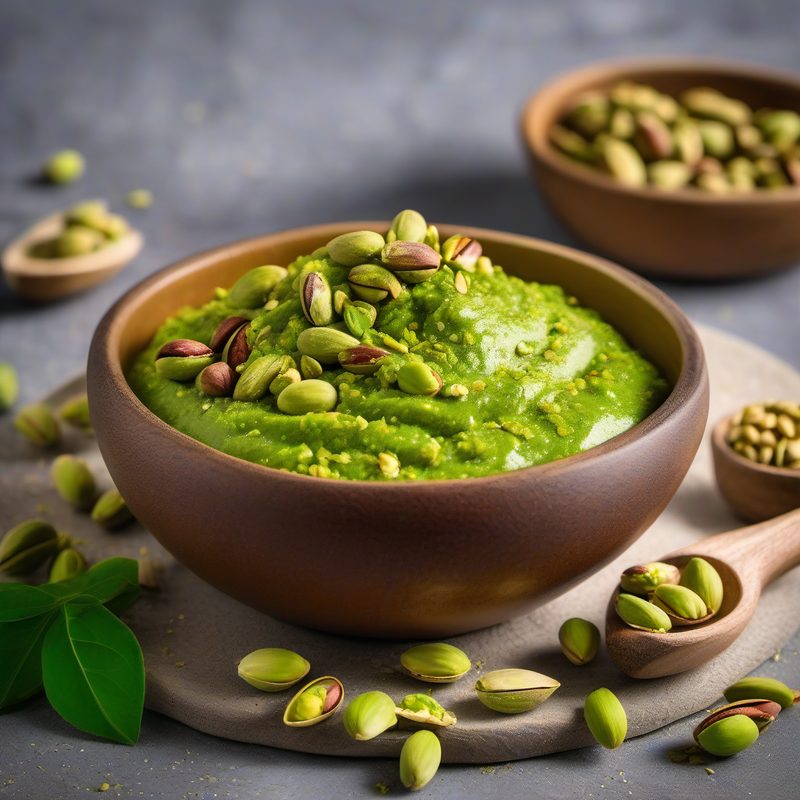
Pistachio Paste
Category: Condimenti, Preparazioni di base
| Amount | Ingredient |
|---|---|
| 200 g (1⅔ cups) | Raw shelled pistachios Unsalted, shelled. Do not use roasted or salted pistachios |
| 50 g (¼ cup) | Granulated sugar White sugar. Caster/superfine is ideal for faster blending |
| 1 tbsp (15 ml) | Pistachio oil (or neutral oil like grapeseed) Pistachio oil intensifies the flavor; neutral oil keeps the pistachio flavor clean |
| Pinch | Fine sea salt |
Yield: ~1 cup (about 240 ml)
Prep time: 25 min
Difficulty: Easy
A silky, intensely nutty homemade pistachio paste — made from blanched, peeled, and toasted pistachios blended with sugar and oil until luxuriously smooth — a versatile pantry essential for pastries, pasta, gelato, and more.
Homemade pistachio paste is a revelation compared to the commercial versions, which are often dull in color, overly sweet, and cut with cheap almond paste or artificial flavorings. Starting with raw, unsalted shelled pistachios, you first blanch them to loosen their thin brown skins, then rub them off by hand to reveal the brilliant emerald-green kernel beneath. Toasting the peeled nuts in a dry pan deepens their flavor, waking up their natural oils and adding a subtle warmth. Then, with patience and a good food processor, you grind them into a powder, then a thick paste, and finally — after adding sugar, oil, and a pinch of salt — a silky-smooth, spoonable puree with a stunning, vibrant green color. The result is pure pistachio essence: nutty, sweet, and creamy, ready to elevate everything from cannoli filling and gelato to pistachio pesto, croissants, and buttercream.
Pistachio quality is everything here. Use raw, unsalted, shelled pistachios from a reputable source — the fresher they are, the brighter the color and more vibrant the flavor. Iranian, Sicilian (Bronte DOP), or Californian pistachios all work beautifully; Sicilian Bronte pistachios have the most intense, almost violet-green color and a distinctly sweet, delicate flavor. If you can't find pistachio oil (it's expensive and sometimes hard to source), a high-quality neutral oil like grapeseed or light olive oil works perfectly — the pistachios themselves provide plenty of flavor. Avoid extra-virgin olive oil here; its grassy, peppery notes will clash with the delicate nuttiness.
🥘 Equipment
- Medium saucepan (for blanching)
- Fine-mesh sieve or colander
- Small sharp knife (for stubborn skins)
- Clean kitchen towel or paper towels (for rubbing off skins)
- Dry skillet or frying pan (for toasting)
- High-speed food processor (or blender)
- Rubber spatula
- Measuring cups and spoons
- Clean glass jar with airtight lid (for storage)
📋 Preparation
Step 1 — Blanch and Peel the Pistachios (15 minutes)
Bring a medium saucepan of water to a rolling boil.
Add the 200 g (1⅔ cups) shelled pistachios and blanch for exactly 1 minute. The water will turn slightly pinkish-brown from the pigment of the skins.
Drain immediately in a fine-mesh sieve and rinse briefly under cool running water until comfortable to handle.
Rub off the skins: Transfer the warm pistachios to a clean kitchen towel or a stack of paper towels. Fold the towel over the nuts and rub vigorously — the skins should slip right off. For any stubborn bits, use your fingers or the tip of a small sharp knife to peel them away. Discard the skins.
The blanching step is quick but essential. One minute in boiling water loosens the tannic, papery skins without cooking the nuts or dulling their bright green color. Skipping the peel is possible, but the resulting paste will have a noticeably duller, brownish-green hue and a slightly more bitter, astringent flavor. For the most vibrant, restaurant-quality pistachio paste, take the 5–10 minutes to peel. If you blanch for longer than a minute, the kernels can become waterlogged and harder to toast evenly.
Step 2 — Toast the Pistachios (3 minutes)
Transfer the peeled pistachios to a dry skillet or frying pan set over medium heat.
Toast, shaking the pan frequently, for 2–3 minutes until the pistachios are fragrant and just beginning to deepen in color — you'll smell their nutty aroma filling the kitchen. Do not let them brown or scorch.
Remove from the heat and spread the toasted nuts on a plate or baking sheet to cool completely, about 5 minutes.
Toasting is optional but highly recommended. The dry heat intensifies the pistachios' natural oils and brings out a deeper, rounder nuttiness that makes the finished paste more complex. Watch carefully — pistachios are high in oil and can go from perfectly toasted to burnt in seconds. Burnt pistachios will ruin the flavor of the paste. They should be warm and fragrant but still bright green, not brown.
Step 3 — Grind and Blend (8 minutes)
Transfer the cooled toasted pistachios to a high-speed food processor (or high-powered blender).
Process on high for 3–4 minutes. The pistachios will first turn into a fine, dry powder (this is normal — scrape down the sides as needed), then begin to clump together as their natural oils release, and finally form a thick, chunky paste.
Add the 50 g (¼ cup) sugar, 1 tbsp (15 ml) pistachio oil, and pinch of salt.
Continue blending for another 3–4 minutes, stopping every minute to scrape down the sides and bottom of the bowl with a rubber spatula, until the paste is completely smooth, glossy, and pourable — it should have the consistency of runny peanut butter or thick honey.
This step tests your patience. Most food processors take a full 5–8 minutes of processing to go from whole nuts to silky-smooth paste. The process happens in stages: powder (dry, fine), then clumpy (starts sticking together), then chunky paste (thick and grainy), then smooth paste (silky and fluid). Do not rush it. If your food processor overheats or the motor labors, stop and let it rest for 2–3 minutes before continuing. Add the sugar early in the blending to help absorb some of the nut oils and create a finer texture. The final paste should be smooth enough to spread — if it's still gritty, keep blending in 1-minute increments.
Step 4 — Jar and Store (5 minutes)
Transfer the finished pistachio paste to a clean glass jar with an airtight lid.
Press a piece of plastic wrap directly onto the surface of the paste (to prevent oxidation and color loss), then seal with the lid.
Label and date the jar.
The paste will keep in the refrigerator for up to 3 weeks. For longer storage, freeze in ice cube trays (about 1 tablespoon per cube), pop out the frozen cubes, and transfer to a freezer bag. Frozen pistachio paste keeps for up to 6 months and can be used straight from the freezer in most applications. Because pistachio paste contains no preservatives, always use a clean, dry spoon when scooping from the jar to prevent spoilage.
🧑🍳 Chef's Tips
- Use a high-speed food processor, not a blender. A blender's narrow jar makes it hard to scrape down the sides and can trap nut pieces in the blade assembly, resulting in uneven grinding. A food processor's wide bowl gives you better control and easier scraping. If you must use a blender, use a tamper to keep the nuts moving and pulse rather than running continuously.
- Don't skip the peeling. Yes, it's fiddly. But nothing makes a bigger difference in the final color of your pistachio paste. Peeled pistachios produce a paste that's brilliant, emerald green; unpeeled pistachios yield a paste that's a muddy, brownish green. For pastry applications (gelato, croissants, buttercream), the color matters as much as the flavor.
- Toast in small batches. A single layer in the pan ensures even toasting. If the nuts are piled up, some will toast while others steam, leading to uneven flavor.
- Cool completely before blending. Warm pistachios will have difficulty grinding into a smooth paste — the heat softens the oils and can cause the mixture to become greasy rather than creamy. Spread them on a plate and let them come to room temperature.
- Add the sugar early. Sugar acts as an abrasive, helping the food processor grind the nuts more finely. Adding it at the beginning of the blending process (after the initial powder stage) results in a smoother, more consistent paste.
- Use pistachio oil for maximum flavor. If you can find it, pistachio oil (made from cold-pressed pistachios) doubles down on the nutty flavor and gives the paste a beautiful, fragrant aroma. It's expensive but a little goes a long way. Store it in the refrigerator after opening — it's highly perishable.
- Scale up the recipe easily. This recipe doubles and triples beautifully. Make a larger batch during pistachio season (late summer to early fall) and freeze in portions for year-round use.
- Save the skins for breadcrumbs. The discarded pistachio skins can be dried in a low oven (200°F/95°C for 15 minutes), then ground into a powder and used as a natural food coloring or added to breadcrumb coatings for a nutty twist.
❌ Common Mistakes
| Mistake | Why It Happens | How to Avoid |
|---|---|---|
| Paste is grainy, not smooth | Not blended long enough; food processor isn't powerful enough | Blend for a full 5–8 minutes; if using a lower-powered machine, add sugar earlier and blend in short bursts with longer rests |
| Paste is oily / separated | Over-processed or pistachios were too warm when blended | Let pistachios cool completely before blending; if the paste splits, whisk in 1 tsp cold water to re-emulsify |
| Paste is brown, not green | Skins were left on; pistachios were over-toasted or old | Always peel the pistachios; toast only until fragrant (2–3 minutes); use the freshest pistachios you can find |
| Paste is too thick / won't blend | Not enough oil or the nuts are too dry | Add pistachio oil (or neutral oil) 1 teaspoon at a time until the processor can move the mixture freely |
| Paste is too runny | Too much oil added | There's no way to fix this — start over with less oil. Pistachio paste should be thick and spreadable, not liquid |
| Bitter flavor | Skins were left on; pistachios were burnt during toasting | Peel thoroughly; watch the toasting carefully and stop at the first sign of browning |
| Mold develops in the jar after a week | Moisture introduced via a wet spoon or insufficient refrigeration | Always use a clean, dry spoon; press plastic wrap onto the surface; keep refrigerated at all times |
💡 Variations
| Variation | How To |
|---|---|
| Bronte Pistachio Paste | Use Sicilian Bronte DOP pistachios with their purple-hued skins (the skins of Bronte pistachios are naturally sweeter and less tannic than other varieties). The paste will have a deeper, more complex flavor and a slightly darker, violet-tinged green color |
| Salted Pistachio Paste | Increase the salt to ½ tsp for a savory-sweet paste ideal for spreading on toast, topping roasted vegetables, or using as a filling for savory pastries |
| Rose-Pistachio Paste | Add 1 tsp rose water along with the oil. The floral notes pair beautifully with the nutty pistachio flavor — a classic Middle Eastern combination perfect for baklava, maamoul, or drizzling over vanilla gelato |
| Turmeric-Infused Pistachio Paste | Add ¼ tsp ground turmeric with the sugar for an even more vibrant, sunny-green color and a subtle earthy warmth. The turmeric doesn't overpower the pistachio but deepens its golden-green hue |
| Orange-Pistachio Paste | Add the finely grated zest of 1 orange along with the sugar. The bright citrus oils lift the nutty richness — wonderful in croissants, on pancakes, or stirred into yogurt |
| Spiced Pistachio Paste | Add ¼ tsp ground cardamom and a pinch of cinnamon with the sugar. A warming, aromatic version perfect for holiday baking, stuffed dates, or Middle Eastern pastries |
| Chocolate-Pistachio Paste | After blending, fold in 30 g (2 tbsp) melted white chocolate. This stabilizes the paste (making it firmer at room temperature) and adds creamy sweetness — ideal as a pastry filling |
| Vegan / Refined-Sugar-Free | Replace the granulated sugar with maple sugar, coconut sugar (for a deeper flavor), or a sugar-free sweetener like erythritol or allulose. Note that coconut sugar will darken the color and add a subtle caramel note |
❄️ Storage & Make-Ahead
| Method | Details |
|---|---|
| Refrigerator | Stored in an airtight glass jar with plastic wrap pressed onto the surface, pistachio paste keeps for up to 3 weeks. The oil may separate slightly over time — stir well before each use |
| Freezer (portions) | Spoon into ice cube trays (about 1 tablespoon per well), freeze until solid (4–6 hours), then transfer cubes to a zipper-lock freezer bag. Keeps for up to 6 months. Use frozen cubes directly in smoothies, sauces, or batters |
| Freezer (bulk) | Transfer the paste to a freezer-safe container, leaving ½-inch headspace. Press plastic wrap onto the surface, seal, and freeze for up to 6 months. Thaw overnight in the refrigerator — stir well before using |
| Room temperature | Not recommended — pistachio paste contains no preservatives and the high oil content makes it prone to rancidity at room temperature. Always refrigerate or freeze |
Note: Pistachio paste will darken slightly over time as it oxidizes, even in the refrigerator. This is natural and doesn't affect the flavor. Pressing plastic wrap directly onto the surface minimizes this discoloration. For the brightest color, use the paste within the first week.
🧑🍳 How to Use Pistachio Paste
Pistachio paste is one of the most versatile pantry items you can make. Here are some of the best ways to use it:
| Application | How to Use |
|---|---|
| Gelato / Ice Cream | Whisk 3–4 tbsp into the base of a vanilla or white chocolate gelato before churning. The paste emulsifies beautifully and creates a silky, intensely pistachio-flavored ice cream without any of the grittiness of straight ground nuts |
| Pasta (Pistachio Pesto) | Thin 2–3 tbsp of paste with a splash of pasta water, a drizzle of olive oil, and grated Parmigiano-Reggiano — toss with hot pasta for an instant, luxurious pistachio pesto that's ready faster than the traditional version |
| Pastry Filling | Use as a filling for croissants, brioche, danishes, cannoli, or laminated dough pastries. The paste is stable at room temperature and won't weep or soak through delicate pastry layers |
| Buttercream / Frosting | Beat 2–3 tbsp into a batch of vanilla buttercream for a pistachio-flavored frosting that's naturally colored a beautiful pale green — no artificial food coloring needed |
| Spreads & Toast | Spread directly on warm toast, crostini, or pancakes. Drizzle with honey and top with flaky sea salt for an instant breakfast or snack |
| Baking (Cakes & Cookies) | Substitute 2–3 tbsp of the butter or oil in cake, cookie, or muffin recipes with pistachio paste for flavor and color. Add at the creaming stage to incorporate evenly |
| Sauces & Dressings | Whisk a spoonful into vinaigrettes, yogurt sauces, or cream sauces for a nutty depth. Works beautifully with roasted vegetables, grilled chicken, or fish |
| Dips | Fold into softened cream cheese or Greek yogurt with a touch of honey for a pistachio dip — serve with fresh fruit, biscotti, or shortbread cookies |
| Hot Chocolate | Stir 1 tbsp into a cup of hot chocolate or latte for a pistachio-flavored drink. The paste melts easily into hot liquids |
| Gelée / Panna Cotta | Swirl a spoonful into vanilla panna cotta or milk gelée before setting for a marbled effect with both visual and flavor impact |
🔗 Related Recipes
- Pistachio Pesto (#251) — A vibrant, creamy pistachio pesto for pasta, made with peeled pistachios, seed oil, and olive oil. This paste is the shortcut to an even quicker version
- Almond and Olive Pesto (#112) — Another nut-based pesto and condiment that benefits from starting with homemade nut paste
- Vanilla Pastry Cream (Crema Pasticcera) — The base pastry cream used in eclairs; stir in pistachio paste for an instant pistachio version
- Éclair Crema e Cioccolato (#106) — Fill these eclairs with pistachio pastry cream (pastry cream + pistachio paste) for a stunning green-and-chocolate dessert
- Cannoli Siciliani (#121) — A classic Sicilian dessert where pistachio paste can be folded into the ricotta filling for an authentic pistachio cannoli
- Chocolate Panna Cotta (#109) — Swirl pistachio paste through panna cotta for a marbled green-and-chocolate effect
- Homemade Red Curry Paste (#285) — The same concept (homemade condiment paste) but with a completely different flavor profile — a great example of the versatility of paste-making
🏷️ Search Tags
📸 Photo Reference
Photo reference: `vol1_405.png` — An overhead or slightly angled close-up of a small white ceramic bowl or ramekin filled with a generous mound of vibrant, emerald-green pistachio paste. The paste is smooth, glossy, and spoonable, catching the light in a way that reveals its silky, almost velvety texture. Beside the bowl: a small pile of raw, shelled pistachios (some with their brown skins still on, some peeled to show the bright green kernel), a glass bottle of pistachio oil, a small dish of white granulated sugar, and a pinch of salt. A clean food processor with a trace of green paste on its blade assembly sits in the background, suggesting the method. A small spoon rests in the paste, lifting a portion to show its smooth, spreadable consistency. A glass jar with a metal lid and label sits nearby, ready for storage. The lighting is bright, natural daylight from a side window — soft, diffused, and cool-toned to preserve the green hues — with no harsh shadows. A white or light marble surface serves as the background, its subtle veining adding texture without competing with the vivid green of the paste. A single pistachio kernel rests on the surface beside the bowl, cracked open. The overall mood is clean, artisanal, and pantry-ready — the kind of image that says "make this, and you'll always have a secret weapon in your refrigerator."
Recipe from "The Italian Kitchen" by Vita Milanese — Volume 1: Pasta Perfetto 🍝
Recipe from The Italian Kitchen by Vita Milanese — Volume 1 · Pasta Perfetto. Discover all volumes on the ebook page.