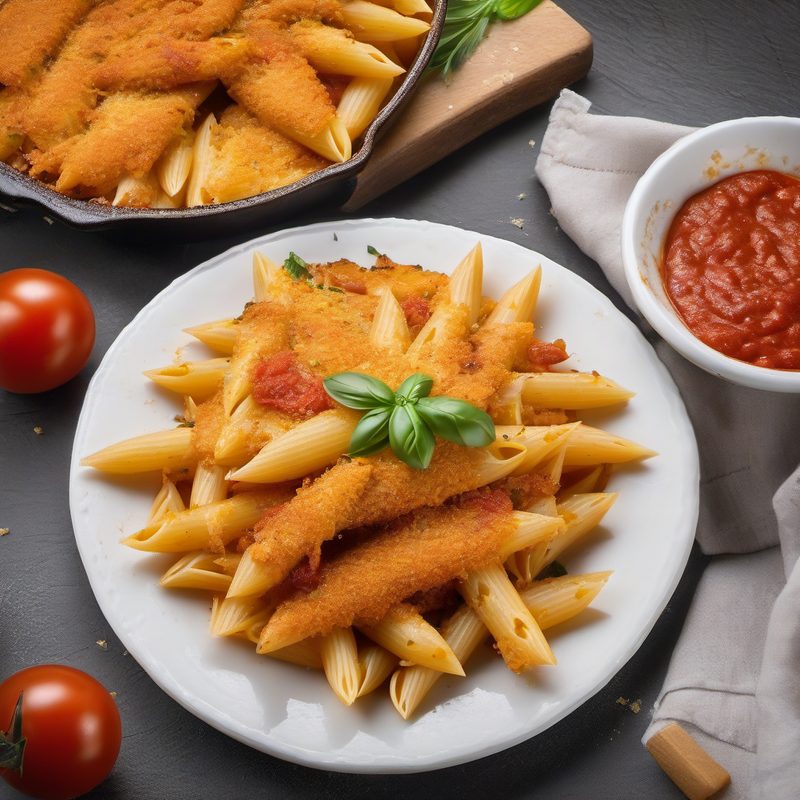
Penne Carrozza Siciliana
Sicilian Fried Pasta Cakes — crispy, golden, and irresistibly cheesy, these breaded-and-fried pasta cakes turn humble penne into a celebration.*
| Amount | Ingredient |
|---|---|
| 50 g | All-purpose flour (about ⅓ cup) |
| 2 | Large eggs, beaten (for dredge) |
| 100 g | Plain breadcrumbs (about 1½ cups) |
| 1 L | Vegetable or peanut oil, for deep frying (or enough for ½-inch / 1 cm depth for shallow frying) |
> Note: Active frying time depends on pan size; working in batches of 3-4 cakes takes about 15 minutes total.
For the Pasta Cakes
For the Breading & Frying
🥘 Equipment
- Large pot (6-qt / 6 L) for boiling pasta
- Colander
- Baking sheet (for cooling pasta)
- Large mixing bowl
- 3 shallow dishes or pie plates (for breading station)
- Large cast-iron or heavy-bottomed skillet (12-inch / 30 cm)
- Spider skimmer or slotted spoon
- Paper towels
- Wire rack set over baking sheet (optional, for holding fried cakes)
📋 Preparation
Step 1: Cook and Cool the Pasta
Bring a large pot of generously salted water (about 1½ tbsp salt per 4 quarts / 4 L water) to a rolling boil. Add the penne and cook until firmly al dente — about 1-2 minutes less than the package directions.
Drain the pasta in a colander, then spread it in a single layer on a baking sheet. Let cool completely, stirring occasionally, until no steam rises — about 10-15 minutes.
Why cool completely? Hot pasta will cook the eggs when mixed, resulting in scrambled-egg clumps instead of a cohesive binder.
Step 2: Mix the Cake Base
In a large bowl, beat 3 eggs until uniform. Add the grated Parmesan, diced mozzarella, a generous pinch of salt (about ½ tsp), and several grinds of black pepper. Stir to combine.
Add the cooled pasta and fold gently with a silicone spatula until every piece of penne is coated with the egg-cheese mixture.
Step 3: Shape the Cakes
Line a baking sheet with parchment paper. Using your hands (lightly moistened if sticky), scoop about 85 g (⅓ cup) of the pasta mixture and shape it into a compact patty about 2½ inches (6 cm) wide and ¾ inch (2 cm) thick. Press firmly so the cakes hold together. Place on the prepared sheet. Repeat with the remaining mixture — you should get 8 cakes.
Refrigerate the shaped cakes for 15 minutes to firm up.
Chilling helps the cakes hold their shape during breading and frying.
Step 4: Set Up the Breading Station
Arrange three shallow dishes:
- Dish 1: 50 g all-purpose flour
- Dish 2: 2 beaten eggs
- Dish 3: 100 g breadcrumbs
Season the flour with a pinch of salt and pepper. Season the breadcrumbs with a pinch of salt and a few grinds of pepper.
Step 5: Bread the Cakes
Working one at a time:
- Coat a chilled cake in the flour, tapping off excess.
- Dip into the beaten egg, letting excess drip off.
- Press firmly into the breadcrumbs, turning to coat all sides. Gently pat to adhere.
Return the breaded cake to the parchment-lined sheet. Repeat with all 8 cakes.
Step 6: Fry Until Golden
Pour oil into the skillet to a depth of ½ inch (1 cm) for shallow frying — or 2 inches (5 cm) for deep frying. Heat over medium-high until the oil reaches 350°F (175°C). Test with a breadcrumb — it should sizzle and float immediately.
Working in batches of 3-4 cakes (do not crowd the pan), gently lower the cakes into the hot oil. Fry until the underside is deep golden brown, about 3-4 minutes. Carefully flip with a spatula or tongs and fry the second side until golden, another 3-4 minutes.
Transfer fried cakes to a paper towel-lined plate or a wire rack set over a baking sheet. Let drain briefly, then season immediately with a tiny pinch of flaky salt.
🧑🍳 Chef's Tips
- Pasta choice matters: Penne's ridges and hollow center trap the egg-cheese mixture, creating better cohesion than smooth pasta shapes. Fusilli, cavatappi, or shells also work.
- Fresh mozzarella vs. low-moisture: Fresh mozzarella (packed in whey) gives a creamy, milky interior. Low-moisture mozzarella is less weepy but also less tender. Pat fresh mozzarella dry with paper towels before dicing.
- Oil temperature is critical: If the oil is too cool (below 325°F / 160°C), the cakes absorb oil and become greasy. If too hot (above 375°F / 190°C), the breadcrumbs burn before the center warms through. Use a thermometer.
- Make-ahead tip: Breaded cakes can be refrigerated for up to 4 hours before frying. Let them sit at room temperature 10 minutes before adding to the oil.
❌ Common Mistakes
| Mistake | Why | Fix |
|---|---|---|
| Pasta is too hot when mixing | Eggs scramble on contact, creating clumps | Cool pasta completely — spread on a baking sheet to speed cooling |
| Cakes fall apart in the oil | Not enough binder or too much moisture | Add an extra egg yolk if the mixture seems dry; chill thoroughly before breading |
| Greasy, soggy cakes | Oil temperature too low | Use a thermometer and maintain 350°F (175°C); fry in small batches |
| Breadcrumb crust falls off | Breading not pressed on firmly enough | Press breadcrumbs onto all surfaces; let breaded cakes rest 5 minutes before frying |
| Bland interior | Not enough salt in the pasta water or egg mixture | Season pasta water generously (it's the only chance to season the pasta itself) |
💡 Variations
- Add herbs: Fold in 2 tbsp finely chopped fresh parsley or basil with the egg mixture.
- Spicy kick: Add ½ tsp red pepper flakes or ¼ tsp cayenne to the egg mixture.
- Meaty version: Add 100 g finely chopped salami or prosciutto, or 100 g cooked, crumbled Italian sausage to the egg mixture.
- Baked alternative: Arrange breaded cakes on a parchment-lined baking sheet, brush or spray with olive oil, and bake at 425°F (220°C) for 12-15 minutes, flipping halfway. Less crispy but still delicious.
- Arancini-style: Roll the mixture into balls instead of patties for pasta arancini.
❄️ Storage
These cakes are best served immediately — they lose their crunch within 30 minutes. Leftovers can be refrigerated for up to 2 days. Reheat in a 400°F (200°C) oven on a wire rack for 8-10 minutes to restore some crispness. Not recommended for microwave reheating.
🍷 Wine Pairing
| Wine | Why |
|---|---|
| Nero d'Avola (Sicily) | Medium-bodied, plush dark fruit — stands up to the fried crust and cheese |
| Cerasuolo di Vittoria | Sicily's only DOCG red, with bright cherry and earthy notes |
| Frappato | Light, fragrant red with low tannins — the chillability factor makes it brilliant with fried food |
| Rosé di Sicilia (dry) | Crisp and refreshing, cuts through the richness |
🍺 Beer Pairing
| Beer | Why |
|---|---|
| Sicilian or Italian lager (e.g., Birra Messina) | Clean, light, high carbonation — a classic Sicilian pairing |
| Pilsner | Crisp bitterness cuts through the fatty crust |
| Belgian Witbier | Spicy-citrus notes complement the creamy mozzarella |
🥗 Suggested Sides
- Sicilian caponata: Sweet-sour eggplant relish — a perfect acidic counterpoint
- Simple arugula salad with lemon juice, shaved Parmigiano, and pine nuts
- Marinated olives and roasted peppers
- Lemon wedges for squeezing over the hot cakes
- Quick tomato sauce (passata warmed with garlic and basil) for dipping
📊 Nutrition (per serving — 2 cakes)
| Calories | Protein | Fat | Carbs | Fiber |
|---|---|---|---|---|
| 620 | 28 g | 32 g | 55 g | 3 g |
Nutrition calculated for deep-fried cakes. Shallow frying reduces fat by approximately 10-15%.
❓ FAQ
Can I use a different pasta shape?
Yes. Short, ridged pasta (fusilli, cavatappi, shells, or farfalle) works best. Avoid long pasta like spaghetti — it won't form cohesive cakes.
Can I make these gluten-free?
Absolutely. Use gluten-free penne (rice/corn blend works best), gluten-free breadcrumbs (or crushed rice crackers), and gluten-free all-purpose flour. The technique remains the same.
What happened to "in carrozza"?
Carrozza means "carriage" in Italian. Mozzarella in carrozza is the classic — breaded and fried mozzarella "riding in a carriage" of bread. This pasta version is a Sicilian twist, where the penne itself becomes the carriage for the melted cheese.
Can I freeze the unbreaded cakes?
Yes. Shape the cakes but do not bread them. Freeze solid on a baking sheet, then transfer to a freezer bag for up to 1 month. Thaw in the refrigerator before breading and frying.
Why is this considered both antipasto and secondo?
In Sicilian home cooking, these substantial cakes can start a meal (antipasto) or be the main course (secondo) with a salad and side. They also make excellent street food and party bites — serve smaller cakes (2-inch / 5 cm) as finger food.
🔗 Related Recipes
- Mozzarella in Carrozza — Classic Neapolitan Fried Mozzarella
- Arancini — Sicilian Stuffed Rice Balls
- Frittatine di Pasta — Neapolitan Fried Pasta Fritters
- Parmigiana di Melanzane — Eggplant Parmigiana
- Crocchè di Patate — Sicilian Potato Croquettes
🏷️ Search Tags
Recipe from The Italian Kitchen by Vita Milanese — Volume 1 · Pasta Perfetto. Discover all volumes on the ebook page.