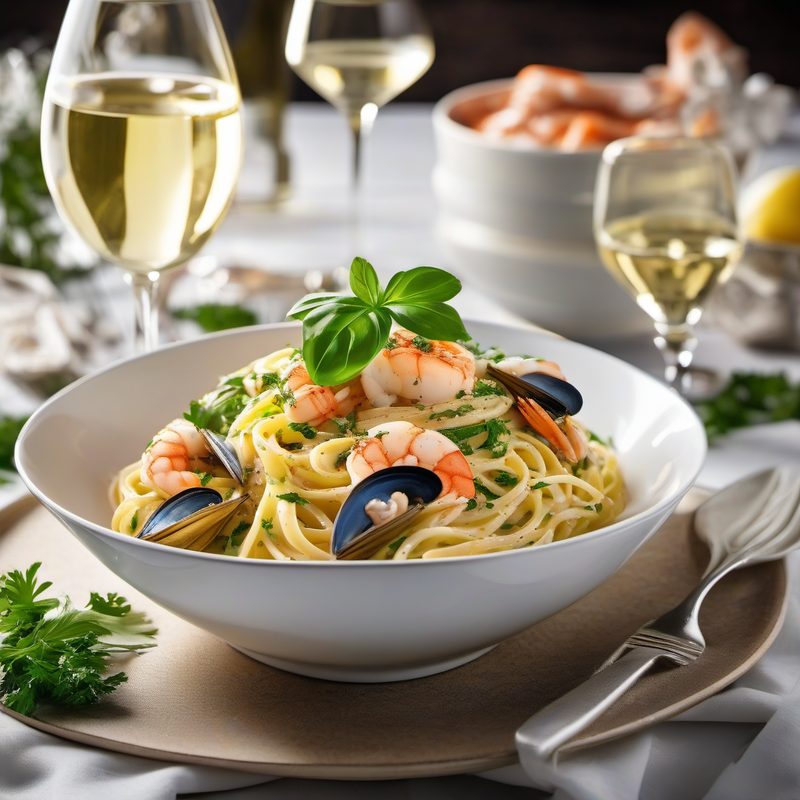
Seafood Linguine Genovese
Neapolitan seafood pasta with a luxuriously slow-caramelized onion sauce — a coastal twist on the landlocked Genovese ragù.
| Amount | Ingredient |
|---|---|
| Crushed tomatoes (passata) | 400 g (14 oz) 1 standard can; preferably Italian San Marzano |
| Linguine | 350 g (12 oz) Can substitute spaghetti, bucatini, or spaghettini |
| Kosher salt | 1½ tablespoons (22 g) For pasta water |
| Fresh flat-leaf parsley | 3 tablespoons Finely chopped, for garnish |
| Black pepper | ½ teaspoon Freshly ground, plus more at the table |
> Note: This is a Neapolitan invention, not a Ligurian one — the "alla genovese" refers to the onion-rich cooking method (caramelized until meltingly sweet), not to the city of Genoa. Here, the classic beef ragù is replaced with seafood for a lighter yet equally decadent primo that showcases the Gulf of Naples' bounty.
🥘 Special Equipment
- Large pot (6–8 qt / 6–8 L) — for pasta
- 12-inch (30 cm) heavy-bottomed skillet or sauté pan with lid — wide surface area is essential for proper onion caramelization
- Colander
- Large mixing bowl
- Chef's knife and cutting board
- Microplane or fine grater (for optional lemon zest garnish)
- Spider skimmer or slotted spoon
- Wooden spoon or silicone spatula
- Measuring cups and spoons
- Kitchen shears (for trimming squid)
For the Onion Base (Soffritto Genovese)
For the Seafood
For the Sauce and Pasta
> Seafood substitution guide: Any combination of 500 g (1 lb 2 oz) firm-fleshed shellfish and cephalopods works. Excellent additions or swaps: clams (vongole, 100 g), baby octopus (150 g, cut in half), scallops (100 g, quartered if large), or lobster meat (150 g, chopped). Avoid delicate white fish fillets (cod, sole) — they overcook and flake apart in the sauce. For best results, use a mix of at least two types of seafood for textural variety.
🔧 Before You Begin
- Prep the onions: Peel and halve the onions through the root end (this helps hold the layers together during slicing). Thinly slice crosswise into ⅛-inch (3 mm) half-rings. A mandoline set to 3 mm ensures even cooking and consistent caramelization; uneven slices will burn before thinner ones are done.
- Prep the soffritto: Dice the carrot and celery into ¼-inch (6 mm) cubes — they should be small enough to melt into the sauce but large enough to provide gentle texture.
- Clean the seafood:
- Shrimp: Peel and devein; if using large shrimp (16/20 count), cut into 2–3 bite-sized pieces. Pat dry with paper towels.
- Squid: Rinse inside and out; slice bodies into ½-inch (12 mm) rings. Leave tentacles whole or halve if large. Pat dry.
- Mussels: Scrub shells under cold running water with a stiff brush to remove any grit. Pull off the fibrous beard (byssus) with a firm tug. Discard any mussels that are open and do not close when tapped.
- Position the wine: Measure the white wine and have it ready at the stove — it goes in at a specific moment to deglaze the pan.
- Pasta water: Fill a large pot with 4–5 quarts (4–5 L) of cold water and bring to a rolling boil. Salt only after boiling — salting cold water extends the time to boil.
📏 Key Ratios
| Ratio | Value | Purpose |
|---|---|---|
| Onion-to-oil | 700 g onions : 75 ml oil | Enough fat to conduct heat slowly for proper caramelization without burning |
| Seafood-to-sauce | 500 g seafood : 400 g tomatoes + 150 ml wine | Balanced — the seafood flavor infuses the sauce without overwhelming it |
| Pasta-to-sauce | 350 g pasta : ~500 ml sauce | Each strand is well-coated with a sauciness that pools at the bottom of the bowl |
| Onion-to-pasta | 700 g onions : 350 g pasta | Generous — the caramelized onions essentially become the sauce's backbone, roughly 2:1 by weight |
> Why this works: The 2:1 ratio of onions to pasta is the defining characteristic of pasta alla genovese in the Neapolitan tradition. The onions cook down by roughly 60–70% of their original volume during the 30-minute caramelization, concentrating their natural sugars into a silky, golden-amber base that clings to every strand of pasta. Replacing the traditional beef with seafood requires careful timing: the seafood goes in late enough to stay tender but early enough to infuse the sauce.
📝 Instructions
Step 1: Caramelize the Onions (35 minutes)
- Heat 3 tablespoons (45 ml) of olive oil in a 12-inch heavy-bottomed skillet over medium heat until shimmering but not smoking — about 1 minute.
- Add the sliced onions and ½ teaspoon salt. Stir to coat every strand with oil. The skillet will appear very full — this is correct; the onions will collapse dramatically as they cook.
- Cook, stirring every 2–3 minutes with a wooden spoon, for 30 minutes total. The onions should sizzle gently but never brown aggressively. Adjust the heat down to medium-low if you see any dark brown spots forming — burnt onions turn bitter.
The progression:
- Minutes 0–10: Onions release their liquid and steam, becoming translucent and limp. The pan will be soupy — keep stirring.
- Minutes 10–20: Liquid evaporates. Onions begin to stick slightly; stir more frequently (every 1–2 minutes). Add 1 tablespoon of water if the pan bottom looks too dry and onions threaten to catch.
- Minutes 20–30: Onions turn from pale yellow to deep golden-amber — the Maillard reaction is in full swing. They should be soft, sweet, and jammy, with a total volume reduction of about two-thirds.
- When the onions are a deep golden-amber and smell sweetly caramelized (not browned), proceed immediately to Step 2.
> Chef's note: The traditional Genovese soffritto takes patience. If you rush this step at high heat, the onions will brown on the outside while remaining raw within, and the final sauce will taste harsh rather than sweet. The 30-minute low-and-slow approach is non-negotiable.
Step 2: Build the Soffritto (5 minutes)
- Push the caramelized onions to one side of the skillet. Add the remaining 2 tablespoons (30 ml) olive oil to the empty side.
- Add the diced carrot and diced celery to the oil. Cook, stirring, over medium heat for 2–3 minutes until the carrot softens slightly and the celery turns translucent.
- Stir the vegetables into the onions until everything is evenly combined. The soffritto should look like a golden, jammy paste studded with tiny orange and green flecks.
Step 3: Cook the Seafood and Build the Sauce (15 minutes)
- Start the seafood: Add all the mixed seafood (shrimp, squid rings and tentacles, mussels) to the skillet. Cook over medium-high heat, stirring gently, for 2 minutes — the shrimp should just begin to turn pink on the outside; the squid will turn opaque.
- Deglaze with wine: Pour in the white wine. Increase the heat to high and cook, scraping up any browned bits from the bottom of the pan with a wooden spoon, until the wine has reduced by about half — about 1–2 minutes. The alcohol will cook off, leaving behind the wine's acidity and fruit.
- Add the tomatoes: Stir in the crushed tomatoes. Bring to a gentle simmer, then reduce the heat to medium-low. Cover partially (lid slightly ajar) and cook for 10 minutes, stirring occasionally.
- Check the mussels: After 5–6 minutes, use tongs to check the mussels. As soon as their shells open (typically at the 6–7 minute mark), remove the open ones to a separate bowl and tent loosely with foil to keep warm. Discard any mussels that remain closed after 10 minutes of cooking.
- Final seasoning: After 10 minutes of simmering, taste the sauce and adjust with salt and black pepper. The sauce should be rich, sweet from the onions, and infused with briny seafood flavor. If the sauce seems thin, uncover and simmer 2–3 minutes more to reduce.
- Return mussels: Return the reserved mussels (in their shells) to the skillet, nestling them into the sauce. Remove from heat and cover to keep warm while the pasta finishes.
Step 4: Cook the Pasta (8 minutes)
- While the sauce simmers, bring the large pot of water to a rolling boil. Add 1½ tablespoons (22 g) kosher salt — the water should taste like the sea.
- Add the linguine and cook according to package directions until al dente — typically 8–10 minutes for dried linguine. Stir occasionally to prevent sticking.
- Reserve 1 cup (240 ml) of pasta cooking water before draining. The starchy water is the secret weapon for binding the sauce to the pasta.
- Drain the pasta in a colander (do not rinse). Shake well to remove excess water. Work quickly — hot pasta absorbs sauce best.
Step 5: Toss and Finish (3 minutes)
- Return the drained linguine to the warm pasta pot or transfer to a large warmed serving bowl.
- Pour about half of the seafood sauce (including some seafood solids) over the pasta. Toss gently with tongs to coat each strand, drizzling in pasta cooking water 1 tablespoon at a time (you'll likely use 3–4 tablespoons) to loosen the sauce and help it cling to the pasta.
- Add the remaining sauce and seafood (including the mussels in their shells) and toss once more — gently, to avoid breaking the mussels or crushing the squid.
- The pasta should be glossy, well-coated, and just slightly loose — the starch in the pasta water emulsifies with the olive oil and tomato juices to create a silky sauce that clings to every strand.
Step 6: Serve (2 minutes)
- Divide the pasta among 4 warm shallow bowls using tongs, twisting each portion into a neat mound.
- Arrange some of the seafood artfully on top of each serving: place 3–4 mussels (in their shells) around the edge, distribute the shrimp and squid evenly, and spoon any remaining sauce from the skillet over the top.
- Sprinkle with chopped fresh parsley and a generous grind of black pepper.
- Serve immediately — this pasta waits for no one. The seafood is at its peak tenderness and the sauce is at its most emulsified.
🍽 Plating & Presentation
- Per serving: A twisted mound of linguine in the center of a shallow rimmed bowl, with mussels arranged like clock hands around the edge (shells facing upward), shrimp and squid studded throughout, and a glistening pool of sauce pooling naturally at the bottom.
- Garnish: A shower of finely chopped fresh flat-leaf parsley — never dried parsley, which has no flavor. A fine grating of lemon zest over each bowl adds a bright citrus note that cuts through the rich, sweet onion sauce. A final drizzle of extra-virgin olive oil (the same you used for cooking) adds gloss and a peppery finish.
- Recommended tableware: White or cream-coloured shallow pasta bowls with a wide rim — the contrast between the amber sauce, pink shrimp, white squid, and black mussel shells is stunning against a neutral background.
- Visual note: The dish is a study in colour and texture: the golden-amber onion sauce, the coral-pink shrimp, the pearly white rings of squid, the glossy black mussel shells, the verdant green parsley, and the pale yellow linguine create a mosaic of the Mediterranean on a single plate.
💡 Troubleshooting
| Problem | Likely Cause | Solution |
|---|---|---|
| Onions are burnt/bitter | Heat too high during caramelization | Start over — burnt onions cannot be rescued. Use medium or medium-low heat; the onions should sizzle gently, not aggressively |
| Onions haven't caramelized after 30 min | Too much liquid or insufficient heat | Drain off any excess onion water; increase heat to medium-high for the last 5 minutes and stir constantly |
| Sauce is too thin | Not enough reduction after adding tomatoes | Uncover and simmer 3–5 minutes more, stirring, until the sauce thickens to a nappe (coats the back of a spoon) |
| Seafood is rubbery/tough | Overcooked | Shrimp and squid need only 2–4 minutes total in the sauce. Add them at the right moment and do not oversimmer |
| Mussels don't open | Already dead or not cooked long enough | Discard any that stay closed after 10 minutes of simmering; they were dead before cooking and unsafe to eat |
| Pasta is watery/diluted | Insufficient draining or too much pasta water added | Drain pasta very thoroughly; add pasta water 1 tablespoon at a time, only as needed to loosen the sauce |
| Pasta clumps together | Not enough oil in the sauce or pasta water too starchy | Toss with a drizzle of olive oil after draining; use tongs to separate strands immediately |
| Sauce doesn't cling to pasta | Pasta is too cool or sauce is too thin | Toss pasta while it's still steaming hot; add a splash of starchy pasta water to the sauce just before tossing — the starch helps the sauce adhere |
🧠 The Science of Onion Caramelization
The 30-minute caramelization of 700 g of onions is the defining technique of pasta alla genovese. Understanding what happens at the molecular level explains why the timing is so precise:
- Thermal breakdown (0–10 min): Heat ruptures cell walls, releasing water and the enzyme alliinase, which converts flavor precursors into thiosulfinates (the pungent, tear-inducing compounds). Most of the water — roughly 85% of the onion's weight — steams off.
- Sugar concentration (10–20 min): As water evaporates, the natural sugars — fructose, glucose, and sucrose — concentrate in the remaining solids. The onion's total sugar content is approximately 4–5% by weight (about 30–35 g of sugar in 700 g of onions). By minute 20, these sugars are concentrated roughly 3-fold.
- Maillard reaction and caramelization (20–30 min): At 110–120°C (230–248°F), the Maillard reaction begins — amino acids (primarily glutamine and aspartic acid in onions) react with reducing sugars to produce hundreds of flavour compounds: pyrazines (nutty), furans (caramel-like), and Strecker aldehydes (floral, fruity). Simultaneously, true sugar caramelization begins at ~160°C (320°F), producing the characteristic amber colour and deeper, bittersweet notes.
- Emulsification: The olive oil, remaining onion juices, and starch from the pasta water form a water-in-oil emulsion during the final tossing step. The starch granules from the pasta water hydrate and swell, creating a network that traps tiny droplets of oil and suspended tomato solids — this is what gives the sauce its silky, clingy texture rather than a watery, greasy appearance.
> The typical Neapolitan home cook has been making this soffritto for generations without knowing the chemistry — but they instinctively know that 30 minutes at the right temperature is the difference between a sauce that tastes like sweet, concentrated onion essence and one that is thin, harsh, and disappointing.
🧪 Variations
- Tradizionale (beef version): Replace the seafood with 400 g (14 oz) beef chuck, cut into ½-inch cubes. Brown the beef in the skillet after caramelizing the onions (Step 2), then proceed with the wine and tomatoes. Simmer covered for 1½ hours until the beef is fork-tender. This is the original Neapolitan pasta alla genovese con carne.
- Pesce spada (swordfish): Replace the mixed seafood with 400 g (14 oz) swordfish, cut into 1-inch cubes. Add in Step 3 and cook just 3–4 minutes total (swordfish dries out quickly). Add 2 tablespoons of capers and ¼ cup of green olives for a Sicilian-accented version.
- Piccante (spicy): Add 1–2 Calabrian chiles (or 1 teaspoon red pepper flakes) along with the soffritto vegetables in Step 2. The heat cuts through the sweet onion base beautifully.
- In bianco (white, no tomatoes): Omit the crushed tomatoes entirely. After deglazing with wine, add ½ cup (120 ml) of fish stock or clam juice and 3 tablespoons of chopped parsley. Simmer for 5 minutes. The sauce will be lighter-coloured and more intensely seafood-flavoured — closer to a linguine alle vongole in spirit.
- Pasta swap: Spaghetti, bucatini, spaghettini, trenette, or even paccheri all work. Adjust cooking time accordingly. Avoid short pasta (penne, fusilli) — the long, thin shapes allow the sauce to coat each strand evenly and are traditional.
- Heritage twist: Add 50 g (½ cup) of toasted breadcrumbs (pangrattato) tossed with lemon zest and parsley as a final garnish — a cucina povera touch that adds crunch and uses up stale bread.
🥗 Suggested Sides
- Insalata di rinforzo (Neapolitan Christmas cauliflower salad) — the briny, pickled flavours provide a brilliant contrast to the sweet onion sauce.
- Caprese salad — fresh tomatoes, buffalo mozzarella, and basil; simple and essential. The creamy mozzarella balances the acidity of the tomato-seafood sauce.
- Grilled zucchini with mint — slice 2 zucchini lengthwise, grill until charred, dress with olive oil, lemon, and fresh mint. The char adds a smoky counterpoint.
- Warm focaccia or pane casereccio — to mop up every last drop of sauce from the bowl. Absolutely mandatory.
- Roasted fennel with Parmesan — the anise notes in the fennel echo the white wine and brighten the rich sauce.
🍷 Suggested Wine Pairing
| Wine | Why |
|---|---|
| Vermentino di Sardegna | The classic pairing — crisp, saline, with a subtle almond bitterness that cuts through the sweet onions and echoes the briny seafood. Serve chilled (8–10°C / 46–50°F) |
| Greco di Tufo | Fuller-bodied and slightly nutty, with a mineral finish that mirrors the mussels and squid. Campania's greatest white grape, born in the same region as this dish |
| Fiano di Avellino | Rich, honeyed, with notes of pear and hazelnut — the body stands up to the generous olive oil and caramelized onions without being overwhelmed |
| Pecorino (off-molo) | Not the cheese — the white wine from Le Marche/Abruzzo. Bright citrus and herbal notes, crisp acidity, medium body. A more affordable but equally worthy pairing |
| Gavi di Gavi (Cortese) | Elegant and mineral-driven, with delicate white flower and green apple notes. A refined choice for a special dinner |
| Franciacorta Brut (sparkling) | For a celebratory version — the bubbles and high acidity scrub the palate clean between each unctuous, sauce-laden bite |
Wine to avoid: Oak-aged Chardonnay (too heavy, creamy notes clash with the onions and seafood), high-tannin reds (tannins + shellfish = metallic aftertaste), and sweet wines (the sugar battles the caramelized onions for dominance).
📚 Original Source & Background
- Italian name: Linguine alla genovese di mare
- English name: Seafood Linguine Genovese
- Region/Heritage: Naples, Campania — despite the name's reference to Genoa (Liguria), this is a proudly Neapolitan creation. Pasta alla genovese in Neapolitan cuisine refers to a cooking method where onions are slowly caramelized into a rich, jammy sauce, not to any Ligurian recipe. The classic version is a beef ragù; this seafood adaptation swaps the meat for shrimp, squid, and mussels, reflecting Naples' position as a coastal city with access to abundant — and affordable — seafood.
- Historical note: The original pasta alla genovese is believed to have been created by Neapolitan cooks who trained in Genoa and returned to Naples, bringing the technique of slow-cooking onions in olive oil with them. In post-unification Italy (late 19th century), when beef was a luxury, adding abundant seafood was a more accessible way to create a festive primo — one that has since become a staple of Neapolitan home cooking.
- Recipe position: 414 in the cookbook series
- Inspiration: This version draws from the cooking of the Trattorie di Mergellina and the Porto di Napoli — the working-class seafood restaurants along the Naples waterfront where the catch-of-the-day is treated with the same reverence as the finest beef.
"In Naples, even the sea can be 'alla genovese' — the sweet onions of Campania embracing the fruits of the Gulf, in a dish that tastes of two coasts and one city's soul."
Recipe from The Italian Kitchen by Vita Milanese — Volume 1 · Pasta Perfetto. Discover all volumes on the ebook page.