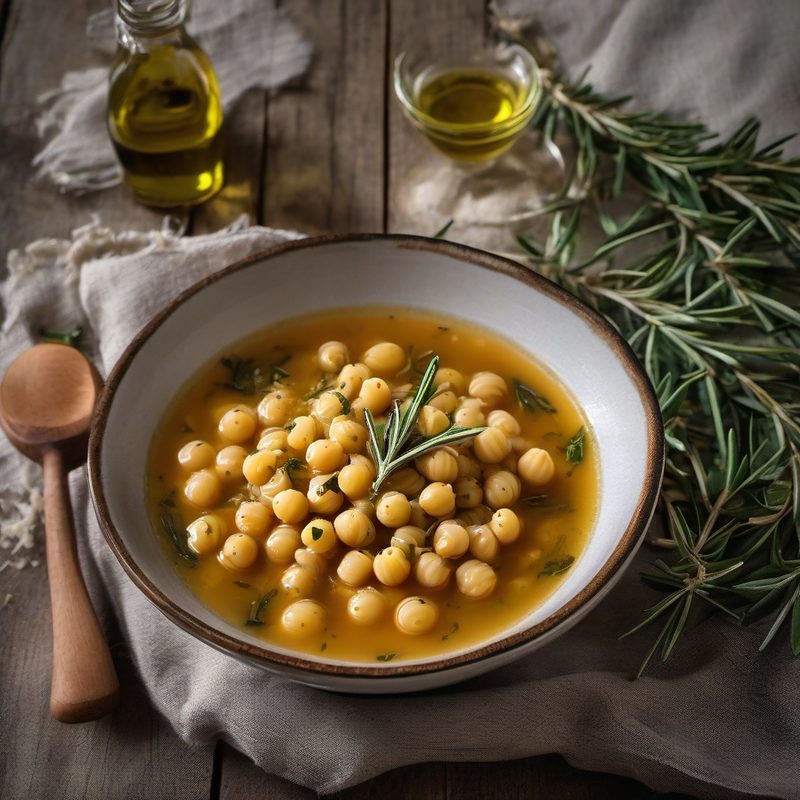
Pasta Ceci
The quintessential Roman cucina povera masterpiece — humble chickpeas, pancetta, and pasta come together in a single pot, where one-third of the chickpeas are blended into a velvety cream that clings to every piece of pipe rigate, while the rest remain whole for texture. This is soulful, hearty, and deeply satisfying, born from the Italian tradition of making the simplest ingredients taste extraordinary.
| Amount | Ingredient |
|---|---|
| 1 medium | Carrot, finely diced |
| 1 rib | Celery, finely diced |
| 1 small | Onion, finely diced |
| 4 oz (115 g) | Pancetta, in one thick slice (1/4 inch / 6 mm) |
| 3 tbsp (45 ml) | Extra-virgin olive oil |
| 2 sprigs | Fresh rosemary, leaves stripped and finely chopped, plus more for garnish |
| ½ cup (120 ml) | Dry white wine |
| 2 cans (15 oz / 425 g each) | Canned chickpeas, drained and rinsed |
| 1 cup (240 ml) | Tomato passata (or crushed tomatoes) |
| 2 tbsp (30 ml) | Tomato paste |
| 1 lb (450 g) | Pipe rigate or ditalini (or other short pasta) |
| Kosher salt and freshly ground black pepper |
This is pasta e ceci the way Romans make it: a soffritto of carrot, onion, and celery builds the aromatic base; pancetta adds depth and savor; white wine deglazes the pan; and canned chickpeas do double duty — some simmer into the sauce, while a portion is puréed into a luscious cream that transforms the whole dish into something far greater than the sum of its parts. A hit of tomato passata lends gentle acidity, and a finishing shower of fresh rosemary and black pepper brings it all to life. The pasta cooks directly in the sauce at the end, absorbing every bit of flavor. It's rustic, it's Roman, and it's perfect.
Use level tablespoons and standard US measuring cups. All produce is medium unless specified.
🥘 Equipment
- Large Dutch oven or heavy-bottomed pot (5- to 6-quart)
- Large pot (6-quart or larger) for boiling pasta
- Chef's knife and cutting board
- Wooden spoon or spatula
- Ladle or heatproof measuring cup (for reserving pasta water)
- Immersion blender (or standard blender — see Chef's Tips)
- Colander
- Measuring cups and spoons
📋 Preparation
Step 1 — Prepare the Ingredients (15 minutes)
Prepare the soffritto: Peel and finely dice the carrot, celery, and onion — they should all be roughly the same size (about ¼ inch / 6 mm) so they cook evenly. Transfer to a bowl and set aside.
Prepare the pancetta: Use a sharp knife to remove the rind from the pancetta slice in one piece — reserve the rind; it will simmer in the sauce and release collagen and flavor. Cut the pancetta into thin strips about ¼ inch wide (matchstick size).
Prepare the rosemary: Strip the leaves from 2 sprigs of rosemary and finely chop them. Set aside half for garnish.
The pancetta rind is the secret to deeper body. Don't skip it — it renders fat and collagen that enrich the sauce in a way pancetta strips alone cannot.
Step 2 — Build the Base (8 minutes)
Place the Dutch oven over medium-high heat and add the 3 tablespoons of olive oil. When it shimmers, add the diced carrot, celery, and onion and cook, stirring occasionally, until softened and just beginning to take on color, about 4 minutes.
Add the pancetta rind, pancetta strips, and half of the chopped rosemary (reserve the rest for finishing). Cook, stirring, until the pancetta is browned and the fat has rendered, about 3 to 4 minutes. The soffritto should be fragrant and the pancetta crisp at the edges.
Don't rush this step — the browning of the pancetta and the caramelization of the soffritto are where the deep flavor foundation of this dish is built.
Step 3 — Deglaze and Build the Sauce (7 minutes)
Pour in the ½ cup of dry white wine and scrape up any browned bits from the bottom of the pot with your wooden spoon — these bits are concentrated flavor and must be incorporated into the sauce. Let the wine bubble and reduce by about half, about 1 minute.
Season with a generous pinch of kosher salt and several grinds of black pepper.
Add the drained and rinsed chickpeas and the tomato passata. Stir to combine. Bring to a simmer, then reduce heat to medium-low, cover, and let the sauce simmer gently for 15 minutes. The chickpeas should be tender and the flavors well-blended.
The sauce should bubble lazily — a vigorous boil will break down the chickpeas too quickly. You want them to hold their shape so some can be blended and some left whole.
Step 4 — Cook the Pasta (concurrent with Step 3, 8–10 minutes)
While the sauce simmers, bring a large pot of generously salted water (about 1½ tablespoons kosher salt per gallon) to a rolling boil over high heat.
Add the pasta and cook until very al dente — about 2 minutes less than the package directions indicate. For most dried short pasta that calls for 10–11 minutes, cook for 8–9 minutes.
Just before draining, reserve 1 cup of the starchy pasta cooking water. Drain the pasta well (do not rinse).
Step 5 — Finish the Sauce (5 minutes)
After the sauce has simmered for 15 minutes, stir in the 2 tablespoons of tomato paste until fully incorporated. This adds depth and a touch of sweetness.
Thin the sauce slightly with ¼ cup of the reserved pasta water — the starch will help the sauce cling to the pasta.
Remove the pancetta rind and discard it — its work is done.
Using an immersion blender (or transfer ⅓ of the sauce to a standard blender — see Chef's Tips for safety), purée about one-third of the chickpeas and sauce directly in the pot. Pulse just until smooth and creamy — you are looking for a velvety texture with some whole chickpeas remaining. Stir the purée back into the pot to combine.
The contrast between the creamy purée and the whole chickpeas is what makes this dish special. If you purée too much, you lose the textural interplay; too little, and the sauce won't have the body to cling to the pasta.
Step 6 — Combine and Finish (2 minutes)
Add the drained pasta directly to the sauce in the Dutch oven. Toss well to coat every piece.
Cook over medium heat for 1 to 2 minutes, stirring constantly, adding more reserved pasta water a splash at a time as needed, until the pasta is perfectly al dente and the sauce clings generously — it should be loose and spoonable, not dry, like a thick, creamy soup with pasta suspended in it.
Remove from heat. Stir in the reserved chopped rosemary and an additional generous grind of black pepper.
Step 7 — Serve Immediately
Divide among warm shallow bowls. Garnish each serving with a sprinkle of fresh rosemary and a final crack of black pepper. A drizzle of excellent extra-virgin olive oil over each bowl is traditional and welcome.
Serve piping hot with a spoon — this is a pasta that practically begs to be eaten with both fork and spoon.
🧑👩🍳 Chef's Tips
- The pancetta rind is non-negotiable: That strip of rind simmered in the sauce releases natural gelatin and collagen, giving the final dish a luxurious body that no other ingredient can replicate. Many Roman cooks keep a bag of pancetta rinds in the freezer just for this purpose. If your pancetta is rindless, add ½ cup of chicken or vegetable broth for extra body.
- Blend smart: An immersion blender is ideal because you can blitz directly in the pot, controlling exactly how much gets puréed. If using a standard blender, let the portion cool for 2 minutes, fill the blender only halfway, remove the center cap from the lid, and cover with a kitchen towel before blending — hot liquids expand and can blow the lid off, causing burns.
- Texture is everything: The ideal consistency for pasta e ceci is not a dry pasta dish — it's a soup-y pasta, more liquid than a standard pasta dish but not as thin as a minestrone. The pasta should be swimming in the chickpea cream, not sitting on top of it. Aim for the consistency of loose oatmeal.
- Short pasta is traditional: Pipe rigate are the classic Roman choice — their ridges catch the chickpea cream beautifully. Ditalini, tubetti, or any small, short pasta shape works. Avoid long pasta like spaghetti; this dish is meant to be eaten with a spoon mingled with a fork, and long strands don't cooperate.
- Rosemary goes in twice: The first addition goes into the soffritto to perfume the oil and the pancetta; the second goes in off the heat at the end for brightness and aroma. Using it all at once would lose the fresh herbaceous note that lifts the finished dish.
- Go easy on the salt: Canned chickpeas and pancetta are already salty. Season the soffritto lightly and taste before adding more salt at the end.
❌ Common Mistakes
| Mistake | Why It Hurts | The Fix |
|---|---|---|
| Skipping the pancetta rind | The rind adds collagen and body that pancetta strips alone can't provide; the sauce will be thinner and less luxurious | If no rind available, add ½ cup broth and simmer longer to concentrate; or add 1 teaspoon of unflavored gelatin dissolved in 2 tablespoons water |
| Over-blending the chickpeas | Puréeing too many chickpeas creates a uniform paste with no texture; the whole point is the contrast between cream and whole beans | Only blend about one-third of the chickpeas. Pulse briefly — you want a rough purée, not a smooth hummus |
| Undercooking the soffritto | Raw-tasting onion and carrot will dominate the dish; the base needs to soften and sweeten before the pancetta goes in | Cook the soffritto until the onion is translucent and the carrot is tender, about 4 minutes. It should smell sweet, not sharp |
| Cooking the pasta fully before combining | Pasta that's already fully cooked will turn mushy and bloated when it finishes in the sauce | Cook the pasta 2 minutes shy of al dente — it will absorb the chickpea sauce and finish perfectly in the final minute together |
| Using too much liquid | The dish should be thick and creamy, not watery. Adding too much pasta water or passata thins the sauce and dilutes the chickpea flavor | Add pasta water a splash at a time and stop when the sauce reaches a loose, spoonable consistency — it should cling to the pasta |
| Forgetting the tomato paste | The tomato paste adds depth and a subtle sweetness that balances the earthy chickpeas; without it, the dish can taste flat | Stir the paste in early enough to let it cook and caramelize slightly before adding the pasta water |
💡 Variations
| Variation | How To |
|---|---|
| Add More Greens | Stir in 4 cups (about 4 oz / 115 g) of chopped escarole, spinach, or Swiss chard during the last 5 minutes of the sauce simmer — wilted greens add color and a pleasant bitterness that cuts through the creaminess |
| Go Vegetarian | Omit the pancetta and pancetta rind. Add 2 tablespoons of olive oil with the soffritto, deglaze as usual, and add ½ teaspoon of smoked paprika with the passata for a smoky depth reminiscent of the pancetta. Use vegetable broth to boost body |
| Make it Spicy | Add ½ teaspoon of red pepper flakes or 1 small dried red chile, crumbled, to the soffritto in Step 2. The heat cuts through the creamy chickpeas beautifully |
| Use Fresh Rosemary and Sage Together | Replace half the rosemary with 4 fresh sage leaves, finely chopped, added to the soffritto — sage and chickpeas are a classic Italian pairing |
| Add Crunch | Toast ½ cup (about 50 g) of fresh breadcrumbs (panko or homemade) in 1 tablespoon of olive oil with a pinch of salt until golden; sprinkle over each serving for a crunchy contrast to the creamy pasta |
| Make it with Ditalini | Replace pipe rigate with ditalini — this is the most common pasta shape for pasta e ceci in many Roman homes. The tiny tubes nestle into the chickpea cream deliciously |
| Add Lemon | Finish with the zest of ½ lemon and a squeeze of lemon juice for brightness — the acidity cuts through the richness of the pancetta and chickpea cream |
| Add Parmigiano for Umami | Stir in ½ cup (50 g) of grated Parmigiano-Reggiano or Pecorino Romano off heat at the end for a savory, salty kick. This is not traditional but delicious |
❄️ Storage & Leftovers
| Method | Details |
|---|---|
| Refrigerator | Store in an airtight container for up to 3 days. The pasta will absorb more liquid as it sits, so the dish will become thicker — this is expected and not a problem |
| Freezer | Freeze in a sealed container for up to 1 month. The texture of the chickpeas may soften slightly upon thawing, but the flavor holds beautifully. Thaw overnight in the refrigerator before reheating |
| Reheating | Reheat in a saucepan over medium-low heat with a splash of water or broth, stirring frequently, until warmed through. The pasta may be softer than fresh, but the flavor will be even deeper. Add a final drizzle of olive oil and fresh rosemary to revive it. Microwave in 30-second bursts, covered, with a damp paper towel |
🍷 Wine Pairing
| Wine | Why |
|---|---|
| Frascati Superiore (Lazio) | The quintessential Roman white — crisp, slightly nutty, with golden apple and almond notes that mirror the earthy chickpeas and complement the pancetta beautifully. Local and perfect |
| Cesanese del Piglio (Lazio) | A light, fruity red from the same region as the dish — soft tannins, red cherry, and dried herbs that echo the rosemary and black pepper without overwhelming the creamy chickpeas |
| Orvieto Classico (Umbria) | A full-bodied white with floral and citrus notes, good acidity, and a subtle almond finish — the structure stands up to the pancetta and the creaminess of the chickpeas |
| Verdicchio dei Castelli di Jesi | Lean, saline, and mineral-driven with a pleasant bitter almond note on the finish — the acidity cuts through the richness of the pancetta and the chickpea cream like a knife |
| Greco di Tufo (Campania) | A rich, aromatic white with stone fruit, herbs, and a saline finish — the body matches the heft of the dish while the herbal notes harmonize with the rosemary |
| Chianti Classico | Sangiovese's bright cherry, dried herbs, and earthy undertones are a natural fit for a tomato-and-pancetta-based pasta. A young, unoaked Chianti Classico works best — no heavy tannins to clash with the creamy chickpeas |
| Morellino di Scansano | A Tuscan red with bright acidity and dark fruit — structured enough for the pancetta and chickpeas, light enough not to overwhelm |
🍺 Beer Pairing
| Beer | Why |
|---|---|
| Italian Pale Lager (e.g., Moretti, Peroni) | Crisp, clean, and unobtrusive — a simple, refreshing lager that doesn't compete with the complexity of the chickpea cream and pancetta |
| Birra del Borgo ReAle Extra | An Italian take on a British-style pale ale with floral hops and a clean malt backbone — the moderate bitterness balances the richness of the dish |
| Belgian Saison | Fruity, peppery, and dry with high carbonation — the spicy phenolic notes complement the rosemary and black pepper beautifully, and the bubbles scrub the palate clean |
| Czech-style Pilsner | Clean maltiness and assertive hop bitterness — the crisp finish cuts through the creamy chickpea sauce and keeps each bite fresh |
| Brown Ale (English-style) | Nutty, lightly sweet, with low bitterness — the toasty malt character echoes the nuttiness of the chickpeas and the browned pancetta |
🥗 Suggested Side Dishes
- Simple arugula salad with lemon vinaigrette — Peppery arugula tossed with lemon juice, olive oil, flaky salt, and shaved Parmigiano-Reggiano. The bright acidity and peppery bite cut through the creamy chickpeas
- Roasted fennel with olive oil and lemon — Thinly sliced fennel bulbs roasted at 400°F (200°C) with olive oil, salt, and lemon juice for 20 minutes until tender and caramelized. The anise sweetness is a surprising but beautiful partner for the rosemary and pancetta
- Sautéed escarole with garlic — Escarole wilted in olive oil with garlic, a pinch of red pepper flakes, and a squeeze of lemon. The gentle bitterness of the escarole balances the richness of the dish
- Warm crusty bread — A hunk of sourdough or ciabatta to mop up every last bit of chickpea cream from the bottom of the bowl (and there will be cream at the bottom of the bowl)
- Grilled radicchio with balsamic — Halved radicchio heads grilled or pan-seared until charred, then drizzled with balsamic vinegar and olive oil. The bitterness and char are a perfect foil for the creamy, savory pasta
- Marinated olives — A bowl of mixed olives marinated in olive oil, orange zest, red pepper flakes, and rosemary — a simple side that echoes the herb notes in the pasta without requiring any additional cooking
📊 Nutrition (per serving, estimated)
| Calories | Protein | Fat | Carbs | Fiber |
|---|---|---|---|---|
| 420 | 18 g | 14 g | 56 g | 12 g |
Nutrition is an estimate based on 4 servings using 1 lb dried short pasta, 2 cans of chickpeas, 4 oz pancetta, 3 tablespoons olive oil, ½ cup white wine, 1 cup passata, and 2 tablespoons tomato paste. Actual values will vary with brands and substitutions. Chickpeas contribute significant fiber and protein.
❓ Frequently Asked Questions
What is the correct consistency for pasta e ceci?
It should be loose and creamy — more liquid than a traditional pasta dish but thicker than a soup. Romans eat it with both a fork (for the pasta) and a spoon (for the chickpea cream). The sauce should coat the pasta generously but still pool in the bottom of the bowl. If it looks dry, add more pasta water; if it looks too thin, let it simmer uncovered for 2–3 minutes.
Can I use dried chickpeas instead of canned?
Yes, but you'll need to plan ahead. Soak 1 cup (200 g) of dried chickpeas overnight in cold water with 1 teaspoon of baking soda (this softens the skins). Drain, rinse, and simmer in fresh water until tender — about 1 to 1½ hours depending on age of the chickpeas. You'll need about 3 cups of cooked chickpeas, which is what 2 cans yield. The cooking liquid from dried chickpeas is especially flavorful — use ½ cup of it instead of pasta water for even more depth.
What if I can't find pipe rigate?
Any short pasta shape with ridges or curves works beautifully. Ditalini (the classic Roman alternative), tubetti, elbow macaroni, conchiglie (small shells), or even orecchiette all work. Avoid long pasta shapes like spaghetti or linguine — this dish is meant to be eaten with a spoon, and long strands don't behave well in a creamy sauce.
Can I make this ahead of time?
Pasta e ceci is best served immediately after finishing, but it reheats beautifully. If making ahead, cook the sauce completely (through Step 5) and cook the pasta separately, very al dente. Store them separately, then combine with a splash of water or broth and finish together in a pot over medium heat. This prevents the pasta from absorbing too much liquid and becoming mushy.
Is pancetta essential? Can I use bacon?
Pancetta is traditional, but good-quality unsmoked bacon (or even guanciale, the cured pork jowl) works beautifully. Smoked bacon adds a smokiness that is not traditional for pasta e ceci but can be delicious in its own right — just use it sparingly, because smoked flavor can overwhelm the delicate chickpea cream. Skip any honey-cured or maple-flavored bacon.
Why do I need to remove the pancetta rind before blending?
The rind is too tough to blend smoothly — it would leave chewy, unpleasant pieces in the otherwise velvety cream. Its work is done after simmering for 15 minutes; it has released its collagen into the sauce and can be discarded.
Can I add other vegetables to the soffritto?
A classic Roman soffritto is strictly carrot, onion, and celery — this is the holy trinity of Italian cooking. Adding garlic, fennel, or bell pepper will change the character of the dish considerably. If you want to experiment, add 2 cloves of minced garlic to the soffritto in the last minute before deglazing, but keep the base traditional otherwise.
Can I make this vegan?
Yes — omit the pancetta and pancetta rind entirely. Increase the olive oil to 3 tablespoons for the soffritto, add 1 teaspoon of smoked paprika or a dash of liquid smoke with the passata for depth, and use ½ cup of chickpea cooking liquid (or vegetable broth) for added body. The dish will be lighter but still deeply satisfying, thanks to the chickpea cream.
Why does the recipe call for rosemary twice?
The first addition (with the pancetta) infuses the oil and meat with the herb's woodsy, resinous character as it cooks. The second addition (off heat at the end) brings the herb's fresh, piney top notes forward. Using it all at once would sacrifice that bright, aromatic finish — you would taste only cooked rosemary, not fresh rosemary.
This looks more like a soup than a pasta dish — is that right?
Yes — pasta e ceci lives somewhere between a pasta dish and a thick soup. In Roman trattorias, it's served in shallow bowls with a spoon and fork, and it's categorized as a primo (first course). The chickpea cream is the defining feature: it should be thick enough to coat the pasta but loose enough to be spoonable.
🔗 Related Recipes
- Spaghetti Aglio e Olio (Spaghetti with Garlic and Oil)
- Pasta e Fagioli (Pasta with Beans — Tuscan Classic)
- Ribollita (Tuscan Bread and Vegetable Soup)
- Pasta con le Sarde (Pasta with Sardines, Fennel, and Breadcrumbs)
- Pasta all'Amatriciana (Pasta with Tomato, Guanciale, and Pecorino)
- Gricia (Pasta with Guanciale, Pecorino, and Black Pepper)
- Lentil Ragu Lasagne (Lentil and Vegetable Lasagne)
- Pasta with Cauliflower — Simple Version (Pasta con Cavolfiore)
🏷️ Search Tags
📸 Photo Reference
| Image | Description |
|---|---|
| `vol1_83.png` | A wide, shallow ceramic bowl of pasta e ceci, the pipe rigate suspended in a velvety, pale orange chickpea cream studded with whole chickpeas and speckled with dark green rosemary. A drizzle of golden-green olive oil ribbons across the surface. A scattering of fresh rosemary leaves and a generous crack of black pepper finish the dish. Steam rises gently. The bowl rests on a rustic wooden table beside a linen napkin and a glass of Frascati — warm, golden, late-afternoon light. Rustic, inviting, Roman. |
Recipe from "The Italian Kitchen" by Vita Milanese — Volume 1: Pasta Perfetto
Recipe from The Italian Kitchen by Vita Milanese — Volume 1 · Pasta Perfetto. Discover all volumes on the ebook page.