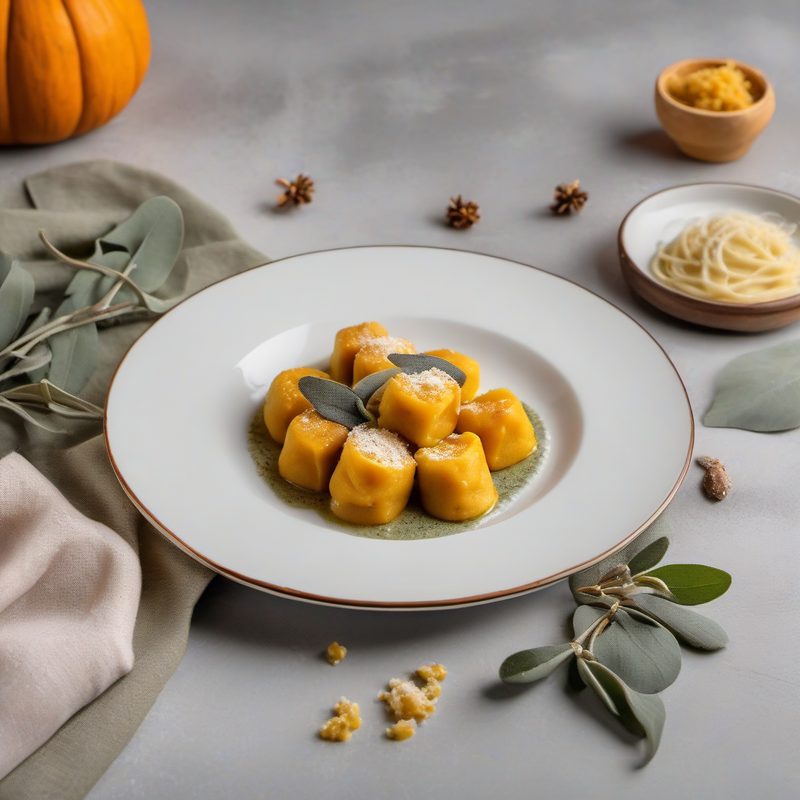
Pumpkin Gnocchi Basic
Tender, golden-orange potato-pumpkin gnocchi with the lightest, pillowy texture — finished simply with nutty browned butter, crisp sage leaves, and a shower of Parmigiano-Reggiano. No cream, no cheese sauce, just pure autumn flavor in under an hour.
Most Americans know gnocchi as a potato-only affair, but Italian home cooks have been slipping puréed squash into their dumplings for generations. The pumpkin does two essential jobs: it adds a whisper of natural sweetness and a brilliant golden hue, and it makes the gnocchi noticeably lighter than their all-potato cousins. The trick is getting the moisture balance right — boil the pumpkin alongside the potatoes, rice everything while it's still steaming, and work the flour in quickly and gently.
This basic version lets the gnocchi shine on their own. A quick sage brown butter — the classic Roman preparation — takes just minutes and coats each ridged dumpling in a nutty, aromatic glaze. In under an hour you'll have a plate of rustic Italian comfort that costs pennies to make and tastes like you spent all afternoon in the kitchen. Serve it as a primi, a light main with a big salad, or the vegetarian centerpiece of a fall dinner.
For the Gnocchi
For the Sage Brown Butter
Use level tablespoons and standard US measuring cups. All produce is medium unless specified.
🥘 Equipment
- Large pot (6-quart) for boiling potatoes and cooking gnocchi
- Small skillet (10-inch) for the sage butter
- Colander
- Potato ricer or food mill (see Chef's Tips for alternatives)
- Large bowl or clean work surface
- Bench scraper or chef's knife
- Gnocchi board or fork (for ridges)
- Rimmed baking sheet (for holding shaped gnocchi)
- Slotted spoon or spider strainer
- Box grater (for Parmigiano-Reggiano)
📋 Preparation
Step 1 — Boil the Potatoes and Pumpkin (35 minutes)
Place the whole, unpeeled potatoes in a large pot and cover with cold water by at least 2 inches. Stir in 2 tablespoons of kosher salt. Bring to a boil over high heat, then reduce to a simmer. Cook for 20 minutes.
After 20 minutes, add the cubed pumpkin or squash to the same pot. Continue simmering for 15 minutes, until both the potatoes and pumpkin are tender when pierced with a paring knife — the pumpkin should hold its shape but offer no resistance. If the pumpkin is very soft and starting to fall apart, that's fine; you'll be ricing it anyway, so err on the side of tenderness.
Drain well in a colander. Let the potatoes sit for 2 to 3 minutes until just cool enough to handle but still steaming hot. Peel the potatoes with a paring knife or your fingers — the skins should slip off easily.
Step 2 — Make the Gnocchi Dough (10 minutes)
On a clean work surface, mound the 2 cups of all-purpose flour in a wide ring, creating a well in the center (the classic fontana, or fountain shape). Rice the hot peeled potatoes directly onto the flour through a potato ricer or food mill. Rice the drained pumpkin on top of the potatoes. Ricing hot potatoes while they're still steaming is the single most important step — cold or cool potatoes will produce dense, leaden gnocchi.
Add the 2 egg yolks to the center. Using a fork or your fingertips, lightly mix the yolks into the potato-pumpkin mixture, then gradually begin incorporating the flour from the inner walls of the well. Work the mixture gently — use a cutting, folding motion rather than kneading — until a soft, slightly tacky dough forms. This should take no more than 2 to 3 minutes. The more you work the dough, the tougher the gnocchi. Stop as soon as it comes together; a few cracks and imperfections are perfectly fine.
Dust the surface and the dough lightly with semolina flour.
Step 3 — Shape the Gnocchi (15 minutes)
Line a rimmed baking sheet with parchment paper and dust generously with semolina flour.
Divide the dough into 4 equal pieces. On a semolina-dusted surface, roll each piece into a long rope about ½ inch (1.5 cm) in diameter. Cut the rope into ½-inch (1.5 cm) pieces with a bench scraper or knife.
To shape: hold a gnocchi board or the tines of a fork at a 45-degree angle. Press each piece gently with your thumb, dragging it down and off the tines in one fluid motion — the gnoccho should curl into a small ridged pillow with a dimple on the opposite side. Place each shaped gnoccho on the prepared baking sheet in a single layer. The ridges catch the sage butter; the dimple helps it cook evenly.
Repeat with the remaining dough. You can refrigerate the shaped gnocchi uncovered for up to 2 hours or freeze them on the sheet until solid, then transfer to a zip-top bag for up to 1 month (cook from frozen, adding 1 minute to the cooking time).
Step 4 — Make the Sage Brown Butter (5 minutes)
While the gnocchi water comes to a boil, make the sauce. Place the 6 tablespoons of butter in a small skillet over medium heat. Swirl the pan occasionally as the butter melts, foams, and then begins to turn golden-brown, about 3 to 4 minutes.
When the butter smells nutty and the milk solids at the bottom of the pan are a deep golden brown, add the sage leaves in a single layer. They will sputter and crisp up in about 30 seconds. Remove the pan from the heat immediately — the butter continues to darken off the heat, so pull it a shade earlier than you think you need to. Season with a pinch of kosher salt and a few cracks of black pepper. Set aside.
Step 5 — Cook and Serve the Gnocchi (5 minutes)
Bring a large pot of salted water to a rolling boil (use 2 tablespoons of salt per gallon of water). Drop half the gnocchi into the water — do not overcrowd. Cook until they float to the surface, 2 to 3 minutes. Let them bob for 30 seconds after surfacing to ensure the centers are tender.
Using a slotted spoon or spider, transfer the cooked gnocchi directly to the skillet with the sage brown butter (reheat the butter briefly if needed). Repeat with the remaining gnocchi. Gently toss over low heat for 30 seconds to coat every ridged surface.
Serve immediately in warm shallow bowls. Spoon any remaining sage butter and crispy sage leaves over the top. Finish with a generous shower of freshly grated Parmigiano-Reggiano and a final crack of black pepper.
🧑🍳 Chef's Tips
- No ricer? No problem. Pass the hot potatoes and pumpkin through a food mill fitted with the fine disc, or mash them thoroughly with a fork, pressing through a coarse-mesh sieve. A potato masher alone will leave lumps — do not use one.
- Russet potatoes are the right choice. Their high starch and low moisture content produce the lightest gnocchi. Waxy red or Yukon Gold potatoes contain too much water and will require significantly more flour, resulting in dense dumplings.
- Work fast and light. The entire dough-making process should take under 3 minutes. If the dough feels too sticky, dust with a little more flour — but resist the urge to add more than a tablespoon at a time.
- Semolina is non-negotiable for dusting. All-purpose flour will absorb into the surface and make the gnocchi gummy. Semolina stays granular, keeping them dry and distinct.
- Don't overcrowd the pot. Gnocchi need room to tumble and cook evenly. Work in batches of no more than 20 pieces at a time.
- Watch the butter like a hawk. Brown butter goes from perfect to burnt in seconds. The moment it smells nutty and the milk solids turn a deep tan, pull it off the heat. If you're unsure, err on the light side — you can always cook it a few seconds more.
❌ Common Mistakes
| Mistake | Why It Hurts | The Fix |
|---|---|---|
| Overworking the dough | Develops gluten → tough, rubbery gnocchi | Mix only until combined; a shaggy dough is ideal |
| Using cold potatoes | Cold starch doesn't absorb flour evenly → dense, gluey gnocchi | Rice the potatoes while they're still steaming hot |
| Skipping the pumpkin | You miss the sweetness and lighter texture | The pumpkin is what makes these gnocchi special — don't omit it |
| Overcrowding the boiling water | Water temperature drops → gnocchi sit and turn mushy | Cook in batches of 20 or fewer at a time |
| Burning the brown butter | Burnt butter tastes bitter and acrid | Watch constantly; remove from heat the instant it smells nutty |
| Adding cheese too early | Parmigiano melts into the butter and turns greasy instead of showering the top | Sprinkle cheese on each serving at the table, not in the pan |
💡 Variations
| Variation | How To |
|---|---|
| Sage & Walnut Butter | Add ½ cup (60 g) roughly chopped walnuts to the butter 1 minute before the sage. Toast until fragrant and golden — the nutty walnut + nutty brown butter double-down is spectacular. |
| Pumpkin-Free (Classic Potato Gnocchi) | Omit the pumpkin and increase the potato to 1½ lbs (680 g). The gnocchi will be classic potato — still perfect with sage butter. |
| Add Crispy Pancetta | Fry 4 oz (115 g) diced pancetta until crispy. Remove from the pan, make the sage butter in the rendered fat (reduce butter to 4 tbsp), and sprinkle the crispy pancetta over the finished dish. |
| Lemon & Sage Butter | Add 1 tablespoon of fresh lemon juice and 1 teaspoon of lemon zest to the browned butter just before adding the sage. The brightness cuts through the richness beautifully. |
| Gluten-Free | Substitute the all-purpose flour with a 1:1 gluten-free baking flour (containing xanthan gum). The dough will be more delicate; handle gently and cook immediately. |
❄️ Storage & Leftovers
| Method | Details |
|---|---|
| Refrigerator | Store shaped, uncooked gnocchi on the semolina-dusted baking sheet, covered loosely with plastic wrap, for up to 2 hours. Cooked gnocchi with butter will keep 1 day — reheat gently in a nonstick skillet over medium heat. |
| Freezer | Freeze shaped gnocchi in a single layer on the baking sheet until solid (about 1 hour), then transfer to a zip-top freezer bag. Cook from frozen, adding 1 extra minute to the boiling time. Do not thaw first. |
| Reheating | Leftover gnocchi in sage butter: reheat in a nonstick skillet over medium-low heat, adding a small pat of fresh butter to refresh the sauce, stirring gently until warmed through — about 3–4 minutes. |
🍷 Wine Pairing
| Wine | Why |
|---|---|
| Pinot Grigio (Friuli) | Crisp, light-bodied, and unoaked — the clean acidity cuts through the brown butter and lets the sweet pumpkin and sage shine |
| Gavi di Gavi (Piedmont) | Elegant, mineral-driven white with enough structure to stand up to the nutty butter and Parmigiano |
| Soave Classico (Veneto) | Almond and citrus notes provide a bright counterpoint to the rich, buttery sauce |
| Verdicchio dei Castelli di Jesi (Marche) | Slightly more full-bodied with herbaceous notes that echo the sage — a perfect pairing for this dish |
| Lambrusco (Emilia-Romagna, red) | A chilled, sparkling red with bright acidity and low tannins — the bubbles cut through the butter in a way that feels surprisingly right |
| Czech Pilsner or Blonde Ale (beer) | A crisp, clean beer with subtle hop bitterness balances the richness of brown butter and complements the sage |
🥗 Suggested Side Dishes
- Arugula Salad with Lemon Vinaigrette — Peppery greens and bright acid balance the rich butter
- Sautéed Swiss Chard with Garlic — Earthy greens echo the autumnal theme
- Sautéed Mushrooms with Thyme — Foresty flavors that feel right at home with pumpkin and sage
- Fennel and Orange Salad — Thinly sliced raw fennel with orange segments, olive oil, and sea salt
- Crusty Sourdough Bread — For sopping up every last drop of sage butter from the bowl
📊 Nutrition (per serving, estimated)
| Calories | Protein | Fat | Carbs | Fiber |
|---|---|---|---|---|
| 435 | 13 g | 18 g | 57 g | 4 g |
Nutrition is estimated and will vary based on specific brands and ingredient substitutions. The lower calorie count vs. cream-based versions reflects the simplicity of the sage brown butter finish.
❓ Frequently Asked Questions
Can I use canned pumpkin purée instead of fresh?
You can, but proceed with caution: canned pumpkin contains significantly more water than boiled fresh pumpkin. You'll need to drain it in a fine-mesh sieve lined with cheesecloth for at least 30 minutes to remove excess moisture. Alternatively, spread it on a baking sheet and dry it in a 250°F (120°C) oven for 15 minutes before ricing. If you skip the drying step, the dough will be impossibly sticky and you'll need far more flour, yielding heavy gnocchi.
Why are my gnocchi falling apart in the water?
Three likely causes: (1) the dough was under-floured and didn't have enough structure, (2) the gnocchi were boiled too long (once they float, give them only 30 seconds more), or (3) the water wasn't salted enough or wasn't boiling vigorously — gnocchi need aggressive heat to set the exterior quickly. Next time, add an extra tablespoon of flour to the dough and make sure the water is at a full, rolling boil.
Can I make the gnocchi ahead of time?
Absolutely. Shape the gnocchi and arrange them in a single layer on a semolina-dusted baking sheet. Refrigerate uncovered for up to 2 hours, or freeze until solid (about 1 hour) and transfer to a zip-top bag for up to 1 month. Cook frozen gnocchi directly from the freezer — no thawing — adding 1 extra minute to the boiling time. Freshly cooked gnocchi are best, but frozen is a close second and makes weeknight dinner effortless.
Can I use sweet potatoes instead of pumpkin?
Yes — sweet potatoes are an excellent substitute. They have a similar moisture content and starch profile to pumpkin, and their natural sweetness pairs beautifully with sage brown butter. Peel and cube them the same way. The gnocchi will be a deeper orange and slightly sweeter, but the texture will be just as light and pillowy.
Do I have to use semolina for dusting?
Yes — it makes a real difference. Semolina's coarse, granular texture stays on the surface of the gnocchi and acts as a barrier, preventing them from sticking to each other or to the baking sheet. All-purpose flour will absorb into the dough and make the exterior gummy. If you absolutely cannot find semolina, substitute fine cornmeal (not corn flour) as a second-best option.
🔗 Related Recipes
- Pumpkin Gnocchi with Gorgonzola Cream (Gnocchi di zucca con crema di gorgonzola) — The indulgent, blue-cheese version of these same gnocchi
- Classic Potato Gnocchi with Sage Brown Butter (Gnocchi di patate al burro e salvia)
- Ricotta Gnocchi with Peas, Pecorino, and Guanciale (Gnocchi di ricotta con piselli, pecorino e guanciale)
- Baked Gnocchi with Four Cheeses (Gnocchi al forno con quattro formaggi)
- Pumpkin and Sage Risotto (Risotto alla zucca e salvia)
🏷️ Search Tags
Photo reference: `vol1_82.png` — Golden-orange pumpkin gnocchi tumbled in nutty brown butter with crispy fried sage leaves, piled in a warm white ceramic bowl, a generous dusting of freshly grated Parmigiano-Reggiano on top, steam rising, soft natural daylight, 45-degree overhead angle, rustic wooden table with a linen napkin and a small sage sprig beside the bowl.
Recipe from "The Italian Kitchen" by Vita Milanese — Volume 1: Pasta Perfetto
Recipe from The Italian Kitchen by Vita Milanese — Volume 1 · Pasta Perfetto. Discover all volumes on the ebook page.