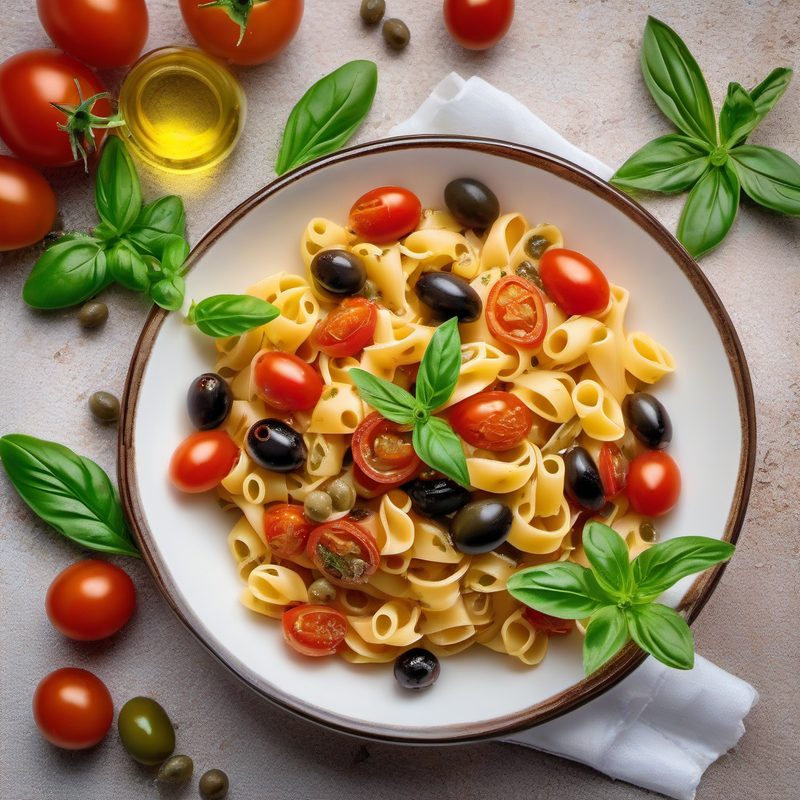
Pasta Vesuviana
| Amount | Ingredient |
|---|---|
| Calories | 505 kcal |
| Total Fat | 17 g |
| Saturated Fat | 4 g |
| Trans Fat | 0 g |
| Cholesterol | 15 mg |
| Sodium | 890 mg |
| Total Carbohydrates | 68 g |
| Dietary Fiber | 4 g |
| Total Sugars | 6 g |
| Protein | 18 g |
| Calcium | 250 mg |
| Iron | 3 mg |
1. Category
Primi Piatti — First Course (Pasta)
2. Yield / Serves
Serves 4 as a main course
Serves 6 as a first course (primo)
3. Total Time
35 minutes
4. Active Time / Prep Time
15 minutes
5. Difficulty
Easy — ★☆☆☆☆ (1/5)
6. Why This Recipe Works
Named after Mount Vesuvius, the brooding volcano that looms over the Bay of Naples, Pasta alla Vesuviana is a fearless, fiery tribute to its namesake. This dish thrives on opposites: the sweetness of blistered cherry tomatoes tamed by the smoldering heat of fresh chilies, all bound together by a glossy, creamy sauce that owes its silkiness to nothing more than pasta cooking water and finely grated Parmesan. Unlike many Neapolitan pasta dishes that lean heavily on long-simmered ragu, this one comes together in the time it takes to boil water — a weeknight-friendly eruption of flavor.
The key to its layered heat and depth lies in how the chilies are treated. By slicing them and sizzling them in olive oil at the very start, their capsaicin infuses the oil, creating a fragrant base that carries heat into every corner of the dish. The cherry tomatoes, halved and added after the garlic and chili have softened, are left to burst and collapse in the pan, their juices mingling with the oil to form a rustic, emulsified sauce. The final trick — a splash of starchy pasta water and a generous shower of Parmesan — transforms the thin, brothy mixture into a creamy, clingy coating that drapes each strand of pasta like lava cascading down a mountainside.
7. Key Equipment
- Large pot (6–8 quart) for boiling pasta
- Large skillet or sauté pan (12-inch) — wide enough for tomatoes to blister, not steam
- Chef's knife and cutting board
- Box grater or Microplane for Parmesan
- Tongs for tossing pasta
- Ladle or heatproof measuring cup for reserving pasta water
- Colander
- Cherry tomatoes — Their high sugar content and thin skins make them ideal for quick blistering. Grape tomatoes are an acceptable substitute but will take 1–2 minutes longer to burst. Do not use canned or Roma tomatoes; their lower moisture content will yield a dry, pasty sauce.
- Fresh chili peppers — The gold standard. Red Fresno or red jalapeño chilies bring vibrant heat and a touch of fruity acidity. Bird's eye chilies will deliver searing, volcanically hot results — use only one. If fresh chilies are unavailable, substitute 1 teaspoon of red pepper flakes added with the garlic; the flavor will be less complex but still pleasingly spicy.
- Parmigiano-Reggiano — True Parmigiano-Reggiano is nonnegotiable for that nutty, umami-rich finish. Pre-grated cheese is coated in anti-caking agents and will clump rather than melt into the sauce. Grate it fresh from a wedge on the fine holes of a box grater or Microplane.
- Pasta shape — Long, sturdy shapes (spaghetti, linguine, bucatini) work best, as the sauce clings to their surface. Short pasta (penne, rigatoni) is an acceptable alternative, though the sauce will pool inside the tubes rather than coating the exterior.
9. Before You Begin (Mise en Place)
- Fill a large pot with 4 quarts of water and bring to a rolling boil. Add 1½ tablespoons of kosher salt per quart.
- Halve all cherry tomatoes crosswise through the equator (not stem-to-blossom end) — this exposes more cut surface to the pan for faster blistering.
- Slice chili peppers into thin rings. For milder heat, remove the seeds and white membranes before slicing. Leave them intact for full Vesuvian fury.
- Peel and thinly slice garlic cloves.
- Grate Parmesan finely (you need about 1¾ cups gently packed).
- Pick basil leaves from stems; stack, roll, and chiffonade into thin ribbons.
- Have a ladle or measuring cup ready near the pasta pot to scoop water before draining.
11. Instructions
Step 1: Cook the Pasta
Bring 4 quarts of water to a rolling boil in a large pot. Add 2 tablespoons kosher salt (or 1½ tablespoons table salt). Add pasta and cook until very al dente — 1 to 2 minutes less than the package's al dente time. The pasta will finish cooking in the sauce, so it must be removed from the water while it still has a distinct chalky-white core when bitten.
Reserve 1½ cups (360 ml) of pasta cooking water just before draining. Drain pasta (do not rinse) and set aside.
Step 2: Infuse the Oil
While the pasta cooks, heat 3 tablespoons of olive oil in a 12-inch skillet over medium heat. Add the sliced chili peppers and cook, stirring, until fragrant and the oil takes on a faint reddish hue, about 1 minute.
Step 3: Sauté the Garlic
Add the sliced garlic to the chili oil and cook, stirring constantly, until golden and fragrant — about 30 to 45 seconds. Do not let the garlic brown; burnt garlic turns bitter and will spoil the sauce.
Step 4: Blister the Tomatoes
Add the halved cherry tomatoes cut-side down in a single layer (work in batches if your pan is crowded). Cook without moving for 3 minutes to allow deep blistering and browning on the cut surfaces. Then stir and continue cooking, stirring occasionally, until the tomatoes begin to soften and release their juices — about 2 to 3 minutes longer. Gently press a few tomatoes with the back of a spatula to encourage them to burst, but leave some mostly intact for texture.
Step 5: Build the Sauce
Reduce heat to medium-low. Add ½ cup (120 ml) of the reserved pasta water to the skillet and stir, scraping up any browned bits from the bottom. Sprinkle in half the grated Parmesan (about 25 g / 1 scant cup) and stir vigorously until the cheese melts into the liquid, creating a silky, emulsified sauce. Season with salt to taste — about ¼ teaspoon, adjusted based on the saltiness of your pasta water and cheese.
Step 6: Toss the Pasta
Add the drained pasta to the skillet. Using tongs, toss and turn the pasta vigorously for 1 to 2 minutes, allowing it to absorb the sauce and finish cooking. The sauce should coat each strand thickly. If the sauce seems too tight or dry, add more reserved pasta water, 1 tablespoon at a time, until it flows freely.
Step 7: Finish and Serve
Remove the skillet from the heat. Add the remaining Parmesan and the chiffonaded basil, and toss once more to distribute. Divide among warmed bowls. Drizzle each portion with a finishing swirl of extra-virgin olive oil and top with an extra grind of black pepper (optional) and a few small fresh basil leaves for garnish. Serve immediately.
12. Step-by-Step Visual Guide
| Stage | Visual Cue |
|---|---|
| Chili-infused oil | Oil should be fragrant and lightly tinted red, chilies starting to soften |
| Garlic | Pale gold, softened, not brown |
| Blistered tomatoes | Cut surfaces deeply browned, skins wrinkled, juices pooled in pan |
| Emulsified sauce | Opaque, creamy, coating the back of a spoon, no oil slick visible |
| Finished pasta | Glossy, sauce clings to each strand, no liquid pooling at bottom of bowl |
13. Troubleshooting
| Problem | Cause | Solution |
|---|---|---|
| Sauce is watery / pools at bottom of bowl | Pasta was undercooked before saucing, or too little cheese | Add remaining Parmesan and toss over low heat for 1 more minute to emulsify further |
| Sauce is greasy / separated | Heat too high after adding cheese; oil and water broke | Remove from heat, add 1 tbsp cold pasta water, and whisk/toss vigorously — it will re-emulsify |
| Pasta is gummy | Overcooked before draining, or rinsed after draining | Cook to very al dente; never rinse — surface starch is essential for sauce adhesion |
| Not spicy enough | Chilies were too mild or seeds were removed | Add a pinch of red pepper flakes with the garlic next time, or use spicier chilies |
| Garlic tastes bitter | Garlic was cooked too long or over too-high heat | Keep heat at medium and add garlic for only 30–45 seconds before adding tomatoes |
14. Make Ahead / Storage
- Refrigerator: Pasta alla Vesuviana is best eaten immediately, but leftovers can be stored in an airtight container for up to 2 days. The pasta will absorb much of the sauce overnight, so revive it by reheating in a skillet with a splash of water or broth, adding a little extra olive oil and a grating of Parmesan.
- Freezer: Not recommended. The creamy emulsion breaks upon thawing and the pasta texture becomes mushy.
- Prep ahead: Cherry tomatoes can be halved and chilies can be sliced up to 1 day in advance and stored in separate covered containers in the refrigerator. Garlic should be sliced just before cooking — pre-sliced garlic oxidizes and develops a harsh, stale flavor.
15. Variations
Pasta alla Vesuviana with Pancetta (Version: Vesuviana Ricca)
Add 100g (3½ oz) of pancetta, diced into ¼-inch pieces, to the cold skillet before the olive oil. Cook over medium heat, stirring, until the pancetta renders its fat and turns crisp, about 4–5 minutes. Remove pancetta with a slotted spoon and set aside. Proceed with the recipe, using the rendered fat in place of 1 tablespoon of the olive oil. Return the pancetta to the skillet just before tossing with the pasta.
Pasta alla Vesuviana with Capers and Olives (Version: Vesuviana alla Puttanesca)
Add 2 tablespoons of rinsed and drained capers and ¼ cup of pitted, halved Gaeta or Kalamata olives to the skillet after the tomatoes have begun to burst. Proceed with the recipe. The salty, briny notes add a Puttanesca-like complexity.
Milder Version (Vesuviana Dolce)
Omit the fresh chilies entirely. Add ½ teaspoon of smoked paprika to the oil with the garlic for a whisper of warmth without any heat. Increase the cherry tomatoes to 500g (1 lb 2 oz) for a sweeter, fruitier sauce.
Vegan Version (Vesuviana Vegana)
Substitute the Parmesan with 3 tablespoons of nutritional yeast stirred into the sauce at the end, plus ¼ cup of raw cashew cream (¼ cup cashews blended with ½ cup water until silky). Omit the Parmesan finish. The sauce will be less clingy but still rich and savory.
16. Wine Pairing
- Red: A bright, unoaked Lacryma Christi del Vesuvio (the "Tears of Christ" wine of the region) — a perfect geographic and flavor match. Alternatively, a chillable Barbera d'Alba or a light Valpolicella.
- White (unconventional but excellent): A mineral-driven Greco di Tufo — the slight bitterness of the finish contrasts beautifully with the chili heat.
- Rosé: A dry Cerasuolo d'Abruzzo rosato — bright cherry and herbal notes bridge the tomatoes and basil.
17. Serving Suggestions
- Serve as a primo piatto before a simply grilled fish (branzino or orata) or a lemony chicken cutlet (scaloppina al limone).
- Pair with a crisp side salad of arugula, shaved fennel, and lemon vinaigrette to cut the richness.
- For a rustic spread, serve alongside bruschetta al pomodoro and a plate of melanzane alla scapece (marinated fried eggplant).
18. Nutritional Information (per serving, serves 4)
Note: Nutritional values are estimates and will vary based on specific ingredient brands and portion sizes.
19. Recipe Source & Notes
Origin: Campania, Italy — specifically the Vesuvius region near Naples
Inspired by: Traditional Neapolitan home cooking and La Cucina Napoletana
Author: Hermes Agent Cookbook, Volume I
Recipe ID: 441
Date Added: July 2026
> Note on pasta water salinity: The rule of thumb — 1½ tablespoons of kosher salt per quart of water — may seem aggressive, but the salty water seasons the pasta from within. Most of the salt is discarded with the water; only about 5% is absorbed. Under-salted pasta water is the most common reason home cooks find their pasta dishes bland.
"A volcano on a plate — quick to erupt, impossible to forget." 🌋
Recipe from The Italian Kitchen by Vita Milanese — Volume 1 · Pasta Perfetto. Discover all volumes on the ebook page.