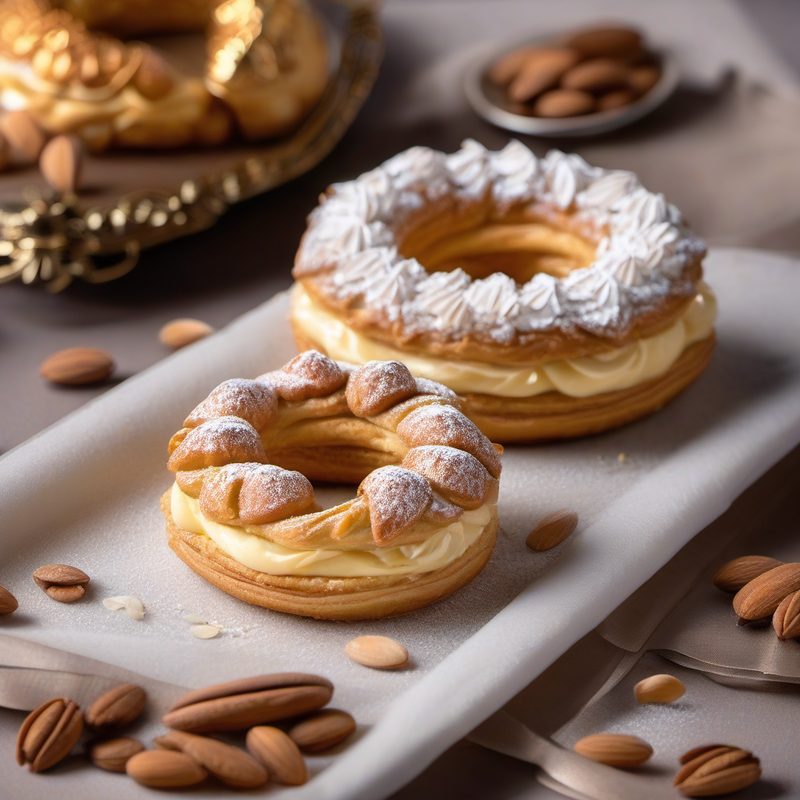
Paris Brest
A magnificent ring of golden, crackling choux pastry, split and filled with a luscious praline pastry cream — nutty, caramelized, and impossibly creamy — then dusted with powdered sugar. Born from a bicycle race, perfected by French patissiers, and now one of the most celebrated desserts in the French repertoire.
| Amount | Ingredient |
|---|---|
| Praline cream is lumpy or greasy | Butter was too cold when added, or the pastry cream was not fully smooth before chilling Ensure butter is at soft room temperature; pass the finished cream through a fine-mesh sieve or re-whip with a warm bowl |
| Praline cream tastes flat or one-dimensional | Not enough praline paste, or the praline paste is low-quality Use 200 g of premium praline paste; taste the cream and add more paste if the praline flavor isn't prominent |
| Choux ring is soggy after filling | The filled Paris-Brest sat too long before serving, or the choux wasn't fully dried during baking Serve within 2 hours of filling; ensure the choux ring was oven-dried thoroughly before cooling |
| Cream is too sweet | The praline paste and sugar combined may be overly sweet for some palates Reduce the sugar in the pastry cream to 80 g; use a praline paste with no added sugar (pure praline) |
| Choux ring cracks or breaks when splitting | The choux was over-baked (too dry and brittle), or the knife was not sharp enough Bake until golden but not dark brown; use a very sharp serrated knife with a gentle sawing motion |
| Almonds fall off the baked ring | The egg wash was too thin or the almonds weren't pressed on gently Apply a slightly thicker egg wash; press almonds gently but firmly into the surface immediately after egg-washing |
| The Paris-Brest is difficult to slice cleanly | The cream is too cold (firm), or the serrated knife is dull Let the assembled dessert rest at room temperature for 30 minutes; use a sharp serrated knife, wiping clean between cuts |
The Paris-Brest is a dessert with a story. Created in 1910 by Louis Durand, a Parisian pastry chef, to commemorate the Paris-Brest-Paris bicycle race (a grueling 1,200-kilometer endurance event), the ring shape was designed to evoke a bicycle wheel. Over a century later, it remains one of the great monuments of French pâtisserie — a choux pastry ring, crackling-crisp on the outside and hollow within, filled with a praline-infused crème mousseline (pastry cream lightened with butter) that is simultaneously rich, airy, and intensely nutty.
The magic of the Paris-Brest lies in its contrasts: the shattering choux shell against the silky, mousse-like cream; the toasted almond crunch on top against the cloud-like filling within; the caramelized depth of praline against the clean, eggy notes of the choux. Properly executed, it is less a cake than an experience — a crescendo of textures and flavors that builds with every bite.
This recipe follows the classic French method. The choux pastry ring is piped in a continuous circle, topped with sliced almonds, and baked until deeply golden. The filling is a proper crème pâtissière (French pastry cream) enriched with praline paste and beaten butter into a light, spreadable crème mousseline. The finished ring is sliced horizontally, filled, and dusted with a snowfall of powdered sugar. It serves 8 generously — each slice a perfect wedge of choux, cream, and praline.
> Active work is concentrated in two blocks: making and piping the choux (about 20 minutes), then making the pastry cream while the choux bakes (about 25 minutes). The most time-consuming part is the cooling — the choux ring must cool completely before filling, and the praline cream needs to chill to a spreadable consistency. Plan ahead; this is a weekend-project dessert that rewards patience with a stunning result.
Choux Pastry Ring
For the choux pastry, use the standard recipe from Choux Pastry (#322) — 125 ml water, 125 ml milk, 100 g butter, ¼ tsp salt, 1 tsp sugar, 150 g flour, and 4 large eggs. Prepare the paste as directed through Step 3 of that recipe. The full batch makes enough paste for one large Paris-Brest ring (about 10 inches / 25 cm in diameter). The sliced almonds are sprinkled on top before baking — use blanched almonds for a more uniform appearance or natural almonds with their skins on for a more rustic look. The egg wash gives the choux a deep, glossy golden-brown finish.
Praline Pastry Cream (Crème Mousseline au Praliné)
For Finishing
The praline paste is the soul of this dessert. It is a smooth paste made from caramelized hazelnuts and/or almonds ground to a butter-like consistency. Look for it in specialty baking shops, online, or in well-stocked grocery stores (brands like Valrhona, Cacao Barry, or even Nutella-style hazelnut spreads will work, though praline paste is smoother and less sweet than commercial chocolate-hazelnut spreads). If you cannot find praline paste, make your own: caramelize 200 g sugar with a splash of water until deep amber, stir in 200 g toasted hazelnuts and 100 g toasted almonds, cool completely, then grind in a food processor until it forms a smooth, runny paste — this takes 5–10 minutes of grinding and patience. The butter must be genuinely softened — not melted, not cold. Cut it into cubes and let it sit at room temperature for at least 1 hour before using. Cold butter will seize the pastry cream into a lumpy mess; melted butter will make the cream runny. The cornstarch is the only thickener — no flour needed — giving the cream a clean, silky texture without any pasty taste.
🥘 Equipment
- Digital kitchen scale
- Medium heavy-bottomed saucepan (2–3 quart / 2–3 L) for choux
- Medium saucepan (2 quart / 2 L) for pastry cream
- Large mixing bowl (for pastry cream base)
- Wooden spoon or heat-resistant silicone spatula
- Whisk (balloon whisk + flat whisk ideal for pastry cream)
- Rubber spatula
- Piping bag (16-inch / 40 cm, reusable canvas or disposable plastic)
- Large plain round piping tip (½–⅝ inch / 12–16 mm)
- Small plain round piping tip (¼ inch / 6 mm, optional for any decorative piping)
- Baking sheet (heavy-duty, rimmed, about 13 × 18 inches / 33 × 46 cm)
- Parchment paper
- Small round template or cake pan (8–9 inch / 20–23 cm diameter) — to trace a circle on parchment
- Pencil or food-safe marker (for tracing the guide circle)
- Pastry brush (for egg wash)
- Small offset spatula or butter knife
- Large offset spatula or palette knife (for spreading filling)
- Wire cooling rack
- Fine-mesh sieve (for sifting powdered sugar)
- Instant-read thermometer (optional, for pastry cream — target 170°F / 77°C)
- Plastic wrap (for covering pastry cream)
- Serrated bread knife (for splitting the baked choux ring)
- Serving platter or cake stand
- Stand mixer with paddle attachment (optional but recommended for beating butter into the cream)
- Hand mixer (alternative to stand mixer)
📋 Preparation
Step 1 — Prepare the Choux Pastry (15 minutes)
Follow the recipe for Choux Pastry (#322) through Step 3 (making the paste).
Prepare the dough in a medium heavy-bottomed saucepan:
- Combine 125 ml water, 125 ml whole milk, 100 g unsalted butter (cut into small cubes), ¼ tsp fine sea salt, and 1 tsp granulated sugar in the saucepan.
- Bring to a rolling boil over medium-high heat, stirring occasionally with a wooden spoon. The butter must be fully melted before the liquid comes to a boil.
- Remove the pan from the heat immediately when the mixture reaches a full, active boil. Add 150 g sifted all-purpose flour all at once. Stir vigorously with the wooden spoon until the flour is fully incorporated and the dough comes together into a smooth, cohesive ball — about 30 seconds of stirring.
- Return the pan to medium heat and cook, stirring constantly and energetically, for 1 to 2 minutes. The dough will begin to film the bottom of the pan — this is called dessécher (drying) the paste. Cook until a thin film forms on the bottom of the pan and the dough feels slightly drier and pulls away from the sides of the pan in a single mass. Do not under-cook — excess moisture will prevent the choux from puffing properly.
- Transfer the dough to a large mixing bowl (or the bowl of a stand mixer) and let it cool for 2 to 3 minutes — it should be warm but not hot enough to cook the eggs.
- In a small bowl, beat 4 large eggs (room temperature) with a fork until homogeneous.
- Add the beaten eggs to the dough one at a time, stirring vigorously after each addition with a wooden spoon (or using the paddle attachment on a stand mixer on medium speed). Each egg must be fully incorporated before the next is added. After the third egg, check the consistency: the dough should be smooth, glossy, and fall from the spoon in a thick, V-shaped ribbon. The fourth egg may not be needed in its entirety — add it gradually, stopping when the dough reaches the perfect consistency. You are looking for a paste that is:
- Glossy and smooth, not greasy or broken
- Thick enough to hold its shape when piped
- Soft enough to pipe through a ½-inch tip without extreme resistance
- It should form a stiff peak that slowly droops when lifted with a spoon
> The perfect choux paste consistency is the most critical skill to learn. Too stiff, and the choux won't puff; too loose, and the ring will spread into a flat puddle. If you add all 4 eggs and the paste is still too stiff to pipe, beat a fifth egg lightly and add it tablespoon by tablespoon until the consistency is right. If the paste becomes too thin (it flows rather than holds its shape), it's over-egged — next time, use 3½ eggs. For this batch, you can try to salvage it by beating in 1 tablespoon of flour, but prevention is better. Practice makes perfect.
Step 2 — Pipe the Choux Ring (10 minutes)
Preheat the oven to 200°C (400°F) with a rack in the middle position.
Prepare the baking sheet: Line a heavy-duty baking sheet (rimmed) with parchment paper. Using a small round cake pan or a template, trace a circle approximately 8–9 inches (20–23 cm) in diameter onto the parchment with a pencil or food-safe marker. Flip the parchment over so the pencil mark faces down but remains visible as a guide. (Do not use the marked side up — you don't want graphite or ink in contact with the food.)
Fill the piping bag: Fit a piping bag with a large plain round tip (½–⅝ inch / 12–16 mm). Fold the top of the bag over your hand to create a wide opening, and fill the bag with the choux paste. Twist the top of the bag closed and squeeze gently to eliminate any air pockets.
Pipe the ring: Starting at one point on the traced circle, pipe a continuous ring of choux paste directly onto the parchment, following the guide circle. You want a ring that is about 1 inch (2.5 cm) wide — think of a thick bagel shape, not a thin line. Pipe one complete ring, then pipe a second ring directly on top of the first, creating a double-stacked ring about 1½ to 2 inches (4–5 cm) tall when baked. The two layers should merge into a single, smooth ring. Keep the piping bag at a 45-degree angle to the baking sheet and apply steady, even pressure.
Seal the seam: After completing the second ring, gently smooth the seam where the ends meet with a wet fingertip — a tiny dab of water on your finger eliminates the telltale gap.
Egg wash and almonds: In a small bowl, beat 1 egg with 1 tablespoon water to make an egg wash. Using a pastry brush, gently brush the surface of the piped choux ring with a thin, even layer of egg wash. Be careful not to let the egg wash drip down the sides and pool on the parchment — it will glue the choux to the paper and prevent proper rising.
Sprinkle the almonds: Generously scatter 60 g sliced almonds evenly over the top of the egg-washed ring, pressing them in very gently so they adhere. Do not press hard enough to deflate the choux. The almonds will toast during baking, adding crunch and a nutty aroma that echoes the praline filling.
> The double-stacked ring is the traditional Paris-Brest shape. The two layers rise and merge into a tall, hollow ring. A single-layer ring will be too thin to split and fill properly. If you prefer a neater shape, you can pipe a single thick ring (about 1½ inches / 4 cm wide) followed by a slightly smaller concentric ring inside it, then pipe a third ring on top of the seam where the two meet — this creates a wider, more substantial ring. For the home cook, the simple double-stack method is perfectly sufficient.
Step 3 — Bake the Choux Ring (30–35 minutes + 10 minutes oven-drying)
Bake at 200°C (400°F) for 25 minutes. Do NOT open the oven door during this time — the steam inside is what inflates the choux. After 25 minutes, the ring should be puffed, deeply golden, and firm to the touch.
Reduce the oven temperature to 180°C (350°F) and bake for another 5 to 10 minutes — the extended bake at the lower temperature dries out the interior, preventing the choux from collapsing when cooled. The ring should be a rich golden-brown, the almonds should be toasted and fragrant, and the surface should feel crisp.
Oven-dry: Turn off the oven and prop the oven door open slightly (with a wooden spoon handle or an oven mitt). Leave the choux ring in the turned-off oven for 10 minutes. This final drying step ensures the pastry stays crisp rather than softening as it cools. For an even drier, crisper result, leave the choux in the turned-off, propped-open oven for up to 15–20 minutes.
Cool completely: Transfer the baking sheet to a wire cooling rack and let the choux ring cool completely — at least 30 minutes, ideally 45 minutes to 1 hour. Do not attempt to split or fill a warm choux ring; the steam inside will make the interior soggy, and the structure may collapse under the weight of the cream.
> Choux pastry needs to be thoroughly baked and dried. A pale, under-baked choux ring will deflate as it cools, becoming flat and doughy rather than tall and crisp. The extended bake at 180°C (350°F) and the oven-drying step are non-negotiable for a professional result. The ring should feel light and hollow when you pick it up — if it feels heavy or damp, return it to a 180°C (350°F) oven for another 5 minutes.
Step 4 — Make the Praline Pastry Cream (20 minutes + cooling time)
While the choux bakes, prepare the pastry cream.
In a medium saucepan, combine 500 ml whole milk and (if using a vanilla bean) the split vanilla bean and its scraped seeds. Heat over medium heat until the milk is steaming and small bubbles form around the edge — just below a simmer. Do not let it boil. Remove from heat, cover, and let steep for 10 minutes if using a vanilla bean. If using vanilla extract, simply heat the milk until steaming and proceed.
In a large mixing bowl, whisk together 5 large egg yolks and 100 g granulated sugar until the mixture is thick, pale, and forms a ruban (a ribbon that falls from the whisk and holds its shape on the surface for a few seconds) — about 2 minutes of vigorous whisking.
Sift 40 g cornstarch over the yolk mixture and whisk until completely smooth and free of lumps. The mixture will look like a thick, pale paste.
Temper the yolks: Slowly pour about one-third of the hot milk into the yolk mixture while whisking constantly. This raises the temperature of the yolks gradually, preventing them from scrambling. Whisk until smooth, then pour the tempered yolk mixture back into the saucepan with the remaining hot milk.
Cook the pastry cream: Return the saucepan to medium heat, whisking constantly and energetically. The mixture will thicken rapidly after about 2 to 3 minutes — you will feel the whisk meet resistance. As soon as it reaches a thick, pudding-like consistency and the first large bubble breaks the surface, continue whisking for exactly 30 seconds more to cook out the cornstarch flavor. The cream should be smooth, thick, and glossy.
Finish the base: Remove from heat. If using vanilla extract (not a bean), stir in 1 tsp vanilla extract and ¼ tsp fine sea salt now. If using a vanilla bean, remove the pod, scrape any remaining seeds back into the cream, and stir to incorporate.
Cool the pastry cream: Transfer the pastry cream to a shallow, wide dish (a 9 × 13-inch baking dish works perfectly — the surface area helps it cool quickly). Press a piece of plastic wrap directly onto the surface of the cream — this is essential to prevent a skin from forming. Let cool at room temperature for 15 minutes, then refrigerate for at least 1 hour, until completely cold (below 15°C / 60°F). The cream must be fully chilled before adding the butter.
> The pastry cream must be fully chilled before proceeding to the butter stage. If the cream is even slightly warm, the butter will melt rather than emulsify, producing a thin, greasy, runny cream instead of a light, mousse-like crème mousseline. Most Paris-Brest failures happen at this stage — patience is essential.
Step 5 — Finish the Praline Cream (Crème Mousseline) (10 minutes)
Once the pastry cream is thoroughly chilled (about 1 hour in the refrigerator), prepare the buttercream:
In the bowl of a stand mixer fitted with the paddle attachment (or in a large bowl with a hand mixer), beat 200 g softened unsalted butter on medium speed until pale, light, and fluffy — about 3 to 4 minutes. The butter should be very soft, almost mayonnaise-like in texture, but not melted. Scrape down the bowl and paddle thoroughly.
Add the chilled pastry cream to the beaten butter, about one-third at a time, beating on low to medium speed after each addition until fully incorporated and smooth. Scrape down the bowl between additions. The mixture may look slightly broken or curdled at first — this is normal. Keep mixing; it will come together into a silky, unified cream.
Add 200 g praline paste and beat on medium speed until fully combined, smooth, and uniform in color — about 1 to 2 minutes. The cream should be a light tan, the color of café au lait, with a pronounced hazelnut-almond aroma.
Check the consistency: The finished crème mousseline should be:
- Smooth, silky, and spreadable — like a firm buttercream
- Light and creamy, not greasy or heavy
- Pale tan in color with a glossy sheen
- Firm enough to hold its shape when piped, but soft enough to spread smoothly
If the cream is too soft (it won't hold its shape), refrigerate it for 15–20 minutes and re-whip before filling.
> The crème mousseline is the heart of the Paris-Brest. Unlike a simple whipped-cream filling (which is light but lacks structure), the crème mousseline is stable, sliceable, and holds its shape beautifully. The praline paste adds not just flavor but also a subtle fat content that enriches the cream. If your cream looks curdled (greasy streaks separating from the cream), the ingredients were at different temperatures — the butter was too cold, or the pastry cream was too cold. Fix: transfer a small amount of the mixture to a microwave-safe bowl and microwave for 5 seconds (just to barely warm it), then add it back to the main batch and beat on medium speed until it emulsifies. If that doesn't work, place the bowl over a pot of barely simmering water (a double boiler) for 5–10 seconds, stirring constantly, then beat again.
Step 6 — Assemble the Paris-Brest (10 minutes)
Split the choux ring: Using a long serrated bread knife, carefully slice the cooled choux ring in half horizontally, like splitting a bagel. Use a gentle sawing motion — the choux is delicate and will crumble if pressed. You want two even rings: a top and a bottom. Set the top ring aside.
Inspect the interior: The inside of the choux should be largely hollow, with a thin, tender, custard-like layer at the bottom. If the interior looks doughy or raw, the choux was under-baked — next time, extend the bake time. For this batch, you can carefully scoop out any doughy interior with a spoon to create room for the filling.
Fill the bottom ring: Place the bottom choux ring on a serving platter or cake stand. If desired, pipe a few dots of cream underneath to anchor the ring in place. Fill a piping bag fitted with a large plain or star tip (½ inch / 12 mm) with the praline crème mousseline.
Pipe the cream onto the bottom ring in a continuous spiral, starting at the outer edge and working inward. Fill the ring generously — the cream should be about 1½ to 2 inches (4–5 cm) tall, rising well above the top edge of the choux. Alternatively, use a large offset spatula to spread the cream in an even layer, dome-shaped in the center. The cream should be mounded, not flat — this is the visual and textural centerpiece.
Place the top ring: Gently set the top choux ring onto the cream, pressing very lightly to adhere. The cream should peek out slightly around the edges — this is the hallmark of a generously filled Paris-Brest.
Dust with powdered sugar: Place a heaping tablespoon of powdered sugar in a fine-mesh sieve and dust the top of the Paris-Brest generously, as if the ring has been lightly snowed upon. The contrast of the white powdered sugar against the golden, almond-studded choux is part of the dessert's charm.
Garnish (optional): Scatter a few toasted sliced almonds on top for additional crunch and visual appeal. Some pastry chefs add a small dollop of extra praline cream on top as a flourish.
> Assembly is the moment when all the components come together. The cream should be slightly mounded — the Paris-Brest is not a flat cake; it is a tall, generous, unabashedly decadent ring of cream and choux. A classic Paris-Brest serves 8, meaning each slice should be a substantial wedge. Use the full amount of cream; do not skimp. The powdered sugar dusting should be heavy and visible — it is both a flavor element and a visual signature of the dessert.
Step 7 — Rest and Serve (30 minutes minimum)
Rest at room temperature: Let the assembled Paris-Brest rest at room temperature for at least 30 minutes (up to 2 hours) before serving. This allows the crème mousseline to soften slightly and the flavors to meld. A cold Paris-Brest (straight from the refrigerator) has a firmer, less luscious texture — it needs time at room temperature to reach its ideal state.
Serve: Use a sharp serrated knife to slice the Paris-Brest into 8 wedges. Wipe the knife clean between cuts for the neatest slices. Each wedge should show the striated layers of crisp choux, creamy praline filling, and the almond-topped choux lid. Serve on individual dessert plates.
> The 30-minute rest at room temperature is not optional — it transforms the dessert. The crème mousseline relaxes from a stiff, buttercream-like consistency into a silky, luxurious cream that coats the palate. The choux softens just slightly, making it easier to slice without shattering. A Paris-Brest served too cold will taste like cold butter and hard choux; a Paris-Brest at room temperature tastes like a cloud of praline and toasted almonds.
🧑🍳 Chef's Tips
- Praline paste is the star — choose wisely. The quality of your praline paste directly determines the quality of the filling. Use a premium brand like Valrhona Praliné Feuilletine, Cacao Barry Pâte de Prliné, or a praline paste from a reputable French producer. Commercial chocolate-hazelnut spreads (Nutella, etc.) contain palm oil, sugar, and cocoa that alter the flavor and texture — they work in a pinch but produce a sweeter, less nutty, and slightly greasier cream. If making your own praline paste, use a 2:1 ratio of hazelnuts to almonds and caramelize the sugar to a deep amber (170°C / 338°F on a candy thermometer) for the most intense praline flavor. The grinding process takes patience — 5–10 minutes in a food processor, stopping to scrape down the sides, until the nuts release their oils and form a smooth, pourable paste.
- The butter must be properly softened. This is the single most common point of failure in crème mousseline. The butter should be at cool room temperature — around 68–70°F (20–21°C). It should yield easily to a finger press without resistance, and it should look smooth and spreadable, not greasy or melted. If your kitchen is cold, cut the butter into small cubes and place it near the oven (not on it) for 30 minutes. If it's too warm (above 72°F / 22°C), the cream will be too soft to hold its shape — refrigerate the finished cream for 15–20 minutes before filling.
- Choux troubleshooting: why did my ring collapse? A collapsed choux ring is almost always due to one of three causes: (1) the choux paste was too wet (over-egged), causing it to spread rather than puff; (2) the oven temperature was too low, producing steam too slowly to inflate the pastry; (3) the choux was under-baked and the interior hadn't dried sufficiently before cooling. Fix: use exactly the recommended egg quantity, verify your oven temperature with an oven thermometer, and bake until the ring is deeply golden and feels very light and hollow. The oven-drying step (10 minutes in the turned-off oven with the door propped open) is your insurance policy against collapse.
- Make the choux ring ahead. The baked, unfilled choux ring can be made a day ahead. Cool it completely, then store it in an airtight container at room temperature (not in the refrigerator — the fridge softens choux). On the day of serving, re-crisp the ring in a 180°C (350°F) oven for 3–5 minutes, cool, then fill. Do not refrigerate the assembled, filled Paris-Brest for more than 2 hours before serving — the choux absorbs moisture from the cream and becomes soggy.
- A star tip for the cream. While a plain round tip works for piping the cream, a large star tip (open star, ½ inch / 12 mm) creates a beautiful ridged pattern on the surface of the filling that peeks out from the sides of the choux ring — an elegant professional touch.
- Use a turntable for assembly. If you have a cake turntable, use it for filling the Paris-Brest. The ability to rotate the base while piping the cream spiral results in a perfectly even, professional-looking filling. Without a turntable, simply turn the serving platter carefully as you pipe.
- Save the trimmings. If you trim any doughy interior from the split choux ring, toss the scraps with a little powdered sugar and serve as a chef's snack — they're a delicious preview of the main event.
❌ Common Mistakes
| Mistake | Why It Hurts | The Fix |
|---|---|---|
| Choux ring is flat and spread out instead of tall and puffed | The choux paste was too wet (over-egged) or the oven was not hot enough — the pastry spread before the steam could inflate it | Use exactly 4 large eggs (add gradually — you may need only 3¾); verify oven temperature with an oven thermometer; pipe the ring tall, not wide |
| Choux ring collapsed after baking | Under-baked choux — the interior steam hadn't finished drying, so the structure weakened as it cooled | Bake until deeply golden and very light; extend the oven-drying step (propped-open door) to 15 minutes |
💡 Variations
- Paris-Brest with Gianduja Cream: Replace the praline paste with 200 g gianduja (chocolate-hazelnut spread). The result is a chocolate-hazelnut Paris-Brest that appeals to chocolate lovers while maintaining the classic structure. Use a 50/50 mix of praline paste and gianduja for a hybrid version.
- Chocolate Paris-Brest (Paris-Brest au Chocolat): Add 100 g melted dark chocolate (70% cocoa) to the crème mousseline along with the praline paste. Omit 50 g of the praline paste to keep the balance. The chocolate adds depth and bitterness that contrasts beautifully with the sweet praline.
- Coffee-Praline Paris-Brest: Infuse the milk for the pastry cream with 2 tablespoons coarsely ground espresso beans (steep for 15 minutes, then strain). The coffee notes amplify the nuttiness of the praline and add a sophisticated grown-up twist.
- Caramel-Praline Paris-Brest: Drizzle the finished crème mousseline with ribbons of salted caramel sauce before adding the top ring. Swirl the caramel gently into the cream with a skewer for a marbled effect.
- Gluten-Free Paris-Brest: Replace the all-purpose flour in the choux pastry with a 50/50 blend of rice flour and tapioca starch (or a 1:1 gluten-free flour blend). The choux will be slightly more delicate but still puffs beautifully. The filling is naturally gluten-free.
- Mini Paris-Brest (Individual): Pipe the choux into 2-inch (5 cm) rings (about 8–10 individual portions) instead of one large ring. Reduce the bake time to 18–22 minutes. Fill each mini ring individually with a star-tipped dollop of praline cream. Perfect for dinner parties where each guest gets their own pasty.
- Fraisier-Brest (Strawberry Paris-Brest): Add a layer of fresh strawberries (sliced or halved) on top of the praline cream before placing the top ring. The bright acidity of strawberries cuts through the richness of the cream beautifully — a seasonal summer variation.
- Salted Caramel Praline: Add ½ teaspoon of fleur de sel or flaky sea salt to the crème mousseline with the praline paste. The salt amplifies the caramel notes in the praline and balances the sweetness — a small adjustment with a big impact.
- Pistachio Paris-Brest: Replace the praline paste with 200 g pistachio paste, and top the choux ring with crushed pistachios instead of sliced almonds. The green of the pistachio cream against the golden choux is visually stunning, and the flavor is delicate, nutty, and distinctly Mediterranean.
- Raspberry Praline Paris-Brest: After filling the ring with praline cream, top with fresh raspberries before adding the lid. The raspberries' tart, acidic pop provides a brilliant counterpoint to the creamy, nutty filling.
❄️ Storage & Make-Ahead
| Method | Details |
|---|---|
| Room temperature (same day) | The assembled Paris-Brest is at its absolute peak within 2 hours of assembly. Serve within 4 hours of filling for the best texture — after that, the choux begins to absorb moisture from the cream and soften. Store in a cool, draft-free spot (not in direct sun, not near a heat source). |
| Refrigerator (assembled) | The filled Paris-Brest can be refrigerated for up to 24 hours, but the choux will soften noticeably. If you must refrigerate, do so uncovered for the first 30 minutes (to allow the cream to set), then wrap loosely in plastic wrap. Before serving, let it sit at room temperature for 45–60 minutes to soften the cream. The texture will be compromised but the flavor will still be excellent. |
| Refrigerator (components, unassembled) | This is the best make-ahead strategy: bake the choux ring 1 day ahead, cool completely, and store airtight at room temperature. Make the praline crème mousseline 1 day ahead and refrigerate in an airtight container. On serving day, re-crisp the choux ring in a 180°C (350°F) oven for 3–5 minutes, cool, re-whip the cream briefly to restore its texture (it stiffens in the fridge), and assemble. This gives you a freshly assembled Paris-Brest with no day-of choux or cream work. |
| Freezer (unfilled choux ring) | Freeze the baked, fully cooled choux ring (without filling) in an airtight freezer bag for up to 1 month. Thaw at room temperature for 15 minutes, then re-crisp in a 180°C (350°F) oven for 5 minutes. Fill and serve. |
| Freezer (crème mousseline) | The praline cream can be frozen for up to 1 month in an airtight container. Thaw overnight in the refrigerator, then bring to room temperature and re-whip with a paddle attachment or hand mixer to restore its silky texture before filling. |
| Freezer (assembled, whole) | Not recommended — the choux becomes irreversibly soggy upon thawing, and the cream's texture degrades unevenly. |
| Leftover cream | Any remaining praline mousseline can be refrigerated for up to 5 days and used as a filling for cream puffs, éclairs, or as a spread on brioche. Bring to room temperature and re-whip before using. |
| Stale choux ring reviving | If the unfilled choux ring has gone soft (the next day), place it on a baking sheet in a 180°C (350°F) oven for 3–5 minutes. It will crisp back up almost like fresh. |
🍷 Wine Pairing
| Wine | Why |
|---|---|
| Champagne Brut or Franciacorta | The high acidity, fine bubbles, and toasty yeast notes cut through the rich praline cream like a knife, while the bubbles provide a textural contrast to the creamy, mousse-like filling. A classic celebration pairing. |
| Moscato d'Asti (lightly sparkling, 5.5% ABV) | The gentle frizzante, low alcohol, and floral-sweet peach and apricot notes mirror the dessert's sweetness without overwhelming it. The praline's nuttiness finds a perfect partner in Moscato's fruit. |
| Sauternes or Barsac (late-harvest Sémillon-Sauvignon Blanc, France) | The luscious, honeyed sweetness of Sauternes, with its notes of apricot, honey, and botrytis spice, pairs sublimely with the caramelized nuttiness of the praline. The wine's acidity keeps it from cloying. |
| Vin Santo del Chianti (Italian dessert wine) | Dried fruit, honey, and almond notes echo the toasted almond flavor in the praline. The wine's oxidative character adds an extra layer of complexity to an already complex dessert. |
| Rutherglen Muscat (Australia) | An intensely sweet, fortified wine with notes of raisins, toffee, and Christmas cake — the sticky, concentrated sweetness stands up to the rich butter and praline without fading. |
| Banyuls (French fortified wine from Roussillon) | A red dessert wine with flavors of dark fruit, chocolate, and dried figs — works especially well with the chocolate variation of Paris-Brest. |
| Tokaji Aszú (5 Puttonyos) | Hungarian noble-rot wine with honey, apricot, and marmalade flavors and a bright acid spine — the acidity is high enough to cut through the cream while the sweetness complements the praline. |
| Malvasia delle Lipari Passito (Sicily) | A sweet, aromatic dessert wine from the Aeolian Islands with notes of dried apricots, honey, and orange blossom — the floral notes provide an elegant contrast to the earthy nuttiness of praline. |
🍺 Beer Pairing
| Beer | Why |
|---|---|
| Belgian Dubbel (e.g., Westmalle Dubbel, St. Bernardus Prior 8) | Dark fruit, caramel, and toasted malt notes echo the caramelized sugar in the praline. The moderate sweetness and medium body stand up to the richness of the cream without being overwhelmed. |
| Quadrupel (e.g., Rochefort 10, La Trappe Quadrupel) | Deep, complex, and richly malty with notes of dark fruit, brown sugar, and a warming alcohol finish — the intensity matches the decadence of the dessert. Serve slightly below cellar temperature. |
| Baltic Porter | Roasty, chocolatey, with a smooth, full body and moderate sweetness — the roasted malt character complements the toasted almonds and caramel praline beautifully. |
| English Barleywine | Intensely malty, sweet, and fruity with notes of toffee, dark fruit, and a warming alcohol presence — a sipping beer that treats the Paris-Brest as an equal partner in a luxurious pairing. |
| Bière de Garde (French farmhouse ale) | Malty, earthy, and slightly sweet with a smooth, rounded character — the French origins of both the beer and the dessert make for a natural pairing. The maltiness echoes the caramel notes in the praline. |
| Stout (Imperial or Oatmeal) | Creamy, roasty, with notes of chocolate and coffee — works especially well with the chocolate variation. The roasty bitterness balances the sweetness of the praline cream. |
| Belgian Strong Dark Ale (e.g., Chimay Bleue) | A classic pairing for desserts: the fruity, spicy, malty complexity with a dry finish complements the nutty, caramelized praline without competing. |
🥗 Suggested Accompaniments
- Crème anglaise — A pool of vanilla custard sauce on the plate creates a beautiful presentation and adds a silky, liquid element that contrasts with the crisp choux and airy cream.
- Fresh raspberries or strawberries — A handful of fresh, tart berries alongside each slice cuts through the richness with bright acidity. The red color against the golden choux and cream is visually stunning.
- Whipped crème fraîche — Lightly sweetened crème fraîche whipped to soft peaks adds a tangy, dairy-fresh counterpoint to the sweet praline cream. A dollop on each plate is both beautiful and functional.
- Chocolate sauce — A drizzle of warm dark chocolate sauce (70% cocoa) over the plate adds a bitter, sophisticated edge that balances the sweetness beautifully.
- Salted caramel sauce — A ribbon of salted caramel alongside each slice amplifies the caramel notes already present in the praline. The salt calms the sweetness and adds a savory dimension.
- Coffee or espresso — A small, strong coffee (espresso, ristretto, or Americano) served alongside is the traditional Parisian accompaniment. The bitterness of the coffee is the ideal foil for the rich, sweet pastry.
- Vin Santo or sweet wine — A small glass of Vin Santo, Sauternes, or Moscato d'Asti makes the dessert feel like a full-course finale.
- Chestnut purée swirl — A small spoonful of sweetened chestnut purée (crème de marrons) on the plate adds an earthy, nutty note that complements the praline beautifully — a classic French combination.
- Candied orange zest — Thin strips of candied orange peel scattered over the powdered sugar add brightness, color, and a citrusy aromatic lift between bites.
📊 Nutrition (per serving, estimated)
| Calories | Protein | Fat | Carbs | Fiber |
|---|---|---|---|---|
| ~580 | 9 g | 40 g | 48 g | 2 g |
Nutritional values are estimates based on 1 batch choux pastry (322) made with standard ingredients (250 ml liquid, 100 g butter, 150 g flour, 4 large eggs), 500 ml whole milk, 5 egg yolks, 100 g sugar, 40 g cornstarch, 200 g praline paste, 200 g butter, 60 g sliced almonds, and powdered sugar, divided into 8 servings. This is a rich, decadent dessert — a single slice provides approximately 40 g of fat (primarily from the butter, egg yolks, and praline paste) and 48 g of carbohydrates. The protein content (9 g per serving) comes mainly from the eggs and the nuts in the praline paste. The fiber is minimal (2 g), primarily from the almonds and the small amount of whole-grain content in the flour. The sodium content is approximately 280 mg per serving, contributed by the salt in the choux pastry and the pastry cream. For context, a typical fine-dining restaurant serving of Paris-Brest is comparable in caloric density — this is a special-occasion dessert, not an everyday indulgence. To lighten the recipe, you could reduce the butter in the crème mousseline to 150 g, though the texture will be slightly less luxurious. A gluten-free version (using a gluten-free flour blend in the choux) would have similar nutritional values. A dairy-free version (using plant-based butter and milk alternatives) would reduce the saturated fat but may compromise the texture. Values are estimates and will vary based on exact ingredients, brands, and portion sizes.*
❓ Frequently Asked Questions
What is the difference between Paris-Brest and a cream puff or profiterole?
All three are made from choux pastry, but they differ in shape and filling. A cream puff is a small, round, unbaked choux ball filled with whipped cream or pastry cream. A profiterole is a small, baked choux puff, typically filled with ice cream or pastry cream and topped with chocolate sauce. Paris-Brest is a large ring of choux pastry (double-stacked), split horizontally, and filled with praline crème mousseline. The Paris-Brest is larger, more dramatic, and specifically associated with the praline flavor — it is the most elaborate and celebratory of the choux family.
Can I make Paris-Brest without praline paste?
Praline paste is the defining flavor of a classic Paris-Brest. Without it, you are making a different dessert: a choux ring filled with plain pastry cream or buttercream. If you cannot find praline paste, try: (1) making your own by caramelizing sugar and grinding it with toasted hazelnuts and almonds; (2) using a high-quality hazelnut-chocolate spread (like Nutella) with a pinch of salt to approximate the flavor; or (3) substituting 200 g almond paste (marzipan) softened with a tablespoon of milk or cream, though the texture and flavor will be very different.
Why did my choux ring split or burst open during baking?
A choux ring that splits or bursts open usually means: (1) the ring was piped with a weak point or gap in the seam where the two ends meet; (2) the choux paste was too wet and the ring expanded too quickly; (3) the oven temperature was too high, causing the steam to expand faster than the pastry structure could hold. To prevent: ensure a tight, smooth seam where the piping meets; use the correct choux consistency; and verify your oven temperature. If the ring does burst, it is still delicious — the broken ring is a rustic-looking but perfectly edible Paris-Brest.
My crème mousseline is too runny to hold its shape. How do I fix it?
A runny crème mousseline is almost always caused by the pastry cream being too warm when the butter was added — the butter melted rather than emulsified. To fix: refrigerate the cream for 30 minutes until it firms up, then re-whip. If it is still too soft after chilling, the proportions may be off — check that you used exactly 200 g butter (not less) and that the pastry cream was properly thickened (it should be pudding-thick before chilling). If all else fails, use the runny cream as a sauce or filling for a simpler dessert (cream puffs or profiteroles) and reattempt the crème mousseline with properly chilled pastry cream.
How far ahead can I make the components?
The choux ring can be baked up to 1 day ahead (store airtight at room temperature, re-crisp before filling). The praline cream can be made up to 2 days ahead (refrigerate airtight, re-whip before using). The assembled Paris-Brest should be filled no more than 2–4 hours before serving for best texture. The praline paste (if making from scratch) can be made up to 2 weeks ahead and stored at room temperature in an airtight jar.
Can I freeze a fully assembled Paris-Brest?
No — this is the one thing you should not do. The choux absorbs moisture from the cream as it thaws, turning into a soggy, deflated mess. Freeze the components separately (unfilled choux ring + sealed container of cream) for the best make-ahead option.
What is the best way to slice a Paris-Brest cleanly?
Use a long, sharp serrated bread knife. Start at the outer edge and cut through the choux, cream, and top choux in one clean motion — do not saw back and forth excessively. Wipe the knife clean between each cut with a damp paper towel — the cream will smear across the choux and make the slices look messy if you don't. For the neatest presentation, you can refrigerate the assembled Paris-Brest for 15 minutes before slicing to firm up the cream slightly, then let the slices come to room temperature for 10 minutes before serving.
How do I make my own praline paste at home?
Making praline paste at home is straightforward but requires patience. Toast 200 g (1½ cups) hazelnuts and 100 g (¾ cup) blanched almonds at 180°C (350°F) for 8–10 minutes until fragrant and lightly golden. While the nuts toast, combine 200 g (1 cup) granulated sugar with 60 ml (¼ cup) water in a small saucepan. Cook over medium heat, swirling occasionally (do not stir), until the sugar caramelizes to a deep amber color (about 170°C / 338°F on a candy thermometer). Immediately stir in the hot toasted nuts — the caramel will seize and harden, which is normal. Pour the mixture onto a parchment-lined baking sheet and let cool completely (about 30 minutes). Break the hardened caramel-nut slab into pieces and transfer to a food processor. Process for 5–10 minutes, scraping down the sides every minute, until the mixture transforms from coarse powder to a smooth, runny paste. The nuts will release their oils and create a silky, creamy paste. Store in an airtight jar at cool room temperature for up to 2 weeks. Yield: approximately 300–350 g (more than enough for this recipe).
My choux ring is lopsided — one side is taller than the other. Why?
A lopsided choux ring is usually the result of uneven piping — one section of the ring was piped thicker than another. It can also happen if the oven has hot spots (common in home ovens), causing one side of the ring to puff more than the other. To fix: rotate the baking sheet halfway through baking (after 15 minutes), being quick to avoid losing too much oven heat. For the piping, use steady, even pressure and a smooth, consistent motion. Even a lopsided Paris-Brest, however, tastes just as good.
Can I use a different nut for the praline?
Absolutely. While the classic Paris-Brest uses a blend of hazelnuts and almonds in the praline, you can experiment with: pure hazelnut praline (for a deeper, earthier flavor), pecan praline (for a sweeter, southern American twist), macadamia nut praline (for a buttery, luxurious version), or pistachio praline (for a vibrant green color and delicate, floral flavor). The technique for making the paste is the same regardless of the nut.
🔗 Related Recipes
- 322 — Pasta a choux (Choux Pastry) — The master recipe for the choux pastry used here. Master this technique, and you unlock éclairs, cream puffs, profiteroles, gougères, and Paris-Brest.
- 106 — Éclair Crema e Cioccolato (Chocolate & Cream Eclairs) — The classic elongated choux pastry filled with vanilla pastry cream and dipped in chocolate — a direct sibling to the Paris-Brest, using the same choux technique and similar pastry cream.
- 343 — Crema Pasticcera (Italian Pastry Cream) — The plain vanilla pastry cream that forms the base of the praline crème mousseline. A fundamental Italian recipe used in countless desserts.
- 340 — Crema al Burro (Italian Buttercream) — Another Italian buttercream technique, useful for comparison with the crème mousseline method used here.
- 321 — Pasta Brisée (Shortcrust Pastry Dough) — The fundamental shortcrust pastry used in tarts and crostatas — the opposite end of the pastry spectrum from the steam-leavened choux.
- 347 — Pain de Campagne (French Country Bread) — A lean, yeast-risen bread — contrast the choux pastry's steam-leavening with traditional yeast bread leavening.
- 349 — Crema Chantilly (Chantilly Cream) — The simple, lightly sweetened whipped cream that can be used as an alternative filling for a lighter Paris-Brest variation.
- Pâte Sablée (Sweet Shortcrust Pastry) — The sweet tart dough used for dessert tart shells, a common companion to the choux pastry family in French patisserie.
- Crème Pâtissière (French Pastry Cream) — The French cousin of Italian crema pasticcera — essentially identical but with vanilla bean as the standard flavoring and butter often added after cooling (for crème légère).
- Crème Diplomate — Pastry cream lightened with whipped cream and gelatin — a lighter alternative to the crème mousseline used in this Paris-Brest.
- Baba au Rhum — Another classic French pastry, where a yeast-leavened brioche is soaked in rum syrup — compare the steam-leavened choux with the yeast-leavened baba to understand two different ways to create a light, airy pastry.
🏷️ Search Tags
📸 Photo Reference
Photo reference: `vol1_354.png` — A dramatic, three-quarter angle shot of a whole Paris-Brest presented on an elegant round white ceramic cake stand or a marble pedestal. The choux ring is a deep golden-brown, generously studded with toasted sliced almonds that catch the light. A heavy, cloud-like dusting of powdered sugar blankets the top of the ring, with a few patches where the golden almond-studded choux peeks through. The Paris-Brest has been sliced into eight wedges, with one wedge slightly separated from the ring to reveal the cross-section: the crisp, hollow choux shell on the bottom and top, sandwiching a thick, creamy layer of pale tan praline crème mousseline. The cream is visibly smooth, silky, and generously mounded — between 1½ to 2 inches (4–5 cm) tall. Small flecks of vanilla bean are visible in the cream. The choux itself shows a delicate, airy, honeycomb-like interior structure with small to medium irregular air pockets. A small ramekin of extra praline cream sits on the side, with a few fresh raspberries scattered artfully around the base of the stand. A linen napkin is folded beneath the cake stand. In the background, a glass of Champagne or Moscato d'Asti catches the light, and a silver dessert fork rests on the table. The lighting is warm, golden, natural daylight from a side window — the kind of late-afternoon light that makes powdered sugar glow and golden choux shimmer. A sprig of fresh mint rests beside the cut wedge for a pop of green contrast. The mood is elegant, celebratory, and deeply inviting — the kind of dessert that demands to be photographed before being devoured.
Recipe from "The Italian Kitchen" by Vita Milanese — Volume 1: Pasta Perfetto 🥐
Recipe from The Italian Kitchen by Vita Milanese — Volume 1 · Pasta Perfetto. Discover all volumes on the ebook page.