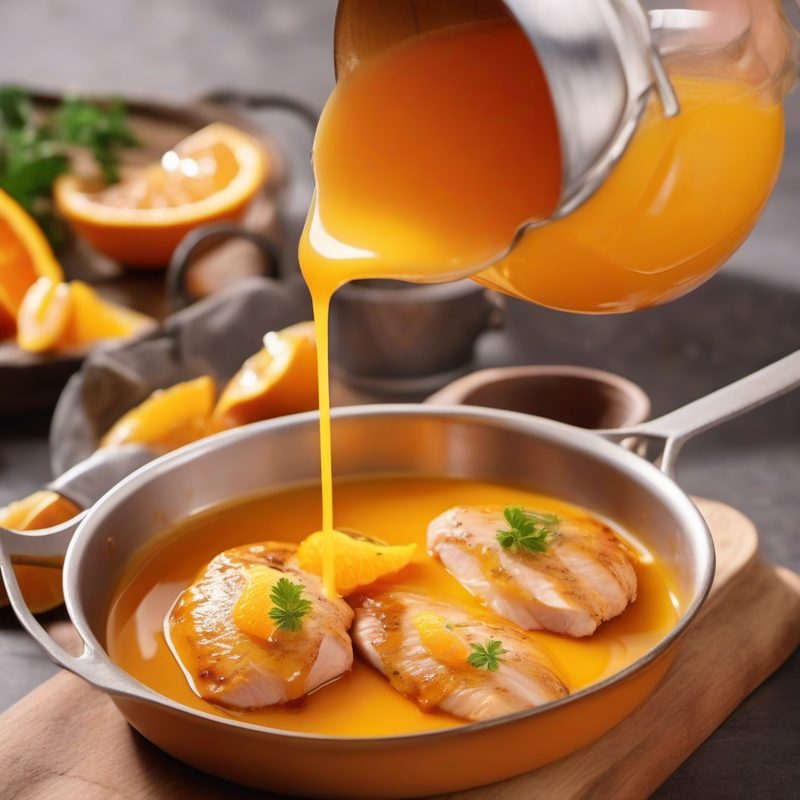
Orange Sauce for Savory Dishes
A bright, elegant citrus pan sauce that transforms simple chicken, pork, or fish into something special — ready in under 10 minutes with fresh orange juice, butter, and a touch of white wine.
| Amount | Ingredient |
|---|---|
| 100 ml (scant ½ cup) | fresh orange juice (from about 1½ oranges) |
| 20 g (1½ tbsp) | dry white wine |
| 15 g (1 tbsp) | unsalted butter |
| 10 g (2 tsp) | potato starch |
| to taste | ginger powder |
| to taste | salt and freshly ground black pepper |
| to taste | finely grated orange zest |
This is the kind of sauce that looks and tastes like it came from a restaurant kitchen but comes together faster than a trip to the takeout menu. The technique is straightforward: a quick roux of butter and potato starch provides body without floury heaviness, white wine adds acidity and depth as the alcohol cooks off, and fresh orange juice brings bright, natural sweetness. Ginger and orange zest add aromatic complexity, while a finishing seasoning of salt and pepper keeps everything in balance. The sauce is silky, glossy, and intensely orange-flavored without being cloying — the savory backbone from the butter and wine keeps it firmly in "dinner sauce" territory. It's a masterclass in how a few simple ingredients, treated with care, can produce a sauce that feels far greater than the sum of its parts.
Ingredient notes: Use fresh-squeezed orange juice — bottled juice contains preservatives and lacks the bright, clean acidity of fresh. Navel or Valencia oranges work well. The white wine should be dry, not sweet; a Sauvignon Blanc or Pinot Grigio is ideal. Potato starch (sometimes called potato flour or potato starch flour) creates a silky, translucent sauce without the cloudy appearance of cornstarch or the graininess of wheat flour. Do not substitute cornstarch here; the texture will be different. Ginger powder provides gentle warmth; use fresh grated ginger (about ½ teaspoon) for a brighter, spicier kick. Grating the zest from the orange before juicing is essential — zest contains aromatic oils that juice alone cannot provide.
- Small saucepan
- Citrus juicer or reamer
- Fine-mesh grater or Microplane (for zest)
- Fine-mesh sieve (for straining juice)
- Whisk
- Measuring spoons and cup
- Spatula
- Prepare the orange (3 min). Finely grate the zest of half an orange using a Microplane or the finest side of a box grater. Set the zest aside. Cut the orange in half and squeeze 100 ml (scant ½ cup) of juice. Strain through a fine-mesh sieve to remove pulp and seeds. Set aside.
- Make the roux base (2 min). In a small saucepan, melt the butter over medium heat. Add the potato starch and whisk continuously until smooth and bubbling, about 30 seconds. The mixture should look like a pale paste — do not let it brown.
- Add the wine (1 min). Pour in the white wine while whisking constantly. The mixture will seize slightly and then loosen. Continue cooking and whisking until the alcohol aroma evaporates, about 1 minute.
- Add the orange juice and seasonings (3–4 min). Pour in the orange juice in a steady stream, whisking constantly. Add the reserved orange zest, a pinch of ginger powder, a pinch of salt, and a few grinds of black pepper. Cook over medium heat, whisking occasionally, until the sauce thickens to a silky, pourable consistency — it should coat the back of a spoon — about 3 to 4 minutes.
- Taste and serve. Remove from heat. Taste and adjust seasoning with additional salt, pepper, ginger, or a pinch of sugar if the orange is too tart. Serve immediately over sautéed chicken breast, pan-seared pork chops, or grilled white fish.
- Zest before juicing. A whole orange is much easier to grate than a floppy, juiced half. Always grate the zest before cutting the fruit for juicing.
- Whisk the roux thoroughly. Potato starch clumps easily if not whisked vigorously. Make sure the butter and starch form a smooth, lump-free paste before adding any liquid.
- Cook off the wine. The alcohol in the wine can create a raw, harsh flavor if not allowed to evaporate. Cook for the full minute and let your nose guide you — when the sharp alcohol smell dissipates, it's ready.
- Do not boil aggressively. A gentle simmer is all the sauce needs to thicken. Boiling over high heat can cause the potato starch to break down, resulting in a thin, watery sauce.
- Serve immediately. This sauce is at its best fresh from the pan. It will thicken further as it cools. If it becomes too thick upon standing, whisk in a teaspoon of warm water or orange juice to loosen it.
| Mistake | Why It Hurts | The Fix |
|---|---|---|
| Using bottled orange juice | Lacks acidity and brightness; the sauce tastes flat and dull | Always squeeze fresh oranges. The 5 minutes of extra effort make a dramatic difference. |
| Browning the butter-starch roux | The sauce takes on a nutty, brown color and flavor that competes with the bright citrus | Cook the roux just until it bubbles — 30 seconds is enough. Remove from heat briefly if needed. |
| Adding the wine too slowly | The mixture seizes into lumps that are difficult to smooth out | Pour the wine in a steady stream while whisking vigorously. Commit to the pour. |
| Using too much ginger | Overpowers the delicate orange flavor, making the sauce taste like ginger tea | Start with a tiny pinch (⅛ teaspoon or less). You can always add more, but you cannot remove it. |
| Not straining the orange juice | Pulp and seeds create an unpleasantly textured sauce | Always strain freshly squeezed juice through a fine-mesh sieve. The sauce should be silky-smooth. |
| Over-thickening the sauce | The sauce becomes gluey, pasty, or pudding-like | Cook only until it coats the back of a spoon — 3 to 4 minutes. Thin with warm water or juice if needed. |
- Orange-Thyme Sauce: Add ½ teaspoon of fresh thyme leaves (or ¼ teaspoon dried) along with the orange juice. The herbaceous notes pair beautifully with chicken and pork.
- Orange-Rosemary Sauce: Add a small sprig of fresh rosemary while the sauce simmers; remove before serving. Excellent with roasted lamb or duck.
- Spicy Orange Sauce: Add a pinch of red pepper flakes or a small pinch of cayenne along with the ginger. Works well with grilled shrimp or fish tacos.
- Orange-Honey Sauce: Increase the depth of sweetness with 1 teaspoon of honey, added after the sauce has thickened. Particularly good with roast duck or pork tenderloin.
- Orange-Balsamic Sauce: Replace the white wine with balsamic vinegar for a deeper, more complex tang. Reduce the amount to 1 tablespoon and taste before adding more. Excellent with roasted root vegetables.
- Creamy Orange Sauce: After the sauce thickens, whisk in 2 tablespoons of heavy cream or crème fraîche. The dairy mellows the acidity and creates a richer, more luxurious sauce for chicken or fish.
| Storage Method | Details |
|---|---|
| Refrigerator | Store in an airtight container for up to 3 days. The potato starch may cause the sauce to thicken into a gel when cold. Reheat gently in a small saucepan over low heat, whisking in a splash of warm water or orange juice to restore the proper consistency. |
| Freezer | Not recommended. The potato starch-based sauce breaks upon thawing, resulting in a watery, separated texture. Make fresh. |
| Per Serving (3 tbsp / 45 ml) | |
|---|---|
| Calories | 65 |
| Protein | 0 g |
| Fat | 4 g |
| Carbohydrates | 7 g |
| Fiber | 0 g |
| Sugar | 4 g |
Nutrition values are approximate and based on fresh orange juice, unsalted butter, potato starch, and dry white wine. Actual values will vary based on specific brands and orange sweetness.
Can I use cornstarch instead of potato starch?
Yes, but the texture will be different. Cornstarch creates a slightly thicker, more gel-like sauce that can appear cloudy rather than translucent. If substituting, use 1½ teaspoons of cornstarch mixed with 1 tablespoon of cold water (a slurry) instead of incorporating it into the butter roux. Whisk the slurry into the simmering sauce and cook until thickened, about 1 minute.
Can I make this with blood oranges or mandarins?
Absolutely. Blood oranges will produce a beautiful deep red-orange sauce with a slightly more floral, tart flavor — pair it with fish or pork. Mandarins or clementines will produce a sweeter, more delicate sauce; reduce the sugar or omit it entirely. Adjust the wine and ginger to balance the sweetness.
What proteins pair best with this sauce?
This sauce is versatile enough for almost any mild protein. It is especially good with: pan-seared chicken breast, roasted chicken thighs, grilled or pan-seared pork chops, pork tenderloin, roasted or pan-seared salmon, halibut, cod, sea bass, and even firm tofu or seitan (for vegetarians). Avoid pairing it with strongly flavored meats like lamb (unless you add rosemary) or beef (which calls for a deeper, richer sauce).
Can I make this ahead for a dinner party?
You can prepare the sauce base (steps 1–4) up to 24 hours in advance. Reheat gently in a small saucepan over low heat, whisking constantly. You may need to add a splash of warm water or fresh orange juice to restore the proper consistency. For the best texture and brightest flavor, finish the sauce just before serving.
Why did my sauce turn out thin?
The sauce may not have simmered long enough, or the potato starch may not have been properly incorporated into the butter roux. Ensure you cooked the roux until bubbling and smooth before adding the wine. Also, make sure the sauce simmered for a full 3–4 minutes — it will look thin at first, then thicken relatively quickly at the end.
- Orange Sauce for Meat and Fish (Volume 2)
- Lemon Butter Sauce (Volume 2)
- Delicate Garlic Cream Sauce (Volume 2)
- Browned Butter Umami Sauce (Volume 2)
- Classic Hollandaise (Volume 1)
Recipe from "The Italian Kitchen" by Vita Milanese — Volume 2: Sunday Sauce
Recipe from The Italian Kitchen by Vita Milanese — Volume 2 · Sunday Sauce. Discover all volumes on the ebook page.