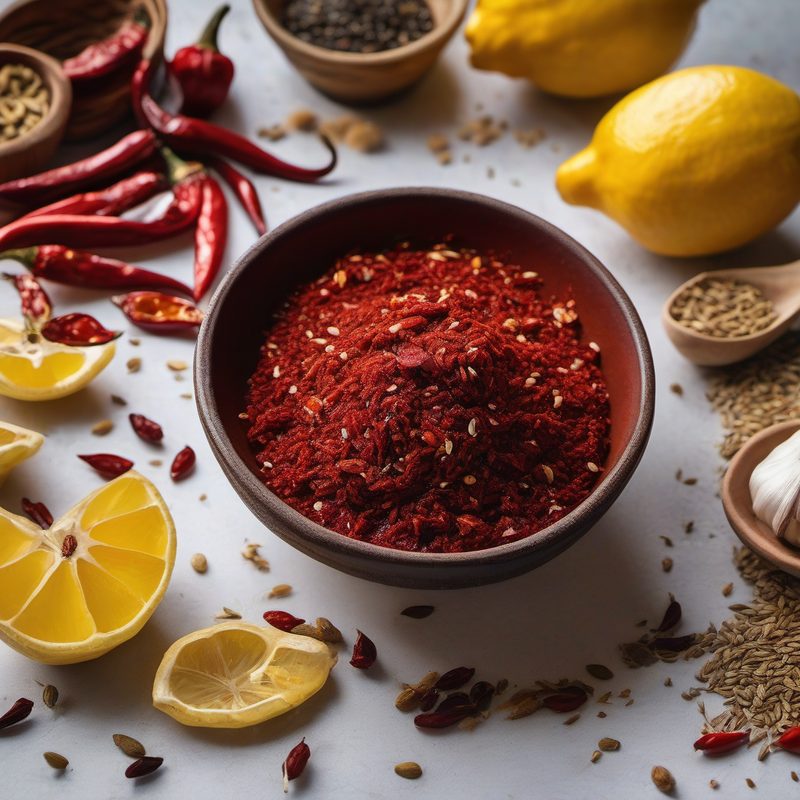
Harissa (Harissa)
A smoky, complex North African chili paste built on toasted spices, confit garlic, and preserved lemon — fiery, fragrant, and deeply savory, essential with couscous, grilled meats, roasted vegetables, and eggs.
| Amount | Ingredient |
|---|---|
| 150 g (about 20–25) | mixed dried peppers (combination of sweet paprika peppers and spicy dried chilies, such as guajillo, New Mexico, or dried Thai chilies) |
| 4–6 cloves | confit garlic (or roasted garlic) |
| 2 | preserved lemons (rind only, pulp removed) |
| 2 tsp | caraway seeds |
| 2 tsp | cumin seeds |
| 1 tsp | coriander seeds |
| 6–8 tbsp (90–120 ml) | olive oil, plus more for storage |
| to taste | salt |
Harissa is the soul of North African cooking — a chili paste so layered and aromatic that it functions as both condiment and ingredient, as comfortable stirred into a tagine as it is smeared on a sandwich or whisked into a vinaigrette. This version honors the Tunisian tradition from which harissa emerged, but with a few refined touches: confit garlic replaces raw garlic for sweetness without sharpness; preserved lemon rind adds a salty, floral-citrus complexity that raw lemon cannot match; and a trio of toasted seeds — caraway, cumin, and coriander — provides the warm, earthy backbone that distinguishes great harissa from mere chili paste. The dried peppers themselves are a blend: sweet paprika peppers (for color, body, and mild sweetness) combined with spicy dried chilies (for heat that builds rather than assaults). The result is a harissa with depth, nuance, and grace — a paste that can be fierce or gentle depending on how you use it.
Ingredient notes: The dried pepper blend is where you customize the heat level. For a mild, deeply colored harissa, use 100% sweet paprika peppers (dried red bell or Italian sweet peppers). For medium heat, use a 2:1 ratio of sweet to spicy. For a fiery harissa, reverse that ratio. Good spicy options include dried guajillo (mild heat, fruity), New Mexico (medium heat, earthy), árbol (hot, sharp), or Thai bird's eye (very hot, direct). Confit garlic — garlic cloves slowly cooked in olive oil until buttery soft — is essential for this recipe; its sweet, mellow character is irreplaceable. If you do not have it, roast garlic in foil at 200°C (400°F) for 40 minutes until soft and golden. Preserved lemons are widely available in Middle Eastern markets and specialty grocery stores; use only the rind, scraping away and discarding all the salty pulp. If preserved lemons are unavailable, substitute 1 tablespoon of fresh lemon zest simmered in olive oil for 2 minutes (to soften the intensity), though the result will lack the fermented complexity.
- Food processor or high-speed blender
- Small skillet (for toasting spices)
- Small bowl (for soaking peppers)
- Chef's knife and cutting board
- Fine-mesh sieve
- Measuring spoons
- Rubber spatula
- Sterilized glass jar (for storage)
- Toast and grind the spices (3 min). Place the caraway seeds, cumin seeds, and coriander seeds in a dry skillet over medium heat. Toast, shaking the pan frequently, until fragrant and the cumin darkens slightly, about 1–2 minutes. Do not let them smoke or burn. Transfer immediately to a plate to cool, then grind to a fine powder using a spice grinder or mortar and pestle.
- Rehydrate the dried peppers (25 min). Wipe the dried peppers with a damp cloth to remove dust. Remove the stems and shake out most of the seeds (leave some seeds if you want extra heat). Place the peppers in a heatproof bowl and cover with warm water (not boiling — just hot tap water works). Place a small plate or lid on top to keep them submerged. Let soak for 20–30 minutes until the peppers are soft, pliable, and rehydrated.
- Strain the peppers (2 min). Drain the peppers in a fine-mesh sieve, reserving the soaking liquid. Do not rinse them — you want to retain the flavorful water. Lightly press the peppers to remove excess liquid, but do not squeeze them dry.
- Blend the harissa (5 min). In a food processor, combine the rehydrated peppers, preserved lemon rind (pulp removed), confit garlic, toasted ground spices, and a generous pinch of salt. Process for 30 seconds until the mixture forms a coarse paste. With the processor running, drizzle in 6 tablespoons (90 ml) of olive oil in a steady stream. Continue processing until the harissa is smooth, thick, and spreadable — about 1 minute. If the paste is too thick and the processor struggles, add reserved soaking liquid 1 tablespoon at a time until it loosens. The final texture should be a thick, rustic paste — not a thin sauce.
- Season and adjust (2 min). Taste the harissa. It should be warm, complex, and balanced — spicy, salty, citrusy, and earthy all at once. Add more salt if needed. For more heat, blend in a pinch of cayenne or a few extra soaked spicy chilies (re-soak them briefly first). For more acidity, add a tiny squeeze of fresh lemon juice. For more smokiness, blend in ½ teaspoon of smoked paprika.
- Transfer and store (2 min). Spoon the harissa into a sterilized glass jar. Smooth the top with a spatula and pour a thin layer of olive oil (about 5 mm / ¼ inch) over the surface — this seals out air and prevents oxidation. Seal the jar tightly.
- Do not skip toasting the spices. Raw cumin and coriander taste grassy and flat; toasting transforms them into warm, aromatic, almost floral versions of themselves. This single step is the difference between a good harissa and a great one.
- Customize your heat level. The beauty of homemade harissa is total control over spiciness. For a family-friendly version, use sweet peppers only. For chili-heads, add a couple of dried habaneros or Scotch bonnets to the blend.
- Preserved lemon is the secret weapon. The salty, fermented, floral-citrus character of preserved lemon rind adds a dimension that fresh lemon simply cannot match. Do not skip it — seek it out at Middle Eastern markets or make your own (it takes 3 weeks, but it keeps forever).
- Confit garlic makes it smooth. Raw garlic would add a sharp, pungent edge that competes with the chilies and spices. Confit garlic brings sweet, buttery garlic flavor that melts into the paste and rounds out the heat.
- Reserve the soaking liquid. The warm water the peppers soak in absorbs a surprising amount of flavor and color. Adding a tablespoon or two to the blender can help achieve the right consistency without diluting the harissa with more oil.
- Let it rest before serving. Like most pastes and sauces, harissa improves after a day in the refrigerator. The flavors meld, the heat settles, and the spices bloom. Make it a day ahead if possible.
| Mistake | Why It Hurts | The Fix |
|---|---|---|
| Not removing the pepper seeds | Seeds add excess bitterness and can make the harissa uncomfortably hot in an uneven way | Shake out most of the seeds after removing the stems. A few seeds left behind are fine. |
| Over-toasting the spices | Burnt spices taste acrid, bitter, and smoky in a bad way — they ruin the entire batch | Toast over medium heat and shake constantly. Remove at the first sign of fragrance and color. |
| Using the pulp of the preserved lemons | The pulp is intensely salty and slimy, throwing off the salt balance and texture of the harissa | Use only the rind. Scrape away the pulp with a spoon and discard it. |
| Using raw garlic instead of confit garlic | Raw garlic overwhelms the chili and spice flavors with its sharp, pungent heat | Confit or roast the garlic first. It takes 30 minutes and transforms the final result. |
| Over-oiling the harissa | Too much oil makes the harissa greasy and loose rather than thick and paste-like | Start with 6 tablespoons of oil and add more only if needed. Remember you will add a layer of oil on top for storage. |
| Not drying the rehydrated peppers | Excess water makes the harissa watery and prone to spoilage | Drain the peppers well and press out excess moisture before blending. Use soaking liquid sparingly to adjust consistency. |
- Rose Harissa: Add 1 tablespoon of dried rose petals (pulsed to a powder) with the spices for a floral, aromatic North African variation that is spectacular with lamb.
- Smoked Harissa: Add 1 teaspoon of smoked paprika and replace half the olive oil with smoked olive oil (if available) for a deeply smoky version perfect for grilled meats.
- Tomato Harissa: Add 2 tablespoons of tomato paste (sautéed in olive oil for 2 minutes to remove raw flavor) to the blender for a richer, more rounded harissa with a slightly sweeter profile.
- Mint Harissa: Stir in 2 tablespoons of finely chopped fresh mint after blending for a bright, cooling contrast to the heat. Ideal with grilled fish or as a yogurt swirl.
- Lemon Harissa (fresh): Add 1 tablespoon of fresh lemon zest and 2 teaspoons of fresh lemon juice with the peppers for a brighter, more immediate citrus character (use in place of preserved lemon if necessary).
- Harissa Paste with Roasted Red Peppers: Replace half the dried peppers with 2 roasted and peeled red bell peppers for a milder, sweeter, more approachable harissa with a softer texture.
- Cumin-Forward Harissa: Double the cumin seeds for a more aggressively earthy, North African character that pairs beautifully with lamb and couscous.
| Storage Method | Details |
|---|---|
| Refrigerator | Store in an airtight jar with a 5 mm (¼ inch) layer of olive oil on top to seal out air. Keeps for up to 3 months. After each use, smooth the surface and replenish the oil layer. If any mold appears on the surface, discard the entire jar. |
| Freezer | Spoon harissa into an ice cube tray (about 1 tablespoon per cube), freeze until solid, then transfer cubes to a zip-top bag. Keeps for up to 6 months. Thaw individual cubes as needed. The texture after thawing is slightly looser but the flavor is intact. |
| Oil separation | Some separation of olive oil is normal over time — simply stir it back in before using. If the separated oil smells rancid, the harissa may have spoiled. |
Harissa is a remarkable versatile condiment. Use it to add depth, heat, and complexity to almost any savory dish:
- Stir into couscous: Add 1–2 tablespoons to cooked couscous with a pat of butter for an instant, fragrant side dish.
- Whisk into vinaigrette: Combine 1 tablespoon harissa with 3 tablespoons olive oil and 1 tablespoon lemon juice for a spicy, North African dressing.
- Smeared on grilled meat: Spread a thin layer on lamb chops, chicken thighs, or steak before or after grilling. Harissa forms a beautiful crust when applied before cooking.
- Swirled into yogurt or labneh: Mix 1 teaspoon harissa into ½ cup of Greek yogurt or labneh for a cooling, spicy dip that is phenomenal with flatbread.
- Stirred into soup or stew: Add 1–2 tablespoons to lentil soup, chickpea stew, or tomato soup for instant complexity.
- Eggs: Spoon a dollop into shakshuka, scramble into eggs, or spread on a fried egg sandwich.
- With roasted vegetables: Toss cauliflower, sweet potatoes, or carrots with harissa and olive oil before roasting.
- Wine pairing: A dry, aromatic white like a Vermentino or a Grüner Veltliner — the wine's herbal notes and crisp acidity complement the complex spice profile. For red wine, a spicy, fruit-forward Côtes du Rhône or a Primitivo works beautifully. For beer, a Belgian dubbel or a Moroccan-style mint tea is the traditional accompaniment.
| Per Serving (about 1 tbsp / 15 g) | |
|---|---|
| Calories | 45 |
| Protein | 1 g |
| Fat | 4 g |
| Carbohydrates | 2 g |
| Fiber | 1 g |
Nutrition values are approximate and based on dried peppers, olive oil, preserved lemon, and spices. Actual values will vary based on pepper-to-oil ratio and specific ingredients used.
How long does homemade harissa last?
Properly stored in the refrigerator with a layer of olive oil on top, homemade harissa keeps for up to 3 months. Always use a clean, dry spoon when scooping it out to prevent introducing bacteria. If you see any mold, discard the entire jar.
Can I make harissa without preserved lemons?
Yes, but the result will be less complex. Substitute 1 tablespoon of fresh lemon zest gently simmered in olive oil for 2 minutes (to soften the sharpness), plus an extra ¼ teaspoon of salt to approximate the salinity of preserved lemon. Alternatively, add 1 tablespoon of brine from a jar of preserved lemons if you have it.
What is the best dried pepper blend for harissa?
A 2:1 ratio of mild sweet peppers (like dried New Mexico or guajillo) to spicy peppers (like árbol or cayenne) produces a well-balanced harissa with approachable heat and deep red color. Adjust the ratio to your preference. Avoid using all one type of pepper — the blend creates complexity.
Can I use fresh chilies instead of dried?
Dried chilies are traditional and produce a thicker, more concentrated paste. Fresh chilies contain too much water and will yield a thinner, less intense harissa that spoils faster. Stick with dried chilies for the authentic texture and shelf life.
How is harissa different from chili oil or chili paste?
Harissa is distinguished by its spice blend (caraway, cumin, coriander — these are non-negotiable) and the inclusion of preserved lemon or citrus. Chili oil (like olio santo) is purely pepper and oil. Chili garlic paste (like sambal) uses fresh chilies and vinegar. Harissa is more aromatic, more complex, and more versatile as an ingredient rather than just a condiment.
- Calabrian Chili Oil (Volume 2)
- Charmoula (Volume 1)
- Preserved Lemons (Volume 1)
- Confit Garlic (Volume 2)
- Couscous with Roasted Vegetables and Harissa (Volume 3)
Recipe from "The Italian Kitchen" by Vita Milanese — Volume 2: Sunday Sauce
Recipe from The Italian Kitchen by Vita Milanese — Volume 2 · Sunday Sauce. Discover all volumes on the ebook page.