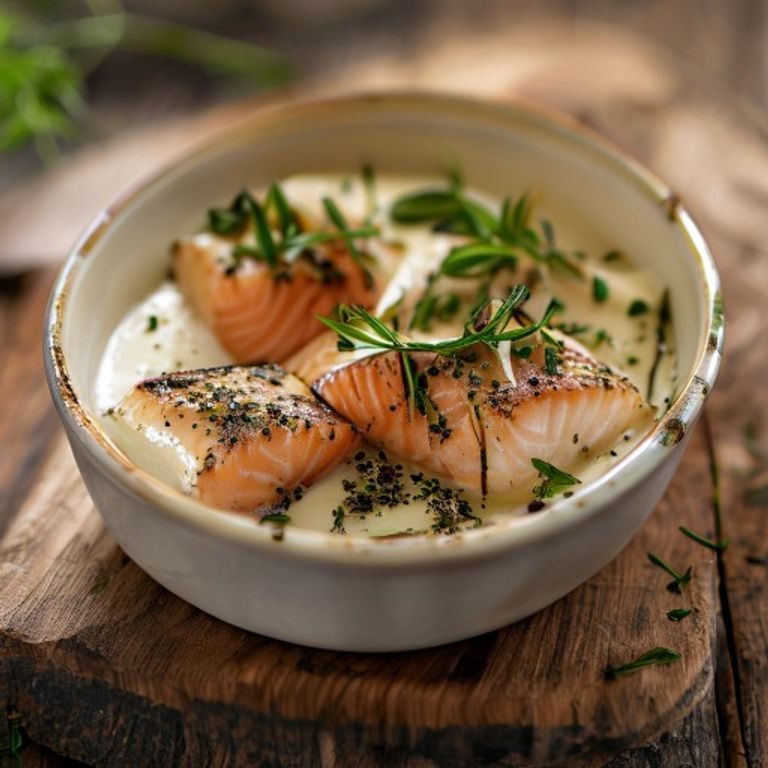
Café dal Tesin (Smoked Trout Herb Butter)
A rustic compound butter from the mountains of Ticino, Switzerland — smoked trout, fresh alpine herbs, and sharp mustard folded into creamy butter create a spread so versatile it transforms grilled meat, crusty bread, or simple fish into a taste of Swiss-Italian tradition.
| Amount | Ingredient |
|---|---|
| 150 g (⅔ cup) | unsalted butter, softened to room temperature |
| 15 g (½ oz) | smoked trout fillet, skin and bones removed |
| 1 tsp (5 g) | Dijon or whole-grain mustard |
| 1 | garlic clove, minced |
| 2 sprigs | fresh parsley |
| 2 sprigs | fresh mint |
| 2 sprigs | fresh mountain thyme (or common thyme) |
| 2 sprigs | fresh oregano |
| ¼ tsp (1.5 g) | kosher salt |
| ⅛ tsp (0.25 g) | freshly ground black pepper |
Café dal Tesin is a traditional flavored butter from the Ticino canton in southern Switzerland, where Swiss precision meets Italian flair. Named after the Tesin (Ticino) river valley, this aromatic butter combines the deep, smoky richness of smoked trout with the bright, grassy notes of mountain herbs — parsley, mint, thyme, and oregano — all bound together with a touch of mustard and garlic. The technique is simple: soften, mix, roll, and chill. But the result is remarkably complex — a butter that is at once smoky, herbal, creamy, and gently pungent. It is the kind of condiment that makes everything it touches taste of alpine meadows and open-fire cooking. Serve it sliced over a grilled steak, melting onto a piece of crusty bread, or crowning a fillet of simply pan-seared fish.
Ingredient notes: Use high-quality smoked trout — the flavor of the butter depends entirely on the quality of the fish. If mountain thyme is unavailable, common garden thyme works perfectly. The herbs should be fresh, not dried, to preserve their bright, grassy character. Use unsalted butter so you can control the salt level.
- Chef's knife
- Cutting board
- Small mixing bowl
- Rubber spatula or wooden spoon
- Fine grater or Microplane (for garlic)
- Parchment paper (12 x 12-inch sheet)
- Refrigerator space (for chilling)
- Prepare the herbs (5 minutes). Wash and thoroughly dry all herb sprigs. Strip the leaves from the stems and discard the stems. Finely chop the parsley, mint, thyme, and oregano until they are uniformly minced. You should have about 2 tablespoons total of finely chopped herbs. Set aside.
- Flake the smoked trout (3 minutes). Using your fingers or a fork, carefully flake the smoked trout into very small pieces — no larger than ¼ inch. Check carefully for any stray bones or skin and remove them. Set aside.
- Combine the base (5 minutes). In a medium mixing bowl, place the softened butter. Add the flaked smoked trout, mustard, minced garlic, and all of the finely chopped herbs. Using a rubber spatula or wooden spoon, fold and press the mixture together until everything is evenly distributed. The butter should look speckled with green herbs and pink trout, with no large streaks of unincorporated butter.
- Season and taste (2 minutes). Add the salt and pepper. Stir thoroughly, then taste a small amount on a piece of plain bread or cracker. Adjust seasoning — you may want a little more pepper or a pinch more salt, depending on the saltiness of your smoked trout.
- Form the log (5 minutes). Lay the parchment paper on a work surface with one corner pointing toward you (diamond orientation). Spoon the butter mixture into a rough log shape along the bottom third of the parchment. Using the paper as a guide, roll the butter tightly into a cylinder, about 1½ inches in diameter. Twist the ends of the parchment firmly to seal, like a candy wrapper, compressing the butter into a compact log. Smooth and shape the log through the paper with your hands.
- Chill until firm (2 hours minimum). Place the wrapped butter log in the refrigerator and chill until completely firm, at least 2 hours. For a firmer, sliceable texture, chill for 4 hours or overnight.
- Serve (1 minute). Unwrap the parchment and slice the butter into ¼- to ½-inch rounds. Arrange on grilled meat, fish, or crusty bread. Let the butter soften for 2 to 3 minutes at room temperature before serving for the best flavor and spreadability.
- Butter must be truly softened. Room-temperature butter (68–70°F / 20–21°C) is essential. If the butter is too cold, the ingredients will not incorporate evenly; if it is too soft (melting), the log will not hold its shape. Leave the butter out for 45 to 60 minutes before starting.
- Chop herbs by hand. A food processor will bruise the herbs and release their bitter chlorophyll, turning the butter green and bitter. Hand-chopping preserves their bright color and delicate flavor.
- Dry the herbs thoroughly. Any moisture on the herbs will create a watery, unstable butter that spoils faster. Pat them completely dry with paper towels before chopping.
- Bones are not your friend. Smoked trout can have tiny pin bones. Run your fingers through the flakes carefully before adding to the butter — one stray bone can ruin the experience.
- Let the butter rest before serving. After slicing, let the butter rounds sit at room temperature for 2 to 3 minutes to soften slightly. The flavors open up dramatically as the butter warms.
- Use a sharp knife for clean slices. A warm or dull blade will smear the butter. For perfect rounds, dip the knife in hot water and wipe dry between cuts.
- Don't overwork the butter. Mix just until combined. Overmixing will make the butter too soft and oily, making it difficult to roll into a clean log.
| Mistake | Why It Hurts | The Fix |
|---|---|---|
| Using cold butter | The trout and herbs will not incorporate evenly, leaving clumps and uneven flavor | Let the butter sit at room temperature for at least 45 minutes before starting |
| Over-chopping herbs in a food processor | The herbs turn into a bitter green paste, and the butter looks unappetizingly green | Always chop herbs by hand with a sharp knife |
| Not drying the herbs | Excess moisture makes the butter watery and prone to spoilage | Pat herbs completely dry with paper towels before chopping |
| Including skin or bones | A bitter, unpleasant texture that ruins the butter experience | Carefully remove all skin and bones before flaking the trout |
| Oversalting | Smoked trout is already salty; too much salt makes the butter inedible | Start with ¼ tsp salt and taste on bread before adding more |
| Skipping the parchment roll | The butter log will be misshapen and hard to slice evenly | Roll tightly in parchment and twist the ends firmly — the compression creates a perfect cylinder |
| Not chilling long enough | The butter smears instead of slicing cleanly, and the flavors haven't melded | Chill for a minimum of 2 hours; overnight is better |
- Smoked Salmon Butter: Substitute the smoked trout with an equal amount of high-quality smoked salmon. The texture will be slightly softer, but the flavor is equally delicious.
- Citrus Kick: Add ½ teaspoon of finely grated lemon zest along with the herbs for a bright, citrusy lift that cuts through the smoky richness.
- Herb Garden Swap: Replace the mint and oregano with equal amounts of fresh dill, chervil, or tarragon for a different herbal profile. Dill pairs especially well with smoked fish.
- Spicy Smoked Butter: Add ¼ teaspoon of red pepper flakes or a pinch of cayenne pepper for gentle heat.
- Caper & Shallot: Add 1 teaspoon of finely chopped capers and 1 tablespoon of finely minced shallot for a more piquant, savory butter.
- Brandy-Peppercorn: Add 1 tablespoon of Cognac and ½ teaspoon of coarsely crushed black peppercorns for a luxurious, aromatic variation.
- Nut-Free Option: The recipe is naturally nut-free; simply ensure your mustard does not contain any nut-derived ingredients if serving to allergy-prone guests.
- Vegetarian Alternative: Replace the smoked trout with 15 g of finely chopped sun-dried tomatoes (oil-packed, drained) for an umami-rich vegetarian butter.
| Storage Method | Details |
|---|---|
| Refrigerator | Wrapped tightly in parchment and stored in a zip-top bag or airtight container, the butter keeps for up to 7 days. The flavor deepens over the first 2 to 3 days. |
| Freezer | Wrap the parchment-wrapped log in a layer of aluminum foil or plastic wrap, then place in a freezer bag. Freeze for up to 3 months. To use, thaw in the refrigerator overnight or slice off frozen rounds and let them come to room temperature. |
| Reheating | This butter is never "reheated" — serve at room temperature or melted over hot food. To melt, place slices on top of hot grilled meat or fish and let the residual heat do the work. |
This compound butter does not accompany wine on its own, but when served atop grilled meat or fish, consider:
- Chasselas (Fendant, Valais) — The classic Swiss white; its clean, mineral finish and slight effervescence cut through the rich butter beautifully.
- Sauvignon Blanc (Loire Valley) — The bright, citrusy acidity and herbal notes mirror the fresh herbs in the butter.
- Pinot Noir (Swiss or Jura) — A light, earthy red served slightly cool — the subtle tannins and red fruit notes complement both the smoky trout and the herbal butter.
- Vermentino di Sardegna — The saline, slightly bitter finish is a perfect foil for the richness of smoked fish and butter.
- For a beer pairing: A crisp, light Swiss lager (like Feldschlösschen) or a dry farmhouse ale — the carbonation and bitterness cut through the butter's richness.
| Per Serving (about 1½ tablespoons / 20 g) | |
|---|---|
| Calories | 112 |
| Protein | 2 g |
| Fat | 12 g |
| Carbohydrates | 1 g |
| Fiber | 0 g |
| Sugar | 0 g |
Nutrition values are approximate and based on 1½-tablespoon servings. Actual values may vary based on specific ingredients and exact measurements.
Can I use salted butter instead of unsalted?
Yes, but reduce or omit the added salt. Different brands of smoked trout vary significantly in saltiness, so taste the final mixture on bread before adding any extra salt.
What if I can't find mountain thyme / wild thyme?
Common garden thyme (Thymus vulgaris) is an excellent substitute. The flavor is slightly less intense but perfectly suited to this recipe. Do not use dried thyme — the texture and flavor will not be the same.
Can I make this butter in a food processor?
It is possible, but not recommended. A food processor will overwork the butter, warm it from friction, and bruise the herbs. For the best texture and appearance, mix by hand. If you must use a food processor, pulse very briefly (3 to 4 short pulses) and scrape the bowl frequently.
My butter log won't hold its shape — what went wrong?
The butter was likely too soft when you rolled it. If your kitchen is warm (above 75°F / 24°C), chill the butter mixture for 10 to 15 minutes in the bowl before rolling. Alternatively, wrap the mixture loosely in parchment, shape into a rough log, and chill for 30 minutes before tightening the roll.
What else can I use this butter for?
Beyond grilled meat, fish, and bread, try it: melting over roasted vegetables (asparagus, green beans, or potatoes); stirred into hot cooked pasta or risotto; spread on a warm crostini and topped with a sliver of radish; as a finishing pat on a grilled steak; or spread onto corn on the cob.
- Lemon-Herb Yogurt Sauce (Volume 2)
- Delicate Garlic Cream (Volume 2)
- Miso Butter (Volume 2)
- Classic Homemade Mayonnaise (Volume 2)
- Browned Butter & Sage Sauce (Volume 2)
- Salsa Verde (Volume 2)
Recipe from "The Italian Kitchen" by Vita Milanese — Volume 2: Sunday Sauce — inspired by the traditional Café dal Tesin of Ticino, Switzerland
Recipe from The Italian Kitchen by Vita Milanese — Volume 2 · Sunday Sauce. Discover all volumes on the ebook page.