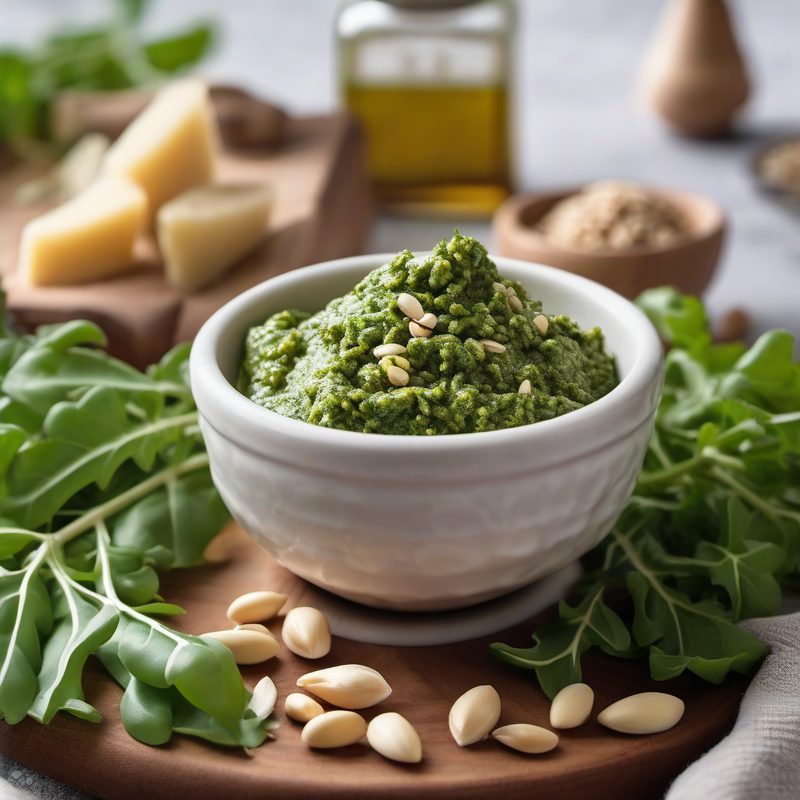
Arugula Pesto
A peppery, vibrant twist on classic Genovese pesto that swaps basil for fresh arugula — bold, nutty, and intensely green, perfect for pasta, sandwiches, and grilled vegetables.
| Amount | Ingredient |
|---|---|
| Forgetting to reserve pasta water | The pesto clumps on the pasta instead of coating it evenly, resulting in a dry, uneven sauce Always reserve at least ½ cup (120 ml) of pasta water before draining. Stir it in gradually until the sauce is silky. |
Where traditional pesto purrs with sweet basil and garlic, this version crackles with the sharp, peppery bite of arugula. The rocket leaves bring a fresh, almost spicy character that stands up beautifully to the rich creaminess of pine nuts and the salty tang of aged cheeses. It is a pesto that feels both familiar and new: the same creamy, emulsified texture, the same rustic charm, but with a bolder, more adult personality. Arugula pesto is remarkably versatile — it clings to pasta (especially short shapes that trap the sauce), transforms a simple sandwich into something memorable, and adds a vibrant green note to grilled chicken, fish, or vegetables. The key is drying the arugula thoroughly after washing and removing the garlic germ to ensure a clean, balanced flavor without bitterness.
Ingredient notes: Use fresh, crisp arugula with firm leaves — avoid wilted or yellowing bunches. Baby arugula is milder and works well for a tamer pesto; mature arugula has a more pronounced peppery kick. The two-cheese blend of Grana Padano and Pecorino is intentional: Grana Padano provides nutty, sweet richness without the sharp salinity of Pecorino alone, while Pecorino adds a salty, tangy edge that cuts through the arugula's pepperiness. If you only have one cheese, use 100 g (1 cup) of Parmigiano-Reggiano, which splits the difference between the two. Pine nuts should be raw for a creamier result; if toasted pine nuts are all you have, they will work but the flavor will be more pronounced. The garlic germ (the small green sprout inside the clove) must be removed — it is the source of bitter, harsh notes that can overpower the delicate arugula.
- Food processor (or mortar and pestle)
- Salad spinner and kitchen towels
- Chef's knife and cutting board
- Box grater or Microplane (for cheese)
- Rubber spatula
- Measuring cups and spoons
- Serving bowl or airtight container
- Wash and dry the arugula (3 min). Wash the arugula leaves thoroughly in cold water to remove any grit or sand. Dry them in a salad spinner, then spread on a clean kitchen towel and pat dry. The arugula must be completely dry — any residual water will make the pesto thin, watery, and prone to separation.
- Prepare the garlic (1 min). Peel the garlic clove and cut it in half lengthwise. If you see a small green sprout (the germ) running through the center, remove it with the tip of a knife and discard. This simple step eliminates the bitter, acrid note that raw garlic can impart, leaving only the sweet, pungent garlic flavor.
- Pulse the arugula, garlic, and pine nuts (2 min). In a food processor, combine the dried arugula, the garlic clove (germ removed), and the pine nuts. Pulse 5 to 7 times in 1-second bursts until the mixture is coarsely chopped. Scrape down the sides of the bowl with a rubber spatula.
- Add the cheeses and oil (3 min). Add the grated Grana Padano and Pecorino to the food processor. Drizzle in about 2 tablespoons of the olive oil. Pulse 3 to 4 times to combine. With the food processor running, slowly pour the remaining olive oil through the feed tube in a steady stream. Process until the pesto is creamy but still retains visible texture — small flecks of arugula and bits of pine nut should be evident. Stop before the mixture becomes a completely smooth, homogenized paste.
- Season and adjust (1 min). Season with salt to taste. Remember that both Grana Padano and Pecorino are salty cheeses, so start with a small pinch and adjust upward. If the pesto tastes flat, a tiny squeeze of lemon juice or an extra pinch of salt can brighten it.
- Serve or store (1 min). Transfer the pesto to a serving bowl. For pasta, toss immediately with 12 oz (340 g) of cooked trofie, orecchiette, or fusilli, reserving about ½ cup (120 ml) of pasta water to loosen the sauce. For other uses, transfer to an airtight container and refrigerate.
- Dry the arugula thoroughly. This is the most important step. Waterlogged arugula dilutes the pesto, prevents proper emulsification, and accelerates spoilage. Use a salad spinner, then press between paper towels or a clean kitchen towel.
- Remove the garlic germ every time. The small green sprout in the center of a garlic clove is intensely bitter. Removing it takes seconds and makes a noticeable difference in the final flavor — the difference between a pesto that sings and one that has an unpleasant sharp edge.
- Use the two-cheese blend. Grana Padano alone can be too mild; Pecorino alone can be too salty. Together, they create a balanced, complex cheese base that complements the arugula's peppery personality perfectly.
- Do not over-process. Arugula pesto should have texture — visible flecks of green leaves and tiny bits of pine nut. A completely smooth, homogenized paste loses the rustic charm and the bright, fresh character of the arugula. Pulse in short bursts and check the texture often.
- Taste before adding salt. The cheeses are already salty, and arugula has its own mineral, slightly salty character. You may need very little added salt, if any.
- Reserve pasta water. When using arugula pesto with pasta, always reserve some of the starchy cooking water. A splash (2–3 tablespoons) stirred in at the end helps the pesto coat every piece of pasta evenly and creates a silky, emulsified sauce.
| Mistake | Why It Hurts | The Fix |
|---|---|---|
| Not drying the arugula | Water dilutes the pesto, stopping the oil from emulsifying properly and making the sauce thin and watery | Spin dry in a salad spinner, then blot with paper towels. The arugula must be bone-dry. |
| Including the garlic germ | Adds a harsh, bitter note that overpowers the arugula's fresh, peppery character | Always split the garlic clove and remove the green sprout before adding to the processor. |
| Using only Pecorino | The pesto becomes excessively salty and sharp, overwhelming the arugula and pine nuts | Use half Grana Padano (or Parmigiano-Reggiano) and half Pecorino for balance. |
| Over-processing into a smooth paste | The pesto loses its texture and becomes dense, pasty, and flat; the arugula's freshness is lost | Pulse in short bursts. Stop while the mixture still has visible flecks of arugula and pine nuts. |
- Arugula and Walnut Pesto: Replace the pine nuts with 50 g (½ cup) of toasted walnuts for a nuttier, earthier flavor that pairs beautifully with roasted squash or beetroot.
- Arugula and Almond Pesto: Use 50 g (⅓ cup) of blanched almonds instead of pine nuts — the milder almond flavor lets the arugula shine even more brightly.
- Arugula and Basil Pesto: Use half arugula (50 g) and half fresh basil (50 g) for a pesto that bridges the classic and the peppery — the best of both worlds.
- Arugula Lemon Pesto: Add the zest of 1 lemon and 1 tablespoon of lemon juice with the olive oil for a brighter, more citrus-forward version that is spectacular with fish.
- Spicy Arugula Pesto: Add ¼ teaspoon of red pepper flakes along with the garlic for a pesto with a gentle, warming heat.
- Arugula Ricotta Pesto: Fold in 100 g (½ cup) of fresh ricotta after processing for a creamier, milder pesto that is ideal for tossing with pasta without needing much pasta water.
- Vegan Arugula Pesto: Omit both cheeses and add 3 tablespoons of nutritional yeast and an extra 2 tablespoons of pine nuts (or 1 tablespoon of white miso paste for savory depth).
- Arugula Pesto with Sun-Dried Tomatoes: Add 30 g (¼ cup) of oil-packed sun-dried tomatoes, drained, to the food processor with the arugula for a tangy, umami-rich variation.
| Storage Method | Details |
|---|---|
| Refrigerator | Store in an airtight container with a thin layer of olive oil on top to prevent oxidation. Keeps for up to 5 days. Bring to room temperature and stir well before serving. The arugula flavor is brightest in the first 2 days. |
| Freezer | Pack into an ice cube tray, cover with a thin layer of olive oil, and freeze for up to 2 months. Transfer frozen cubes to a zip-top bag. Thaw at room temperature. The peppery character of arugula mutes slightly after freezing. |
| Surface oxidation | The top layer may darken from exposure to air — press plastic wrap directly onto the surface or maintain a layer of olive oil on top. This is cosmetic and does not significantly affect flavor. |
Arugula pesto's bold, peppery character pairs beautifully with a wide range of dishes:
- Tossed with trofie, orecchiette, or fusilli: Short, textured pasta shapes trap the pesto in their crevices. Toss with reserved pasta water and top with extra grated Pecorino.
- Spread on a sandwich: Use in place of mayonnaise on a roasted turkey, mozzarella and tomato, or prosciutto sandwich. The peppery arugula cuts through rich meats and cheese.
- Spooned over grilled chicken or fish: A dollop of arugula pesto on grilled chicken breast, salmon, or swordfish adds a vibrant, herbaceous finish.
- Swirled into soup: Stir a spoonful into minestrone, tomato soup, or white bean soup for a fresh, peppery lift.
- As a dip for crudité: Serve with raw vegetables like bell peppers, celery, carrots, and cherry tomatoes.
- On crostini: Spread on toasted bread and top with burrata, cherry tomatoes, or grilled shrimp.
- Wine pairing: A crisp, herbaceous Sauvignon Blanc (Loire or New Zealand) or a Grüner Veltliner (Austria) — the wine's grassy, peppery notes echo the arugula. For red, a light, bright Barbera or a Pinot Nero works well.
| Per Serving (about 2 tbsp / 30 g) | |
|---|---|
| Calories | 155 |
| Protein | 5 g |
| Fat | 14 g |
| Carbohydrates | 3 g |
| Fiber | 1 g |
Nutrition values are approximate and based on arugula, pine nuts, Grana Padano, Pecorino, and extra-virgin olive oil. Actual values will vary based on oil absorption and exact proportions.
Can I use baby arugula instead of mature arugula?
Yes. Baby arugula has a milder, less peppery flavor and a more tender texture, which makes for a gentler, more approachable pesto. If using baby arugula, you may need slightly more (about 120 g / 4.2 oz) since the leaves are less dense. The pesto will be milder and more pastel green.
Can I make this pesto without a food processor?
Absolutely — a mortar and pestle is the traditional method. Pound the pine nuts and garlic first until broken down, then add the arugula in batches, grinding it against the sides of the mortar. Finally, work in the cheeses and drizzle in the olive oil while stirring continuously. The texture will be more rustic and the flavor more vibrant.
Why does my arugula pesto taste bitter?
Bitterness in arugula pesto usually comes from one of three sources: (1) the garlic germ was not removed; (2) the olive oil is too bitter or grassy (some assertive oils can clash with arugula); or (3) the arugula itself was overly mature or past its prime. If your pesto is already made, try adding a pinch of sugar or a squeeze of lemon juice to balance the bitterness.
Can I freeze arugula pesto?
Yes. Freeze in ice cube trays with a thin layer of olive oil on top. Once frozen, transfer the cubes to a zip-top bag. Arugula pesto retains its flavor well for up to 2 months, though the peppery character is slightly muted after thawing. Thaw at room temperature and stir before using.
What pasta shapes work best with arugula pesto?
Short, textured shapes are ideal because they trap the pesto in their crevices. Trofie (the classic Ligurian pasta for pesto), orecchiette, fusilli, gemelli, casarecce, and farfalle all work beautifully. For long pasta, linguine or spaghetti work if you use enough pasta water to create a creamy, emulsified sauce.
Can I use this pesto as a marinade?
Yes, but use it sparingly and for no more than 30 minutes — the enzymes in the arugula and garlic can begin to break down the protein of delicate fish or chicken. It is best used as a finishing sauce or spread rather than a long marinade.
- Classic Basil Pesto (Volume 1)
- Lemon Pesto (Volume 2)
- Almond Pesto (Volume 2)
- Sun-Dried Tomato Pesto (Volume 2)
- Grilled Chicken with Arugula Pesto (Volume 3)
Recipe from "The Italian Kitchen" by Vita Milanese — Volume 2: Sunday Sauce
Recipe from The Italian Kitchen by Vita Milanese — Volume 2 · Sunday Sauce. Discover all volumes on the ebook page.