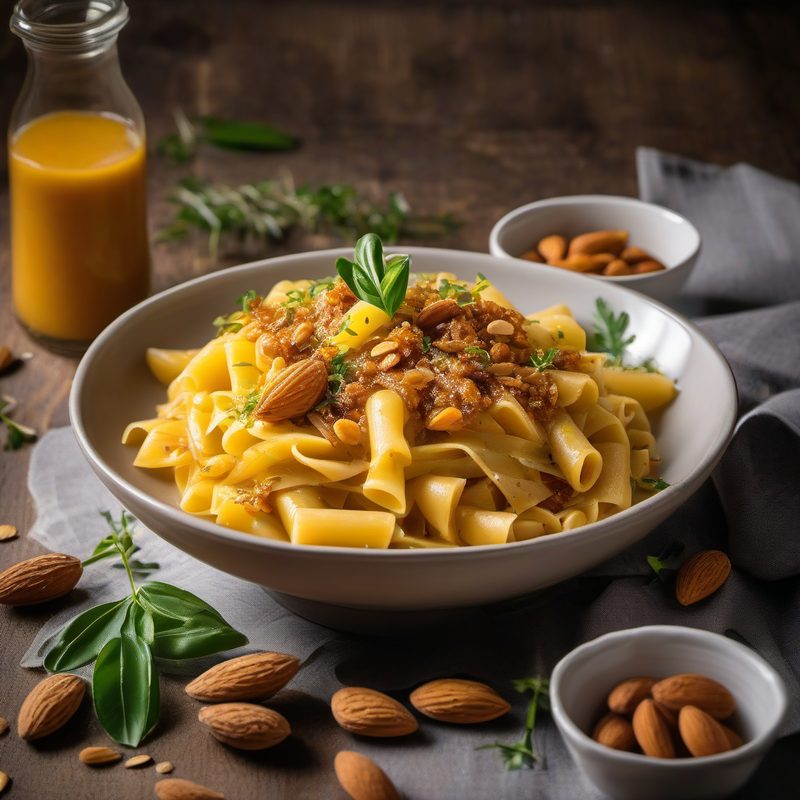
Agglassata Sicilian
| Amount | Ingredient |
|---|---|
| Calories | ~520 kcal |
| Fat | 16 g |
| Saturated Fat | 2 g |
| Carbohydrates | 82 g |
| Fiber | 5 g |
| Sugar | 22 g |
| Protein | 12 g |
| Sodium | ~480 mg |
Pasta Agglassata — Pasta Cull'Agghiazzata
Category: Primi Piatti, Cucina Siciliana (Palermitana)
Servings: 4
Active Time: 20 minutes
Total Time: 55 minutes
Difficulty: Easy
Headnote
Agglassata — from the Sicilian agghiazzata, meaning "iced" or "chilled" — is a curiously named pasta whose roots reach deep into Palermo's medieval Arab-Norman kitchens. The name likely refers to the cooling, refreshing contrast of sweet-and-sour flavors that characterize agrodolce cooking, a technique the Arabs brought to Sicily in the 9th century. While most Sicilian pasta dishes lean into tomato, seafood, or abundant cheese, Agglassata stands apart: a humble, soulful dish built from little more than slowly caramelized onions, a glistening sweet-sour vinegar glaze, plumped raisins, toasted pine nuts, and a whisper of cinnamon. The onions are the star — cooked patiently until they collapse into a jammy, amber treasure that clings to every strand of pasta. It is peasant food elevated by patience, and it remains one of Palermo's best-kept secrets.
Why This Recipe Works
- Slow caramelization is non-negotiable. Rushing the onions produces a pallid, sulfurous result. Thirty minutes over medium-low heat coaxes out their natural sugars and develops deep, savory sweetness as the foundation of the dish.
- Sugar arrives after the onions color. Adding sugar too early can scorch before the onions are ready. Sprinkling it over deeply caramelized onions builds a glossy, almost candied layer that balances the vinegar's bite.
- Vinegar goes in off the heat — then back on. Adding vinegar after removing the pan from the heat prevents immediate boil-off, then a brief return to the heat melds the flavors without losing acidity.
- Pine nuts and raisins provide textural counterpoint. The chewy-sweet raisins and buttery-crisp pine nuts punctuate the soft, silky onions, giving every forkful complexity.
- Cinnamon is measured with a light hand. A pinch — not a teaspoon — is all that's needed. It should whisper in the background, evoking the spice routes that brought it to Palermo, not overwhelm.
- Pasta water is the bridge. A splash of the starchy cooking water loosens the onion sauce and helps it cling to the pasta without needing cream or cheese.
- Onions: Use yellow or red onions. Yellow onions offer the most reliable sweetness; red onions give a slightly milder, more colorful result. Sweet onions (Vidalia, Tropea) can be substituted but reduce the cooking sugar slightly.
- Vinegar: Red wine vinegar is traditional for its fruity acidity. White wine vinegar or sherry vinegar work well. Avoid balsamic — its syrupy sweetness and distinct flavor overwhelm the dish's delicacy.
- Pine nuts (Pinoli): Sicilian pine nuts from the stone pine are ideal. Toasted in a dry skillet until golden, they release their piney, buttery character. Substitute blanched slivered almonds in a pinch.
- Raisins (Uva passa): Golden or dark raisins both work. Plump them in warm water (or the vinegar called for in the recipe) for 10 minutes before cooking for the juiciest result.
- Cinnamon: Use Ceylon cinnamon (true cinnamon) if available — it is milder and more floral than cassia. A single small stick simmered with the onions and removed before serving is an alternative to ground.
- Pasta: Traditional shapes include bucatini, perciatelli, or spaghetti. Short pasta like penne or casarecce also works. Bronze-die extruded pasta is preferred for its rough texture that grips the sauce.
Equipment
- 12-inch (30 cm) stainless steel or enameled cast-iron skillet
- 6-to-8-quart (6–8 L) pasta pot
- Chef's knife
- Cutting board
- Wooden spoon or silicone spatula
- Fine-mesh strainer
- Small skillet (for toasting pine nuts)
- Small bowl (for plumping raisins)
Prep Work
- Plump the raisins: Place raisins in a small bowl. Warm 2 tablespoons of the vinegar (or water) and pour over the raisins. Let sit for 10 minutes. Drain, reserving the liquid.
- Toast the pine nuts: In a dry small skillet over medium heat, toast the pine nuts, shaking frequently, until fragrant and golden (2–3 minutes). Immediately transfer to a plate to cool.
- Slice the onions: Halve the onions pole-to-pole (through the root end), peel them, and slice crosswise into ⅛-inch (3 mm) half-rings. Do not dice — thin, uniform half-rings yield the best texture.
- Set up the pasta water: Fill the pasta pot with 4 quarts (3.8 L) water, bring to a boil, and salt generously (about 1½ tablespoons / 25 g salt).
Instructions
1. Caramelize the Onions
Heat the olive oil in the 12-inch skillet over medium-high heat until shimmering. Add the sliced onions, salt, and pepper. Cook, stirring frequently, for 5 minutes, until the onions begin to soften and release their liquid.
Reduce the heat to medium-low. Cook, stirring every 3–4 minutes, scraping up any browned bits from the pan's bottom. The onions should sizzle gently but not brown aggressively. After 20 minutes, the onions will be very soft, shrunken, and pale gold.
Total caramelization time: 25–30 minutes. The onions are ready when they are a deep golden-amber color, sweet-smelling, and have reduced to roughly one-quarter of their original volume.
2. Build the Agrodolce (Sweet-and-Sour) Glaze
Sprinkle the sugar evenly over the caramelized onions. Increase the heat to medium. Cook, stirring constantly, for 1–2 minutes, until the sugar melts and the onions become glossy and begin to caramelize further.
Remove the pan from the heat (this prevents the vinegar from violently boiling off). Add the remaining 2 tablespoons vinegar and the reserved plumping liquid. Return the pan to medium heat, add the drained raisins, toasted pine nuts, and cinnamon. Cook, stirring, for 3–4 minutes, until the sauce is syrupy and cohesive. Taste and adjust with salt, pepper, or a few drops more vinegar as needed.
Off heat, cover to keep warm.
3. Cook and Dress the Pasta
Meanwhile, cook the pasta in the boiling salted water until just al dente (1 minute less than package directions). Reserve 1 cup (240 ml) of the pasta cooking water before draining.
Drain the pasta (do not rinse). Return the empty pasta pot to the stove.
Add the pasta to the pot, pour the onion sauce over it, and add ½ cup (120 ml) of the reserved pasta water. Toss vigorously with tongs or a wooden spoon, adding more pasta water a tablespoon at a time as needed, until the sauce coats each strand evenly and the pasta is glossy but not soupy.
4. Serve
Divide the pasta among warmed serving bowls. Garnish with chopped fresh parsley, if using. Serve immediately.
Note: Agglassata is traditionally served without grated cheese — the cheese would compete with the delicate sweet-sour balance. If you must, a very light dusting of aged ricotta salata or toasted breadcrumbs (see variation) is the closest Sicilian option.
Timing Guide
| Step | Time |
|---|---|
| Prep (slice onions, plump raisins, toast nuts) | 15 min |
| Caramelize onions | 25–30 min |
| Build agrodolce glaze | 5 min |
| Cook pasta | 8–10 min |
| Toss and serve | 3 min |
| Total | 55–60 min |
Troubleshooting
| Problem | Cause | Solution |
|---|---|---|
| Onions are browning too fast | Heat too high | Drop heat to low, add 1 tablespoon water, stir vigorously. |
| Onions are not browning after 20 minutes | Heat too low | Raise to medium, stir more frequently to encourage evaporation. |
| Sauce is too thin | Insufficient reduction | Simmer uncovered for 2–3 minutes after adding vinegar. |
| Sauce is too thick/sticky | Over-reduction | Thin with pasta cooking water, 1 tablespoon at a time. |
| Too sour | Vinegar too aggressive | Stir in ½ teaspoon sugar at a time to balance. |
| Too sweet | Sugar overpowers | Add ½ teaspoon vinegar to brighten. |
Variations
Agglassata con Mollica (with Toasted Breadcrumbs)
In the Sicilian 'nzocculi tradition, omit the pine nuts and instead top the finished pasta with mollica — breadcrumbs toasted in olive oil with a clove of garlic (discarded afterward). The crumbs provide crunch and are a classic cheese substitute in many Sicilian pastas.
Agglassata con Sarde (Palermitan with Sardines)
Add 150 g (5 oz) of fresh sardine fillets, cut into bite-size pieces, to the onions during the last 5 minutes of caramelization. This recalls Palermo's famous pasta con le sarde and adds oceanic depth to the sweet-sour base.
Agglassata al Forno (Baked)
Toss the dressed pasta into a buttered 9×13-inch baking dish, top with a mixture of breadcrumbs and pine nuts, and bake at 375°F (190°C) for 15–20 minutes until the top is golden and crisp.
Saffron-Agglassata
Add a generous pinch of Sicilian saffron threads steeped in 2 tablespoons of warm water to the onion sauce with the vinegar. This golden-hued version is especially common in Palermo's historic Kalsa district.
Vegan / Plant-Based
The recipe is already fully vegan. For extra richness, stir in 1 tablespoon of pine nut cream (blend 25 g pine nuts with 60 ml water until smooth) just before tossing the pasta.
Wine Pairing
- White: Grillo (Sicily) — citrusy, medium-bodied, handles the sweet-sour balance. Or a dry Sicilian Moscato (Moscato di Noto).
- Red: A light, unoaked Nero d'Avola (Nero d'Avola novello) or a Frappato from Vittoria — low tannins, red berry fruit, and enough acidity.
- Rosé: A dry Sicilian rosato from Nerello Mascalese.
- Sparkling / Fortified: A dry passito or a chilled Marsala Secco (dry) echoes the sweet-sour notes.
Make-Ahead & Storage
- Onion sauce can be prepared up to 3 days in advance. Cool completely, transfer to an airtight container, and refrigerate. Reheat gently in a skillet with 2–3 tablespoons water before tossing with fresh-cooked pasta.
- Assembled pasta is best eaten immediately. Leftovers can be stored in the refrigerator for up to 2 days. To reheat, warm in a skillet over medium-low heat with a splash of water, or enjoy cold as a room-temperature pasta salad (the Sicilian way).
- Do not freeze — the texture of the onions and pasta degrades unacceptably.
About the Dish
Agglassata's history is a delicious palimpsest of Palermo's layers of conquest and culture. The word itself likely derives from the Arabic al-ghiyata (to ice or chill) or Sicilian agghiacciata (chilled), possibly referring to the practice of serving the dish at room temperature — a common medieval custom. The sweet-sour (agrodolce) technique — sugar plus vinegar — is a hallmark of Arab-occupied Sicily (831–1071 CE), as are the raisins, pine nuts, and cinnamon that converge in this dish. Unlike Norman-era Arabic-Sicilian legacies captured in cookbooks like The Book of Good Food (13th c.), Agglassata survives entirely through oral tradition, passed down through Palermitan families who knew the recipe by touch and taste. It is a survival dish — inexpensive, pantry-driven, yet rich enough to grace a feast table. In modern Palermo, it remains most common in the Vuccirìa and Capo markets, where home cooks and trattorias still make it a modu anticu (the old way).
Nutritional Information (per serving)
Values are estimates and will vary based on specific ingredients and brands used.
"A pasta dish so old it remembers when sugar was a luxury, cinnamon a treasure, and an onion was the heart of a meal."
Recipe from The Italian Kitchen by Vita Milanese — Volume 1 · Pasta Perfetto. Discover all volumes on the ebook page.