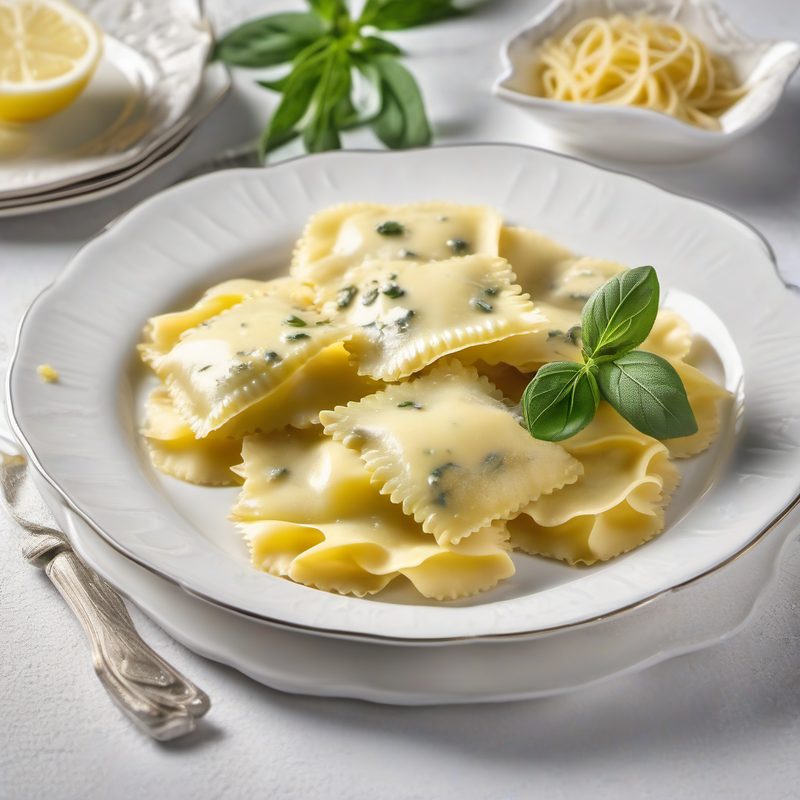
Ravioli Ricotta Lemon
Delicate half-moon pillows of fresh pasta enveloping a cloud-like filling of creamy ricotta, bright lemon zest, and nutty Parmigiano-Reggiano, all gently kissed with fragrant nutmeg and finished in a foaming butter sauce with crackling sage leaves. This is spring on a plate — bright, herbaceous, and luxuriously simple. The lemon and ricotta pairing is a classic of Italian home cooking, elevated here into a ravioli that sings with freshness. A dish that tastes far greater than the sum of its modest parts, it comes together quickly once the pasta sheets are ready, making it the perfect showcase for high-quality ricotta and a steady hand at the stove.
| Amount | Ingredient |
|---|---|
| Freshly grated Parmigiano-Reggiano | |
| Fresh lemon zest curls (optional) | |
| Flaky sea salt |
This is the ravioli that proves restraint is the highest form of sophistication. The filling is intentionally minimal — just four core ingredients plus seasoning — because each one must be allowed to speak clearly. The ricotta provides a silky, milky base; the lemon zest cuts through with bright, citrusy perfume; the Parmigiano-Reggiano adds depth and salt; and a whisper of nutmeg warms the background. Wrapped in tender fresh pasta and sauced simply with browned butter and sage, the result is a dish where every element is both distinct and harmonious. The technique is straightforward: mix the filling, fill and seal the ravioli, cook briefly in salted water, then finish in a sizzling pan of butter and sage. There are no complicated emulsions, no reductions, no multi-component sauces — just pure, honest ingredients handled with care. It's the kind of dish that rewards quality ingredients and clean technique, and it's within easy reach of any confident home cook.
Does not include time to make fresh pasta sheets. Start with pre-rolled pasta sheets (homemade or store-bought) for a 45-minute total. If making pasta from scratch, add 45–60 minutes for dough preparation and rolling.
For the Ricotta-Lemon Filling
For the Ravioli
For the Butter Sage Sauce
For Garnish
Use the best ricotta you can find — fresh, whole-milk, preferably from an Italian market or specialty dairy. The quality of the ricotta is the single most important determinant of this dish's success. Supermarket tub ricotta often contains stabilizers and excess moisture that produce a gummy, bland filling. Look for ricotta that is creamy, slightly sweet, and spoonable — almost like a thick, fresh clotted cream. If using supermarket ricotta, drain it overnight in a cheesecloth-lined sieve over a bowl in the refrigerator.
The lemon should be organic or unwaxed, as you will be using the zest. A conventional lemon can be used if scrubbed very well in warm water to remove any wax coating. The essential oils in the zest are what provide the bright, aromatic lift — do not substitute bottled lemon juice or dried zest under any circumstances.
🥘 Equipment
- Large pot (6 qt / 6 L minimum) for boiling pasta
- 12-inch (30 cm) skillet or sauté pan (for butter sage sauce)
- Chef's knife and cutting board
- Microplane or fine grater (for lemon zest and nutmeg)
- Fine-mesh strainer and cheesecloth (for draining ricotta, if needed)
- Large mixing bowl
- Fork or spatula (for mixing filling)
- Pastry brush (for sealing ravioli)
- Bench scraper or sharp knife (for cutting pasta sheets)
- 3-inch (7.5 cm) round cutter or sharp knife with template
- Baking sheet, dusted with semolina (for holding assembled ravioli)
- Spider skimmer or slotted spoon
- Tongs
- Measuring cups and spoons
- Kitchen scale (digital)
- Clean kitchen towels
- 4 warmed shallow bowls or plates
📋 Preparation
Step 1 — Prepare and Drain the Ricotta (5 minutes active, optional 30–60 minutes draining)
Assess the ricotta: Examine your ricotta for excess moisture. If the surface looks watery or if liquid pools around the spoon when you scoop it, the ricotta must be drained. Skip this step only if you are using premium, dry-ish fresh ricotta from an Italian market that holds its shape on a spoon.
Drain the ricotta (if needed): Line a fine-mesh strainer with a double layer of cheesecloth or a clean, thin kitchen towel. Set the strainer over a bowl. Spoon the ricotta into the lined strainer. Gather the edges of the cheesecloth and gently twist to form a pouch. Let the ricotta drain at room temperature for 30 minutes, or in the refrigerator for up to 4 hours, until noticeably thicker. You should see whey collecting in the bowl below. Discard the whey.
Draining is the single most important step for the filling. Excess moisture in the ricotta will make the filling too loose to pipe, cause the ravioli to leak during cooking, and dilute the delicate lemon flavor. Even if your ricotta looks dry, draining for 20 minutes is cheap insurance. If you forgot to drain, wrap the ricotta in a clean kitchen towel and squeeze firmly over the sink — you'll be shocked at how much liquid comes out.
Step 2 — Make the Ricotta-Lemon Filling (5 minutes)
Zest the lemon: Using a Microplane or fine grater, grate the zest of 1 lemon directly into a large mixing bowl. Grate only the bright yellow outer layer — the white pith underneath is bitter. You should have about 1 heaping tablespoon (6 to 8 g) of zest.
For the most vibrant lemon flavor, grate the zest directly over the bowl so the aromatic oils fall into the ricotta rather than onto your cutting board. Roll the lemon firmly on the counter under your palm for 10 seconds before zesting — this releases more essential oils from the pores of the peel.
Mix the filling: Add the drained ricotta, grated Parmigiano-Reggiano, egg yolk, and freshly grated nutmeg to the bowl. Season with ½ teaspoon of fine sea salt and ¼ teaspoon of freshly ground black pepper. Using a fork or spatula, stir until everything is thoroughly combined and the filling is smooth, creamy, and uniform. Taste and adjust salt and pepper — the filling should taste well-seasoned and bright, with the lemon zest and nutmeg present but not dominant.
Chill the filling: Cover the bowl with plastic wrap and refrigerate for 15 to 20 minutes while you prepare your workspace. Chilling firms up the ricotta, making it easier to portion and shape.
The filling should be thick enough to hold a dollop on a spoon without slumping. If it seems too loose after mixing, stir in an additional tablespoon of grated Parmigiano-Reggiano. If it's too thick (unlikely with well-drained ricotta), stir in a teaspoon of water or milk. The egg yolk acts as a binder, helping the filling hold together during cooking and adding richness. Do not omit it.
Step 3 — Set Up Ravioli Assembly Station (5 minutes)
Prepare your workspace: Clear a large work surface and have the following ready:
- Fresh pasta sheets (at room temperature, covered with a barely-damp kitchen towel)
- Chilled ricotta filling
- Small bowl with beaten egg (the egg wash for sealing)
- Pastry brush
- 3-inch (7.5 cm) round cutter or a knife with a template
- Semolina-dusted baking sheet (for finished ravioli)
- Bench scraper or sharp knife
Cut the pasta sheets: Lay one fresh pasta sheet on a lightly floured work surface. Using a bench scraper or sharp knife, trim it into a neat rectangle. You will place spoonfuls of filling along one half of the sheet, then fold the other half over to seal — working lengthwise, envision folding the sheet like a book. You may find it easier to cut the sheets into halves or thirds crosswise, depending on the size of your sheets, to create manageable rectangles for folding.
If using homemade pasta sheets rolled to setting #6 or #7, they should be thin enough to see the shadow of your hand through them. If using store-bought sheets, they may be slightly thicker — roll them one or two passes through your pasta machine at setting #5 or #6, or use a rolling pin to thin them gently. Thicker pasta will require a longer cooking time, which can cause the delicate ricotta filling to overcook and become grainy.
Step 4 — Assemble the Ravioli (15 minutes)
Working one sheet at a time: Lay one pasta sheet on your work surface, oriented with the long side facing you. Visualize dividing the sheet in half horizontally.
Dollop the filling: Using a teaspoon or a small piping bag (or zip-top bag with corner snipped), place heaping teaspoon-sized dollops (about 2 teaspoons / 15 g each) of the ricotta filling along the center line of the bottom half of the pasta sheet. Space each dollop about 1½ inches (4 cm) apart to allow room for sealing. You should fit about 6 to 8 dollops per standard pasta sheet, depending on its size.
The dollops should be neat and compact — not flattened or spread out. If using a spoon, shape each dollop into a rough oval as you drop it. If using a piping bag, pipe a short, fat log of filling. The goal is a compact mound that leaves a generous border of clean pasta around each one for sealing.
Brush with egg wash: Using a pastry brush, gently paint the exposed pasta surface around each filling dollop with the beaten egg. Be careful not to drip egg onto the filling itself — egg on the filling can prevent a clean seal and create raw, slippery patches inside the finished ravioli.
Fold and seal: Lift the top half of the pasta sheet and gently fold it over the filling, lining up the edges as evenly as possible. Starting at the center of each filling mound, use your fingertips to gently press the top sheet down around each mound of filling, pushing out any air pockets as you work outward toward the edges. A properly sealed raviolo has no air trapped inside — air expands during cooking and can cause the ravioli to burst.
Cut the ravioli: Using a 3-inch (7.5 cm) round cutter or a fluted pastry wheel, cut between each filled pocket to create individual ravioli. A fluted wheel produces the classic ruffled edge that is both beautiful and functional — the ridges create extra surface area for sauce to cling to. If using a cutter, press firmly and cleanly; if using a pastry wheel, cut with a decisive, even motion. Each raviolo should have a ¼-inch (6 mm) border of sealed pasta around the filling.
Check the seal: Pick up each raviolo and examine the edges. If any edge is not fully sealed, press it firmly with your thumb or brush with a tiny dab of egg wash and press again. Transfer the finished ravioli to the semolina-dusted baking sheet in a single layer, making sure they do not touch each other.
Repeat: Continue with the remaining pasta sheets and filling. You should have 28 to 32 ravioli total — about 7 to 8 per person.
Keep the assembled ravioli uncovered at room temperature while you work. If your kitchen is very warm or humid, refrigerate the baking sheet. Do not cover with plastic wrap — condensation will make the pasta sticky and cause the ravioli to stick to each other and tear. Semolina dusting prevents sticking and adds a pleasant toothsome texture to the cooked pasta.
If the pasta sheets begin to dry out and the edges refuse to seal, lightly spritz the sheet with water from a spray bottle or re-moisten the edges with a damp fingertip before applying egg wash. Dried-out pasta is the most common cause of ravioli bursting during cooking.
Step 5 — Cook the Ravioli and Make the Sauce (5 minutes)
Bring water to a boil: Fill a large pot with 4 quarts (4 liters) of water and add 1½ tablespoons of kosher salt — the water should taste pleasantly salty, like sea water. Bring to a rolling boil over high heat.
Melt the butter and crisp the sage: While the water comes to a boil, place a 12-inch (30 cm) skillet over medium heat. Add 80 g (6 tbsp) of unsalted butter. Cook, swirling the pan occasionally, until the butter melts and begins to foam. Add the fresh sage leaves — they should sizzle on contact. Continue cooking, swirling the pan, until the butter turns a pale hazelnut brown and smells nutty and toasty, and the sage leaves become crisp and darker green — about 2 to 3 minutes. Be careful not to let the butter burn; if it turns dark brown or smells acrid, start over. Remove the skillet from the heat and set aside.
The butter should be a warm golden-brown, with a toasty, nutty aroma — what the Italians call burro nocciola or beurre noisette. This is not a raw butter sauce; browning the butter deepens its flavor dramatically, adding a toasty, caramelized dimension that pairs beautifully with the bright lemon and creamy ricotta. The sage leaves will crisp as they cook; they should be crackling and translucent, not burnt and black.
Cook the ravioli: Gently drop the ravioli into the boiling water, about 8 to 10 at a time to avoid crowding. Stir gently once with a spider skimmer or slotted spoon to keep them from sticking to the bottom. Cook for 3 to 4 minutes — the pasta should be tender and translucent, and the filling should be heated through. Fresh pasta cooks quickly; start checking at 3 minutes. The ravioli will float to the surface when they are nearly done, but do not rely on floating alone — taste one for doneness.
The exact cooking time depends on the thickness of your pasta sheets. Thinner homemade sheets may cook in 2½ to 3 minutes; thicker store-bought sheets may need 4 minutes. Always test one raviolo first — cut it open to confirm the filling is hot throughout and the pasta is tender.
Reserve pasta water: Just before the ravioli are done, scoop out ½ cup (120 ml) of the starchy pasta cooking water with a ladle or measuring cup. Set aside.
Transfer to the sauce: Using the spider skimmer or slotted spoon, gently lift the cooked ravioli from the water, letting the excess water drain off. Transfer the ravioli directly to the skillet with the browned butter and sage. Return the skillet to medium heat.
Toss and glaze: Add 2 to 3 tablespoons of reserved pasta water to the skillet. Gently swirl and tilt the pan to coat the ravioli in the buttery emulsion. Use tongs to carefully turn the ravioli, ensuring each one is glistening and coated. Cook for 30 to 60 seconds — just long enough for the sauce to emulsify and cling to the ravioli. If the sauce looks too thick or dry, add another splash of pasta water. If it looks too thin, let it bubble for a few seconds longer.
The butter, sage-infused oil, and starchy pasta water combine to form a light, emulsified sauce that clings to each raviolo. This is the same mantecatura technique used for classic pasta dishes — the starch in the pasta water binds the fat and water into a creamy, cohesive sauce. The result is far more elegant than simply spooning melted butter over the pasta.
Plate immediately: Divide the ravioli among 4 warmed shallow bowls or plates, spooning any remaining butter and sage leaves from the skillet over the top. Garnish each serving with a generous dusting of freshly grated Parmigiano-Reggiano, a few fresh lemon zest curls (if using), and a sprinkle of flaky sea salt. Serve immediately.
Speed is everything at this stage. The ravioli go from pot to plate in under 2 minutes. Have your bowls warmed, your garnishes ready, and your diners seated. Cold bowls will cause the butter sauce to solidify and the pasta to cool too quickly, dulling the bright lemon and suppressing the nutty aroma of the browned butter.
🧑🍳 Chef's Tips
- Drain the ricotta overnight for the best texture. Fresh ricotta varies wildly in moisture content depending on the brand and how long it has been sitting. Even premium ricotta benefits from draining. Place it in a fine-mesh strainer lined with cheesecloth set over a bowl, cover with plastic wrap, and refrigerate for 6 to 12 hours (or overnight). You'll lose 20–30% of the weight to whey, but the remaining ricotta will be thick, creamy, and luxurious — ideal for ravioli filling. The difference between drained and undrained ricotta in the finished dish is night and day.
- Use a Microplane for the lemon zest. The fine, fluffy zest from a Microplane distributes evenly through the filling and releases more aromatic oils than the coarse shreds from a box grater or a vegetable peeler. Zest directly over the mixing bowl so the volatile oils fall into the filling rather than evaporating on your cutting board.
- Season the filling assertively. The ricotta, pasta, and butter sauce are all relatively mild. The filling needs to be well-seasoned — almost to the point where it tastes slightly salty and very lemony on its own — because it will be balanced by the neutral pasta and the rich butter. Taste the filling before filling the ravioli. If it tastes flat, add more salt, more lemon zest, or a tiny pinch more nutmeg. Trust your palate.
- Don't overfill the ravioli. A heaping teaspoon (about 15 g) is the right amount. Overfilled ravioli are difficult to seal properly, and the filling can bulge out during cooking, causing the ravioli to burst open. If you're unsure, err on the side of less filling — it's better to have a slightly skimpier raviolo than a burst one.
- Work in small batches. Roll, fill, and seal only as many ravioli as you can cook immediately, or freeze the extras (see Storage & Leftovers). Ravioli left at room temperature for more than 30 minutes will begin to dry out and may crack during cooking. If you need to hold them longer, refrigerate on a semolina-dusted baking sheet, uncovered, for up to 4 hours.
- Freeze extra ravioli on the baking sheet. If you have more ravioli than you can eat, arrange them in a single layer on a semolina-dusted baking sheet (not touching) and freeze until solid, about 2 hours. Transfer to a zip-top freezer bag, squeeze out the air, and freeze for up to 1 month. Cook directly from frozen — do not thaw — adding 1 to 1½ minutes to the cooking time. This is a fantastic make-ahead strategy.
- Use sage leaves of similar size. For even cooking and attractive presentation, select sage leaves that are roughly the same size. Very large leaves can be torn in half; very small leaves can be doubled up. The sage should be crisp and translucent after frying — not chewy or leathery.
- Save the pasta water. The starchy water is essential for creating the emulsified butter sauce. Do not drain the pasta without reserving at least ½ cup. If you forget, you can use hot tap water, but the sauce will be thinner and less cohesive.
❌ Common Mistakes
| Mistake | Why It Hurts | The Fix |
|---|---|---|
| Using watery ricotta | Excess moisture makes the filling runny, causes the pasta to become soggy, and dilutes the lemon flavor | Drain the ricotta in a cheesecloth-lined sieve for at least 30 minutes (or overnight) before mixing; squeeze firmly if short on time |
| Overfilling the ravioli | Too much filling makes sealing difficult and causes ravioli to burst open during cooking | Use a heaping teaspoon (about 15 g) per raviolo; better to underfill than overfill |
| Not sealing the edges properly | Ravioli open during cooking, releasing filling into the boiling water | Brush edges generously with egg wash; press firmly with fingertips; check each raviolo before cooking; re-seal any weak spots |
| Air trapped inside ravioli | Air expands during cooking and bursts through the pasta | Press firmly from the center outward when sealing; use fingertips to coax out air pockets before cutting |
| Pasta sheets dry out | Dry pasta won't seal properly and cracks during cooking | Keep sheets covered with a barely-damp kitchen towel; work one sheet at a time; re-moisten edges with water if they start to dry |
| Burning the butter | Burnt butter is bitter and acrid, overwhelming the delicate ricotta and lemon | Cook butter over medium heat, swirling constantly; remove from heat as soon as it turns pale hazelnut brown and smells nutty |
| Overcooking the ravioli | Pasta becomes mushy; ricotta filling turns grainy and dry | Cook for exactly 3–4 minutes; start checking at 3 minutes; remove with a spider skimmer the moment pasta is tender |
| Skipping the pasta water in the sauce | Butter sauce is thin and doesn't cling to the ravioli; it pools at the bottom of the bowl | Always add 2–3 tablespoons of starchy pasta water to the butter; the starch emulsifies the sauce and helps it coat the pasta |
| Serving on cold plates | Butter solidifies; ravioli cool too quickly; flavors become muted | Warm serving bowls in a 200°F (95°C) oven for 5 minutes, or rinse with hot water and dry thoroughly before plating |
| Not seasoning the filling enough | The whole dish tastes flat and bland — ricotta, pasta, and butter are all mild | Taste the filling before using it; season generously with salt, pepper, and lemon zest until it tastes distinctly savory and bright |
💡 Variations
| Variation | How To |
|---|---|
| Ravioli Ricotta e Spinaci | Wilt 200 g (7 oz) of fresh spinach in a covered skillet over medium heat with a splash of water for 2 minutes. Drain, squeeze completely dry, finely chop, and fold into the ricotta filling along with the lemon zest. Omit the nutmeg or keep it — both work. The spinach adds color, nutrients, and an earthy depth that pairs beautifully with the lemon and butter sage sauce |
| Ravioli Ricotta e Erbette (Herb Ricotta) | Replace the lemon zest with ¼ cup of finely chopped mixed fresh herbs — parsley, chives, basil, and a touch of mint. Add the zest of ½ lemon for brightness. The herb filling is fragrant and garden-fresh, perfect with the butter sage sauce or a simple tomato concassé |
| Ravioli Ricotta e Noci (Ricotta Walnut) | Add 50 g (½ cup) of toasted, finely chopped walnuts to the ricotta filling. The nutty crunch and earthy flavor of the walnuts complement the lemon and pair magnificently with the browned butter and sage — a classic autumnal twist |
| Ravioli Ricotta e Gamberi (Ricotta Shrimp) | Add 150 g (5 oz) of cooked, chopped shrimp to the ricotta filling. Reduce the lemon zest to ½ lemon and add a pinch of red pepper flakes. Serve with the butter sage sauce or a light tomato-cream sauce. The sweet shrimp and bright lemon are a classic Italian seafood-pasta pairing |
| Sauce Alternative: Pomodoro e Basilico | Replace the butter sage sauce with a simple fresh tomato sauce: 400 g (14 oz) of San Marzano tomatoes, crushed by hand, simmered with 2 tablespoons of olive oil, 1 clove of garlic, salt, and fresh basil for 15 minutes. Toss the cooked ravioli gently in the sauce. The bright, acidic tomatoes provide a completely different but equally delicious counterpoint to the creamy lemon ricotta |
| Sauce Alternative: Gorgonzola Cream | Replace the butter sage sauce with a creamy Gorgonzola sauce: melt 100 g (3½ oz) of Gorgonzola dolce with ½ cup (120 ml) of heavy cream and a splash of pasta water over low heat. Toss the ravioli gently. The sharp, funky blue cheese is a bold counterpoint to the mild, sweet ricotta and bright lemon |
❄️ Storage & Leftovers
| Method | Details |
|---|---|
| Refrigerator (uncooked ravioli) | Arrange uncooked ravioli in a single layer on a semolina-dusted baking sheet, not touching each other. Cover loosely with a clean kitchen towel (not plastic wrap — condensation makes the pasta sticky). Refrigerate for up to 4 hours. Cook directly from the refrigerator; do not let them come to room temperature |
| Freezer (uncooked ravioli) | Arrange ravioli in a single layer (not touching) on a semolina-dusted baking sheet. Freeze until solid, about 2 hours. Transfer to a zip-top freezer bag, squeeze out as much air as possible, and freeze for up to 1 month. Cook directly from frozen — do not thaw. Add 1 to 1½ minutes to the cooking time. Freezing works beautifully; the ricotta filling freezes and thaws without degrading |
| Refrigerator (cooked ravioli) | Store leftover cooked ravioli in an airtight container for up to 2 days. The pasta will continue to soften and absorb sauce, so the texture will be less delicate than fresh. Store the butter sage sauce separately if possible |
| Reheating | The best way to reheat is in a nonstick skillet over medium-low heat with a splash of water or milk and a pat of butter, tossing gently, until heated through (about 3–4 minutes). Add fresh sage leaves and a sprinkle of Parmigiano-Reggiano before serving. Do not microwave — the pasta becomes rubbery and the ricotta turns grainy |
| Freezing the filling only | Leftover ricotta filling can be frozen in an airtight container for up to 1 month. Thaw overnight in the refrigerator, stir well, and use within 2 days. The texture may be slightly looser after freezing — drain any excess liquid before using |
| Reviving leftover filling | Leftover filling (from imperfect ravioli or extra batch) makes an excellent spread for crostini, a filling for stuffed chicken breast or zucchini boats, a topping for baked potatoes, or a dip for crudité. Mix with an egg and some breadcrumbs to make ricotta fritters, fried in olive oil until golden and crisp |
🍷 Wine Pairing
| Wine | Why |
|---|---|
| Gavi di Gavi (Piedmont) | A classic pairing — this crisp, mineral-driven white from the Cortese grape has notes of green apple, white flowers, and wet stone, with a clean, precise acidity that cuts through the rich ricotta and butter like a surgeon's knife. The wine's steely finish refreshes the palate between each creamy, buttery bite |
| Verdicchio dei Castelli di Jesi Classico Superiore (Marche) | A medium-bodied white with bright citrus, green almond, chamomile, and a distinctive saline, almost bitter-almond finish. The wine's savory depth and bright acidity stand up to the browned butter and sage while complementing the lemon zest in the filling. One of Italy's most food-versatile whites |
| Soave Classico (Veneto) — from the Foscarino or Monteforte subzones | Top-quality Soave from volcanic soils offers notes of white peach, lemon blossom, crushed stone, and a distinctive salty minerality. The wine's surprising depth and texture harmonize with the silky ricotta and nutty browned butter without overwhelming the delicate lemon |
| Franciacorta Brut (Lombardy) — Sparkling | The fine, persistent bubbles and bright, citrusy acidity of this metodo classico sparkling wine cut through the richness like a palate-cleansing scrub. The brioche and almond notes in Franciacorta echo the nutty Parmigiano-Reggiano and browned butter. A celebratory, elegant pairing that elevates this simple dish |
| Friulano (Friuli-Venezia Giulia) | An aromatic, medium-bodied white with notes of white flowers, almond, pear, and a characteristic bitter almond finish. The wine's gentle aromatic profile and soft texture complement the mild ricotta and lemon without competing, while the bitter almond finish provides a perfect foil for the browned butter |
| Dry Riesling (Kabinett Trocken, Germany or Alto Adige) | A dry Riesling offers piercing acidity, notes of green apple, lime zest, and slate minerality, and a razor-sharp finish. The bright, precise acidity is a perfect counterbalance to the rich ricotta and butter, while the citrus notes echo and amplify the lemon zest in the filling |
| Vermentino di Sardegna | Bright, crisp, and herbal with notes of green apple, white flowers, and a distinctive saline finish. The acidity cuts through the creamy ricotta while the herbal notes echo the sage. A sunny, Mediterranean pairing that feels like a coastal vacation |
| Lugana (Lombardy/Veneto) | A fuller-bodied white from the Turbiana grape, with notes of lemon curd, almond blossom, and a creamy texture that mirrors the ricotta filling. The wine's moderate acidity and round body create a harmonious, seamless pairing that feels luxurious and well-matched |
🥗 Suggested Side Dishes
- Simple arugula and shaved fennel salad with lemon vinaigrette — Peppery wild arugula tossed with paper-thin shavings of raw fennel bulb, a squeeze of fresh lemon juice, good olive oil, flaky salt, and shaved Parmigiano-Reggiano. The sharp, peppery greens and crisp, anise-scented fennel provide a bright, refreshing contrast to the rich, buttery ravioli
- Sautéed asparagus with lemon and olive oil — Fresh asparagus spears sautéed in olive oil with a clove of garlic until tender-crisp, finished with a squeeze of lemon juice and flaky salt. The bright, grassy flavor and slight char echo the lemon in the ravioli and add a fresh green element
- Roasted cherry tomatoes with garlic and oregano — Cherry tomatoes halved and roasted at 400°F (200°C) until jammy and concentrated, finished with fresh oregano. Their sweet-tart intensity and bright acidity cut through the buttery richness of the ravioli
- Crusty sourdough or ciabatta with olive oil — A warm, crusty loaf, sliced and served with a dish of your best extra-virgin olive oil for dipping. Essential for sopping up every last drop of the butter sage sauce from the bottom of the bowl
- Fennel and orange salad with black olives — Thinly shaved raw fennel bulb tossed with orange segments, pitted black olives (Gaeta or Taggiasca), olive oil, and flaky salt. The bright citrus, briny olives, and crunchy fennel provide a vibrant counterpoint to the rich ravioli
- Sautéed chard with garlic and lemon — Rainbow chard stems and leaves sautéed in olive oil with garlic and finished with lemon juice. The earthy, slightly bitter greens balance the richness of the butter and ricotta
- Caprese salad — Classic slices of ripe tomato, fresh mozzarella, and basil dressed with olive oil and flaky salt. A simple, no-cook side that's always a welcome companion to any pasta dish
📊 Nutrition (per serving, estimated)
| Calories | Protein | Fat | Carbs | Fiber |
|---|---|---|---|---|
| 495 | 22 g | 32 g | 32 g | 2 g |
Nutrition values are estimates based on 4 servings using 500 g whole-milk ricotta, 50 g Parmigiano-Reggiano, 80 g butter, 4 fresh pasta sheets (homemade), 1 egg yolk, 1 egg (egg wash, partially used), 16 sage leaves, and garnishes. Actual values will vary based on specific brands, the fat content of your ricotta, and the exact amount of butter absorbed. This dish is naturally vegetarian and provides a good amount of protein and calcium from the ricotta and Parmigiano. The dish contains gluten (pasta), dairy (ricotta, butter, Parmigiano), and eggs — it is not suitable for gluten-free, dairy-free, or vegan diets without the substitutions noted in the Variations section. To reduce fat, use part-skim ricotta and reduce the butter to 60 g (4 tbsp).
❓ Frequently Asked Questions
Can I use store-bought fresh pasta sheets instead of making my own?
Absolutely — and this is the most practical shortcut for weeknight cooking. Look for rectangular fresh egg pasta sheets (lasagna sheets or ravioli sheets) in the refrigerated section of Italian markets or well-stocked supermarkets. You'll need about 4 to 6 sheets, each roughly 6×12 inches (15×30 cm). The texture won't be quite as silky as homemade, especially around the sealed edges, but the flavor and structure will be good. If the store-bought sheets are thick (many are), gently roll them a bit thinner with a rolling pin before using. Cook the ravioli for about 30 seconds less than you would homemade sheets of comparable thickness.
My ricotta filling is too loose and won't hold its shape. What can I do?
This is the most common issue with ricotta-based fillings. If you have time, drain the ricotta in a cheesecloth-lined sieve for 30 minutes. If you're short on time, wrap the ricotta in a clean kitchen towel and squeeze firmly over the sink — you'll be surprised at how much liquid comes out. If the filling is already mixed and too loose, stir in 1 to 2 tablespoons of dry breadcrumbs or panko and let the mixture sit for 5 minutes to absorb excess moisture. The breadcrumbs also help stabilize the filling during cooking.
Can I use lemon juice instead of lemon zest?
No — lemon juice adds acidity and moisture, which will make the filling too wet and cause the ravioli to leak. The lemon flavor in this recipe comes entirely from the fragrant essential oils in the zest. If you want a more pronounced lemon flavor, add the zest of 1½ lemons instead of 1. You can also rub the lemon zest into a pinch of salt in the mixing bowl before adding the ricotta — this helps release even more essential oils from the zest.
The pasta sheets are drying out too quickly. How do I prevent this?
Fresh pasta sheets dry out alarmingly fast, especially in a dry kitchen or near a hot stove. Keep all rolled sheets covered with a barely-damp (not wet) clean kitchen towel at all times. Work one sheet at a time, leaving the rest covered. If the edges of a sheet start to look dry or feel leathery, lightly spritz them with water from a spray bottle before applying egg wash. If a sheet dries out completely and cracks when folded, discard it — it cannot be salvaged.
How do I know when the ravioli are done cooking?
Fresh pasta ravioli cook very quickly — 3 to 4 minutes is usually sufficient. The ravioli will float to the surface when they are nearly done, but this is not a reliable indicator on its own (air trapped inside can cause them to float before the pasta is fully cooked). The best test is to remove one raviolo with a spider skimmer, let it cool for 10 seconds, and cut into it. The pasta should be tender (not chalky or doughy at the folded edges) and the filling should be hot throughout. If the pasta is still firm or the filling is cool, cook for another 30 to 60 seconds and test again.
My ravioli burst open during cooking. What went wrong?
This happens for one of three reasons: (1) the edges weren't sealed properly — the pasta was dry or not enough egg wash was used. Fix: use more egg wash and press firmly with your fingertips; check each raviolo before cooking. (2) There were air bubbles trapped inside that expanded during cooking and burst through the pasta. Fix: press firmly from the center outward when sealing; use a toothpick to pop any visible air bubbles before cutting. (3) The pasta was too thin or had weak spots. Fix: roll to setting #6 instead of #7 if your sheets tear easily; discard any sheets with holes or thin patches. A single burst raviolo is salvageable — carefully lift it from the pot and set it aside; you can't reseal it, but you can serve it to the cook as a chef's snack.
Can I make the ravioli in advance and cook them later?
Yes, with caveats. The best approach is to assemble the ravioli, arrange them on a semolina-dusted baking sheet (not touching), cover loosely with a kitchen towel, and refrigerate for up to 4 hours. Cook directly from the refrigerator — do not let them come to room temperature. For longer storage, freeze them (see Storage & Leftovers). The butter sage sauce should be made fresh just before serving — it takes only 3 minutes and the difference between freshly browned butter and reheated browned butter is significant.
What can I substitute for the sage?
If you don't have sage, thyme is the best substitute — its earthy, lemony notes complement the ricotta and lemon beautifully. Rosemary (lightly crushed, removed before serving) also works, though its flavor is more assertive and piney. If you have neither, use the butter on its own and finish the dish with extra Parmigiano-Reggiano and a sprinkle of lemon zest. Do not use dried sage — it has a musty, dusty character that cannot replace the fresh, aromatic crispness of fried sage leaves.
The butter sauce looks greasy and separated. How do I fix it?
The butter sauce should be a creamy, emulsified mixture of butter, sage-infused fat, and starchy pasta water. If it looks greasy or separated, it likely needs more pasta water. Remove the skillet from the heat and add another tablespoon of hot pasta water, swirling vigorously with the pan handle. The starch in the pasta water will re-emulsify the fat and water into a cohesive sauce. If that doesn't work, whisk in an ice cube — the shock can help re-emulsify a broken butter sauce.
Is it worth making fresh pasta from scratch for this recipe?
Yes — especially if you've never done it. Fresh pasta has a tender, silky texture that store-bought can't match, and the process of rolling, filling, and cutting ravioli is deeply satisfying and meditative. That said, if you're short on time or intimidated by pasta-making, high-quality store-bought fresh pasta sheets produce a perfectly respectable dish. The filling and sauce are the stars here, and both are entirely independent of the pasta-making process. Use good store-bought sheets with confidence — the dish will still be delicious.
🔗 Related Recipes
- Durum Wheat Fresh Pasta Dough (Pasta di grano duro) (page 306)
- Raviolone with Runny Egg Yolk, Ricotta, and Asparagus (page 114)
- Pasta with Zucchini and Creamy Ricotta (Pasta zucchine e ricotta) (page 104)
- Linguine with Lemon Ricotta and Asparagus (Linguine con ricotta al limone e asparagi) (page 104)
- Tagliatelle with Artichokes, Lemon, and Mint (Tagliatelle carciofi limone e menta) (page 3)
- Cavatelli with Bottarga and Cherry Tomatoes (Cavatelli con bottarga e pomodorini) (page 109)
- Potato and Onion Ravioli with Gorgonzola Sauce (Ravioli patate e cipolle al Gorgonzola) (page 149)
- Frittatine di Pasta Napoletane (Neapolitan Fried Pasta Cakes) (page 102)
- Fresh Egg Pasta Dough Master Recipe (Volume 1, page 1)
🏷️ Search Tags
📸 Photo Reference
Photo reference: `vol1_431.png` — A single white ceramic bowl filled with delicate, half-moon shaped ravioli, each pillow perfectly pleated and glistening with a glossy, golden-brown butter sauce. The ravioli are nestled together, generously dusted with freshly grated Parmigiano-Reggiano and scattered with crisp, translucent sage leaves that have curled slightly in the hot butter. Fine curls of lemon zest catch the light, adding bright yellow specks against the creamy white pasta and the deep green of the sage. Steam rises softly from the bowl, suggesting the dish has just left the stove. A shallow pool of the emulsified butter-sage sauce glistens at the bottom of the bowl, its pale golden hue speckled with tiny browned milk solids. The lighting is warm and natural, as if captured at a sunlit lunch table — golden-hour light filtering through a window, casting soft shadows across a rustic wooden surface. The composition is tight and intimate, focused on the ravioli, with a crusty slice of sourdough bread visible at the edge of the frame (for sopping up sauce). The overall impression is one of simple elegance, rustic comfort, and the bright, sunny flavors of Italian spring cooking. A dish that looks both approachable and refined — exactly what ricotta and lemon ravioli should be.
📝 Recipe Notes
Recipe from "The Italian Kitchen" by Vita Milanese — Volume 1: Pasta Perfetto
Ravioli ricotta e limone (ricotta and lemon ravioli) is a classic of Italian home cooking, particularly beloved in the regions of Lazio, Campania, and Liguria, where fresh ricotta is abundant and the cuisine prizes simplicity and quality of ingredients over complexity of technique. The pairing of ricotta and lemon is a time-honored one in Italian cuisine — the bright, citrusy acidity of the lemon cuts through the rich, milky creaminess of the ricotta, creating a filling that feels light and fresh even as it is undeniably rich and indulgent. The butter and sage sauce (burro e salvia) is the most classic and elegant accompaniment, its nutty, aromatic depth complementing both the ricotta and the lemon without overwhelming either.
This recipe is designed to be approachable for the confident home cook while still delivering a result that feels special and refined. The keys to success are: (1) draining the ricotta thoroughly for a firm, creamy filling; (2) seasoning the filling assertively so it doesn't taste flat inside the pasta; (3) sealing the ravioli carefully to prevent bursting; (4) cooking the butter to a perfect hazelnut brown — not raw and not burnt; and (5) serving immediately, while the ravioli are hot and the sauce is glossy and emulsified.
The recipe makes generous use of fresh sage, which crisps beautifully in the hot butter and provides a textural counterpoint to the tender ravioli. If you can find it, use large, fresh sage leaves — the small ones burn too quickly. The optional lemon zest curls (made with a vegetable peeler) are a simple but impactful garnish that signals to your diners what they are about to taste: bright, fresh, lemony, and utterly delicious.
Buon appetito!
Recipe from The Italian Kitchen by Vita Milanese — Volume 1 · Pasta Perfetto. Discover all volumes on the ebook page.