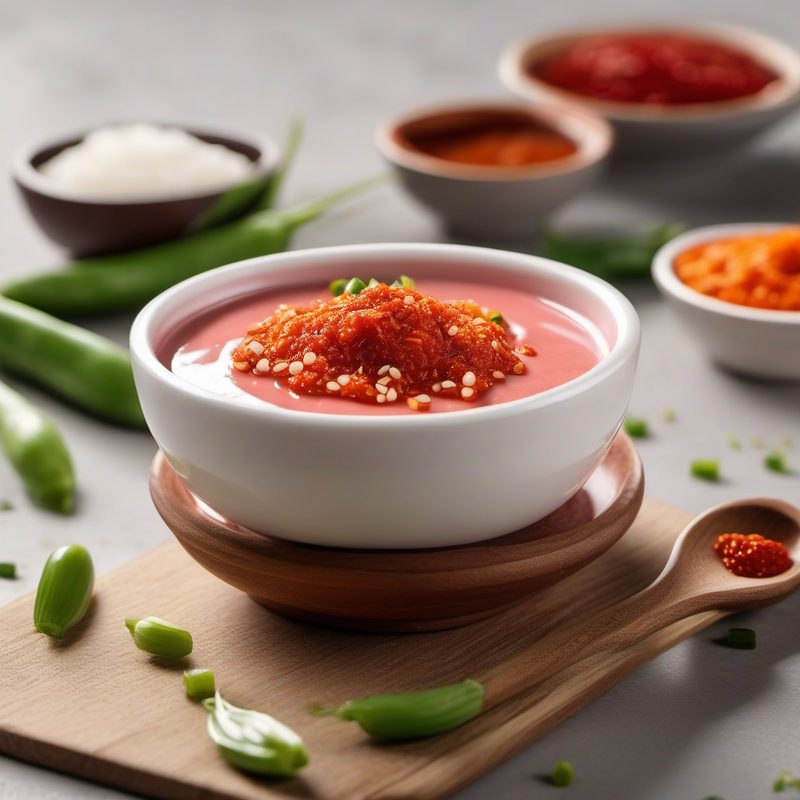
Yogurt Gochujang Fusion Sauce
A creamy, spicy, umami-packed Korean-Italian fusion dipping sauce that comes together in 30 seconds — Greek yogurt provides a cool, tangy base while gochujang delivers fermented chili depth, creating a perfectly balanced condiment that bridges East and West with every dip.
| Amount | Ingredient |
|---|---|
| 100 g (about ⅓ cup plus 2 tbsp) | plain Greek yogurt (full-fat or 2%) |
| 1 tsp (5 g) | gochujang (Korean chili paste) |
| to taste | freshly squeezed lemon juice (about ½ to 1 tsp) |
| pinch | kosher salt |
This is the kind of sauce that makes you wonder why you ever settled for plain ranch or boring ketchup. At its heart, it is a two-ingredient wonder: the cool, thick creaminess of Greek yogurt meets the bold, funky, spicy-sweet intensity of gochujang, the fermented Korean chili paste that has become a pantry staple in kitchens around the world. A squeeze of lemon and a pinch of salt are all it takes to wake up the flavors and bring them into perfect harmony. The result is a sauce that is simultaneously cooling and warming, tangy and savory, creamy and bright — an unlikely fusion that somehow makes perfect sense on the palate. Use it as a dip for crispy chicken nuggets, spring rolls, or fresh vegetables, and watch it disappear before your eyes. It takes longer to set out the serving bowl than to make the sauce itself.
Ingredient notes: Use a good-quality, thick Greek yogurt — Fage Total, Chobani Plain, or any full-fat or 2% Greek yogurt will work beautifully. Avoid non-fat yogurt, which can be thin and lack the body to stand up to the gochujang. Gochujang brands vary in heat level and sweetness; Tae Kyung, Chung Jung One, and Sempio are widely available and reliable. If your gochujang is very thick, stir it vigorously in its container before measuring. Lemon juice should be freshly squeezed — bottled lemon juice has a flat, metallic flavor that dulls the sauce. Start with a small squeeze and add more to taste.
- Small mixing bowl
- Whisk or small fork
- Measuring spoons
- Citrus reamer or juicer (for fresh lemon)
- Serving bowl
- Combine the ingredients (30 seconds). In a small mixing bowl, add the Greek yogurt, gochujang, a squeeze of fresh lemon juice (about ¼ teaspoon to start), and a pinch of kosher salt.
- Whisk until smooth (30 seconds). Whisk vigorously until the gochujang is fully incorporated into the yogurt and the sauce is a uniform, pale coral color with a smooth, creamy consistency. There should be no streaks of red or white.
- Taste and adjust (30 seconds). Taste the sauce and adjust the balance to your preference. For more heat, add another ¼ teaspoon of gochujang. For more tang, add another squeeze of lemon juice. For more saltiness, add another small pinch of kosher salt. The sauce should be creamy, tangy, and gently spicy with a subtle fermented depth.
- Serve immediately (optional chill, 15 min). Transfer to a serving bowl and serve immediately. For the best flavor, the sauce can be refrigerated for 15 to 30 minutes before serving — the flavors meld and mellow slightly as it chills. The sauce is excellent at room temperature or chilled.
- Serving Suggestions. Serve as a dipping sauce for Korean-style fried chicken nuggets, tempura vegetables, spring rolls, or dumplings; dollop over rice bowls, bibimbap, or grain bowls for a creamy, spicy finish; serve alongside grilled meats (beef bulgogi, pork belly, or grilled chicken thighs) as a dipping sauce; use as a spread for tacos, wraps, or sandwiches; drizzle over roasted vegetables (broccoli, cauliflower, sweet potatoes) for a creamy, spicy glaze; or serve simply with fresh cucumber spears, carrot sticks, and bell pepper strips as a healthy snack dip.
- Use thick, full-fat yogurt. The sauce needs the body of a thick yogurt to stand up to the gochujang. Thin or watery yogurt will result in a runny sauce that fails to cling to whatever you are dipping.
- Start with less gochujang and build up. Gochujang varies significantly in heat level between brands. Start with 1 teaspoon and add more if you want a spicier sauce. You can always add more heat, but you cannot take it away.
- Fresh lemon juice is non-negotiable. The bright, floral acidity of fresh lemon is essential to balance the rich, fermented depth of the gochujang. Bottled lemon juice adds a dull, metallic note that flattens the sauce.
- Let the sauce rest briefly. Even 15 minutes in the refrigerator allows the flavors to meld and the gochujang to fully hydrate and release its complexity. The sauce is good immediately but noticeably better after a short rest.
- Adjust the consistency. If the sauce is too thick for your liking, stir in 1 teaspoon of water or an extra squeeze of lemon juice. If it is too thin, add a spoonful more yogurt.
- Double or triple easily. This recipe scales perfectly. For a party, make a double batch — it will disappear fast.
- Make it a meal. Turn this sauce into a quick dressing by thinning with 1 to 2 tablespoons of rice vinegar or lemon juice and drizzling over an Asian-style slaw or grain bowl.
| Mistake | Why It Hurts | The Fix |
|---|---|---|
| Using non-fat or thin yogurt | The sauce turns out watery and fails to cling to food, creating a messy dipping experience | Use full-fat or 2% Greek yogurt with a thick, spoonable consistency |
| Adding too much gochujang at once | The sauce becomes overwhelmingly spicy and the fermented flavor dominates, losing the yogurt's creamy balance | Start with 1 teaspoon and add more gradually, tasting as you go |
| Using bottled lemon juice | The sauce tastes flat, metallic, and lacks the bright, clean acidity that makes the flavors pop | Use only freshly squeezed lemon juice — it takes 30 seconds and makes a real difference |
| Not whisking thoroughly | Streaks of unmixed gochujang create uneven pockets of intense heat and salt in an otherwise balanced sauce | Whisk vigorously until the sauce is a uniform coral color with no visible streaks |
| Oversalting | The gochujang already contains significant sodium. Adding too much salt makes the sauce overly salty and one-dimensional | Start with a tiny pinch of salt, taste, and add more only if needed |
| Serving straight from the refrigerator | The flavors are muted and the yogurt is too firm and cold to allow the gochujang to express its full complexity | Let the sauce sit at room temperature for 5 to 10 minutes before serving, or make it 15 minutes ahead |
- Spicy Sesame Yogurt Sauce: Add ½ teaspoon of toasted sesame oil and 1 teaspoon of toasted white sesame seeds for a nutty, aromatic depth that pairs beautifully with Korean fried chicken or dumplings.
- Garlic Gochujang Yogurt Sauce: Add ½ small clove of garlic, grated on a Microplane, for an extra savory, pungent kick. Let rest for 10 minutes for the garlic flavor to meld.
- Lime-Cilantro Gochujang Yogurt: Replace the lemon juice with fresh lime juice and fold in 1 tablespoon of finely chopped fresh cilantro. Perfect for tacos, grilled fish, or Mexican-Korean fusion bowls.
- Honey Gochujang Yogurt: Add ½ teaspoon of honey (or more to taste) for a sweet-spicy sauce that is incredible with chicken tenders, sweet potato fries, or crispy tofu.
- Minty Gochujang Yogurt: Fold in 1 tablespoon of finely chopped fresh mint for a cooling, refreshing twist that works beautifully with lamb or spring rolls.
- Smashed Cucumber Salad Dressing: Thin the sauce with 2 tablespoons of rice vinegar and 1 teaspoon of water, then toss with smashed cucumbers, sliced scallions, and sesame seeds for a quick Korean-inspired salad.
- Vegan Version: Substitute the Greek yogurt with a thick, plain plant-based yogurt (coconut-based or soy-based yogurt works best). The sauce will be slightly less tangy but still delicious.
| Storage Method | Details |
|---|---|
| Refrigerator | Store in an airtight container for up to 3 days. Stir well before serving, as some separation may occur. The flavors will deepen slightly overnight. |
| Freezer | Not recommended — the yogurt will separate upon thawing, resulting in a watery, grainy texture. The sauce is quick enough to make fresh. |
This sauce is a condiment, but its bright, creamy-spicy character pairs well with the dishes it accompanies:
- With Korean fried chicken or nuggets: A crisp, off-dry Riesling (Kabinett) or a cold, hoppy IPA — the slight sweetness handles the heat while the bubbles or bitterness refresh the palate.
- With spring rolls or dumplings: A dry, citrusy Sauvignon Blanc (Loire or Marlborough) or a light, crisp lager. The bright acidity cuts through the creamy sauce.
- With grilled meats (bulgogi, pork belly): A juicy, fruit-forward Beaujolais or a chilled glass of Sémillon. The fruit complements the fermented chili notes.
- With rice bowls or grain bowls: A Korean rice lager (Hite, Cass) or a light, unoaked Chardonnay. Clean and refreshing to balance the creamy heat.
- As a snack dip: A sparkling water with lime or a dry, bubbly Prosecco — the effervescence is a perfect palate cleanser between dips.
| Per Serving (about 2 tablespoons / 30 g) | |
|---|---|
| Calories | 33 |
| Protein | 3 g |
| Fat | 1 g |
| Carbohydrates | 3 g |
| Fiber | 0 g |
| Sugar | 2 g |
Nutrition values are approximate and based on full-fat Greek yogurt and standard gochujang. Actual values will vary based on yogurt fat content and specific brand of gochujang.
Can I use sour cream instead of Greek yogurt?
Yes — sour cream can be substituted for Greek yogurt in a pinch. The sauce will be slightly richer and more tangy, with a slightly thinner consistency. Reduce the lemon juice slightly, as sour cream is already quite acidic.
What is gochujang and where do I find it?
Gochujang is a thick, fermented Korean chili paste made from chili powder, glutinous rice, fermented soybeans, and salt. It is savory, spicy, and slightly sweet with a deep, funky umami character. Look for it in the international or Asian section of well-stocked supermarkets, at Korean grocery stores, or online. Once opened, store it in the refrigerator — it keeps for months.
How spicy is this sauce?
With 1 teaspoon of gochujang, the sauce is mildly to moderately spicy — noticeable warmth without being overwhelming. The yogurt cools the heat significantly. For a milder version, use ½ teaspoon of gochujang. For a spicier version, increase to 1½ or 2 teaspoons.
Can I make this sauce ahead of time?
Yes — make it up to 1 day in advance and refrigerate in an airtight container. The flavors will meld and deepen overnight. Stir well before serving and let it sit at room temperature for 5 to 10 minutes to take the chill off.
What else can I use this sauce with?
The possibilities are nearly endless: use it as a sauce for buddha bowls, drizzle over roasted salmon or grilled shrimp, spread on a breakfast bagel with smoked salmon and capers, serve alongside samosas or onion bhajis, use as a dressing for shredded cabbage slaw, or simply eat it as a dip with potato chips or crackers.
- Basic Gochujang Sauce (Volume 2)
- Miso Butter (Volume 2)
- Soy-Ginger Dipping Sauce (Volume 1)
- Korean Fried Chicken Nuggets (Volume 3)
- Smashed Cucumber Salad (Volume 1)
Recipe from "The Italian Kitchen" by Vita Milanese — Volume 2: Sunday Sauce
Recipe from The Italian Kitchen by Vita Milanese — Volume 2 · Sunday Sauce. Discover all volumes on the ebook page.