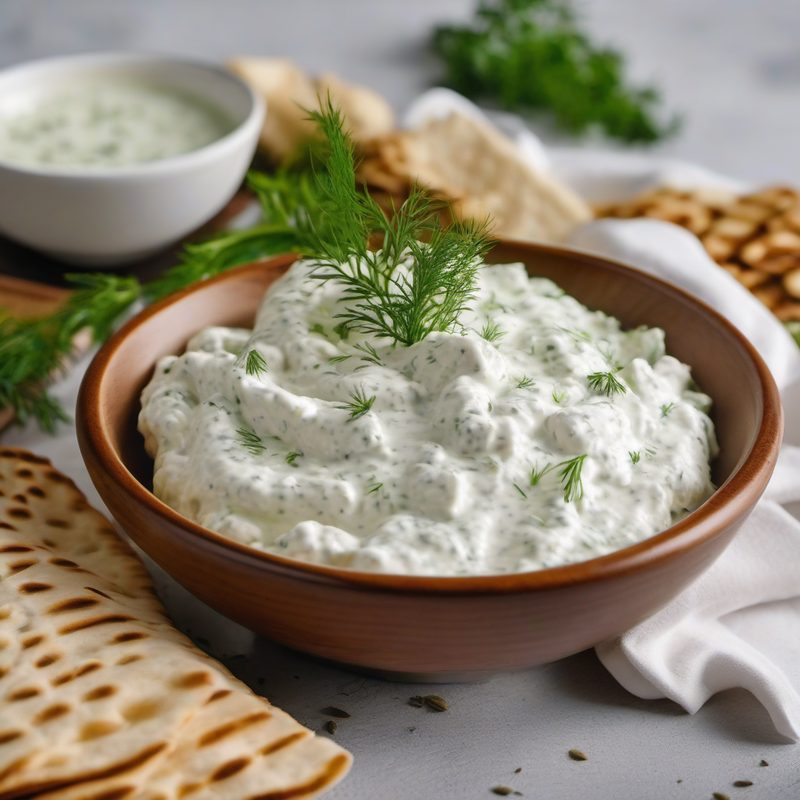
Tzatziki (Tzatziki)
The difference between a great tzatziki and a watery, forgettable one is exactly fifteen minutes of patience — salted grated cucumber, drained of its excess moisture, transforms an ordinary yogurt dip into a thick, creamy, intensely flavored sauce that elevates everything it touches, from grilled lamb to warm pita.
| Amount | Ingredient |
|---|---|
| 400 g (1⅔ cups) | plain full-fat Greek yogurt |
| 1 (about 175 g / 6 oz) | cucumber (English or Persian preferred) |
| 2 cloves | garlic, minced to a paste |
| 20 g (4 tsp) | extra-virgin olive oil, plus more for drizzling |
| 10 g (2 tsp) | white wine vinegar |
| to taste | salt |
Tzatziki is the cooling heart of the Eastern Mediterranean table — a simple sauce of yogurt, cucumber, garlic, and olive oil that appears alongside gyros, souvlaki, grilled fish, and meze spreads from Greece to Turkey to the Levant. But simplicity is deceptive: the balance between tangy yogurt, pungent garlic, and the refreshing crunch of cucumber is easily upset by a single misstep. The most common failure is wateriness, caused by cucumber juice diluting the yogurt into a thin, sad dressing. The solution is ancient and reliable — salt the grated cucumber, let it weep, and press it dry. What remains is a tzatziki so thick you can stand a spoon in it, so balanced you'll want it on everything.
Use level tablespoons and standard US measuring cups.
- Box grater
- Fine-mesh sieve
- Medium mixing bowl
- Spoon or flexible spatula
- Kitchen towel or cheesecloth (optional)
- Airtight container for storage
- Grate the cucumber — 2 minutes. Wash the cucumber thoroughly. Grate it on the large holes of a box grater; do not peel it first. The peel adds color, texture, and a mild bitterness that balances the yogurt's richness. You should have about 1 cup (240 ml) of grated cucumber. Pro tip: Use the large holes, not the fine ones — finely grated cucumber releases too much liquid and turns to mush. English or Persian cucumbers are ideal because they have thinner skins and fewer seeds.
- Salt and drain the cucumber — 15 minutes. Place the grated cucumber in a fine-mesh sieve set over a bowl. Sprinkle with ½ teaspoon of fine salt and toss gently to combine. Let drain at room temperature for 15 minutes. After draining, press firmly on the cucumber with the back of a spoon to extract as much liquid as possible — you should see a significant amount of pale green water pool in the bowl. Discard the liquid. Pro tip: For an even drier result, gather the cucumber in a clean kitchen towel or a double layer of cheesecloth and wring it tightly over the sink. This step separates good tzatziki from great tzatziki.
- Combine the base — 2 minutes. In a medium bowl, stir together the Greek yogurt, drained cucumber, minced garlic, extra-virgin olive oil, and white wine vinegar until smooth and uniform. Pro tip: Mince the garlic to a paste by sprinkling it with a pinch of salt and smearing it across the cutting board with the flat of your knife — this releases the essential oils and prevents biting into raw chunks.
- Season — 1 minute. Taste and adjust salt as needed. The tzatziki should be tangy, well-seasoned, and have a pronounced garlic presence. If it tastes flat, add another pinch of salt and a few more drops of vinegar. Pro tip: Remember that chilling dulls flavors — the tzatziki should taste slightly stronger than you want at room temperature, as it will mellow in the fridge.
- Chill — at least 1 hour. Refrigerate for at least 1 hour before serving to allow the flavors to meld and the texture to firm up. The yogurt will tighten as it chills, and the garlic will mellow into the background while remaining distinct. Pro tip: If you have the time, chill for 4 hours or even overnight — the transformation is remarkable; the garlic becomes sweet and the cucumber infuses the entire sauce.
- Serve — 1 minute. Transfer to a serving bowl, drizzle generously with extra-virgin olive oil, and serve. Garnish with a pinch of dried mint or fresh dill and a few black olives if desired.
- As a dip with warm pita bread, flatbread, or crusty bread
- Alongside grilled lamb chops, souvlaki, or gyros
- With grilled fish (sea bass, sardines, or swordfish)
- As a sauce for falafel or vegetable fritters
- Spooned over roasted vegetables — eggplant, zucchini, or bell peppers
- Dolloped onto spicy dishes like shakshuka or Merguez sausages
- As a spread for sandwiches and wraps, in place of mayonnaise
- Full-fat Greek yogurt is non-negotiable. Low-fat or non-fat yogurt has too much whey and not enough stabilizing protein. The sauce will be thin and watery regardless of how well you drain the cucumber. Use a yogurt with at least 8% milk fat (10% is ideal).
- Do not skip the salting step. Even 5 minutes of draining makes a measurable difference. Skipping it guarantees a watery tzatziki that will weep liquid within 30 minutes of serving.
- Use the best olive oil you have. Since it's one of only five ingredients and goes on as a final drizzle, the olive oil's flavor is front and center. A grassy, peppery Sicilian or Greek extra-virgin olive oil is ideal.
- Fresh garlic is essential. Skip the pre-minced garlic in a jar — it lacks the sharp bite that tzatziki needs. Use fresh cloves and mince them to a paste. If raw garlic is too intense, blanch the cloves in boiling water for 20 seconds before mincing.
- White wine vinegar is traditional, but lemon works. Lemon juice makes a brighter, sharper tzatziki (more Greek in style), while white wine vinegar makes a mellower, rounder one (more Turkish in style). Both are correct — choose based on what you're serving it with.
- Let the tzatziki come to room temperature before serving. Straight from the fridge, the flavors are muted. Let it sit out for 15 to 20 minutes, then stir and taste again before adjusting seasoning.
- A single drizzle of olive oil is not just garnish. The oil acts as a flavor bridge between the sauce and whatever you're dipping. Without it, tzatziki can taste one-dimensionally tangy.
| Mistake | Why It Hurts | The Fix |
|---|---|---|
| Not draining the cucumber | Cucumber water dilutes the yogurt, producing a thin, runny sauce | Always salt, drain 15 minutes, and press firmly; for extra insurance, wring in a kitchen towel |
| Using low-fat or non-fat yogurt | Insufficient protein and fat result in a thin, curdled sauce | Use full-fat Greek yogurt with at least 8% milk fat; Fage Total or similar is ideal |
| Adding garlic too coarsely | Biting into a chunk of raw garlic is unpleasant | Mince to a paste with salt using the flat of your knife, or use a microplane |
| Skipping the chilling step | Flavors remain harsh and separate; texture is loose | Chill for at least 1 hour — 4 hours is better, overnight is best |
| Using the wrong cucumber | Waxed, thick-skinned supermarket cucumbers add bitterness and tough bits | Use English (hothouse) or Persian cucumbers; peel regular cucumbers with thick, waxy skins |
| Over-salting at the start | The salt from draining cucumber plus added salt can make it inedible | Taste after combining everything; the salting step uses only ½ teaspoon for draining |
| Serving straight from the fridge | Cold numbs the flavors and makes the garlic taste harsh | Let tzatziki sit at room temperature for 15 to 20 minutes before serving |
- Greek-Style Tzatziki: Substitute white wine vinegar with lemon juice and add 1 teaspoon of dried oregano to the yogurt base. Serve with lamb.
- Turkish Cacık: Thin the tzatziki with ½ cup (120 ml) of ice-cold water or soda water until it reaches a spoonable, soup-like consistency. Serve as a cold soup with rice and mint.
- Mint and Dill Tzatziki: Add 2 tablespoons finely chopped fresh mint and 1 tablespoon finely chopped fresh dill. This is excellent with fish and vegetable fritters.
- Spicy Tzatziki: Add ½ teaspoon of Aleppo pepper flakes or ¼ teaspoon of cayenne pepper along with the garlic. A pinch of sumac adds a lemony tartness.
- Roasted Garlic Tzatziki: Replace the raw garlic with 6 cloves of roasted garlic (mashed to a paste). The result is sweet, mellow, and nutty — perfect for milder palates.
- Feta Tzatziki: Crumble 60 g (½ cup) of feta cheese into the finished tzatziki and fold gently. The saltiness and crumbly texture add a new dimension.
- Avocado Tzatziki: Blend ½ ripe avocado into the yogurt base before adding cucumber. The avocado adds creaminess and a pale green color — serves 4 as a dip.
| Method | Details |
|---|---|
| Refrigerator | Store in an airtight container for up to 4 days |
| Best Before | Peak flavor is at 24 hours — the garlic mellows and the cucumber infuses the yogurt; best consumed within 2 days |
| Reviving | Stir vigorously before serving; if the tzatziki has thickened too much, whisk in 1 tablespoon of cold water or milk |
| Do not freeze | Freezing destroys the yogurt's emulsion — the tzatziki will separate into watery curds upon thawing |
| Leftover Drainage Note | Some liquid may pool on top after storage — simply stir it back in; this is normal |
- Assyrtiko (Santorini, Greece) — the island's signature white, with volcanic minerality and high acidity that cuts through the yogurt's richness
- Moschofilero (Peloponnese, Greece) — aromatic, floral, and citrusy, with enough body to stand up to garlic
- Savatiano (Attica, Greece) — the workhorse Greek white, unoaked and lemony, perfect for casual meze
- Retsina (Greece) — the pine-scented traditional wine is a divisive but authentic pairing; the resin notes harmonize with olive oil and garlic
- Dry Rosé from the Peloponnese — juicy, fruity, and light, bridging tzatziki's tanginess with grilled meats
| Calories | Protein | Fat | Carbs | Fiber |
|---|---|---|---|---|
| 60 per ¼ cup (60 ml) serving | 5 g | 4 g | 2 g | 0 g |
Q: Can I make tzatziki with regular (non-Greek) yogurt?
A: Yes, but you'll need to strain it first. Line a sieve with cheesecloth or a coffee filter, add 500 g (2 cups) of plain full-fat yogurt, and let it drain in the refrigerator for 4 to 6 hours (or overnight). This removes excess whey and thickens the yogurt to a Greek-style consistency. Proceed with the recipe as written.
Q: My tzatziki is bitter — what went wrong?
A: Two common causes: (1) You used the fine holes of the grater, which released too much cucumber juice including bitter compounds from the peel; (2) Your olive oil was too grassy or aged — use a fruity, medium-intensity extra-virgin olive oil next time, not a peppery Tuscan one.
Q: How do I make tzatziki less garlicky?
A: Use only 1 clove instead of 2, or blanch the garlic cloves in boiling water for 20 seconds before mincing (this tames the heat). Alternatively, use roasted garlic (see Variations) for a sweet, mellow result.
Q: Can I use dried dill instead of fresh?
A: Dried herbs are not recommended for tzatziki. If you must substitute, use 1 teaspoon dried dill (not the full 1 tablespoon of fresh) and let the tzatziki rest for at least 2 hours to rehydrate. Mint is a better dried herb choice than dill.
Q: Why is my tzatziki runny even after draining the cucumber?
A: The yogurt may be the culprit. Some brands of "Greek yogurt" are thickened with starches or gums and have a looser texture. Check the label — the ingredients should be simply "milk and live active cultures." If the consistency is still too thin, stir in 1 tablespoon of labneh or sour cream to tighten the sauce.
- Hummus (Volume 2, Recipe #80)
- Baba Ghanoush (Volume 2, Recipe #81)
- Muhammara (Volume 2, Recipe #82)
- Greek Salad (Volume 1, Recipe #25)
- Souvlaki (Volume 2, Recipe #88)
- Falafel (Volume 2, Recipe #89)
- Pita Bread (Volume 1, Recipe #34)
Recipe from "The Italian Kitchen" by Vita Milanese — Volume 2: Sunday Sauce
Recipe from The Italian Kitchen by Vita Milanese — Volume 2 · Sunday Sauce. Discover all volumes on the ebook page.