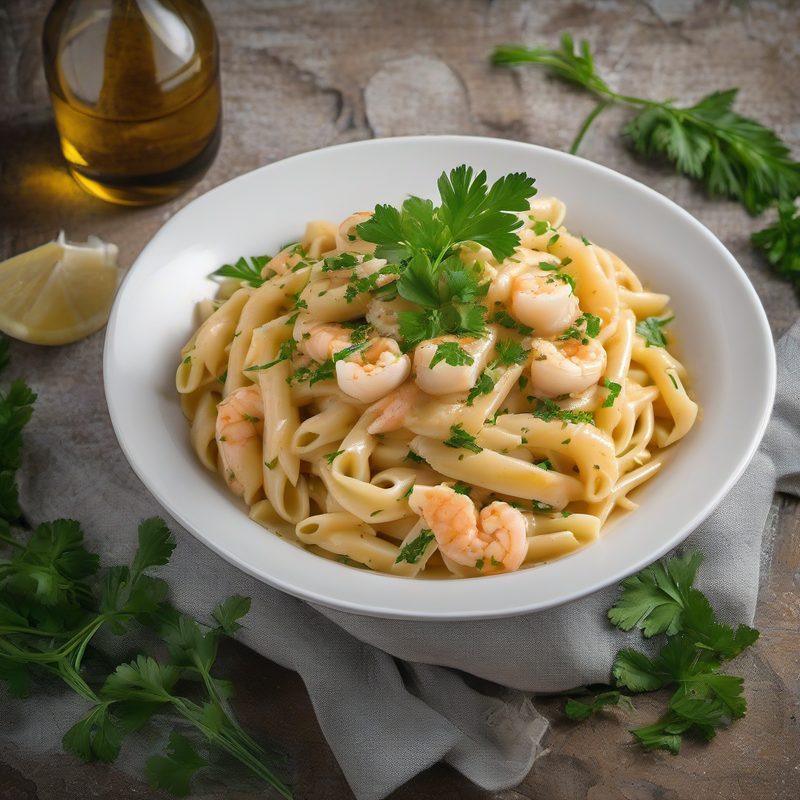
Trofie Cod Sauce
A Ligurian-inspired pasta where tender cod simmers in a silky cherry tomato sauce, punctuated by briny olives and capers — proof that fish and pasta make one of the great marriages of the Italian table.
| Amount | Ingredient |
|---|---|
| 2 tbsp | Capers (salt-packed, rinsed) |
| 1 can (28 oz / 800 g) | Preserved cherry tomatoes (or whole San Marzano tomatoes) |
| 3 tbsp | Extra-virgin olive oil, plus more for drizzling |
| 3 cloves | Garlic |
| ½ tsp | Kosher salt, plus more to taste |
| ¼ tsp | Black pepper, freshly ground |
| ¼ cup (35 g) | Taggiasche olives (or other small black olives), pitted |
| 2 tbsp | Fresh flat-leaf parsley, finely chopped |
| 1 lb (450 g) | Cod fillet, skinless, boneless |
| 1 lb (450 g) | Trofie pasta (or fusilli, gemelli, or casarecce) |
This dish comes from the coastal kitchens of Liguria, where the sea meets the hillsides of trofie-making tradition. The sauce starts simply: preserved cherry tomatoes blitzed into a smooth base, gently simmered with garlic until they concentrate into something sweet and deeply savory. Fresh cod fillet goes in at the end, cooking just long enough to become flaky and tender, absorbing the tomato's brightness without losing its delicate identity. The real magic is the finishing touch — a rough chop of Taggiasche olives and capers stirred in at the last minute, adding briny pops of intensity that make every forkful different from the last. Served over the short, twisted trofie that catch every bit of sauce, this is a weeknight dinner that tastes like a coastal holiday.
Use level tablespoons and standard US measuring cups. All produce is medium unless specified.
🥘 Equipment
- Large pot (6-quart or larger) for boiling pasta
- Large skillet or sauté pan (12-inch) with lid
- Blender or immersion blender (for the tomatoes)
- Chef's knife and cutting board
- Medium bowl (for the olive-caper mixture)
- Measuring cups and spoons
- Tongs or wooden spoon
- Ladle or heatproof measuring cup (for reserving pasta water)
- Colander
📋 Preparation
Step 1 — Prep the Ingredients (10 minutes)
Rinse the capers under cold running water to remove the salt. If using salt-packed capers, soak them in a bowl of cold water for 5 minutes, then drain and rinse. Set aside.
Blend the tomatoes: Empty the preserved cherry tomatoes (with their juices) into a blender or use an immersion blender directly in a large measuring cup. Pulse until completely smooth — you want a uniform sauce with no chunks. Set aside.
Finely chop the capers and olives together on a cutting board. You're looking for a coarse, almost relish-like texture — about ⅛-inch pieces. Transfer to a small bowl.
Finely chop the parsley and set aside separately.
Dice the cod fillet into ¾-inch cubes. Pat dry with paper towels and season very lightly with a pinch of salt — the capers and olives will add plenty of brine later.
Smash the garlic cloves with the side of your knife. Leave them whole — they'll perfume the oil and be removed before serving.
Step 2 — Build the Tomato Sauce (20 minutes)
Place the large skillet over medium heat. Add the 3 tablespoons of olive oil and let it warm until shimmering, about 1 minute.
Add the smashed garlic cloves and cook, stirring, until fragrant but not colored, about 30 seconds.
Pour in the blended cherry tomatoes. Add the ½ teaspoon salt and ¼ teaspoon black pepper. Stir to combine.
Bring the sauce to a gentle simmer, then reduce the heat to medium-low. Cover the pan with the lid slightly ajar — this lets steam escape so the sauce thickens rather than becoming watery — and cook for 20 minutes, stirring every 5 minutes. The sauce should bubble lazily, not vigorously. It will darken from bright red to a deeper, brickier red and thicken visibly.
What's happening? The slow simmer drives off water and concentrates the tomatoes' natural sugars, while the olive oil emulsifies into the sauce, giving it a velvety richness without any cream.
Step 3 — Cook the Cod (5 minutes, concurrent with pasta step)
While the sauce simmers, bring a large pot of generously salted water (about 1½ tablespoons kosher salt per gallon) to a rolling boil — you'll cook the pasta in this shortly.
Add the diced cod to the simmering tomato sauce. Stir gently to submerge the pieces. Cover the pan (fully this time) and cook for 5 minutes, or until the cod is opaque and flakes easily when prodded with a fork. Do not stir too vigorously or the cod will break into too-small pieces.
Check early: at 4 minutes, lift the lid and gently press a piece of cod with the back of a spoon — it should offer no resistance and separate into clean flakes. If it still feels springy, give it another 1 to 2 minutes.
Add the chopped olive-caper mixture to the pan. Stir gently to distribute. Remove and discard the garlic cloves — their work is done.
Keep the sauce warm over the lowest possible heat while you finish the pasta.
Step 4 — Cook the Trofie (8–10 minutes, concurrent with Step 3)
Add the trofie to the boiling salted water and cook according to package directions until al dente. Trofie are small and dense, so they typically need 9 to 11 minutes — start checking at 8 minutes.
Reserve 1 cup of the pasta cooking water before draining. Drain the trofie well (do not rinse).
Step 5 — Finish the Pasta in the Sauce (2 minutes)
Add the drained trofie directly to the skillet with the cod-tomato sauce. Increase the heat to medium.
Add ¼ cup of the reserved pasta water and toss gently to coat the pasta. Cook for 2 minutes, stirring occasionally, until the sauce clings to the twisted ridges of the trofie and everything is piping hot. If the sauce seems too thick, add more pasta water a splash at a time — it should be saucy enough to coat each piece without pooling at the bottom.
Step 6 — Serve Immediately
Remove the skillet from the heat. Sprinkle the chopped parsley over the pasta and toss once more.
Divide among warm bowls. Finish each serving with a generous drizzle of extra-virgin olive oil — a fruity, peppery Ligurian oil if you have it.
🧑🍳 Chef's Tips
- Taggiasche olives are worth seeking out: These small, dark, oil-cured olives from the Ligurian coast have a delicate, slightly fruity flavor that doesn't overpower the cod. If you can't find them, use Niçoise or Gaeta olives — avoid canned black olives, which are too mild and lack the briny punch this dish needs.
- Salt-packed capers, then rinse: Salt-packed capers have a firmer texture and more concentrated flavor than brine-packed ones. Rinsing removes excess salt without stripping all the flavor. If using brine-packed capers, drain and rinse briefly — they'll be less firm but still work.
- Blend the tomatoes for texture: This isn't a chunky sauce — the blended cherry tomatoes create a velvety, emulsified base that coats the trofie evenly. If you prefer a chunkier texture, crush the tomatoes by hand instead and cook for an extra 5 minutes.
- Cod can be swapped: Any firm white fish works here — haddock, halibut, sea bass, or even thick fillets of pollock. Avoid thin, delicate fish like sole or flounder, which will disintegrate during the 5-minute simmer.
- Don't skip the final drizzle of oil: A good olive oil adds a peppery, fruity finish that brightens the entire dish. It's the same move a Ligurian cook would make — the region is famous for its olive oil, and they treat it as a finishing ingredient, not just a cooking medium.
- The twisted shape matters: Trofie's short, twisted shape is perfect for catching this sauce. If using a substitute, choose something with ridges or curves — fusilli, gemelli, or casarecce all work well. Long pasta like spaghetti won't hold the chunky olive-caper pieces as effectively.
❌ Common Mistakes
| Mistake | Why It Hurts | The Fix |
|---|---|---|
| Overcooking the cod | Cod goes from tender and flaky to dry and stringy in under a minute | Cook covered for exactly 5 minutes; check at 4 minutes if the pieces are small. Remove from heat immediately when flaky |
| Forgetting to rinse the capers | Salt-packed capers are intensely salty — unrinsed, they'll make the dish inedible | Rinse capers thoroughly under cold water and taste one before adding. If still too salty, soak in fresh water for 5 more minutes |
| Using unblended tomatoes | Chunky tomatoes don't create the silky sauce that clings to trofie — you'll end up with a watery, separated sauce | Blend until completely smooth. For hand-crushed tomatoes, cook 5 extra minutes and mash with a potato masher halfway through |
| Adding the olive-caper mix too early | The capers and olives lose their distinct briny identity if cooked for 20 minutes — they become one with the sauce instead of providing bright pops of contrast | Add them only in the final minute of cooking, right after the cod is done. They should warm through, not cook through |
| Over-salting the fish | Between the capers, olives, and tomato sauce, there's already plenty of salt | Season the cod very lightly or not at all — taste the sauce before adding any salt to the fish |
| Not reserving enough pasta water | Without starchy pasta water, the sauce won't cling properly to the trofie, and the dish turns dry and clumpy | Always reserve at least 1 cup of pasta water — you may not use it all, but it's cheaper to have extra than to wish you had it |
💡 Variations
| Variation | How To |
|---|---|
| Add White Wine | After cooking the garlic, deglaze the pan with ½ cup of dry white wine (Vermentino or Pigato), let it reduce by half for 2 minutes, then add the blended tomatoes — the acidity brightens the entire dish |
| Make it Spicier | Add a small dried red chile (crumbled) or ½ teaspoon of red pepper flakes with the garlic for gentle, lingering heat |
| Add Toasted Breadcrumbs | Toast ½ cup of panko in 1 tablespoon of olive oil with a pinch of salt until golden; sprinkle over each serving for crunch — a classic Ligurian touch |
| Use Fresh Tomatoes | Substitute 2 lbs (900 g) of ripe cherry tomatoes, halved. Sauté in the oil for 5 minutes until softened, then blend. No need to simmer for 20 minutes — fresh tomatoes cook in 10 minutes |
| Add Pine Nuts | Toast ¼ cup of pine nuts in a dry skillet until golden and sprinkle over the finished pasta for a nutty, buttery crunch that echoes the Ligurian hillsides |
| Swap the Pasta | This sauce works beautifully with trofie's Ligurian cousin, trenette (a thin, flat ribbon pasta), or with orecchiette, which capture the olive-caper bits in their little cups |
| Go Pescatarian with a Kick | Add 2 anchovy fillets to the oil with the garlic — they'll melt into the sauce and add deep umami without tasting fishy |
❄️ Storage & Leftovers
| Method | Details |
|---|---|
| Refrigerator | Store in an airtight container for up to 2 days. The cod will become firmer as it sits and the pasta will absorb some sauce — don't expect it to be as lush as fresh |
| Freezer | The sauce (without pasta) freezes well for up to 2 months. Freeze the pasta separately or cook fresh trofie when reheating |
| Reheating | Reheat in a skillet over medium-low heat with a splash of water or pasta water, stirring gently. The cod will be firmer than when freshly made but still good. Microwave in 30-second bursts, covered, at 50% power |
🍷 Wine Pairing
| Wine | Why |
|---|---|
| Vermentino di Liguria | The definitive Ligurian white — bright, saline, with herbal notes and a subtle almond finish that mirrors the briny olives and complements the cod perfectly |
| Pigato (Riviera Ligure di Ponente) | A Ligurian grape with more body than Vermentino — stone fruit and Mediterranean herbs, with enough acidity to cut through the tomato and olive oil |
| Gavi di Gavi | Crisp and mineral-driven with green apple and citrus notes — a classic pairing for fish in tomato sauce from just across the Ligurian border in Piedmont |
| Greco di Tufo | Full-bodied and structured, with ripe pear and almond notes that stand up to the olive-caper intensity without overwhelming the cod |
| Soave Classico | Medium-bodied with floral and almond notes — its gentle acidity is a safe, crowd-pleasing choice that works with every element |
| Franciacorta Brut | A méthode traditionnelle sparkler — the bubbles and acidity cut through the olive oil's richness and refresh the palate between each briny, tomatoey bite |
🍺 Beer Pairing
| Beer | Why |
|---|---|
| Italian Pilsner (e.g., Moretti La Rossa or Birrificio Italiano Tipopils) | Crisp, clean, moderately hoppy — the bitterness cuts through the olive oil and the carbonation cleanses the palate |
| Belgian Saison | Spicy, fruity, and dry — the peppery notes from saison yeast echo the parsley and olive oil beautifully |
| Czech-style Pale Lager | Clean maltiness and moderate hop bitterness — a straightforward pairing that doesn't compete with the delicate cod |
🥗 Suggested Side Dishes
- Arugula salad with lemon vinaigrette — Peppery arugula, lemon juice, olive oil, flaky salt — three minutes, no cooking, the perfect bright counterpoint to the rich tomato sauce
- Grilled or roasted zucchini with mint — Thin slices grilled or roasted at 425°F (220°C) for 12 minutes, finished with fresh mint and a squeeze of lemon
- Warm focaccia or ciabatta — Ligurian focaccia (the soft, dimpled, olive-oil-drenched kind) is the ideal bread for sopping up every last drop of sauce from the bowl
- Roasted cherry tomatoes on the vine — A simple side that doubles down on the tomato theme; drizzle with olive oil, salt, and roast at 400°F (200°C) for 15 minutes
- Steamed green beans with lemon — Bright, clean, and simple — a vegetable that doesn't compete with the pasta's flavors
- Marinated white beans — Cannellini beans marinated in olive oil, lemon juice, fresh rosemary, and a pinch of red pepper flakes — a classic Ligurian contorno
📊 Nutrition (per serving, estimated)
| Calories | Protein | Fat | Carbs | Fiber |
|---|---|---|---|---|
| 380 | 28 g | 10 g | 48 g | 4 g |
Nutrition is an estimate based on 4 servings using cod fillet, 1 lb of dried trofie pasta, 3 tablespoons of olive oil, and preserved cherry tomatoes. Actual values will vary with brands and substitutions.
❓ Frequently Asked Questions
Can I use frozen cod?
Yes, but thaw it completely in the refrigerator overnight, then pat it very dry with paper towels before dicing. Frozen cod releases more water as it cooks, which can thin out your sauce — if that happens, let the sauce simmer uncovered for 2 to 3 extra minutes after the cod is done to re-thicken.
What if I can't find trofie pasta?
Trofie is a short, hand-rolled Ligurian pasta. Fusilli, gemelli, or casarecce are excellent substitutes — look for anything with twists, ridges, or curves that will catch the sauce. Orecchiette also work wonderfully. Avoid long, thin pasta like spaghetti or linguine.
Do I have to use preserved cherry tomatoes?
Preserved (canned) cherry tomatoes are ideal — they're sweeter and less acidic than standard canned tomatoes, and their small size means they're packed with concentrated tomato flavor. If you can't find them, use whole San Marzano tomatoes (crushed by hand or blended) and add ½ teaspoon of sugar to balance the acidity.
Is this dish traditionally made with fresh or preserved cod?
On the Ligurian coast, you'll find versions made with both. Fresh cod (merluzzo) is the more refined, delicate version — what we've made here. The preserved salt cod version (stoccafisso or baccalà) requires a multi-day soaking process and has a much more intense, savory character. They're different dishes entirely — both delicious, but this fresh version is weeknight-friendly.
Why remove the garlic cloves instead of mincing them?
The garlic's job here is to perfume the olive oil and the tomato sauce gently, not to become a dominant flavor. Smashed whole cloves release their flavor slowly and evenly during the 20-minute simmer, then get removed before serving so you don't bite into an intense piece of garlic that would overwhelm the delicate cod. If you love garlic, you can leave them in — they'll soften into sweet, spreadable morsels.
What if my sauce tastes too acidic?
A pinch of sugar (about ¼ teaspoon) stirred into the sauce will balance the acidity. The canned cherry tomatoes should be naturally sweet, but brand and harvest variation can make them more acidic than expected. Taste before adding — you don't want to make the sauce sweet, just round off the sharp edges.
Can I make this ahead for a dinner party?
You can make the tomato sauce (without the cod) up to 2 days ahead and refrigerate. When ready to serve, reheat the sauce, proceed with cooking the cod and pasta fresh, and finish the dish. The cod and pasta are best made to order — leftovers are good, but the dish truly shines when freshly assembled.
The sauce looks separated — what went wrong?
If the olive oil is pooling on top instead of emulsified into the tomato sauce, the heat was too high during the 20-minute simmer. A gentle, lazy bubble allows the oil to emulsify naturally. To fix a separated sauce, remove from heat and whisk vigorously, or use an immersion blender for 5 seconds to re-emulsify.
🔗 Related Recipes
- Trofie al Pesto (Trofie with Genovese Basil Pesto)
- Linguine alle Vongole (Linguine with Clams)
- Spaghetti con le Sarde (Spaghetti with Sardines, Fennel, and Breadcrumbs)
- Baccalà alla Ligure (Salt Cod Ligurian Style)
- Pasta con le Acciughe e Mollica (Pasta with Anchovies and Breadcrumbs)
- Cima alla Genovese (Stuffed Veal Breast, Genovese Style)
🏷️ Search Tags
Photo reference: `vol1_73.png` — A wide shallow ceramic bowl of trofie with codfish sauce, the short twisted pasta coated in a brick-red silky tomato sauce with visible flakes of white cod, scattered bits of dark Taggiasche olives and capers, and a sprinkle of fresh green parsley, drizzled with golden-green olive oil, steam rising, shot from a slight angle with warm natural lighting on a rustic wooden table with a linen napkin and a glass of white wine in the frame.
Recipe from "The Italian Kitchen" by Vita Milanese — Volume 1: Pasta Perfetto
Recipe from The Italian Kitchen by Vita Milanese — Volume 1 · Pasta Perfetto. Discover all volumes on the ebook page.