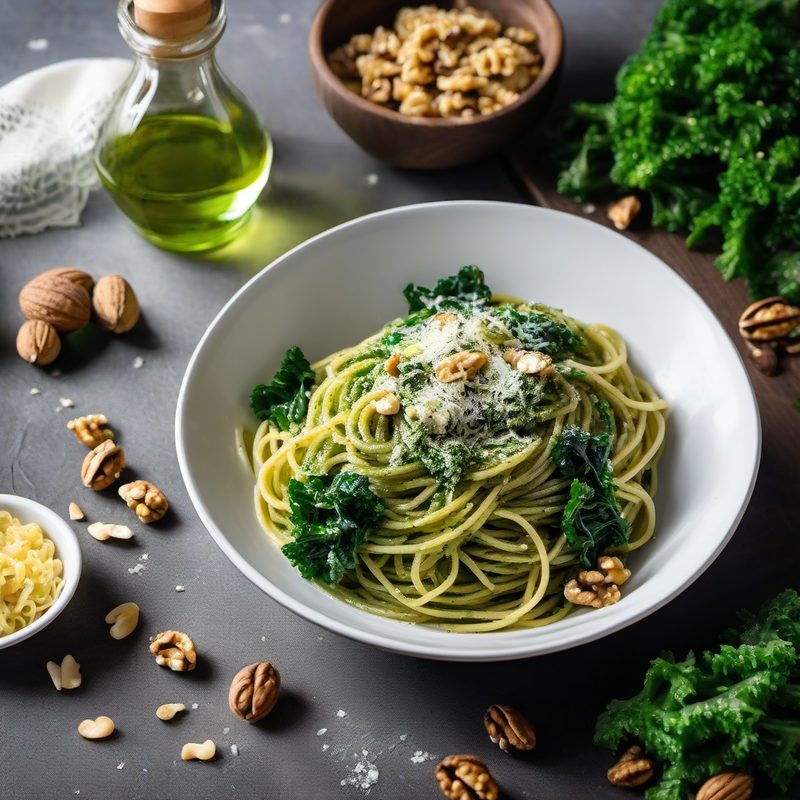
Spaghettini Kale Pesto
Category: Primi piatti
| Amount | Ingredient |
|---|---|
| 13 min | Pulse pesto → reserve 1 cup pasta water |
| 14 min | Drain spaghettini (al dente — watch closely, spaghettini cooks fast) |
| 15 min | Toss spaghettini with pesto and pasta water |
| 17 min | Adjust consistency, taste, and season |
| 19 min | Plate and serve with garnishes |
Servings: 4
Total Time: 25 minutes
Active Time: 20 minutes
Skill Level: Beginner
Source: Liguria-inspired — a refined take on kale pesto with delicate spaghettini
1. Why This Recipe Works
Spaghettini — the thinner, more delicate cousin of spaghetti — demands a sauce that clings without overwhelming. This kale pesto delivers exactly that: a vibrant, emerald-green emulsion that wraps each slender strand with peppery, nutty flavor without weighing it down. Blanching the lacinato kale for one minute in salted boiling water tames its tough texture and bitter edge while locking in a brilliant green color; shocking it in an ice bath fixes that hue and preserves a tender bite. Squeezing the blanched kale bone-dry concentrates its earthy intensity and prevents the pesto from turning watery — a critical step when pairing with the fine gauge of spaghettini, which can't support a loose, wet sauce. Walnuts provide an earthy, slightly bitter counterpoint to the kale's grassiness, while Parmigiano-Reggiano adds salty umami depth. A squeeze of fresh lemon juice brightens the whole sauce, and a splash of the starchy pasta water creates a silky, clingy emulsion that coats every strand of spaghettini perfectly. The result is a dish that is simultaneously robust and refined — rustic in spirit, elegant on the plate.
3. Before You Begin
- Spaghettini matters: Spaghettini is thinner than spaghetti (about 1.0–1.2 mm vs. 1.6–2.0 mm), which means it cooks faster and requires a lighter touch with the sauce. Do not substitute regular spaghetti without adjusting cooking time slightly upward — spaghettini typically cooks 1–2 minutes faster.
- Kale prep: Strip the kale leaves from the tough central ribs by running your hand along the stem from bottom to top. Discard the stems. Tear the leaves into roughly 3-inch pieces.
- Toast the walnuts (optional): Spread the walnuts in a dry skillet over medium heat and cook, shaking frequently, until fragrant and lightly golden, 3–4 minutes. Let cool completely before blending.
- Pasta water: Bring 4–5 quarts of water to a rolling boil and salt generously (1½ tbsp kosher salt per gallon). The pasta water serves double duty — it cooks the kale and the spaghettini, and the starchy water is essential for emulsifying the pesto.
- Grate your own cheese: Pre-shredded Parmesan contains anti-caking agents that prevent smooth blending. Grate from a wedge on the fine side of a box grater or Microplane.
- Work quickly at the end: The sauce comes together in the last minute — have the drained spaghettini, pesto, and a ladle of pasta water all at arm's reach before you start tossing.
4. Equipment
- Large pot (6–8 qt) for pasta and blanching
- Large bowl filled with ice water (ice bath)
- Colander or spider skimmer
- Food processor or high-speed blender
- Chef's knife and cutting board
- Box grater or Microplane
- Rubber spatula
- Tongs or pasta fork
- Measuring cups and spoons
- Paper towels or clean kitchen towel
- Large serving bowl (warmed)
5. Key Steps at a Glance
- Blanch kale → 1 minute in salted boiling water → plunge into ice bath → squeeze dry.
- Cook spaghettini → Reserve 1 cup pasta water → drain al dente.
- Blend pesto → Kale + walnuts + Parmesan + garlic + olive oil + lemon juice → pulse to a coarse, spreadable paste.
- Toss & finish → Combine hot spaghettini with pesto and reserved pasta water → toss until creamy and coated.
- Serve → Garnish with extra Parmesan, crushed walnuts, and a drizzle of olive oil.
6. Step-by-Step Instructions
Step 1: Blanch the Kale
- Bring a large pot of salted water to a rolling boil (you will use the same water for the spaghettini).
- Add the torn kale leaves and cook for exactly 1 minute. The leaves will turn a brilliant bright green and soften slightly — the kale should be tender but still hold its shape.
- Using a spider skimmer or tongs, immediately transfer the kale to a bowl of ice water. Swirl to cool completely — this stops the cooking and sets the color. This step is crucial: without the ice bath, residual heat will continue cooking the kale, turning it an unappealing olive-drab.
- Once cold (about 30 seconds), transfer the kale to a clean kitchen towel or several layers of paper towels. Wrap and squeeze firmly to remove as much water as possible. The kale should feel almost dry to the touch — a compact, dense ball with no dripping water. Squeeze harder than you think necessary; this single step makes the difference between a creamy pesto and a watery one. Set aside.
Step 2: Cook the Spaghettini
- Return the pot of water to a rolling boil (add more water if needed, and re-salt if you topped off).
- Add the spaghettini and cook according to package directions until al dente (about 1 minute less than the suggested time — spaghettini cooks quickly, typically 6–8 minutes, and the pasta will finish cooking in the sauce). Stir occasionally to prevent sticking.
- Reserve 1 cup (240 ml) of pasta cooking water.
- Drain the spaghettini in a colander. Do not rinse — the surface starch helps the sauce cling to the thin strands.
Step 3: Make the Kale Pesto
- While the spaghettini cooks, combine the squeezed-dry kale, toasted walnuts, grated Parmigiano-Reggiano, peeled garlic cloves, lemon juice, and a generous pinch of salt and black pepper in the bowl of a food processor.
- Pulse 5–6 times until the mixture is coarsely chopped and well combined — you want visible flecks of walnut and kale, not a uniform paste.
- With the motor running, drizzle in the 80 ml olive oil in a steady stream through the feed tube. Process until the pesto is thick, creamy, and mostly smooth but retains a little texture from the walnuts — about 20–30 seconds total. Scrape down the sides of the bowl once halfway through with a rubber spatula.
- Taste and adjust seasoning with additional salt, pepper, or lemon juice as needed. The pesto should be vividly green, savory, and bright — if it tastes flat, add another squeeze of lemon.
Step 4: Toss Spaghettini with Pesto
- Transfer the hot drained spaghettini to a large warmed serving bowl or return it to the now-empty pasta pot.
- Add the kale pesto and ¼ cup (60 ml) of the reserved pasta water.
- Toss vigorously with tongs until the pesto coats every strand evenly. Because spaghettini is thinner than regular spaghetti, the sauce should be slightly looser — aim for a silky, clingy consistency where each strand is slicked with green but not swimming.
- If the sauce seems too thick, add more pasta water 1 tablespoon at a time, tossing after each addition, until you reach a silky, spoon-coating consistency. Spaghettini benefits from a slightly looser sauce than thicker pasta shapes — aim for a consistency where the sauce flows gently off the tongs.
- Taste and adjust seasoning with salt and pepper.
Step 5: Serve
- Divide the spaghettini among warmed serving bowls, twirling each portion into a neat nest using tongs.
- Top each portion with a generous grating of Parmigiano-Reggiano, a sprinkle of crushed toasted walnuts, and a light drizzle of extra-virgin olive oil. Finish with a final crack of black pepper. Serve immediately — spaghettini cools faster than thicker pasta, so speed matters.
7. Visual Cues — What to Look For
| Step | Visual Cue |
|---|---|
| Blanched kale | Brilliant bright green; tender but not mushy |
| Squeezed kale | Forms a compact, nearly dry mass; no water drips when squeezed |
| Pesto in processor | Thick, spreadable paste with small walnut flecks; vivid emerald green |
| Cooked spaghettini | Slender, tender with a tiny white heart at the center (al dente) |
| Pesto coating spaghettini | Each thin strand slicked with green; no pools of oil at the bottom of the bowl |
| Final consistency | Sauce clings to pasta; a spoonful of accumulated sauce is creamy, not watery |
| Plated dish | Neat twirled nest of green-slicked pasta with flecks of walnut and white cheese |
8. Recipe Notes & Troubleshooting
| Issue | Cause | Fix |
|---|---|---|
| Pesto tastes bitter | Kale not blanched long enough; walnuts burned | Blanch full 1 minute; toast walnuts on medium heat, not high |
| Pesto is too thick / won't coat spaghettini | Not enough pasta water added | Add reserved pasta water 1 tbsp at a time while tossing — spaghettini needs a looser sauce |
| Pesto is watery / thin | Kale not squeezed dry enough | Squeeze more firmly next time; add extra walnuts (1 tbsp) to absorb moisture |
| Pesto turned brown / dull | Kale not shocked in ice water; over-processed | Always use ice bath; pulse, don't let motor run continuously |
| Spaghettini clumps together | Drained too early; not tossed immediately | Toss with pesto immediately after draining; work quickly |
| Sauce doesn't cling | Pasta rinsed after draining | Never rinse pasta — surface starch is essential for emulsification |
| Spaghettini is mushy | Overcooked | Spaghettini cooks fast (6–8 min); start checking 1 minute before package time |
| Pesto tastes flat | Not enough salt or lemon | Season generously; lemon brightness is non-negotiable for kale pesto |
9. Make-Ahead Tips
- Pesto (up to 3 days ahead): Transfer the finished kale pesto to an airtight container. Press a layer of plastic wrap directly onto the surface (to prevent oxidation — chlorophyll exposed to air turns brown) and seal with a lid. Refrigerate for up to 3 days. Bring to room temperature before tossing with hot spaghettini, then add an extra tablespoon of pasta water to revive the emulsion.
- Freezing (up to 3 months): Spoon the pesto into an ice cube tray, freeze until solid (about 3 hours), then transfer cubes to a freezer bag, pressing out as much air as possible. Thaw overnight in the refrigerator or add frozen cubes directly to hot spaghettini (stir vigorously to melt and emulsify).
- Spaghettini (not recommended): Cooked pesto pasta does not keep well — the sauce separates and the thin pasta turns mushy upon reheating. Best enjoyed immediately.
10. Variations
- Traditional basil pesto: Replace kale with 100 g fresh basil leaves (no blanching needed — use raw). Substitute pine nuts for walnuts. Spaghettini with classic pesto is a Genovese staple — reduce pasta water to 3 tablespoons as basil pesto is more fluid.
- Spicy kale pesto: Add ½ teaspoon red pepper flakes to the food processor with the kale. The heat cuts through the richness beautifully and complements the spaghettini's delicate texture.
- Vegan / dairy-free: Replace Parmigiano-Reggiano with 3 tablespoons nutritional yeast + 1 additional tablespoon toasted walnuts. Use a rich, fruity olive oil.
- Almond-kale pesto: Substitute 50 g blanched almonds for the walnuts. Almonds give a milder, sweeter note that pairs elegantly with thin spaghettini.
- Minty kale pesto: Replace 25 g of the kale with fresh mint leaves (about ½ cup packed) for a bright, refreshing twist — excellent served with grilled shrimp alongside.
- Spaghettini with kale and breadcrumbs: After tossing, top with ¼ cup of toasted panko breadcrumbs tossed in olive oil and garlic for a crunchy contrast to the tender pasta.
11. Wine & Drink Pairing
- White: A crisp, herbaceous Vermentino di Liguria or a grassy Sauvignon Blanc — the herbal notes mirror the kale, and the acidity cuts through the richness. The wine's salinity also echoes the pasta water seasoning.
- Light red: A chillable Dolcetto or Bardolino — low tannins and bright red fruit won't overpower the delicate spaghettini or the pesto's peppery notes.
- Rosé: A dry Provençal-style rosé with citrus and herb notes complements the lemon and olive oil.
- Sparkling: A brut Prosecco or Franciacorta — the fine bubbles and crisp acidity cut through the creamy pesto and refresh the palate between bites.
- Non-alcoholic: Sparkling water with a squeeze of lemon and a basil leaf; or an iced green tea with mint.
12. Serving Suggestions
- Serve with warm, crusty bread to mop up any remaining pesto at the bottom of the bowl — the thin sauce pools elegantly.
- A simple side salad (baby arugula, shaved Parmesan, lemon vinaigrette) adds freshness and crunch that contrasts with the tender spaghettini.
- Top with halved cherry tomatoes quickly sautéed in olive oil until just softened — their sweetness bursts against the peppery kale pesto.
- For a heartier meal, add pan-seared shrimp or grilled chicken breast (sliced thin) on top. The delicate pasta pairs especially well with seafood.
- Finish with a final crack of black pepper and a few flakes of Maldon sea salt for textural contrast.
- For an elegant presentation, twirl each serving into a tall nest using a carving fork and tongs, then garnish in the center.
13. Nutritional Information (per serving)
Approximate values based on ingredients listed; actual values may vary. Spaghettini is slightly lighter than regular spaghetti, contributing to the marginally lower calorie count compared to the same recipe with standard spaghetti.
14. Prep Timeline & Workflow
| Time Elapsed | Action |
|---|---|
| 0 min | Bring pot of salted water to a rolling boil |
| 5 min | Strip kale leaves from stems; tear into pieces |
| 7 min | Prepare ice water bath |
| 8 min | Blanch kale (1 min) → transfer to ice bath → squeeze dry |
| 9 min | Add spaghettini to boiling water |
| 11 min | Toast walnuts (if using) → let cool |
Note: Spaghettini typically cooks in 6–8 minutes. The timeline assumes a 7-minute cook time.
15. Allergen Information
- Contains: Wheat/gluten (spaghettini), tree nuts (walnuts), dairy (Parmigiano-Reggiano)
- Free from: Eggs, shellfish, peanuts, soy, fish, sesame (as written)
- May contain: Traces of other tree nuts if walnuts were processed on shared equipment
- Note: Spaghettini is typically egg-free (made from durum wheat semolina and water), but check packaging if you have egg allergies
16. Regional Background
Pesto alla Genovese — the basil, pine nut, and Parmigiano emulsion from Liguria — is one of Italy's most famous sauces, traditionally paired with trofie or linguine. The substitution of cavolo riccio (lacinato kale, also called Tuscan kale or dinosaur kale) for basil is a modern, innovative twist embraced by contemporary Italian cooks seeking deeper flavor and greater nutritional density. Kale, a hardy winter green that thrives in the cool months of Northern and Central Italy, brings a more assertive, peppery character than basil, along with superior nutritional value — it is rich in vitamins A, C, and K, as well as iron and calcium.
The choice of spaghettini over the more common linguine or trofie is a deliberate refinement. Spaghettini (spaghetti sottili in Italian) originated in Southern Italy's Campania region, where it is traditionally served with lighter, more delicate sauces — think aglio e olio or simple tomato condiments. Pairing it with kale pesto bridges Northern and Southern Italian traditions: the creamy, nutty sauce of Liguria meets the slender, elegant pasta of Naples. The result is a dish that respects both traditions while creating something entirely new — proof that Italian cooking is not a static canon but a living, evolving conversation between regions, seasons, and ingredients.
The use of walnuts (noci) instead of the traditional pine nuts (pinoli) is equally deliberate: walnuts are more affordable, widely available across Italy's mountainous interior, and their slightly bitter, earthy flavor stands up to kale's boldness better than the sweet delicacy of pine nuts. In Tuscany and Umbria, walnut-based pestos (pesto di noci) have a long history of their own, often served with fresh pasta and creamy sauces — this recipe subtly nods to those traditions while keeping its Ligurian soul.
17. Scaling
- For 2 servings: Halve all ingredients. Use 175 g spaghettini, 100 g kale, 25 g walnuts, 25 g Parmesan, 1 garlic clove, 40 ml olive oil, ½ tbsp lemon juice. Blanching and blending time are unchanged. Cook spaghettini in a smaller pot to ensure proper water-to-pasta ratio.
- For 8 servings: Double all ingredients. Blanch kale in two batches or use a larger pot to avoid crowding. Blend pesto in two batches in the food processor (it won't fit all at once). Cook spaghettini in two batches or use the largest pot available — spaghettini strands are delicate and prone to clumping in an overcrowded pot. Use a 14-inch skillet or extra-large serving bowl for tossing.
18. Conversion Table (Volume)
| Metric | US Standard |
|---|---|
| 5 ml | 1 tsp |
| 15 ml | 1 tbsp |
| 60 ml | ¼ cup |
| 80 ml | ⅓ cup |
| 240 ml | 1 cup |
| 50 g walnuts | ≈ ½ cup |
| 50 g Parmesan | ≈ ½ cup grated |
| 200 g kale | ≈ 8 cups packed torn leaves |
| 350 g spaghettini | ≈ 12 oz |
19. Chef's Final Notes
- Don't skip the squeeze. The single most important step for a vibrant, creamy pesto is squeezing the blanched kale absolutely dry. Residual water dilutes the oil, prevents emulsification, and turns the pesto grayish. When you think you've squeezed enough, squeeze again — your hands will ache, but the pesto will reward you.
- Watch spaghettini like a hawk. Its thinness means it goes from perfectly al dente to mushy in about 60 seconds. Start tasting 2 minutes before the package time. The perfect strand offers gentle resistance when bitten with no chalky white center — just a tiny white pinpoint.
- Salt the pasta water aggressively. It should taste like the sea. The spaghettini's interior gets seasoned from the inside out, and that seasoning carries into the final dish. Undersalted pasta water is the most common reason restaurant pesto tastes better than home versions.
- Reserve more pasta water than you think you need. The starchy water is the key to a silky, emulsified sauce. You may not use all of it, but running out mid-toss is a recipe for a dry, clumpy mess. For spaghettini, err on the side of a looser sauce — thin strands need more help staying separate.
- Don't over-process the pesto. A coarse, rustic texture with visible walnut and kale flecks is far more appealing than a homogenized green paste. Pulse, don't let the motor run. The pesto should look a bit like a chunky green spread, not baby food.
- Serve immediately. Pesto pasta waits for no one, and spaghettini waits even less — its slender profile cools and absorbs sauce faster than thicker pasta. If you must hold it, toss with an extra tablespoon of pasta water just before serving to revive the emulsion.
- The lemon juice is non-negotiable. Even a small squeeze brightens the entire dish, cutting through the kale's earthiness and the oil's richness. Taste the pesto before adding it — if it tastes flat or muddy, add a few more drops. The lemon is what makes the kale sing rather than just taste like cooked greens.
- Temperature matters. Warm the serving bowls in a low oven (200°F / 95°C) or with hot water while you cook. Spaghettini served on cold plates will seize up and clump within minutes.
Recipe from The Italian Kitchen by Vita Milanese — Volume 1 · Pasta Perfetto. Discover all volumes on the ebook page.