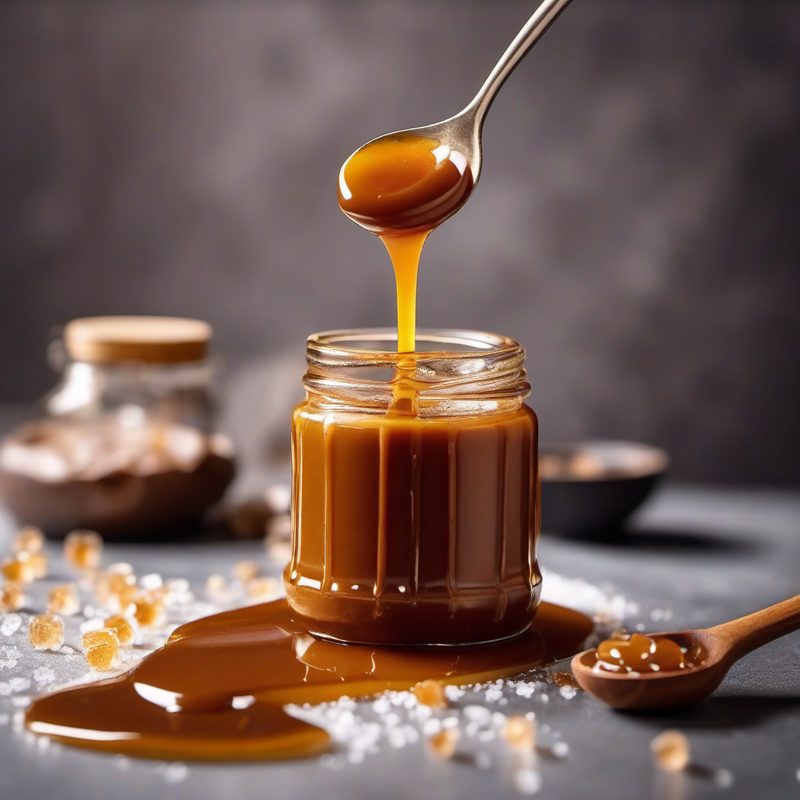
Salted Caramel Sauce
A luxuriously rich, deeply amber salted caramel sauce that strikes the perfect balance between sweet and savory — silky, pourable, and made with just four ingredients in under 15 minutes, with a flaky sea salt finish that transforms everything from ice cream to apple pie into something extraordinary.
This is the salted caramel sauce that every home cook should have in their repertoire. Made with nothing more than sugar, butter, cream, and salt, it is a masterclass in transformation — plain granulated sugar, coaxed over medium heat into a deep amber liquid, then emulsified with cold butter and warm cream into a glossy, pourable sauce that is simultaneously buttery, sweet, and complex. The flaky sea salt is the crucial final touch: it cuts through the sweetness, amplifies the caramel's depth, and adds delicate bursts of salinity with every bite. The technique is straightforward — the key is patience with the caramelization and careful temperature control when adding the butter and cream to prevent the sauce from seizing or separating. Once you master this recipe, you will never buy jarred caramel sauce again.
Ingredient notes: Use pure granulated white sugar — do not use brown sugar, raw sugar, or sugar substitutes. Brown sugar contains molasses that will burn at caramelization temperatures, and raw sugar crystals are too large to melt evenly. The sugar is the foundation of the sauce; its quality matters. Use unsalted butter — salted butter contains varying amounts of salt that make it impossible to control the final seasoning, and the salt content can affect the caramelization process. Cut the butter into small cubes (about ½-inch / 1 cm) and let it come to room temperature; cold butter will cause the hot caramel to seize and splatter violently. Heavy cream (35–40% milk fat) is essential — it provides the richness and body that define a proper caramel sauce. Do not substitute half-and-half, whole milk, or low-fat cream; the sauce will be thin and may separate. Use a good-quality flaky sea salt — Maldon sea salt or fleur de sel are ideal. Their large, delicate crystals provide bursts of clean salinity that fine table salt cannot replicate. Fine salt will dissolve completely and produce a uniformly salty sauce rather than one with distinct salty pops. If you only have fine salt, use ½ teaspoon and whisk it in completely — the result will be different but still good.
- Heavy-bottomed saucepan (2- to 3-quart / 2–3 L, preferably light-colored so you can see the caramel color)
- Heatproof silicone spatula or wooden spoon
- Whisk
- Measuring cups and spoons
- Kitchen scale (recommended for the sugar)
- Glass jar or heatproof container (for storage)
- Pastry brush and small bowl of water (for washing down sugar crystals — optional but recommended)
- Prepare the ingredients (2 min). Before you begin, measure and prepare all ingredients. Cube the butter and let it sit at room temperature. Measure the cream and let it sit at room temperature. Have the flaky sea salt measured and ready. Caramel moves fast once it starts to color, and you will not have time to measure or cube while the sugar is cooking.
- Start the caramel (5–8 min). Place the sugar in an even layer in the heavy-bottomed saucepan. Set the pan over medium heat. Let the sugar heat undisturbed for 1–2 minutes, until the edges begin to melt and turn translucent. Using a heatproof silicone spatula, begin stirring gently, pushing the melted sugar from the edges toward the center. Continue cooking, stirring occasionally, until the sugar is fully melted and has turned a deep amber color — the color of a new penny or dark honey. This process takes 5–8 minutes total. Watch carefully in the final 2 minutes — caramel goes from perfect to burnt very quickly. If you see wisps of smoke or smell a bitter, burnt note, remove the pan from the heat immediately.
- Remove from heat and add the butter (1 min). As soon as the caramel reaches deep amber, remove the pan from the heat entirely. Add the cubed butter all at once. The mixture will bubble vigorously — this is normal and expected. Whisk constantly until the butter is fully melted and incorporated. The sauce will be thin, bubbly, and slightly separated at this point — do not worry, it will come together in the next step.
- Add the cream (1 min). Slowly pour the room-temperature heavy cream into the caramel in a steady stream while whisking constantly. The mixture will bubble up dramatically — use a deep enough pan and pour carefully. Continue whisking until the cream is fully incorporated and the sauce is smooth, glossy, and homogenous.
- Add the salt (30 sec). Whisk in the flaky sea salt. If you want distinct bursts of salt in the finished sauce, stir gently — just enough to distribute the salt without dissolving it completely. If you prefer a uniformly salted sauce, whisk vigorously until the salt is fully dissolved. The choice is yours.
- Cool and store (5 min). Let the sauce cool in the pan for 5 minutes, then transfer it to a glass jar or heatproof container. The sauce will be thin while warm but will thicken significantly as it cools to room temperature. Do not refrigerate the sauce while it is still warm — let it cool completely on the counter before covering and refrigerating.
- Storage. Store in an airtight glass jar in the refrigerator for up to 2 weeks. The sauce will become very thick and firm when cold — almost like soft fudge. To use, reheat gently (see Reheating in the Storage section below).
- Serving Suggestions. Drizzle over vanilla ice cream, gelato, or affogato; spoon over warm apple pie, apple crisp, or baked apples; use as a topping for brownies, blondies, or chocolate cake; swirl into hot chocolate, coffee, or milkshakes; drizzle over pancakes, French toast, or waffles; serve alongside fresh fruit (sliced pears, apples, bananas, or berries); use as a dip for apple slices, pretzels, or shortbread cookies; stir into oatmeal or yogurt; or drizzle over cheesecake, panna cotta, or flan.
- Use a light-colored saucepan. A silver or stainless steel pan allows you to see the true color of the caramel as it develops. Dark nonstick pans and anodized aluminum make it nearly impossible to judge the color accurately, increasing the risk of burning.
- Wash down sugar crystals from the sides of the pan. As the sugar melts, crystals often form on the sides of the pan above the liquid caramel. If these fall back into the caramel, they can cause the entire batch to crystallize and seize into a grainy, unusable mess. To prevent this, dip a pastry brush in water and brush down the sides of the pan whenever you see crystals forming. Alternatively, cover the pan with a lid for 1–2 minutes at the beginning — the steam will wash the sides down naturally.
- Do not walk away from the pan. Caramelization requires your full, undivided attention. The sugar will show no color for several minutes, then darken rapidly in the final minute. Standing at the stove, watching, is the only way to ensure you catch it at the perfect deep amber stage.
- Trust the color, not the timer. The exact time will vary based on your stove, pan, and sugar quantity. The color is the only reliable indicator. Aim for a deep amber — the color of a copper penny or dark honey. If you are unsure, err on the side of slightly lighter rather than darker. A slightly lighter caramel will still taste good; a burnt caramel is bitter and cannot be saved.
- Room-temperature butter and cream are non-negotiable. Cold ingredients shock the hot caramel, causing it to seize, splatter violently, or separate. Let both the butter and cream sit at room temperature for at least 30 minutes before starting. If you forget, cut the butter into very small cubes and warm the cream gently (not hot — just barely warm to the touch) in the microwave for 10–15 seconds.
- Use a deep enough pan. The caramel bubbles up dramatically when you add the cream — it can triple in volume for a few seconds. A 2-quart (2 L) saucepan is the minimum; a 3-quart (3 L) pan is even safer. Do not use a shallow skillet or sauté pan.
- Let the sauce cool before judging the consistency. Warm caramel sauce is significantly thinner than the final product. As it cools to room temperature, it will thicken to a pourable but luxurious consistency. If it is still too thin after cooling completely, return it to the pan and simmer gently for 1–2 minutes to reduce and concentrate. If it is too thick, stir in warm cream 1 tablespoon at a time until it reaches your desired consistency.
| Mistake | Why It Hurts | The Fix |
|---|
- Vanilla Bean Caramel: Split 1 vanilla bean lengthwise and scrape the seeds into the cream before adding. Warm the cream gently with the vanilla pod and seeds, then remove the pod before adding the cream to the caramel. The vanilla adds a floral, aromatic depth that is beautiful with fruit desserts.
- Coffee Caramel: Add 1 tablespoon of instant espresso powder or finely ground coffee to the cream and stir until dissolved before adding to the caramel. The coffee adds complexity and a subtle bitterness that balances the sweetness.
- Bourbon or Rum Caramel: After removing the pan from the heat and adding the cream, stir in 1–2 tablespoons of bourbon, dark rum, or Calvados. Stir gently — the alcohol may sputter. The spirit adds warmth, complexity, and a grown-up edge.
- Spiced Caramel: Add ½ teaspoon of ground cinnamon, ¼ teaspoon of ground ginger, and a pinch of ground cloves to the cream before adding. This spiced version is spectacular over apple pie, pumpkin pie, or spiced cakes.
- Chocolate Caramel: Add 30 g (1 oz) of finely chopped dark chocolate (70% cacao) along with the butter, whisking until melted and smooth. The chocolate adds richness and a slight bitterness that plays beautifully against the salt.
- Citrus Caramel: Add 1 teaspoon of finely grated orange zest along with the salt. The bright citrus oils cut through the caramel's sweetness and add a fresh, aromatic note.
- Smoked Salt Caramel: Substitute the flaky sea salt with smoked flaky salt (such as smoked Maldon). The smokiness adds an intriguing, savory depth that is extraordinary over ice cream or dark chocolate desserts.
- Dairy-Free / Vegan Caramel: Substitute the butter with 90 g (6 tbsp) of refined coconut oil or vegan butter, and substitute the heavy cream with full-fat coconut cream (the thick, solid part from a can of chilled full-fat coconut milk). The sauce will have a subtle coconut flavor and a slightly different texture — still delicious, especially over tropical desserts or brownies.
| Storage Method | Details |
|---|---|
| Room Temperature | The sauce can be stored in an airtight glass jar at cool room temperature (below 70°F / 21°C) for up to 5 days. This is ideal if you plan to use it within a few days — the texture stays perfectly pourable. |
| Refrigerator | Store in an airtight glass jar for up to 2 weeks. The sauce will become very thick and fudge-like when cold. This is normal. To use, reheat gently. |
| Freezer | Freeze in an airtight container for up to 3 months. Leave ½ inch (1 cm) of headspace for expansion. Thaw overnight in the refrigerator, then reheat gently. The sauce retains its texture and flavor exceptionally well after freezing. |
This is a dessert sauce, so pairings depend on what you are serving it with:
- Over vanilla ice cream or gelato: A sweet Vin Santo or Pedro Ximénez Sherry — the wine's raisiny, caramel notes mirror the sauce and create a decadent, harmonious finish.
- Over apple pie or apple crisp: A late-harvest Riesling or a chilled Moscato d'Asti — the wine's sweetness and bright fruit stand up to both the apples and the caramel.
- Over chocolate cake or brownies: A Ruby Port or a Brachetto d'Acqui — the wine's dark fruit and slight sweetness complement both the chocolate and the caramel.
- Over cheesecake or panna cotta: A Tokaji Aszú — the wine's honeyed richness and bright acidity cut through the creamy dessert and the sweet-salty caramel.
- With coffee or affogato: A shot of aged rum or Calvados stirred into the coffee alongside the caramel — the spirit's warmth and complexity elevate the entire experience.
- Non-alcoholic: A cold, creamy oat milk or a strong, unsweetened black tea — the bitterness of the tea balances the sweetness of the caramel beautifully.
| Per Serving (about 2 tbsp / 30 ml) | |
|---|---|
| Calories | 190 |
| Protein | 0.5 g |
| Fat | 13 g |
| Carbohydrates | 20 g |
| Fiber | 0 g |
| Sugar | 20 g |
| Sodium | 220 mg |
Nutrition values are approximate and based on granulated sugar, unsalted butter, heavy cream, and flaky sea salt. Actual values will vary based on butter brand, cream fat content, and exact quantities. Serving size is a generous drizzle — adjust according to your dessert and your conscience.
Why did my caramel seize and turn into a hard, grainy mass?
This is crystallization, and it happens when a stray sugar crystal falls into the melting sugar and triggers the entire batch to solidify. To prevent this: (1) wash down the sides of the pan with a wet pastry brush as the sugar melts; (2) do not stir aggressively; (3) use a clean, dry pan with no residual food particles. If crystallization happens, unfortunately, the batch cannot be saved. Start over with fresh sugar and a clean pan.
Can I use a candy thermometer?
You can, but it is not necessary and can be misleading. The temperature of caramel rises very quickly once the sugar is melted, and the final color is a more reliable indicator than the temperature. If you want to use a thermometer, aim for 340–350°F (170–177°C) for a deep amber caramel. Clip the thermometer to the side of the pan and watch both the temperature and the color.
Why did my sauce separate into greasy liquid and watery liquid?
Separation usually happens for one of two reasons: (1) the cream was too cold when added — it shocked the caramel and the fat did not emulsify properly; (2) the sauce was overheated after the cream was added. To fix a separated sauce, transfer it to a blender or use an immersion blender to re-emulsify it. Blend on low speed until the sauce comes back together into a smooth, glossy emulsion.
My sauce is too thick. How do I thin it?
Warm the sauce gently over low heat and stir in heavy cream (room temperature) 1 tablespoon at a time until it reaches your desired consistency. If you do not have cream, warm milk or even a splash of warm water will work, though the sauce will be slightly less rich.
My sauce is too thin. How do I thicken it?
Return the sauce to the saucepan and simmer over medium-low heat, stirring constantly, for 1–3 minutes. The sauce will reduce and thicken as water evaporates. Be careful not to overcook it — it will thicken further as it cools.
Can I make this with brown sugar?
Brown sugar contains molasses, which burns at a lower temperature than white sugar. The result will be a darker, more molasses-forward sauce with a slightly different flavor profile — still delicious, but it is technically a butterscotch sauce rather than a true caramel. If you want to try it, reduce the heat slightly and watch very carefully to avoid burning.
Can I double the recipe?
Yes. The recipe doubles (or triples) beautifully. Use a larger pan (at least 4-quart / 4 L) to accommodate the increased bubbling when adding the cream. The timing will be slightly longer for the sugar to melt and caramelize, but the visual cues (deep amber color) remain the same.
- Classic Butterscotch Sauce (Volume 1)
- Chocolate Ganache (Volume 1)
- Lemon Curd (Volume 1)
- Crème Anglaise (Volume 2)
- Warm Vanilla Sauce (Volume 1)
Recipe from "The Italian Kitchen" by Vita Milanese — Volume 2: Sunday Sauce
Recipe from The Italian Kitchen by Vita Milanese — Volume 2 · Sunday Sauce. Discover all volumes on the ebook page.