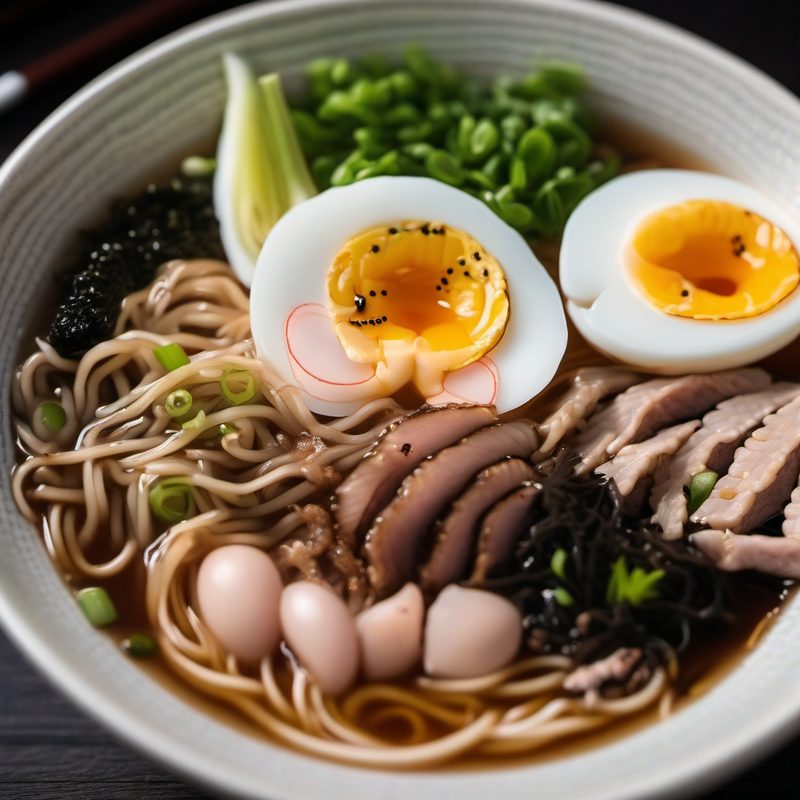
Japanese Soy Sauce Ramen Broth
A deeply savory, umami-rich ramen bowl built around a soy sauce broth base, tender soy-marinated eggs, and slow-cooked roasted pork — a complete, restaurant-quality bowl assembled from components that each build layer upon layer of flavor, the kind of bowl that rewards patience with every single slurp.
| Amount | Ingredient |
|---|---|
| 400 g (14 oz) | fresh or dried ramen noodles |
| 100 g (¾ cup) | sweet corn kernels (fresh or frozen) |
| 100 g (1 cup) | green cabbage, finely shredded |
| 100 g (1 cup) | bean sprouts |
| 60 g (½ cup) | crispy fried onions (store-bought or homemade) |
| 4 | scallions, thinly sliced on the diagonal |
| 1 tbsp (15 ml) | toasted sesame oil (for drizzling) |
This is authentic Japanese shoyu ramen, built from four distinct components that come together in a single, magnificent bowl. The soy-marinated eggs (shoyu tamago) are soft-boiled to jammy perfection, then steeped in a sweet-savory soy marinade until they take on a deep amber hue and a luscious, seasoned interior. The roasted pork slices (chashu) are cooked low and slow in a soy-based braising liquid until knife-tender, then sliced and seared for caramelized edges. The soy sauce broth is the backbone — a rich, clear chicken or pork stock seasoned with soy sauce, mirin, sake, garlic, and ginger for a broth that is simultaneously bold, aromatic, and clean. And finally, the toppings — sweet corn, shredded cabbage, bean sprouts, crispy fried onions, and fresh scallions — add texture, color, and freshness that cut through the richness. Each component can be made ahead, and the final assembly is swift: noodles, broth, toppings. This is ramen as it should be: intentional, layered, and deeply satisfying.
For the Soy-Marinated Eggs (Shoyu Tamago)
For the Chashu (Braised Pork Belly)
For the Soy Sauce Broth Base
For Assembly
Ingredient notes: Use large eggs — not extra-large or jumbo — for the most reliable soft-boiled timing. Room-temperature eggs cook more evenly than cold eggs straight from the refrigerator. For the best flavor in the broth, use homemade chicken or pork stock (see related recipes). Store-bought stock can be substituted but choose a low-sodium variety and adjust the soy sauce accordingly. For the chashu, pork belly with even layers of fat and meat is ideal — the fat renders during braising and keeps the meat moist and tender. If pork belly is unavailable, pork shoulder (butt) can be substituted; the texture will be slightly different but still delicious. Fresh ramen noodles are preferred for their chewy, springy texture; if using dried ramen noodles, cook according to package directions and do not overcook. Mirin is a sweet Japanese rice wine; it adds a gentle sweetness and gloss to both the eggs and the broth. Do not substitute with honey or sugar alone — the flavor profile will be noticeably different. Sake adds a subtle depth and complexity; a dry drinking sake is ideal. If unavailable, dry sherry or Chinese rice wine is an acceptable substitute. Toasted sesame oil is used as a finishing drizzle — it adds a nutty, aromatic note that ties the bowl together.
- Large pot (6-quart / 6 L) for boiling eggs and blanching vegetables
- Medium saucepan (2-quart / 2 L) for the egg marinade
- Dutch oven or heavy-bottomed pot (4- to 5-quart / 4–5 L) for the chashu
- Large stockpot (6- to 8-quart / 6–8 L) for the broth
- Sharp chef's knife and cutting board
- Kitchen twine (for tying the pork belly)
- Slotted spoon
- Spider skimmer or fine-mesh strainer
- Mixing bowls
- Airtight container (for marinating eggs)
- Plastic wrap
- Kitchen timer
- Measuring cups and spoons
- Kitchen scale
Make the Soy-Marinated Eggs
- Prepare an ice bath (1 min). Fill a medium bowl with ice and cold water. Set aside near the stove.
- Soft-boil the eggs (7 min). Bring a large pot of water to a rolling boil (enough water to cover the eggs by at least 2 inches / 5 cm). Gently lower the room-temperature eggs into the boiling water using a slotted spoon. Boil for exactly 6 minutes and 30 seconds for a jammy yolk (the white should be fully set, the yolk creamy and slightly runny). For a firmer yolk, boil for 7 minutes and 30 seconds.
- Shock the eggs (5 min). Using a slotted spoon, transfer the eggs immediately to the ice bath. Let them cool for 5 minutes, then carefully peel under cold running water. The ice bath stops the cooking instantly and makes the eggs easier to peel.
- Make the marinade (5 min). In a small saucepan, combine the soy sauce, mirin, sake, and sugar. Bring to a gentle boil over medium heat, stirring to dissolve the sugar. Remove from heat and let cool to room temperature (about 15–20 minutes). Do not add warm marinade to the eggs — it will continue to cook them.
- Marinate the eggs (3 hours). Place the peeled soft-boiled eggs in a small container or zip-top bag. Pour the cooled marinade over the eggs — they should be fully submerged. If needed, place a crumpled piece of plastic wrap or a small plate directly on top of the eggs to keep them submerged. Refrigerate for at least 3 hours and up to 12 hours. The longer they marinate, the deeper the color and flavor, but beyond 12 hours the eggs can become too salty and the texture may turn rubbery.
- Remove and reserve (5 min). After marinating, remove the eggs from the marinade. Reserve the marinade — it can be used as a finishing drizzle or added to the broth (strain it through a fine-mesh sieve first). The eggs can be stored in an airtight container in the refrigerator for up to 3 days.
Make the Chashu (Braised Pork Belly)
- Prepare the pork belly (5 min). Pat the pork belly dry with paper towels. If the piece is uneven in thickness, roll it tightly and tie it with kitchen twine at 1-inch (2.5 cm) intervals to create an even cylinder. This ensures uniform cooking and makes slicing easier later.
- Combine braising liquid (2 min). In the Dutch oven, combine the soy sauce, sake, mirin, sugar, smashed garlic, and sliced ginger. Add 500 ml (2 cups) of water. Stir to dissolve the sugar.
- Braise the pork (2–3 hours). Add the pork belly to the Dutch oven. The liquid should come about halfway up the sides of the pork — if it doesn't, add more water. Bring the liquid to a gentle simmer over medium heat. Once simmering, reduce the heat to low, cover tightly, and cook for 2–3 hours, flipping the pork every 30 minutes, until the meat is knife-tender — a skewer or fork should slide in with no resistance. The exact time depends on the thickness of the pork belly. Check at 2 hours and continue in 15-minute increments if needed.
- Rest and chill (1 hour minimum). Remove the pork from the braising liquid and place it on a plate or cutting board. Let it rest until cool enough to handle, then wrap tightly in plastic wrap and refrigerate for at least 1 hour. Chilling the pork makes it much easier to slice cleanly into thin, uniform pieces. Reserve the braising liquid — strain it through a fine-mesh sieve and store it separately.
- Slice and sear (5 min). Once chilled, slice the pork belly crosswise into ¼-inch (6 mm) thick slices. Just before serving, sear the slices in a hot, dry skillet or under the broiler for 1–2 minutes per side until the edges are caramelized and the fat is rendered. This step adds texture and deepens the flavor.
Make the Soy Sauce Broth
- Simmer the broth (30 min). In a large stockpot, combine the chicken or pork stock, soy sauce, mirin, sake, smashed garlic, and sliced ginger. Bring to a gentle simmer over medium heat, then reduce the heat to low and simmer for 30 minutes. Do not boil — boiling can make the broth cloudy and harsh.
- Strain (2 min). Remove the pot from the heat. Using a fine-mesh strainer, strain the broth into a clean pot or large bowl, discarding the solids. Keep the broth warm over low heat until ready to serve.
Assemble the Bowl
- Cook the noodles (3–4 min). Bring a large pot of water to a rolling boil. Cook the ramen noodles according to package directions until just tender — fresh noodles typically take 2–3 minutes, dried noodles 3–4 minutes. Drain well. Do not rinse — the starch on the noodles helps the broth cling to them.
- Blanch the vegetables (2 min). While the noodles cook, blanch the bean sprouts in the noodle-cooking water for 30 seconds. Remove with a spider skimmer. Then blanch the shredded cabbage for 1 minute. Drain both well.
- Halve the eggs (1 min). Slice each marinated egg in half lengthwise. The yolks should be jammy and slightly runny.
- Warm the pork (1 min). If you haven't already, sear the sliced chashu in a hot skillet for 1–2 minutes per side until caramelized and hot.
- Assemble (2 min per bowl). Divide the cooked noodles evenly among 4 deep serving bowls (about 100 g / 3.5 oz noodles per bowl). Ladle about 375 ml (1½ cups) of hot broth over the noodles in each bowl. Arrange the toppings neatly on top: 3–4 slices of chashu, 1 halved egg, a small pile of sweet corn, a handful of blanched cabbage, a small pile of bean sprouts, a generous sprinkle of crispy fried onions, and a shower of sliced scallions. Drizzle a few drops of toasted sesame oil over each bowl.
- Serve immediately. Ramen waits for no one — the noodles will continue to cook in the hot broth and will become soft and soggy within minutes. Serve with the reserved chashu braising liquid or extra soy sauce on the side for diners who want a more intense flavor.
| Mistake | Why It Hurts | The Fix |
|---|---|---|
| Overcooking the soft-boiled eggs | The yolks become fully firm and chalky instead of jammy and creamy | Use a kitchen timer for exactly 6 minutes 30 seconds; immediately transfer to an ice bath to stop the cooking |
| Marinating the eggs too long (over 12 hours) | The eggs become overly salty, the whites turn rubbery and tough, and the texture becomes unpleasant | Remove eggs from the marinade after 3–12 hours; do not exceed 12 hours |
- Spicy Miso Ramen: Omit the soy sauce and add 3 tablespoons of white or red miso paste to the broth (dissolve the miso in a small amount of hot broth before adding to the pot). Add 1 tablespoon of gochujang (Korean chili paste) or chili oil. Top with a dollop of chili crisp and a sprinkle of shichimi togarashi (Japanese seven-spice).
- Shio (Salt) Ramen: Replace the soy sauce with 2 tablespoons of sea salt dissolved in the broth. Use a clear chicken stock and a lighter hand with the aromatics. The result is a cleaner, more delicate broth that lets the stock shine. Top with white pepper and a drizzle of sesame oil.
- Tonkotsu-Style Broth: Replace the chicken/pork stock with a rich, opaque pork bone broth (simmer pork bones, fatback, and aromatics for 6–8 hours until milky white). The broth becomes unctuous, creamy, and intensely porky. Use the same soy sauce tare but reduce the amount slightly.
- Vegetable Ramen: Use a rich vegetable stock (mushroom, kombu, onion, carrot, and garlic simmered for 45 minutes). Use soy sauce for the broth base. Top with sautéed mushrooms, bok choy, corn, nori strips, and a soft-cooked egg (or skip the egg for a vegan version).
- Extra-Luxury Toppings: Add a sheet of nori (toasted seaweed), a pat of butter floating on the hot broth, a drizzle of chili oil, a sprinkle of white sesame seeds, and a small pile of pickled ginger. Each addition adds complexity and texture.
| Storage Method | Details |
|---|---|
| Soy-Marinated Eggs | Store submerged in the strained marinade in an airtight container in the refrigerator for up to 3 days. Remove from marinade after 12 hours if you prefer a milder flavor. |
| Chashu (cooked, unsliced) | Wrap tightly in plastic wrap and refrigerate for up to 5 days, or freeze for up to 1 month. Slice and sear just before serving. |
| Chashu Braising Liquid | Strain and refrigerate in an airtight container for up to 5 days, or freeze for up to 3 months. Use as a finishing drizzle, in the broth, or as a base for stir-fry sauces. |
| Soy Sauce Broth | Refrigerate in an airtight container for up to 4 days, or freeze for up to 3 months. Reheat gently — do not boil — until steaming. |
| Cooked Noodles | Not recommended — noodles become mushy. Cook fresh noodles just before serving. |
- Can I use store-bought chashu or pre-cooked pork? Yes, but the quality difference is significant. Homemade chashu is far more tender and flavorful, and the braising liquid doubles as a seasoning component for the broth. If using store-bought, look for vacuum-sealed Japanese-style chashu at Asian markets, and add a splash of soy sauce and mirin to the broth to compensate for the missing braising liquid.
- What if I don't have mirin or sake? Mirin can be substituted with 1 tablespoon of sugar dissolved in 2 tablespoons of water plus 1 teaspoon of rice vinegar. Sake can be substituted with dry sherry, Chinese rice wine (Shaoxing), or even dry white wine. The flavor profile will change slightly but will still be delicious.
- Can I make the components ahead of time? Absolutely — in fact, this is the recommended approach. The eggs can be marinated up to 3 days ahead. The chashu can be cooked and refrigerated up to 5 days ahead. The broth can be made up to 4 days ahead. This makes ramen an excellent make-ahead meal for guests: all components are ready, and assembly takes 10 minutes.
- What type of ramen noodles should I use? Fresh ramen noodles are ideal — they have a springy, chewy texture that dried noodles cannot replicate. Look for fresh "alkaline" ramen noodles (which contain kansui, an alkaline mineral water that gives ramen noodles their signature yellow color and texture) at Asian grocery stores. If unavailable, dried ramen noodles (sold in packages with seasoning packets — discard the seasoning and use only the noodles) are a decent substitute. Do not use instant ramen noodles — their texture is too soft.
- The yolks of my soft-boiled eggs are too runny. What went wrong? Several factors: (1) the eggs were too cold when they went into the water — room-temperature eggs cook more predictably; (2) the water was not at a full rolling boil when the eggs were added; (3) the eggs were boiled for less than 6 minutes 30 seconds. Next time, use room-temperature eggs, bring the water to a full boil, and set a timer for exactly 6 minutes 30 seconds.
- Can I double this recipe? Yes. The eggs, chashu, and broth all double beautifully. Use a larger pot for the chashu and increase braising time by about 30 minutes if the pork belly is larger. The assembly will take longer per bowl but the component work is the same.
- Dark Chicken Broth (Volume 2, Recipe #14)
- Miso Butter (Volume 2, Recipe #20)
- Basic Gochujang Sauce, Korean (Volume 2, Recipe #23)
- Chinese Spicy Sauce (Volume 2, Recipe #42)
Recipe from "The Italian Kitchen" by Vita Milanese — Volume 2: Sunday Sauce
Recipe from The Italian Kitchen by Vita Milanese — Volume 2 · Sunday Sauce. Discover all volumes on the ebook page.