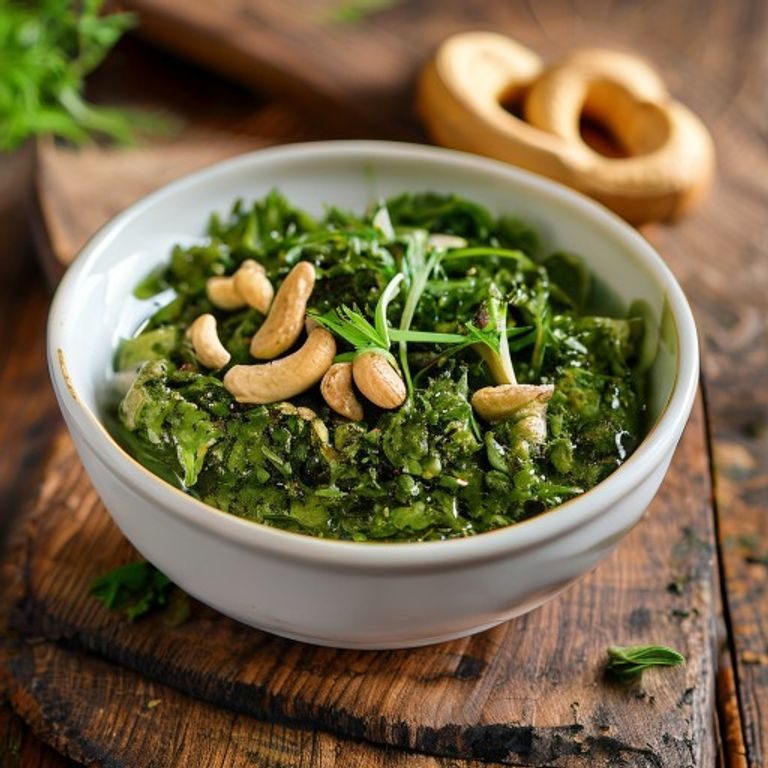
Ramson Pesto (Pesto all'aglio orsino)
A vibrant, garlicky pesto that captures the fleeting magic of spring — wild ramson leaves blitzed with toasted cashews, chili, and olive oil into a bright green sauce that is ready in five minutes and brings a punch of wild garlic flavor to pasta, crostini, roasted vegetables, and eggs.
| Amount | Ingredient |
|---|---|
| 1 | organic lemon (zest and juice) |
| 1¾ oz (50 g) | fresh ramson (wild garlic) leaves |
| 1¾ oz (50 g) | raw cashews |
| 1 small | fresh red chili (such as red Fresno or bird's eye), seeds removed if desired |
| ½ tsp | fine sea salt |
| A few turns | freshly ground black pepper |
| ½ cup (120 ml) | extra-virgin olive oil |
This pesto is a celebration of foraging and the short-lived ramson season. Unlike traditional basil pesto, which relies on pine nuts and Parmigiano, this version uses cashews for a creamier, milder base and a fresh red chili for gentle heat. The result is a pesto that is simultaneously pungent (from the ramson), nutty (from the toasted cashews), and bright (from the lemon zest and juice). It is looser than a traditional pesto, more of a sauce than a paste — ideal for tossing with pasta, spooning over grilled fish, or drizzling over roasted potatoes. The recipe makes about 2 cups (475 ml), enough for two pasta dinners for four, or a week of creative eating. It keeps beautifully in the refrigerator, the ramson flavor mellowing into something more complex and rounded over the first few days.
Ingredient notes: Ramson leaves should be bright green, firm, and smell pungently of garlic — avoid wilted or yellowing leaves. If foraging, be 100% certain of your identification: ramson leaves look similar to lily of the valley (Convallaria majalis), which is highly toxic. The surest differentiator is the smell — ramson smells unmistakably of garlic; lily of the valley has no garlic scent. Cashews are preferred over pine nuts here for their creamier texture and milder flavor, which lets the ramson shine. Toast them lightly to deepen their nuttiness — watch carefully, as cashews burn quickly. The chili adds a gentle warmth, not intense heat. If you prefer no heat, omit the chili entirely. Use a good-quality extra-virgin olive oil — the oil is a primary flavor component, not just a processing aid.
- Small skillet (for toasting cashews)
- Food processor or blender
- Rubber spatula
- Fine grater or Microplane (for lemon zest)
- Citrus juicer
- Small jar or airtight container (for storage)
- Toast the cashews (3 minutes). Place the cashews in a small dry skillet over medium heat. Toast, shaking the pan frequently, for 2 to 3 minutes until the cashews are fragrant and lightly golden in spots — they should smell nutty and warm. Do not walk away — cashews go from toasted to burnt in seconds. Immediately transfer the cashews to a plate to cool. Pro tip: Toasting is optional but highly recommended. Raw cashews produce a perfectly good pesto, but toasted cashews add a deeper, richer flavor that complements the ramson's pungency. If you are short on time, skip the toasting and use raw cashews directly — the pesto will still be delicious, just less complex.
- Prep the ingredients (3 minutes). Wash and thoroughly dry the ramson leaves. Zest the lemon (you need about 1 teaspoon of zest) and set aside. Cut the lemon in half and juice it (you need about 2 tablespoons of juice). Stem the chili, cut it open lengthwise, and remove the seeds and white membrane if you prefer less heat. Pro tip: The ramson leaves must be bone-dry — any water will make the pesto watery and spoil faster. Pat them dry between paper towels or spin them in a salad spinner. For the chili, the seeds and membrane contain most of the heat; removing them yields a mild warmth, leaving them yields a noticeably spicier pesto.
- Blend the pesto (2 minutes). Add the cooled toasted cashews, ramson leaves, chili, lemon zest, lemon juice, salt, and a few grinds of black pepper to the food processor. Pulse 5 to 6 times to chop everything roughly. With the motor running, slowly drizzle in the olive oil through the feed tube. Continue processing for 30 to 45 seconds, scraping down the sides once, until the pesto is smooth but still has a bit of texture — you want a sauce, not a paste. It should be loose enough to drizzle but thick enough to cling to pasta. Pro tip: The perfect pesto texture is achieved when you can still see tiny specks of ramson leaf and cashew in the sauce — do not over-process into a completely smooth puree. If the pesto is too thick, add 1 or 2 tablespoons of warm water and pulse to combine. Taste and adjust salt and lemon juice — it should taste bright, garlicky, and nutty.
- Transfer and store (1 minute). Scrape the pesto into a sterilized jar or airtight container. Press a piece of plastic wrap directly onto the surface of the pesto (this prevents oxidation, which turns the top layer brown), then screw on the lid. Refrigerate for up to 10 days. The pesto will keep its bright green color for 3 to 4 days; after that, the top layer may darken slightly but the flavor remains excellent. Pro tip: To keep the pesto bright green for longer, pour a thin layer (about ⅛ inch / 3 mm) of olive oil over the surface before sealing. This creates an airtight barrier that prevents oxidation.
- Use dry ramson leaves — any water dilutes the flavor and reduces shelf life.
- Taste before adding extra salt; the lemon juice and chili provide plenty of flavor on their own.
- For a vegan version, simply serve as-is — this pesto contains no cheese by design.
- The pesto thickens in the refrigerator; stir in a splash of pasta water or olive oil before using.
- For a chunkier texture, reserve a handful of toasted cashews and roughly chop them by hand, folding them in at the end.
| Mistake | Why It Hurts | The Fix |
|---|---|---|
| Pesto is too thick | Not enough oil or the ramson leaves were too dry | Stir in 1 to 2 tbsp warm water or olive oil until the desired consistency |
| Pesto is too spicy | Chili seeds were not removed | Stir in 2 tbsp Greek yogurt or a handful of fresh spinach and re-blend |
| Pesto tastes bitter | Oil was low-quality or ramson leaves were past their prime | Add a pinch of sugar and an extra squeeze of lemon juice to balance |
| Pesto turned brown quickly | Surface was not protected from air | Always press plastic wrap onto the surface or top with a layer of oil |
| Variation | How To |
|---|---|
| Ramson Pesto with Walnuts | Replace cashews with 1¾ oz (50 g) toasted walnuts for an earthier flavor |
| Ramson Pesto with Almonds | Replace cashews with 1¾ oz (50 g) toasted almonds for a crunchier texture |
| Cheesy Ramson Pesto | Fold in ¼ cup (25 g) finely grated Parmigiano-Reggiano after blending |
| Ramson Pesto with Mint | Add 10 fresh mint leaves along with the ramson for a brighter, fresher flavor |
| Ramson Pesto with Breadcrumbs | Stir in 2 tbsp toasted breadcrumbs for a Sicilian-style twist |
| Storage | Method |
|---|---|
| Refrigerator | Store in an airtight jar for up to 10 days. Top with a layer of olive oil to prevent browning. |
| Freezer | Spoon into ice cube trays, freeze solid, then transfer cubes to a freezer bag. Keeps for 3 months. Thaw individual cubes for single servings. |
| Wine | Why |
|---|---|
| Vermentino | Herbaceous and slightly saline — echoes the wild garlic notes |
| Soave Classico | Light, crisp, with almond notes that complement the cashews |
| Grignolino | A light, tannic red that can stand up to the garlicky pesto without overwhelming it |
| Pinot Grigio (Friuli) | Clean, neutral, and crisp — lets the pesto be the star |
| Per Serving (2 tbsp / 30 ml) | |
|---|---|
| Calories | 142 |
| Protein | 2 g |
| Fat | 14 g |
| Carbohydrates | 4 g |
| Fiber | 1 g |
Nutrition values are approximate and based on using the full amount of oil and cashews divided across 16 servings.
What is ramson and when is it in season?
Ramson (Allium ursinum), also known as wild garlic, bear's garlic, or buckrams, is a wild spring plant that carpets woodland floors from March to June. The broad, bright green leaves have a distinct garlic aroma. The season is short — typically 6 to 8 weeks — so stock up and freeze pesto to enjoy year-round.
Can I make this pesto without a food processor?
Yes — you can make it in a mortar and pestle. Grind the toasted cashews and chili first, then add the ramson leaves a handful at a time, grinding to a paste, before slowly incorporating the olive oil. This traditional method produces a coarser, more rustic texture.
How do I use ramson pesto beyond pasta?
Toss it with roasted potatoes, spread it on crostini with fresh ricotta, spoon it over grilled fish or chicken, drizzle it over a frittata or scrambled eggs, swirl it into soup, or use it as a dressing for white bean salad.
Can I substitute the cashews with another nut?
Absolutely — pine nuts (traditional), walnuts, almonds, or even sunflower seeds for a nut-free version. Each will change the flavor profile, but all work well. Toast whichever nut you choose for the best flavor.
Is ramson pesto safe for pregnant women?
Yes — unlike pesto made with raw garlic, the ramson leaf is mild and gentle on the stomach. The cashews and lemon provide plenty of flavor without the intensity of raw garlic cloves.
- Classic Basil Pesto (Volume 2)
- Ramson and Feta Dip (Volume 2)
- Arugula Pesto (Volume 2)
- Sicilian Pesto (Volume 2)
- Pistachio Pesto (Volume 2)
Recipe from "The Italian Kitchen" by Vita Milanese — Volume 2: Sunday Sauce
Recipe from The Italian Kitchen by Vita Milanese — Volume 2 · Sunday Sauce. Discover all volumes on the ebook page.