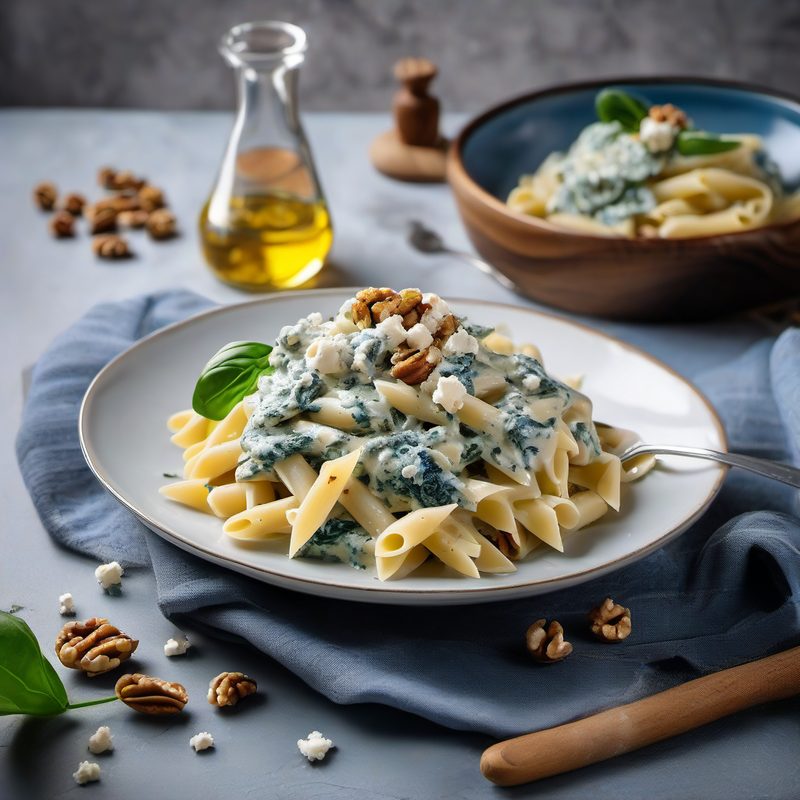
Pasta Roquefort Spinach
Category: Piatti unici \
| Amount | Ingredient |
|---|---|
| Calories | ≈ 510 kcal |
| Protein | 18 g |
| Fat | 28 g |
| Saturated Fat | 14 g |
| Carbohydrates | 48 g |
| Fiber | 4 g |
| Sugar | 3 g |
| Sodium | 620 mg |
Servings: 4 \
Total Time: 25 minutes \
Active Time: 20 minutes \
Skill Level: Beginner \
Source: Italian one-dish tradition — a creamy, indulgence-driven pasta that pairs pungent blue cheese with sweet wilted spinach and crunchy walnuts
1. Why This Recipe Works
Pasta con Roquefort e Spinaci is the kind of weeknight dinner that feels like a splurge — a rich, satiating one-bowl meal built on three bold ingredients that balance each other brilliantly. The key to this dish is orchestrating the creamy sauce around the cheese's intensity. Roquefort (or any high-quality blue cheese) is the sole seasoning anchor: its salty, tangy, barnyardy punch means you need very little additional salt. By crumbling the cheese into warm cream off the heat, it melts into a velvety sauce without breaking or turning grainy — a gentler approach than boiling it, which can cause separation. The spinach, wilted briefly with sautéed garlic in the same pan, contributes earthy sweetness and a tender, silky texture that tempers the cheese's assertiveness. Walnuts, toasted until fragrant and added at the very last toss, bring a nutty crunch and a subtle bitterness that cuts through the richness. The pasta — cooked aggressively al dente and finished in the starchy sauce — absorbs the creamy coating from within, while a splash of reserved pasta water emulsifies everything into a glossy, cling-worthy finish. The entire dish comes together in one pan (plus the pasta pot), making it a true piatto unico — a complete, satisfying meal in under half an hour.
3. Before You Begin
- Choose the right pasta shape: Short, sturdy shapes like penne, fusilli, rigatoni, or orecchiette work best. Their ridges and hollows trap the creamy sauce, while long strands like spaghetti tend to let the rich sauce slide off. If you only have long pasta, increase the cream to 250 ml (1 cup) for better cling.
- Toast the walnuts: Raw walnuts benefit enormously from a quick toast — it deepens their flavor, crisps their texture, and removes any raw bitterness. Toast them in a dry skillet over medium heat for 3–4 minutes, shaking frequently, until fragrant and slightly darkened. Watch closely — walnuts burn fast.
- Don't boil the cream sauce: The cheese is stirred into warm (not boiling) cream off the heat. Boiling can cause the cheese to seize, turn grainy, or separate into greasy pools. Gentle heat is the secret to a silky, homogeneous sauce.
- Reserve more pasta water than you think: The starchy water is essential for loosening the sauce to the right consistency and helping it cling to the pasta. Reserve a full cup (240 ml); you may not need it all, but running short mid-toss is frustrating.
- Work fast in the final minute: This is a quick-toss pasta — the sauce, spinach, pasta, and walnuts come together in a single furious minute of tong-tossing. Have everything measured and ready before you drain the pasta.
4. Equipment
- Large pot (6–8 qt) for pasta
- Large skillet or sauté pan (12-inch / 30 cm) — wide enough to hold the wilted spinach and pasta for tossing
- Chef's knife and cutting board
- Colander
- Tongs or pasta fork
- Measuring spoons and cups
- Ladle or heatproof measuring cup (for reserving pasta water)
- Small dry skillet (for toasting walnuts, or use the same pan before starting the sauce)
- Large serving bowl (warmed)
5. Key Steps at a Glance
- Toast walnuts → Dry skillet, medium heat, 3–4 minutes → set aside.
- Cook pasta → Reserve 1 cup pasta water → drain al dente.
- Sauté garlic → Olive oil in skillet, medium heat, 45–60 seconds until fragrant and pale gold.
- Wilt spinach → Add spinach to skillet, toss with tongs, 1–2 minutes until just wilted.
- Make sauce → Reduce heat to low → add cream and crumbled Roquefort → stir until smooth and melted (do not boil).
- Toss pasta → Add hot drained pasta to skillet with sauce → toss to coat → add pasta water as needed for consistency.
- Finish → Toss in toasted walnuts and black pepper → serve immediately.
6. Step-by-Step Instructions
Step 1: Toast the Walnuts
- Place 50 g (½ cup) roughly chopped walnuts in a small dry skillet over medium heat. Toast, shaking the pan frequently, until fragrant and the walnuts deepen in color by a shade — about 3–4 minutes. Transfer immediately to a small bowl to stop the cooking. Set aside.
Step 2: Cook the Pasta
- Bring a large pot of generously salted water to a rolling boil (about 1½ tbsp kosher salt per 4 quarts / gallon of water).
- Add 350 g pasta and cook according to package directions until al dente (typically 10–12 minutes for penne/rigatoni; start checking 1 minute before the package suggests). The pasta should be tender but still offer gentle resistance when bitten.
- Reserve 1 cup (240 ml) of the pasta cooking water.
- Drain the pasta in a colander. Do not rinse — the surface starch is essential for helping the creamy sauce cling.
Step 3: Sauté the Garlic
- While the pasta cooks, heat 2 tablespoons (30 ml) of extra-virgin olive oil in a large 12-inch skillet over medium heat.
- Add the thinly sliced garlic and cook, stirring constantly, until fragrant and just turning pale gold — about 45–60 seconds. The garlic should be soft and translucent, with no browning whatsoever. If it browns, the pan is too hot — lift it off the heat briefly.
Step 4: Wilt the Spinach
- Add 200 g (6–7 cups) fresh spinach to the skillet in batches if necessary. Use tongs to toss and stir the spinach as it wilts. The spinach will collapse dramatically — this is normal.
- Cook until the spinach is just wilted, bright green, and tender — about 1–2 minutes total. It should still have some texture and life; do not cook it to a limp, watery mush. If liquid pools in the pan, let it simmer briefly to evaporate.
Step 5: Make the Cream and Roquefort Sauce
- Reduce the heat to low. Pour 200 ml (¾ cup + 1½ tbsp) heavy cream into the skillet with the wilted spinach. Stir gently to combine.
- Crumble 150 g Roquefort (or blue cheese) into the cream. Stir continuously in a slow, circular motion until the cheese is fully melted and the sauce is smooth, velvety, and pale blue-green — about 1–2 minutes. Do not let the sauce boil; bubbles should just barely break the surface. If the sauce looks separated or greasy, remove the pan from the heat immediately and whisk in 1 tablespoon of cold cream or pasta water to re-emulsify.
- Taste the sauce — it should be rich, salty, and tangy. Add a small pinch of salt only if needed (Roquefort is already quite salty). Add several grinds of black pepper.
Step 6: Toss Pasta with Sauce
- Add the hot drained pasta directly to the skillet. Turn off the heat.
- Toss vigorously with tongs for 30–45 seconds, lifting and turning the pasta to coat every piece in the creamy sauce. The sauce should be thick enough to coat the pasta generously but loose enough to flow — if it seems tight, add reserved pasta water 1 tablespoon at a time, tossing after each addition, until the pasta glistens with a creamy, clinging finish.
Step 7: Finish and Serve
- Add the toasted walnuts to the skillet. Toss once or twice to distribute evenly.
- Taste and adjust seasoning — add additional black pepper generously if desired, and a light pinch of salt only if the sauce tastes flat (this is unlikely with Roquefort).
- Divide the pasta among warmed serving bowls. Garnish each portion with a final grind of black pepper and, if desired, a few extra crumbles of Roquefort for visual contrast. Serve immediately.
7. Visual Cues — What to Look For
| Step | Visual Cue |
|---|---|
| Toasted walnuts | Deep golden-brown, fragrant, slightly glossy with released oils |
| Sautéed garlic | Pale gold, translucent, fragrant — not brown |
| Wilted spinach | Bright green, collapsed to about one-quarter its original volume, tender but not mushy |
| Cream sauce after cheese melts | Smooth, homogeneous, pale blue-green with no visible lumps or greasy oil slicks |
| Sauce consistency before pasta | Thick enough to coat the back of a spoon in a solid, opaque layer |
| Pasta after tossing | Each piece glistens with creamy blue-green sauce that clings to ridges and fills hollows |
| Final dish | Rich, creamy, speckled with dark green spinach and pale walnut bits — no pools of separated oil |
8. Recipe Notes & Troubleshooting
| Issue | Cause | Fix |
|---|---|---|
| Sauce is grainy or separated | Cheese added to boiling cream; heat too high | Remove from heat immediately; whisk in 1 tbsp cold cream or pasta water to re-emulsify. Next time, keep heat on low and never let the cream boil |
| Sauce is too thick | Not enough pasta water added | Add reserved pasta water 1 tbsp at a time while tossing — the sauce should coat, not clump |
| Sauce is too thin | Too much pasta water; cream too low-fat | Simmer gently over low heat for 1–2 minutes to reduce; next time use full-fat cream |
| Dish tastes too salty | Roquefort is very salty; pasta water oversalted | Add a squeeze of lemon juice or a splash of milk to balance; next time use less salt in the pasta water and under-salt the sauce |
| Dish is bland / not salty enough | Not enough Roquefort; cheese was mild | Crumble in more cheese (20–30 g) off the heat and stir; next time use a more pungent blue cheese |
| Spinach released too much water | Mature spinach not dried; cooked too long | Drain excess liquid before adding cream; next time dry spinach thoroughly and wilt quickly over higher heat |
| Walnuts are bitter | Not toasted; old walnuts | Toast thoroughly; next time buy fresh walnuts and store in the freezer — rancid walnuts taste intensely bitter |
| Pasta doesn't hold the sauce | Smooth pasta shape; sauce too thin | Use ridged/tubular pasta next time (penne, rigatoni, fusilli); add less pasta water for a thicker sauce |
| Cream sauce broke on reheat | Sauce reheated too aggressively | Reheat gently over low heat, stirring constantly, with a splash of milk or cream |
9. Make-Ahead Tips
- Walnuts (up to 2 weeks ahead): Toast the walnuts, let them cool completely, and store in an airtight container at room temperature. Toasting ahead saves 4 minutes but is best done within a few days — toasted walnuts lose their crunch over time.
- Spinach-garlic base (up to 2 days ahead): Complete Steps 3 and 4 (sauté garlic, wilt spinach) and transfer to an airtight container. Refrigerate. To serve, reheat the spinach base in the skillet over medium heat, then proceed with the cream and cheese sauce. The spinach will be slightly darker but the flavor will be fine.
- Full sauce (up to 1 day ahead): Complete the recipe through Step 5 (cream and cheese sauce with spinach). Cool completely, transfer to an airtight container, and refrigerate. To serve, reheat the sauce gently in a skillet over low heat, adding 2–3 tablespoons of milk or cream to loosen it. Cook fresh pasta and toss as directed. Note: The sauce may separate slightly upon standing; vigorous whisking over low heat will bring it back together.
- Freezing (not recommended): Cream-based sauces generally do not freeze well — they separate upon thawing and become grainy. The texture of thawed, re-cooked spinach is also unpleasant. This dish is best made fresh.
- Leftovers (up to 2 days): Store leftover pasta in an airtight container in the refrigerator. Reheat in a skillet over low heat with a splash of milk or cream, stirring gently until warmed through. The texture will be denser and the walnuts will have softened, but the flavor remains excellent. Avoid the microwave, which can make the sauce separate and the pasta rubbery.
10. Variations
- Pasta con Gorgonzola e Spinaci (milder blue cheese): Substitute 150 g Gorgonzola dolce (sweet, creamy Gorgonzola) for the Roquefort. Gorgonzola dolce is milder, sweeter, and creamier than Roquefort, producing a gentler, more approachable sauce. This is the most common Italian supermarket version and works beautifully. Gorgonzola piccante (aged, firmer) falls between Gorgonzola dolce and Roquefort in pungency.
- Pasta con Roquefort e Noci (Roquefort and walnut pasta — no spinach): Omit the spinach entirely. Increase walnuts to 75 g (¾ cup) and add them both to the sauce and as a garnish. The simpler combination lets the Roquefort-walnut pairing shine — a classic French-inspired Italian crossover.
- Pasta con Roquefort, Spinaci e Pere (with pear): Add 1 ripe but firm pear (Bosc or Bartlett), cored and cut into ½-inch dice, to the skillet with the wilted spinach. The pear's sweetness and soft crunch are a classic pairing with blue cheese and walnuts. Heat briefly before adding the cream.
- Pasta con Roquefort e Spinaci con Panna e Limone (with lemon zest): Add the finely grated zest of ½ lemon to the sauce just before tossing with the pasta. The lemon's bright acidity cuts through the richness and adds a surprising, refreshing lift. A squeeze of lemon juice (about 1 tsp) can also be added if the sauce tastes too heavy.
- Spicy Roquefort-Spinach Pasta (con Peperoncino): Add ¼–½ teaspoon red pepper flakes to the olive oil with the garlic. The heat cuts through the creamy richness and provides a pleasant contrast to the sweet spinach and salty Roquefort.
- Pasta con Roquefort, Spinaci e Funghi (with mushrooms): Sauté 150 g sliced cremini or shiitake mushrooms in the skillet before adding the garlic. Cook until golden and all moisture has evaporated (5–6 minutes), then proceed with the garlic and spinach. The earthy mushrooms add depth and transform this into a heartier, more substantial dish.
- Whole-wheat or gluten-free version: Substitute 350 g whole-wheat penne or gluten-free pasta. Whole-wheat pasta pairs beautifully with the earthy spinach and walnuts. For gluten-free, choose a blend-based pasta (brown rice and corn or quinoa) — 100% rice pasta turns mushy in creamy sauces. Cook according to package directions and reserve extra pasta water, as GF starches behave differently.
- Lighter version: Substitute 100 ml heavy cream + 100 ml whole milk for the full 200 ml cream. Use 120 g Roquefort instead of 150 g. Add an extra drizzle of pasta water to maintain sauciness. The result is still creamy but noticeably lighter — about 400 kcal per serving instead of 510.
11. Wine & Drink Pairing
- Red: A light, fruity Barbera d'Alba or Dolcetto d'Alba — the bright acidity cuts through the creamy sauce while the red fruit complements the spinach and walnuts without competing with the Roquefort. A chilled Valpolicella Classico also works beautifully. Avoid tannic, oaky reds (Barolo, Brunello) — tannins clash with blue cheese's pungency.
- White (Classic pairing): A Sauternes or late-harvest Riesling — the classic sweet wine pairing for Roquefort. The wine's sweetness and honeyed character balance the cheese's salt and tang. Alternatively, a rich, full-bodied white like a white Burgundy (Meursault or Puligny-Montrachet) or an aged Chardonnay with moderate oak — the creaminess mirrors the sauce's texture.
- Sparkling: A dry, high-acidity Franciacorta or Cava brut — the fine bubbles and crisp acidity refresh the palate between rich, creamy bites. A bone-dry Prosecco also works, though its lighter body may be overwhelmed by the Roquefort's intensity.
- Dessert wine: A late-harvest Gewürztraminer or Vin Santo — the floral, honeyed sweetness is a divine counterpoint to the salty-tangy cheese. Serve the wine alongside, not after, the pasta.
- Beer: A Belgian tripel or saison — the fruity, spicy esters and moderate carbonation stand up to the rich sauce and cut through the cream. A malty, slightly sweet bock or dunkel also works well. Avoid hop-bitter IPAs, which clash with blue cheese's pungency.
- Non-alcoholic: Sparkling water with a lemon twist and a pinch of black pepper; a chilled, unsweetened apple cider (the fruitiness complements the walnuts); or a tart cherry juice mixed with sparkling water (the acidity balances the richness).
12. Serving Suggestions
- Serve with warm, crusty bread — a country sourdough or a rustic Italian pagnotta — to mop up every last ribbon of the creamy sauce. The bread becomes a vehicle for the Roquefort-spinach sauce, which is arguably the best part.
- A simple, sharp green salad dressed with a lemon vinaigrette provides a bright, acidic contrast to the richness of the pasta. Use arugula, frisée, or radicchio — their bitterness stands up to the creamy sauce. Avoid a creamy dressing; this dish has enough cream already.
- For a more substantial meal, serve alongside grilled chicken (marinated in lemon, garlic, and rosemary), seared lamb chops, or a simple pan-seared steak. The creamy pasta acts as a luxurious side-garnish to the meat.
- A handful of fresh pear slices or green apple wedges on the side — the crisp, tart fruit is a classic counterpoint to blue cheese that brightens every bite.
- Finish each serving with an extra scattering of toasted walnuts and a light drizzle of finishing-quality extra-virgin olive oil (a peppery Tuscan or grassy Sicilian oil). A few extra crumbles of Roquefort on top create an appealing visual contrast — the creamy sauce below and the sharp, white crumbles above.
- Warm the serving bowls — stack them near the simmering pasta pot so steam heats them, or fill them with hot water while the pasta cooks. Warm bowls keep the creamy sauce from congealing on contact with cold ceramic.
13. Nutritional Information (per serving)
Approximate values based on ingredients listed; actual values may vary. This is a rich, filling one-dish meal — the calorie count is driven primarily by the heavy cream and Roquefort. For a lighter version, see Variations.
14. Prep Timeline & Workflow
| Time Elapsed | Action |
|---|---|
| 0 min | Bring large pot of salted water to a rolling boil |
| 2 min | Toast walnuts in dry skillet (3–4 min); set aside |
| 4 min | Roughly chop walnuts (if not pre-chopped); slice garlic |
| 6 min | Start cooking pasta |
| 7 min | Heat olive oil in large skillet; add garlic — cook 45–60 sec until pale gold |
| 8 min | Add spinach to skillet; wilt 1–2 min |
| 9 min | Reserve 1 cup pasta water |
| 10 min | Reduce heat to low; add cream to skillet; crumble Roquefort; stir until smooth (1–2 min) |
| 12 min | Drain pasta (al dente) — total cook time ~10–12 min |
| 13 min | Add hot drained pasta to skillet; toss to coat; adjust consistency with pasta water |
| 14 min | Toss in toasted walnuts and black pepper |
| 15 min | Taste and adjust seasoning |
| 16 min | Plate and serve with garnishes |
Note: Timing assumes a 10-minute pasta cook time for penne/rigatoni. Adjust based on your pasta brand and shape.
15. Allergen Information
- Contains: Milk/dairy (Roquefort cheese, heavy cream), tree nuts (walnuts), wheat/gluten (pasta)
- Free from: Eggs, shellfish, peanuts, soy, fish, sesame
- May contain: Traces of other tree nuts if walnuts are processed on shared equipment; traces of penicillin mold (naturally present in Roquefort) — generally not a concern for those with common mold allergies, but consult a physician if you have a known allergy to Penicillium cultures
- Note: Traditional Italian dried pasta is made from durum wheat semolina and water — it typically does not contain eggs. Check the package if you have egg allergies. This recipe is not suitable for vegans or those avoiding dairy. For a dairy-free alternative, see Variations.
16. Regional Background
Pasta con Roquefort e Spinaci is not an ancient Italian tradition — it is a modern piatto unico (one-dish meal) that reflects the mid-to-late 20th-century evolution of Italian home cooking, when convenience, speed, and international ingredients began mingling with the country's deep pasta culture. Unlike the codified, regional pasta dishes of Italy — think Cacio e Pepe (Rome), Pasta alla Norma (Sicily), or Trofie al Pesto (Liguria) — this recipe has no single town or grandmother claiming birthright. It is a cucina fusion in the best sense: an Italian cook's adaptation of a French cheese (Roquefort, from the caves of Mont Combalou in southern France) into a quick, creamy, all-in-one pasta dinner.
Roquefort itself is one of the world's oldest and most protected cheeses, with a history stretching back to the Roman naturalist Pliny the Elder, who described its production in A.D. 79. Made from raw ewe's milk and aged in the natural limestone caves of Roquefort-sur-Soulzon, the cheese develops its signature blue veining from Penicillium roqueforti mold, which flourishes in the caves' cool, humid, drafty conditions. By French law, only cheese aged in those specific caves may bear the name Roquefort. Its arrival in Italian kitchens likely followed the post-war economic boom of the 1950s and 1960s, when northern Italian families with newfound disposable income began experimenting with imported ingredients and French-inspired cooking. The combination of pasta, blue cheese, and cream — essentially an Italian interpretation of a French sauce au roquefort served over noodles — became a fashionable, quick supper for busy home cooks.
The addition of spinach and walnuts grounds the dish in Italy's own pantry. Spinach (spinaci) has been cultivated in Italy since the Renaissance — Catherine de' Medici, the Florentine-born queen of France, was famously so fond of it that she brought her own spinach growers to the French court, and dishes "à la Florentine" (with spinach) remain a Franco-Italian culinary bridge to this day. Walnuts (noci), meanwhile, grow abundantly across Italy, especially in Campania, Calabria, and the Sorrento peninsula, where they are used in everything from pesto (pesto alla trapanese, with walnuts instead of pine nuts) to desserts (crostata di noci) and pastas. The walnut-Roquefort pairing — sweet, oily nuts against salty, tangy cheese — is a classic combination found in both Italian and French cuisines, from salads to cheese boards to stuffings.
Today, Pasta con Roquefort e Spinaci is a staple of Italian home cooking magazines, meal-plan websites, and family dinner rotations — especially in February and March, when heavy, warming pasta dishes are still welcome and good spinach is plentiful. It is not a dish you will find on a restaurant menu in Rome or Bologna (where it would be considered too informal or "cucina casalinga" — home cooking), but it is exactly the kind of honest, satisfying, moderately ambitious weekday meal that defines how real Italians eat at home: a handful of good ingredients, a single pan, and twenty-five minutes to dinner.
17. Scaling
- For 2 servings: Halve all ingredients. Use 175 g pasta, 100 g spinach, 75 g Roquefort, 1 garlic clove (use 2 small cloves and don't worry about the half), 100 ml heavy cream, 25 g walnuts, 1 tbsp olive oil. Cooking times are unchanged. Use a 10-inch skillet. Reserve about ½ cup pasta water.
- For 8 servings: Double all ingredients. Use the largest skillet you have (14–16 inches) to avoid overcrowding the spinach. If the spinach fits in but the final tossing seems tight, work in two batches: cook the sauce, then toss half the pasta at a time, combining in a large warmed bowl. Cook pasta in two batches or use the largest pot you own. Cook the pasta 1 minute less than usual, as doubling the cooking water ratio may extend cooking time. Reserve at least 2 cups of pasta water. Note: The sauce may need a touch more cream to maintain the same consistency — add up to 50 ml (¼ cup) extra if the doubled sauce seems thick.
- For 1 serving (single portion): Use 90 g pasta, 50 g spinach, 40 g Roquefort, 1 small garlic clove, 50 ml heavy cream (about 3½ tbsp), 15 g walnuts (about 2 tbsp), ½ tbsp olive oil. Use an 8-inch skillet or small saucepan. Cooking times are unchanged.
18. Conversion Table (Volume)
| Metric | US Standard |
|---|---|
| 5 ml | 1 tsp |
| 15 ml | 1 tbsp |
| 30 ml | 2 tbsp (¼ cup) |
| 60 ml | ¼ cup |
| 120 ml | ½ cup |
| 200 ml | ¾ cup + 1½ tbsp |
| 240 ml | 1 cup |
| 350 g pasta | ≈ 12 oz |
| 150 g Roquefort | ≈ 1⅓ cups crumbled |
| 200 g spinach | ≈ 6–7 cups packed |
| 50 g walnuts | ≈ ½ cup chopped |
19. Chef's Final Notes
- Roquefort is the seasoning anchor — taste before you salt. Roquefort is famously salty, with a briny, tangy character that can vary significantly from wheel to wheel (and even within the same wheel, as blue veins concentrate salt). Always taste the cheese before adding any salt to the sauce. In many cases, the cheese alone will provide all the salt the dish needs. If your Roquefort is exceptionally mild or young, you may need a pinch of salt at the end. If it's mature and intensely salty, you might even want to cut it with a milder blue like Gorgonzola dolce — but that's a variation, not a compromise.
- Don't scrimp on the walnuts — and toast them. Raw walnuts are edible but unremarkable. Toasted walnuts are an entirely different ingredient: the heat coaxes out their natural oils, deepens their flavor from flat to nutty and sweet, and gives them a satisfying crunch that contrasts with the creamy sauce. Toast them in a dry pan, watch them like a hawk (they go from perfect to burnt in about 30 seconds), and transfer them immediately to a bowl. If you're feeling ambitious, toss them with a tiny pinch of flaky sea salt while they're still warm.
- The spinach must be dry before it hits the pan. Wet spinach steaming in the pan instead of sautéing will release a puddle of gray-green liquid that thins the sauce and dilutes the flavor. If your spinach is pre-washed and damp, spread it on a clean kitchen towel and pat it dry. If it's soaking wet, spin it in a salad spinner first, then towel-dry. This one step makes the difference between a silky, cohesive dish and a watery one.
- Warm the bowls. This is the single best investment of 30 seconds you can make for any creamy pasta. Cold ceramic pulls heat from the hot pasta the instant it's plated, and the sauce — which relies on warmth for its velvety texture — congeals into a waxy, unappetizing film on the surface. Stack the bowls near the pasta pot to catch steam, or fill them with hot tap water and dump them just before plating. The difference is subtle but transformative: every bite stays hot, the sauce stays glossy, and the walnuts stay crunchy from the first forkful to the last.
- Resist the urge to add more cheese on top (at first). It's tempting to pile extra crumbled Roquefort onto the finished pasta for a dramatic, photo-worthy finish. But Roquefort is already the dominant flavor — the sauce itself is intensely cheesy. Extra crumbles on top add texture and visual contrast, but too many overwhelm the spinach and walnuts. A light sprinkle (about 10 g per serving) is enough to create that appealing white-blue contrast without hijacking the balance. Add more at the table if you crave it — let each diner adjust to their own taste.
- Trust the single-pan method. There is no need to cook the pasta and sauce separately and then combine — this dish is designed to come together in the skillet for the last minute, letting the starchy pasta water, the creamy sauce, the wilted spinach, and the pasta emulsify into a cohesive whole. That last minute of vigorous tossing — with the heat off — is where the magic happens. The sauce wraps around every piece of pasta, the spinach clings to the ridges, and the walnuts embed themselves in the creamy coating. Don't skip the toss, and don't rush it. Thirty seconds of focused, energetic tong-work is all it takes to turn a collection of ingredients into a piatto unico.
Recipe from The Italian Kitchen by Vita Milanese — Volume 1 · Pasta Perfetto. Discover all volumes on the ebook page.