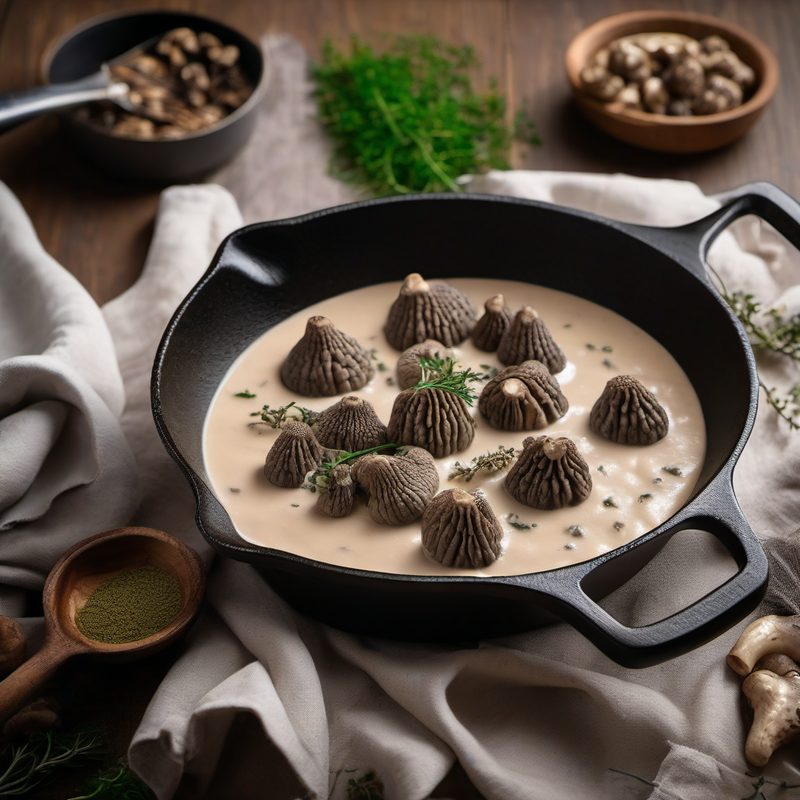
Morel Mushroom Cream Sauce
A decadent, woodsy cream sauce that captures the prized morel mushroom at its peak — earthy, nutty, and impossibly luxurious, this silky sauce builds depth from dried morels, dry sherry, and a double-reduced mushroom concentrate that delivers an intense umami punch in every spoonful.
| Amount | Ingredient |
|---|---|
| 175 g (6 oz) | dried morel mushrooms |
| 35 g (2½ tbsp) | unsalted butter |
| 50 g (⅓ cup) | shallot, finely chopped |
| 15 cl (⅔ cup) | dry sherry (Xeres) |
| 40 cl (1⅔ cups) | heavy cream |
| to taste | kosher salt |
| to taste | freshly ground black pepper |
This is the sauce that transforms a humble steak, a simple chicken breast, or a bowl of pasta into a special-occasion dish. Rather than relying on fresh morels (which are notoriously seasonal and expensive), we start with dried morels — which are actually more flavorful, as the drying process concentrates their characteristic nutty, smoky notes. The secret to this sauce's profound depth is a two-step mushroom extraction: first, the dried morels are rehydrated in cold water; then, the soaking liquid is strained and reduced to a dark, concentrated essence that is added back to the cream. This double hit of mushroom flavor, combined with the nutty complexity of dry sherry and the velvety richness of heavy cream, creates a sauce that is elegant, balanced, and utterly memorable.
Ingredient notes: Dried morels are preferable to fresh here — they are more intensely flavored, available year-round, and actually less expensive than fresh morels. Look for plump, whole dried morels with no signs of dust or mold. Dry sherry (such as an Amontillado or Fino) provides a nutty, slightly oxidative note that complements the earthiness of the morels; do not substitute cooking sherry, which is salted and artificially flavored. Heavy cream (at least 36% milk fat) is essential for the sauce to thicken properly — half-and-half or whole milk will produce a thin, watery sauce.
- Fine-mesh sieve or cheesecloth (for straining soaking liquid)
- Small skillet (for reducing mushroom concentrate)
- Medium saucepan (stainless steel or enameled cast iron)
- Chef's knife and cutting board
- Measuring cups and spoons
- Rubber spatula
- Airtight storage container
- Rehydrate the morels (2 hr). Place the dried morels in a large bowl and cover with cold water. Let soak at room temperature for 2 hours, gently pressing the mushrooms down occasionally to ensure they are fully submerged. Drain, reserving the soaking liquid. Rinse the rehydrated morels under cold running water to remove any grit or sand, then pat dry with paper towels. Cut each morel in half lengthwise.
- Reduce the mushroom concentrate (10 min). Line a fine-mesh sieve with a double layer of cheesecloth (or a paper coffee filter) and strain the reserved mushroom soaking liquid into a clean bowl. Pour the strained liquid into a small skillet and bring to a boil over medium-high heat. Reduce the heat to medium and simmer, swirling occasionally, until the liquid has reduced to a dark brown, syrupy concentrate — about ¼ cup (60 ml). The concentrate should be intensely fragrant and almost syrupy in texture. Remove from heat and set aside.
- Sauté the aromatics (3 min). In a medium saucepan, melt the butter over medium heat. Once the butter is foaming but not browning, add the finely chopped shallot. Cook, stirring frequently, until the shallot is translucent and softened, about 3 minutes. Do not let the shallot brown.
- Cook the morels (3 min). Add the halved morels to the saucepan. Cook, stirring gently, until the mushrooms release their characteristic nutty, woodsy aroma and begin to soften, about 3 minutes. The morels should be fragrant and just beginning to curl at the edges.
- Deglaze with sherry (2 min). Pour the dry sherry into the saucepan. Increase the heat to medium-high and cook, stirring and scraping up any browned bits from the bottom of the pan, until the sherry has nearly evaporated — only a thin film of liquid should remain, about 2 minutes.
- Finish the sauce (5-7 min). Add the reduced mushroom concentrate and the heavy cream to the saucepan. Stir to combine and bring to a gentle simmer over medium heat. Reduce the heat to medium-low and cook, stirring occasionally, until the sauce has thickened enough to coat the back of a spoon — it should leave a clean trail when you drag your finger through the coating on the spoon, about 5 to 7 minutes. The sauce should be glossy, pale golden-brown, and richly fragrant.
- Season and serve (1 min). Remove from heat. Season with kosher salt and freshly ground black pepper to taste. The sauce should be well-balanced — earthy from the morels, nutty from the sherry, rich from the cream, with no single element dominating.
- Serving Suggestions. Spoon over grilled or pan-seared steak (ribeye or filet mignon are excellent); serve with roasted or pan-seared chicken breasts; toss with fresh fettuccine or pappardelle and a sprinkle of Parmigiano-Reggiano; drizzle over creamy polenta for a vegetarian main course; or use as a luxurious topping for seared pork chops or veal scaloppine.
- Soak morels in cold water, not hot. Hot water extracts bitter tannins from the mushrooms and can cause them to become mushy. Cold water rehydrates gently and preserves the delicate flavor.
- Reserve and strain the soaking liquid carefully. Morel soaking liquid can contain grit and sand from the mushrooms — straining through a fine-mesh sieve lined with cheesecloth or a paper towel is essential for a silky finished sauce.
- Reduce the soaking liquid to a concentrate. This is the secret to the sauce's deep mushroom flavor. Do not skip this step — the concentrated liquid adds an intensity that simply cannot be achieved with the raw soaking liquid alone.
- Do not brown the shallots. Browned shallots add bitterness and muddied flavors. Cook them just until translucent and soft.
- Cook the morels until fragrant but not crisp. Morels should soften and release their aroma, but they should not become crunchy or fried. Gentle cooking preserves their tender, meaty texture.
- Let the sherry nearly evaporate before adding cream. If too much raw sherry remains, it will make the sauce taste harsh and alcoholic. The sauce should have a nutty, cooked-sherry character, not a boozy one.
- Simmer the cream gently. Boiling the cream can cause it to separate or curdle. Keep the heat at a gentle simmer — small bubbles around the edge of the pan are fine, but a full rolling boil is not.
- Season at the end. The cream reduces and concentrates as it simmers, so seasoning too early can result in an overly salty sauce.
| Mistake | Why It Hurts | The Fix |
|---|---|---|
| Soaking morels in hot water | Extracts bitter tannins and makes mushrooms mushy | Always use cold water and soak for the full 2 hours |
| Skipping the liquid reduction | The sauce will be thin and mushroom flavor will be weak | Reduce the strained soaking liquid to ¼ cup — it should be syrupy and intensely fragrant |
| Using cooking sherry | Cooking sherry is salted and contains preservatives that ruin the sauce's delicate balance | Use a good-quality dry sherry (Amontillado or Fino) |
| Browning the butter | Burnt butter solids add bitterness that clashes with the delicate morel flavor | Melt butter over medium heat and remove from heat the moment the foam subsides |
| Adding cream too early (before sherry reduces) | Excess liquid thins the sauce and the raw sherry flavor overwhelms the mushrooms | Let the sherry reduce to nearly evaporated before adding cream |
| Boiling the cream | High heat can cause the cream to separate into fat and whey, ruining the sauce's silky texture | Keep at a gentle simmer — small bubbles only |
| Over-seasoning | The reduced mushroom concentrate is naturally savory and salty | Taste before adding salt, and adjust only at the end |
- Thyme-Infused: Add 2 sprigs of fresh thyme to the cream while it simmers. Remove and discard before serving. The thyme's floral, slightly lemony notes complement the earthiness of the morels beautifully.
- Garlic-Mushroom: Add 2 finely minced garlic cloves along with the shallots in step 3. Cook until fragrant, about 30 seconds, before adding the morels. Garlic adds a savory backbone that pairs well with steak.
- Brandy Variation: Substitute half the dry sherry (about 3 tablespoons / 45 ml) with Cognac or brandy. The fruitier, wood-aged notes of the brandy add another layer of complexity.
- Dairy-Free: Substitute the butter with a high-quality vegan butter (such as Miyoko's) and the heavy cream with full-fat coconut cream (the thick layer from a chilled can of full-fat coconut milk). The sauce will have a subtle coconut undertone but will still be rich and luxurious.
- Herb Finish: Stir in 1 tablespoon of finely chopped fresh parsley and 1 teaspoon of fresh thyme leaves just before serving. The fresh herbs brighten the sauce and add color.
- Cheese Enrichment: For an even richer sauce, stir in 2 tablespoons of grated Parmigiano-Reggiano after removing from heat. The cheese adds salty, nutty notes that deepen the mushroom flavor.
| Storage Method | Details |
|---|---|
| Refrigerator | Store in an airtight container for up to 4 days. The flavors will meld and deepen overnight. Reheat gently over low heat, adding a splash of cream or milk if the sauce has thickened too much. |
| Freezer | Freeze in airtight containers for up to 1 month. Thaw overnight in the refrigerator. The cream may separate slightly upon thawing — whisk vigorously while reheating to re-emulsify. |
| Reheating | Warm gently in a small saucepan over low heat, stirring frequently. Do not boil. If the sauce seems thin, simmer gently for 1-2 minutes to re-thicken; if too thick, add a splash of cream or whole milk. |
This sauce's earthy, nutty richness pairs best with wines that can match its intensity:
- White Burgundy (Meursault or Puligny-Montrachet) — The richness and buttery notes of a well-made Chardonnay mirror the sauce's creamy texture, while the minerality cuts through the richness.
- Barolo or Barbaresco (Nebbiolo) — The ethereal, truffle-like aromatics of Nebbiolo are a classic pairing with morels. The wine's high acidity and firm tannins stand up to the creamy sauce beautifully.
- Oregon Pinot Noir — Earthy, red-fruited, and medium-bodied, a Willamette Valley Pinot Noir complements the woodsy morels without overpowering them.
- Châteauneuf-du-Pape Blanc — A full-bodied white Rhône with notes of honey, stone fruit, and herbs that harmonize with the sherry and mushroom flavors.
- Dry Sherry (Fino or Amontillado) — Served slightly chilled, it echoes the sherry used in the sauce and creates a seamless pairing.
| Per Serving (about ⅓ cup) | |
|---|---|
| Calories | 342 |
| Protein | 4 g |
| Fat | 32 g |
| Carbohydrates | 8 g |
| Fiber | 1 g |
Nutrition values are approximate and based on ⅓-cup servings using dried morels, unsalted butter, dry sherry, and heavy cream (36% milk fat). Actual values may vary based on specific brands and ingredient measurements.
Can I use fresh morels instead of dried?
Yes, but the flavor will be less concentrated. Use 350 g (12 oz) of fresh morels. Clean them thoroughly (fresh morels are notoriously buggy — soak in salted water for 10 minutes, then rinse). Skip the soaking and reduction steps; begin directly with sautéing the fresh morels in butter. The sauce will be lighter and more delicate, with a shorter cooking time (about 3-4 minutes to finish).
Can I use another type of dried mushroom?
Yes, though the flavor will be different. Dried porcini (ceps) are the best substitute — they have a similarly intense, nutty, earthy character. Dried shiitake or dried chanterelles will also work, though each will bring its own distinct flavor. The technique remains the same.
My mushroom soaking liquid had grit in it. What did I do wrong?
Dried morels are typically foraged and can contain sand and grit trapped in their honeycomb structure. Always rinse dried morels before soaking (a quick shake under cold water), and always strain the soaking liquid through a fine-mesh sieve lined with cheesecloth or paper towels. Even with careful rinsing, some grit may remain, which is why straining is non-negotiable.
The sauce separated / looks grainy. Can I save it?
Grainy sauce is usually a sign that the cream was boiled or that the sauce was reheated too aggressively. To salvage it, remove from heat immediately, let cool for 1 minute, then whisk vigorously. If that doesn't work, transfer to a blender and blend on low speed for 10 seconds — this will often re-emulsify the sauce.
Can I make this sauce ahead for a dinner party?
Absolutely. The sauce can be made up to 2 days in advance and refrigerated. In fact, the flavors deepen and meld overnight. Reheat gently over low heat, adding a splash of cream or milk to restore the consistency. The sauce may need a few extra minutes of simmering to re-thicken.
What main course pairs best with this sauce?
This sauce is incredibly versatile but truly shines with three dishes: (1) a perfectly seared ribeye steak, (2) pan-roasted chicken thighs with crispy skin, or (3) fresh pappardelle pasta tossed with the sauce and a generous grating of Parmigiano-Reggiano.
- Porcini Mushroom Sauce (Volume 1)
- Truffle Cream Sauce (Volume 2)
- Red Wine Mushroom Sauce (Volume 2)
- Béchamel Sauce (Volume 1)
- Herb-Crusted Beef Tenderloin (Volume 3)
Recipe from "The Italian Kitchen" by Vita Milanese — Volume 2: Sunday Sauce
Recipe from The Italian Kitchen by Vita Milanese — Volume 2 · Sunday Sauce. Discover all volumes on the ebook page.