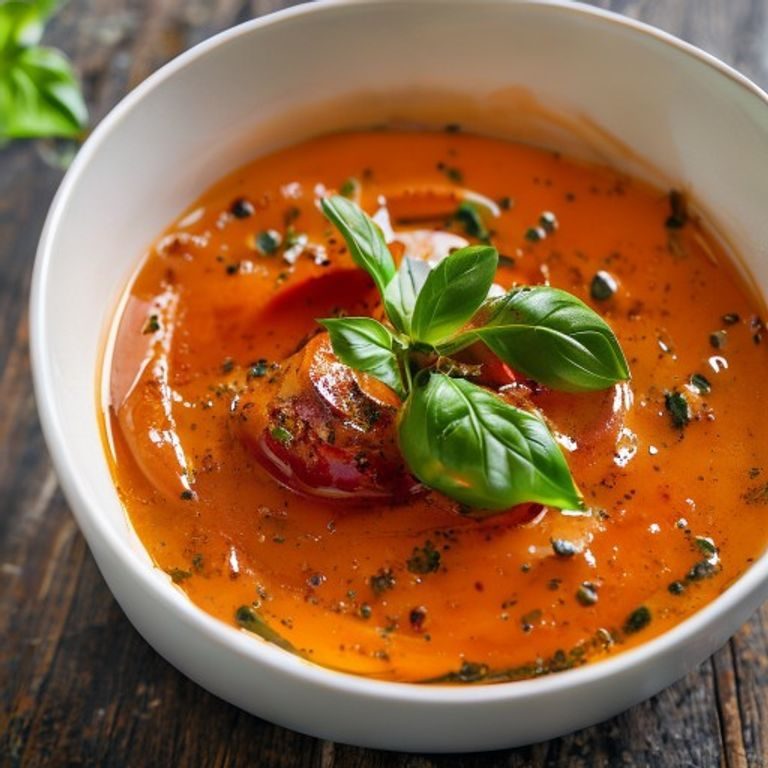
Roasted Red Pepper Cream Sauce
A velvety, deeply flavorful sauce born from the humble red bell pepper — slow-cooked with Roma tomatoes and garlic until meltingly tender, then blitzed into a silky, sunset-hued cream that works on pasta, fish, bruschetta, and everything in between.
| Amount | Ingredient |
|---|---|
| Burning the garlic | Bitter, acrid notes permeate the entire sauce Cook garlic over medium heat only until fragrant and pale gold; if it browns, discard and start over |
| Overcooking into brown sauce | The vibrant red-orange color turns muddy and brownish from extended heat Cook just until soft (20 minutes); blend immediately once the peppers are tender |
| Under-blending | The sauce has a stringy, fibrous texture from pepper skin and tomato seeds Blend for a full 60 seconds on high until completely smooth; strain for guaranteed silkiness |
| Skipping the salt during cooking | The sauce tastes flat and one-dimensional — peppers need salt to unlock their sweetness Season the vegetables with salt at the start of cooking |
| Adding basil during cooking | The basil turns dark and loses its fresh, bright character Add fresh basil at the blending stage only |
| Using too much garlic | Overwhelms the delicate sweetness of the peppers and tomatoes One clove is sufficient for this quantity; discard the cooked clove and don't blend it |
This is the sauce that makes you wonder why you ever reached for a jar. Ripe red bell peppers and Roma tomatoes are gently simmered with garlic in fruity olive oil until they soften into a fragrant, concentrated compote. A quick trip to the blender transforms them into a luxuriously smooth sauce — no cream, no butter, just pure vegetable silk with a bright finish of fresh basil. The natural sweetness of the peppers is balanced by the gentle acidity of tomatoes, while a generous hand with olive oil and a single garlic clove provide savory depth. Serve it twirled into pasta, spooned over grilled fish, or spread on crusty bread for a bruschetta that rivals any tomato version. It is proof that the simplest ingredients, treated with care, produce the most satisfying results.
Ingredient notes: Choose firm, glossy red bell peppers with no wrinkles or soft spots — they should be heavy for their size, a sign of juiciness. Roma tomatoes (also called plum tomatoes) are ideal for cooking because they have fewer seeds and less water content than round slicing tomatoes, resulting in a thicker, more concentrated sauce. If Roma tomatoes are unavailable, substitute with 2 medium vine-ripened tomatoes and remove the seeds and excess pulp before cooking. Use a good-quality extra-virgin olive oil here — it is a primary flavor component, not just a cooking fat.
- Chef's knife and cutting board
- Vegetable peeler (optional, for peeling peppers)
- Medium saucepan with lid (3–4 quart)
- Wooden spoon or heat-resistant spatula
- Blender (standard or immersion)
- Rubber spatula
- Fine-mesh strainer (optional, for smoother sauce)
- Prepare the vegetables (5 min). Wash the bell peppers. Cut off the top (stem end), slice each pepper in half lengthwise, and remove the seeds, ribs, and white membranes. Cut the peppers into 2.5 cm (1-inch) cubes. Wash the Roma tomatoes, remove the core, and roughly chop into 2.5 cm (1-inch) chunks. No need to peel or seed the tomatoes — the blender will handle that.
- Sauté the garlic (2 min). In a medium saucepan, heat the olive oil over medium heat until shimmering. Add the smashed garlic clove and cook, stirring frequently, until fragrant and just beginning to turn golden at the edges — about 1 minute. Do not let the garlic brown or burn, as it will become bitter.
- Cook the vegetables (20 min). Add the cubed bell peppers and chopped tomatoes to the pot. Stir to coat in the oil and garlic. Season with a generous pinch of salt and a few grinds of black pepper. Cover the pot and reduce the heat to medium-low. Cook, stirring occasionally, until the peppers and tomatoes are very soft and collapsing — about 20 minutes. The mixture should look jammy and concentrated, with most of the liquid evaporated.
- Blend the sauce (2 min). Remove the pot from the heat. Discard the garlic clove (it has done its job infusing the oil). Carefully transfer the cooked vegetables to a blender. Add the fresh basil leaves, a pinch of salt, and a few grinds of black pepper. Blend on high speed until completely smooth and velvety, about 60 seconds. For an ultra-smooth sauce, strain through a fine-mesh sieve, pressing with the back of a ladle — this is optional but produces a restaurant-quality texture.
- Adjust and serve (1 min). Taste the sauce and adjust salt and pepper to your preference. The sauce should be thick enough to coat the back of a spoon. If it is too thick, thin with 1–2 tablespoons of warm water or vegetable broth. Serve immediately with pasta, grilled fish, roasted vegetables, or as a bruschetta topping.
- Cut the peppers evenly. Uniform cubes ensure even cooking — some pieces shouldn't be mushy while others are still crunchy. Aim for 2.5 cm (1-inch) pieces.
- Cook covered to steam. The lid traps steam, which helps the peppers soften without drying out. If the mixture looks dry at any point, add 1 tablespoon of water and re-cover.
- Don't rush the cook time. Twenty minutes on medium-low heat is the minimum — the peppers need time to break down completely. If they still have structure at 20 minutes, continue cooking for 5 minutes more. The softer they are, the silkier the final sauce.
- Discard the garlic clove, don't blend it. A single clove infused during cooking is enough to perfume the sauce. Blending the whole clove can make the sauce harsh and garlic-forward. If you want more garlic, add half a small raw clove to the blender.
- Use fresh basil, not dried. Fresh basil adds a bright, peppery-sweet note that dried basil cannot match. Add it after cooking, not during — the residual heat is enough to wilt it.
- Salt at the right time. Season the vegetables as they cook, not just at the end. Early salting helps draw out moisture and deepens flavor. But taste and adjust at the end too — you may need more.
- Blend carefully with hot liquids. Hot liquids expand in the blender, which can cause the lid to pop off. Remove the center cap of the lid and cover the opening with a folded kitchen towel while blending on low speed before increasing to high.
| Mistake | Why It Hurts | The Fix |
|---|
- Smoky Roasted Version: Instead of sautéing the vegetables, roast the pepper cubes and tomato chunks on a baking sheet at 220°C (425°F) for 25–30 minutes until charred in spots. Proceed with blending. The result is a deeper, smokier sauce with complexity from the caramelization.
- Creamy (Dairy) Version: After blending, stir in 2 tablespoons of heavy cream, crème fraîche, or mascarpone for a richer, more decadent sauce. A tablespoon of grated Parmesan also adds savory depth.
- Vegan Creamy Version: Add ¼ cup of soaked raw cashews to the blender along with the cooked vegetables. The cashews provide creaminess without dairy, and their mild flavor doesn't compete with the peppers.
- Spicy Arrabbiata: Add ½ teaspoon of red pepper flakes or 1 small dried arbol chili (stemmed) to the pot when sautéing the garlic.
- Herb Garden: Add 1 sprig of fresh thyme or rosemary to the pot during cooking, then remove before blending. Finish with chopped fresh parsley or oregano at serving.
- Balsamic Finish: Drizzle 1 tablespoon of aged balsamic vinegar into the blender for a sweet-tangy depth that beautifully complements the roasted pepper sweetness.
- White Bean Boost: Add ½ cup of drained canned cannellini beans to the blender for added protein, body, and a silky texture — the beans blend completely and are undetectable.
| Storage Method | Details |
|---|---|
| Refrigerator | Store in an airtight container for up to 5 days. The sauce will keep its color and flavor well; stir before serving. |
| Freezer | Freeze in a freezer-safe container or ice cube tray for up to 3 months. Thaw overnight in the refrigerator, then warm gently. |
| Reheating | Warm in a saucepan over medium-low heat, stirring occasionally. Thin with a splash of water or vegetable broth if the sauce has thickened in the fridge. Do not boil — high heat can dull the color and flavor. |
The bright, sweet-savory profile of this sauce makes it remarkably versatile with wine:
- Pinot Grigio (Friuli or Alto Adige) — Clean, crisp, and mineral-driven — the classic pairing for pepper-based sauces.
- Vermentino di Sardegna — Herbal and saline notes cut through the sweetness of the peppers beautifully.
- Sauvignon Blanc (Loire Valley) — High acidity and grassy notes provide a bright counterpoint to the sauce's richness.
- Rosé di Cerasuolo d'Abruzzo — The berry fruit and medium body match the sauce's intensity without overwhelming it.
- For red wine lovers: A light, chilled Dolcetto d'Alba or Bardolino — low tannins and bright red fruit flavors that won't clash.
- For seafood pairings: A dry, minerally Assyrtiko from Santorini or a Muscadet Sèvre-et-Maine.
| Per Serving (about ⅓ cup) | |
|---|---|
| Calories | 85 |
| Protein | 1 g |
| Fat | 6 g |
| Carbohydrates | 8 g |
| Fiber | 2 g |
Nutrition values are approximate and based on ⅓-cup servings. Actual values will vary based on olive oil quantity, pepper size, and tomato variety.
Can I use jarred roasted red peppers instead of fresh?
Yes — this is a great shortcut. Use about 300 g (10 oz) of jarred roasted red peppers (drained). Sauté the garlic in olive oil, add the drained peppers and fresh tomatoes, cook for 10 minutes (not 20, since the peppers are already soft), and proceed with blending. The flavor will be slightly smokier and more mellow.
Can I make this sauce chunky instead of smooth?
Absolutely. After cooking, use an immersion blender and pulse a few times for a rustic, chunky texture, or leave the vegetables whole for a hearty, stew-like consistency. The recipe is flexible.
Do I need to peel the bell peppers?
No — the blender pulverizes the skins completely if you have a standard or high-speed blender. If your blender is weak, you can peel the peppers after roasting (in the smoky variation) by placing them in a covered bowl for 10 minutes to steam, then slipping off the skins.
Can I use this sauce for pizza?
Yes — it makes a fantastic pizza base. Spread it thinly on rolled-out pizza dough, top with fresh mozzarella, a drizzle of olive oil, and fresh basil, and bake at the highest possible temperature (250°C / 500°F) until bubbly and golden.
What's the best pasta shape for this sauce?
The smooth, clingy texture works beautifully with short pasta shapes — penne, rigatoni, fusilli, and orecchiette catch and hold the sauce in their nooks. For long pasta, try pappardelle or fettuccine.
Can I add protein to make it a main dish?
Yes. Stir in 200 g (7 oz) of cooked chickpeas, white beans, or lentils, or top the pasta with grilled shrimp, seared chicken breast, or crumbled Italian sausage.
- Classic Marinara Sauce (Volume 1)
- Vegan Cashew Alfredo Sauce (Volume 2)
- Pesto alla Genovese (Volume 1)
- Bruschetta al Pomodoro (Volume 1)
- Roasted Tomato & Garlic Sauce (Volume 1)
Recipe from "The Italian Kitchen" by Vita Milanese — Volume 2: Sunday Sauce
Recipe from The Italian Kitchen by Vita Milanese — Volume 2 · Sunday Sauce. Discover all volumes on the ebook page.