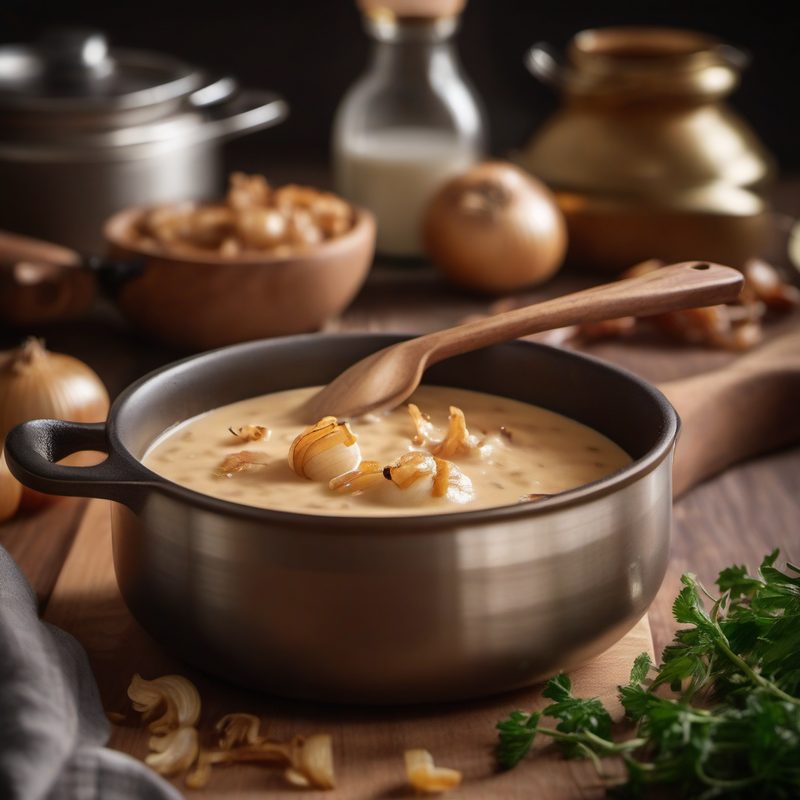
Caramelized Onion Cream Sauce
A deeply savory, silky cream sauce built on the foundations of patience — slowly caramelized onions are deglazed with white wine, enriched with broth and cream, then partially or fully puréed into a luxurious condiment that transforms simple grilled meats and sausages into something memorable.
| Amount | Ingredient |
|---|---|
| 2 medium (250 g / about 2 cups sliced) | white or yellow onions, thinly sliced |
| 20 g (1½ tbsp) | unsalted butter |
| 1 tbsp (15 ml) | extra-virgin olive oil |
| 80 ml (⅓ cup) | dry white wine (such as Sauvignon Blanc or Pinot Grigio) |
| 100 ml (scant ½ cup) | warm chicken or vegetable broth |
| 50 ml (3–4 tbsp) | heavy cream (or whole milk for a lighter version) |
| to taste | kosher salt |
| to taste | freshly ground black pepper |
| 1 tsp (5 g) | Dijon mustard (optional) |
| 1 sprig | fresh thyme, or 1 bay leaf (optional) |
This sauce is a lesson in how a single humble ingredient, treated with time and care, can become something extraordinary. Two ordinary onions, cooked low and slow for 20 minutes until they are soft, translucent, and just beginning to take on color, provide a remarkable depth of savory sweetness that no shortcut can replicate. A splash of wine deglazes the pan, capturing every last bit of fond, while warm broth and a modest amount of cream (or milk for a lighter take) round the sauce into something that is simultaneously rich and restrained — it clings to the back of a spoon without being heavy. An optional touch of Dijon mustard adds a whisper of sharpness that cuts through the sweetness, and a sprig of fresh thyme or a bay leaf lends an aromatic backbone. The choice between a fully smooth, velvety sauce and a more rustic, textured version is yours, and both are equally delicious.
Ingredient notes: Yellow onions are the best choice here — they strike an ideal balance between sweetness and savory depth, and they caramelize more evenly than red or white onions. If using white onions, expect a slightly milder, sweeter result. The wine should be dry and drinkable; avoid anything labeled "cooking wine" as it is salted and often contains preservatives. For a vegetarian version, use vegetable broth and ensure the Dijon mustard is vegan-friendly if that matters. The cream can be replaced with whole milk for a lighter sauce, but the result will be thinner and less luscious — whisk in 1 teaspoon of all-purpose flour dissolved in 1 tablespoon of cold water if you need extra body.
- Large skillet or sauté pan (10–12 inch / 25–30 cm, preferably stainless steel or nonstick)
- Wooden spoon or heat-resistant spatula
- Chef's knife and cutting board
- Immersion blender or countertop blender
- Liquid measuring cup
- Measuring spoons
- Fine-mesh strainer (optional, for smoothest sauce)
- Caramelize the onions (20 min). Heat the butter and olive oil in a large skillet over low heat. Add the thinly sliced onions and a generous pinch of kosher salt — the salt helps draw out moisture and prevents the onions from browning too quickly. Cook, stirring frequently with a wooden spoon, until the onions are very soft, completely translucent, and just beginning to turn a light golden color, about 15–20 minutes. If the onions start to dry out or stick to the pan before they are fully soft, add a splash of water (about 1–2 tablespoons) and continue cooking. Do not rush this stage — the flavor develops in the final minutes of gentle cooking.
- Deglaze with wine (2 min). Increase the heat to medium-high. Pour in the dry white wine and stir vigorously, scraping up any browned bits (fond) from the bottom of the pan with your wooden spoon. Let the wine bubble and reduce until the alcohol aroma has dissipated and the pan is almost dry again, about 1–2 minutes. The onions should be glossy and fragrant.
- Simmer with broth (6 min). Reduce the heat to medium and add the warm chicken or vegetable broth. Stir to combine. Bring to a gentle simmer and cook, stirring occasionally, until the onions are very soft and the liquid has reduced by about half, about 5–6 minutes. The mixture should look concentrated and deeply flavored, with just enough liquid to barely cover the onions.
- Add the cream (3 min). Pour in the heavy cream (or milk) and add the optional Dijon mustard and thyme sprig or bay leaf if using. Stir to combine. Simmer gently for another 2–3 minutes, stirring constantly, until the sauce has thickened slightly and coats the back of a spoon. Remove and discard the thyme sprig or bay leaf.
- Blend to desired consistency (2 min). For a silky, elegant sauce, use an immersion blender directly in the pan and purée until completely smooth, about 30 seconds. For a more rustic sauce with texture, transfer half the mixture to a blender and purée until smooth, then stir back into the remaining chunky onions in the pan. This "half-blend" method gives you the best of both worlds — a creamy body with occasional bits of soft onion for texture. If using a countertop blender, work in batches and remove the center cap to allow steam to escape, covering with a folded kitchen towel.
- Finish and season (1 min). Taste and adjust seasoning with salt and freshly ground black pepper. The sauce should be savory, sweet from the onions, and well-balanced, with the cream providing a smooth, luxurious finish.
- Low and slow is the only way to caramelize onions. High heat will brown the onions (and potentially burn the butter) before they have fully softened, resulting in a sauce that is bitter rather than sweet. Keep the heat low and be patient — 20 minutes is the minimum, and 25 is fine if the onions need a bit more time.
- Add a splash of water during caramelization if needed. If the onions look dry or the butter-oil mixture is browning before the onions are fully soft, add water 1 tablespoon at a time. The water will steam the onions, helping them soften without browning too quickly.
- Use warm broth, not cold. Adding cold broth to the hot pan will shock the onions and slow down the cooking. Heat the broth in a small saucepan or microwave for 30 seconds before adding it.
- Do not skip the deglazing step. The browned bits (fond) on the bottom of the pan are packed with concentrated onion flavor. The wine dissolves them and incorporates that depth into the sauce.
- For the smoothest sauce, strain after blending. If you purée the entire sauce and want an absolutely velvety, restaurant-quality texture, pass it through a fine-mesh strainer, pressing on the solids with a rubber spatula. This is an optional refinement — the sauce is already excellent unstrained.
- The Dijon mustard makes a difference. Even 1 teaspoon of Dijon brightens the sauce noticeably, cutting through the richness of the cream and the sweetness of the onions. It does not make the sauce taste like mustard — it simply makes it taste more alive.
Serving suggestions: Spoon over chicken paillard or pan-seared chicken breasts; serve with pork medallions or a roasted pork tenderloin; drizzle over grilled sausages (bratwurst, Italian sausage, or kielbasa); pair with pan-seared veal chops or a simple beef steak; serve alongside roasted potatoes or steamed green beans; use as a base for a creamy mushroom and onion crostini; or thin with a little extra broth and toss with pappardelle or fettuccine for a quick pasta dinner.
Garnish: A sprinkle of finely chopped fresh parsley, a grating of fresh nutmeg, or a few fresh thyme leaves.
Recipe from The Italian Kitchen by Vita Milanese — Volume 2 · Sunday Sauce. Discover all volumes on the ebook page.