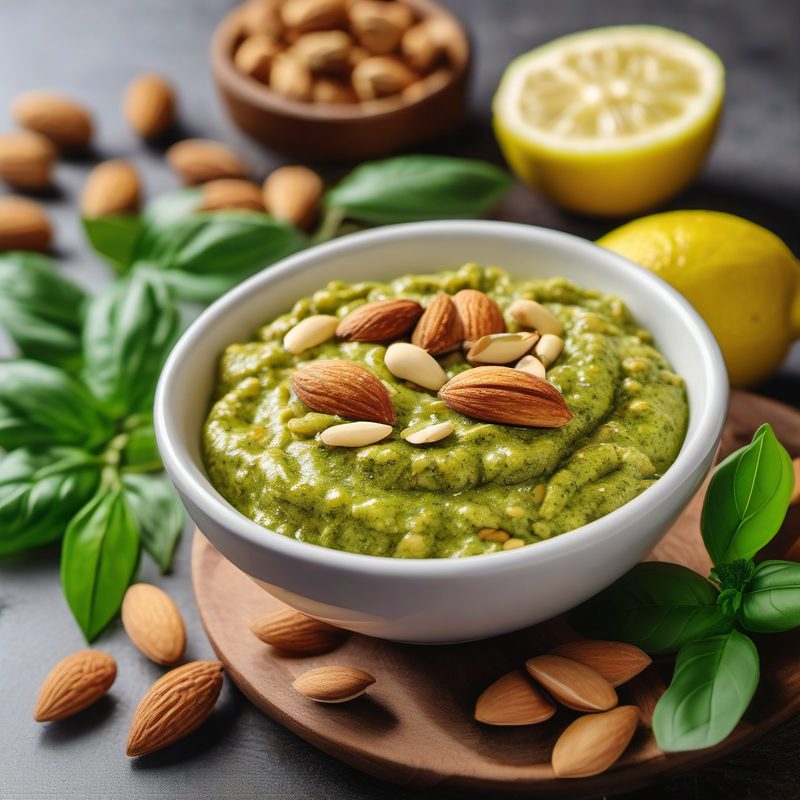
Lemon Pesto with Almonds
A bright, nutty Ligurian-inspired pesto that swaps some of the traditional pine nuts for almonds and lets lemon zest and juice take center stage — creamy, fragrant, and intensely citrusy, perfect on pasta, grilled fish, or roasted vegetables.
| Amount | Ingredient |
|---|---|
| 1 large (or 2 small) | lemon |
| 80 g (¾ cup) | Parmigiano-Reggiano, finely grated |
| 100 ml (scant ½ cup) | extra-virgin olive oil |
| 40 g (⅓ cup) | pine nuts |
| 30 g (¼ cup) | whole almonds, blanched or raw |
| 6 leaves | fresh basil |
| 1 clove | garlic |
| to taste | kosher salt |
This lemon pesto is a sunnier, more acidic cousin of the classic Genovese. Where traditional pesto relies on basil as its dominant flavor, here the lemon — both zest and juice — takes the lead, creating a sauce that is simultaneously rich from the nuts and cheese and bright from the citrus. The combination of pine nuts and almonds is deliberate: the pine nuts bring buttery sweetness, while the almonds add a subtle, earthy backbone and a slightly coarser texture. Basil plays a supporting role, lending just enough herbal freshness to keep the pesto from tasting one-dimensional. This is a pesto that works beautifully with delicate pastas (linguine, angel hair), as a marinade for chicken or fish, or simply spooned over grilled zucchini or asparagus. The key is to pulse, not purée — a coarse, textured paste is the goal.
Ingredient notes: Use a large, unwaxed organic lemon if possible — you will be using the zest, and waxed supermarket lemons can leave a chemical residue. If only small lemons are available, use two. The Parmigiano-Reggiano should be finely grated on a Microplane or the smallest holes of a box grater; pre-grated cheese contains anti-caking agents that prevent it from emulsifying properly. Blanched almonds (skins removed) produce a creamier, milder pesto; raw almonds with skins will work but yield a slightly more bitter, darker result. Toast the nuts lightly for the deepest flavor, though untoasted nuts work well for a more delicate, raw-nut character.
- Food processor
- Small skillet (for toasting nuts)
- Microplane or fine grater (for lemon zest)
- Chef's knife and cutting board
- Rubber spatula
- Measuring cups and spoons
- Airtight container or serving bowl
- Prepare the lemon (2 min). Wash and dry the lemon thoroughly. Using a Microplane or fine grater, grate all the zest — you should have about 1 tablespoon. Be careful to avoid the bitter white pith. Halve the lemon and squeeze; reserve about 2 tablespoons of juice.
- Toast the nuts (2 min). In a small, dry skillet over medium heat, combine the pine nuts and almonds. Toast, shaking the pan frequently, until fragrant and just beginning to take on color — the pine nuts will turn golden on one side, and the almonds will smell deeply nutty. This takes about 2 minutes. Immediately transfer to a plate to cool completely. Toasting is essential: raw nuts create a flat, one-dimensional pesto.
- Build the base (1 min). In a food processor, combine the cooled toasted nuts, peeled garlic clove, basil leaves, and lemon zest. Pulse 5 to 7 times, until the nuts are coarsely chopped and the garlic and basil are broken down. Scrape down the sides of the bowl with a rubber spatula.
- Add the cheese and liquids (1 min). Add the grated Parmigiano-Reggiano, lemon juice, and about half the olive oil. Pulse 3 to 4 times to combine. With the food processor running, drizzle in the remaining olive oil in a steady stream until the pesto comes together into a thick, creamy paste. Stop the machine and scrape down the sides.
- Adjust the consistency (1 min). The pesto should be thick enough to coat a spoon but loose enough to toss with pasta. If it is too thick, add warm water 1 tablespoon at a time and pulse to incorporate. If it is too thin, add more Parmigiano or a small handful of almonds, pulsed in.
- Season and serve (1 min). Season with salt to taste. Keep in mind that the Parmigiano is already salty — start with a small pinch and adjust upward. Toss immediately with hot pasta (reserve ½ cup of pasta water to loosen the sauce), use as a marinade, or transfer to a jar and top with a thin layer of olive oil to prevent oxidation.
- Toast the nuts for depth. This is non-negotiable for the best flavor. Raw nuts produce a flat, starchy pesto; toasted nuts release their oils and transform the sauce into something fragrant and complex.
- Zest first, then juice. Grate the zest before cutting and juicing the lemon — a whole, uncut lemon is much easier to zest than a halved one.
- Pulse, don't purée. A smooth, homogenous paste is not the goal. The pesto should have visible flecks of nuts and herbs — a coarse texture that clings to pasta and provides contrast in every bite.
- Reserve pasta water. If using this pesto with pasta, always reserve a cup of the starchy cooking water before draining. A splash (or two) loosens the pesto into a silky sauce that coats every strand.
- Let it rest. Like most pestos, this one improves after a 15-minute rest at room temperature. The flavors meld, the nuts absorb the oil, and the lemon mellows slightly.
- Don't skip the basil. Six leaves may seem like a modest amount, but they provide a crucial herbal backdrop that prevents the pesto from tasting like straight lemon and oil.
| Mistake | Why It Hurts | The Fix |
|---|---|---|
| Using pre-grated Parmigiano | Anti-caking agents prevent proper emulsification, yielding a gritty, greasy sauce | Grate a block of Parmigiano-Reggiano fresh on a Microplane |
| Over-toasting the nuts | Burnt nuts add a bitter, acrid flavor that cannot be masked — pine nuts burn especially fast | Watch the pan constantly; remove the nuts the moment they are fragrant and lightly colored |
| Including white pith with the zest | Pith is intensely bitter and will ruin the bright, clean flavor of the pesto | Use a Microplane or sharp grater that takes only the yellow surface, not the white layer underneath |
| Adding all the oil at once | The pesto becomes greasy and separates, with oil pooling on top | Drizzle the oil in slowly while the processor runs, allowing the nuts and cheese to absorb it evenly |
| Over-processing into a smooth paste | The pesto loses its rustic texture and becomes pasty and heavy | Pulse in short bursts and check the texture frequently — visible nut and herb flecks are the goal |
| Skipping the salt adjustment | Without enough salt, the pesto tastes flat and acidic rather than bright and balanced | Taste on a piece of bread or pasta before serving; adjust salt upward until the flavors pop |
- Spicy Lemon Pesto: Add ½ teaspoon red pepper flakes or one small dried chili (crumbled) with the nuts in step 3. The heat cuts beautifully through the richness of the nuts and cheese.
- Herb Lemon Pesto: Replace the basil with an equal mix of fresh mint and parsley for a greener, more cooling pesto that is excellent with lamb or grilled fish.
- Vegan Lemon Pesto: Omit the Parmigiano-Reggiano and substitute 2 tablespoons nutritional yeast plus an extra 2 tablespoons of almonds. Add an extra tablespoon of lemon juice and a pinch of salt to compensate for the lost umami.
- Lemon-Ricotta Pesto: After making the pesto, fold in 100 g (½ cup) of fresh whole-milk ricotta. This creates a creamier, milder sauce that is spectacular with stuffed pasta shells or as a dip for crudité.
- Arugula Lemon Pesto: Swap the basil for 40 g (2 cups) of fresh arugula. The peppery bite of arugula pairs beautifully with the lemon and almonds — ideal with grilled chicken or steak.
Recipe from The Italian Kitchen by Vita Milanese — Volume 2 · Sunday Sauce. Discover all volumes on the ebook page.