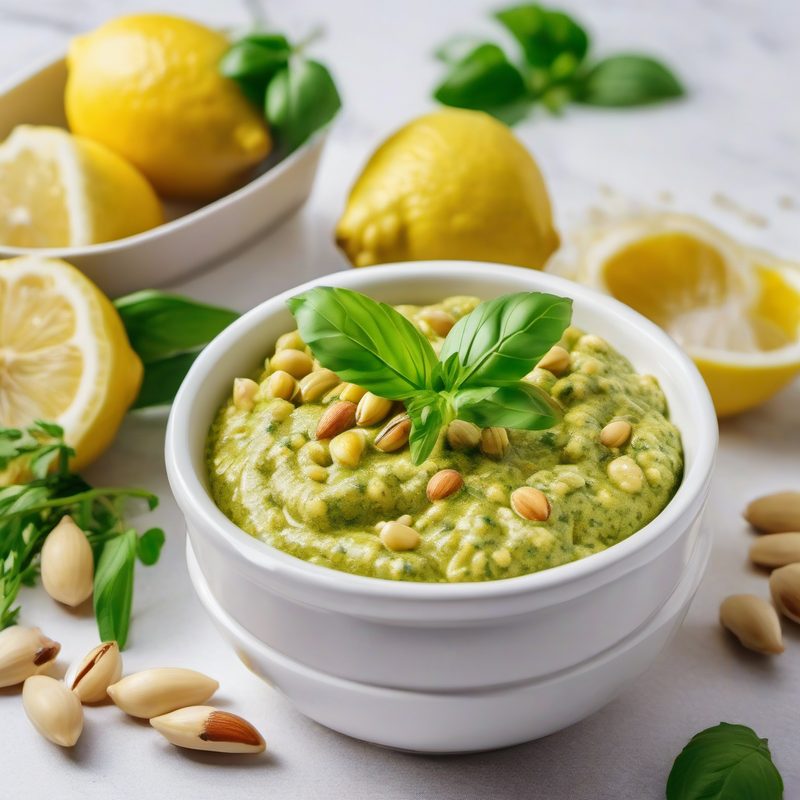
Lemon Pesto
A bright, sun-drenched Sicilian-style pesto that swaps basil for lemon zest and juice — vibrant, creamy, and intensely citrusy, perfect for tossing with pasta, brushing onto fish, or spooning over grilled chicken.
| Amount | Ingredient |
|---|---|
| 2 | lemons (zest and juice) |
| 40 g (⅓ cup) | pine nuts |
| 50 g (½ cup) | Parmigiano-Reggiano, grated |
| 1 small bunch | fresh parsley |
| to taste | fresh basil |
| ½ clove | garlic |
| as needed | extra-virgin olive oil |
| to taste | salt |
This lemon pesto is a revelation in simplicity: where traditional Genovese pesto relies on basil for its green punch, this version lets lemons take center stage. The zest provides perfumed intensity, while the juice adds a clean, sharp acidity that cuts through the richness of pine nuts and Parmigiano-Reggiano. Fresh parsley and basil lend herbaceous notes that frame the citrus without overwhelming it. The result is a pesto that feels lighter and brighter than its classic cousin — a sauce for spring and summer, for seafood and vegetables, for any dish that needs a hit of sunshine. A food processor makes quick work of it, but a mortar and pestle yields a coarser, more rustic texture that many prefer.
Ingredient notes: Use unwaxed, organic lemons if possible — the zest is a primary flavor component, and you want it free of chemical residues. The pine nuts should be raw (not toasted) for a creamier result; if only toasted are available, they will work but the flavor will be more pronounced. Parmigiano-Reggiano is strongly preferred over generic grated cheese — its granular texture and nutty, salty complexity are integral to the pesto's character. Use flat-leaf (Italian) parsley for its cleaner, less bitter flavor than curly parsley. Basil is added to taste — start with a small handful (about 10 g / ¼ cup) and adjust. The garlic should be a single small clove or half a large one; lemon pesto should whisper garlic, not shout it.
- Food processor (or mortar and pestle)
- Chef's knife and cutting board
- Microplane or fine zester
- Citrus juicer or reamer
- Rubber spatula
- Measuring cups and spoons
- Serving bowl or airtight container
- Prepare the lemons (3 min). Using a Microplane or fine zester, grate the zest of both lemons, taking care to avoid the bitter white pith. Set the zest aside. Halve the lemons and juice them; you should have about 3–4 tablespoons (45–60 ml) of juice. Strain the juice to remove seeds.
- Toast the pine nuts (3 min). Place the pine nuts in a dry skillet over medium-low heat. Toast, shaking the pan frequently, until they are fragrant and just beginning to take on a light golden color, about 2–3 minutes. Watch carefully — pine nuts burn in seconds. Transfer to a plate and let cool completely.
- Combine the aromatics (2 min). In a food processor or large mortar, combine the cooled pine nuts, the ½ garlic clove (peeled), the parsley leaves (roughly chopped), the basil leaves, and the lemon zest. If using a food processor, pulse 5 to 7 times until coarsely chopped. If using a mortar, pound with a circular grinding motion until the ingredients are broken down into a coarse, uneven paste.
- Add the cheese and liquids (2 min). Add the grated Parmigiano-Reggiano, the strained lemon juice, and 3 tablespoons (45 ml) of extra-virgin olive oil. Pulse or grind until the mixture is creamy but still retains visible texture — it should look like a thick, spreadable paste with flecks of herbs and nuts. If the pesto is too thick, add additional olive oil 1 tablespoon at a time, pulsing after each addition.
- Season and adjust (1 min). Season with salt to taste. Remember that Parmigiano is already quite salty, so start with a small pinch and adjust. If the pesto tastes flat, a touch more lemon juice or a tiny pinch of lemon zest can brighten it.
- Serve or store (1 min). Transfer to a serving bowl. For pasta, toss immediately with 12 oz (340 g) of cooked spaghetti or linguine, reserving about ½ cup (120 ml) of pasta water to loosen the sauce. For fish or chicken, use as a marinade or finishing sauce.
- Use a gentle hand with the garlic. Lemon pesto is delicate — a single large clove of raw garlic can overwhelm the citrus notes. Use half a clove, or even a single small clove. When in doubt, err on the side of less; you can always add more, but you cannot take it out.
- Toast the pine nuts for maximum flavor. Raw pine nuts work, but toasting transforms them — they become sweeter, nuttier, and more aromatic, providing a creamy counterpoint to the bright lemon. Just do not walk away from the pan.
- Do not over-process. The best lemon pesto has texture — visible bits of pine nut, tiny flecks of lemon zest, and small herb fragments. A smooth, homogenized paste is lifeless. Pulse in short bursts and check the texture frequently.
- Reserve pasta water. When using lemon pesto with pasta, always reserve some starchy pasta water before draining. A splash (2–3 tablespoons) stirred in at the end helps the pesto coat every strand evenly and creates a silky, emulsified sauce without added oil.
- Zest before juicing. Always zest the lemons before cutting and juicing them — it is much easier to zest a whole, firm lemon than a floppy, juiced half.
- Let it rest. Like all pestos, this one improves after a 10-minute rest at room temperature, allowing the flavors to meld and the pine nuts to absorb the lemon juice and oil.
| Mistake | Why It Hurts | The Fix |
|---|---|---|
| Using bottled lemon juice | Lacks the floral, aromatic quality of fresh zest and juice — the pesto tastes one-dimensional and sour rather than bright and complex | Always use fresh lemons. Zest and juice them yourself. |
| Including the white pith in the zest | Adds a harsh, bitter note that overpowers the delicate citrus flavor | Use only the yellow outer layer of the peel. A Microplane makes this easy. |
| Over-toasting the pine nuts | Burnt pine nuts taste acrid and bitter, ruining the entire pesto | Toast over medium-low heat and shake the pan constantly. Remove at the first sign of color. |
| Adding too much garlic | Raw garlic dominates and masks the lemon — the pesto tastes like garlic paste with a hint of citrus | Use half a clove. For a milder version, blanch the garlic clove in boiling water for 30 seconds first. |
| Over-processing into a smooth paste | The pesto loses its rustic character and becomes dense and pasty | Pulse in short bursts. Stop while the mixture still has visible texture. |
| Skipping the salt | The pesto tastes flat — salt is essential to wake up the lemon and Parmigiano flavors | Add a small pinch at the end and adjust. Remember that Parmigiano is salty. |
- Lemon Basil Pesto: Double the basil and reduce the parsley to a few sprigs for a more classic basil-lemon hybrid that bridges Genovese and Sicilian traditions.
- Lemon Mint Pesto: Replace the basil with fresh mint and add 2 tablespoons of toasted almonds for a refreshing, Middle Eastern-inspired pesto that is spectacular with lamb or grilled vegetables.
- Lemon Cilantro Pesto: Replace the parsley and basil with fresh cilantro and add a small pinch of red pepper flakes for a citrusy, herbaceous pesto perfect for fish tacos.
- Lemon Arugula Pesto: Replace the parsley with 50 g (2 cups) of arugula for a peppery, adult version with more complexity and a beautiful pale green color.
- Lemon Ricotta Pesto: Fold in 100 g (½ cup) of fresh ricotta at the end for a creamier, milder pesto that coats pasta beautifully without needing much pasta water.
- Lemon Caper Pesto: Add 1 tablespoon of rinsed and drained capers with the herbs for a briny, savory variation that pairs brilliantly with grilled fish.
- Vegan Lemon Pesto: Omit the Parmigiano-Reggiano and add 2 tablespoons of nutritional yeast and an extra tablespoon of pine nuts. The result is surprisingly close in flavor and texture.
| Storage Method | Details |
|---|---|
| Refrigerator | Store in an airtight container with a thin layer of olive oil on top (to prevent oxidation) for up to 5 days. Bring to room temperature and stir well before serving. The lemon flavor fades over time, so use within 2–3 days for best results. |
| Freezer | Pack into an ice cube tray, cover with a thin layer of olive oil, and freeze for up to 2 months. Transfer frozen cubes to a zip-top bag. Thaw at room temperature. Lemon flavor is slightly diminished after freezing. |
| Surface oxidation | The top layer may darken from exposure to air — press plastic wrap directly onto the surface or maintain a layer of olive oil on top. This is cosmetic and does not affect flavor. |
This bright, citrus-forward pesto pairs beautifully with:
- Tossed with spaghetti or linguine: A crisp, mineral-driven white wine like a Vermentino (Sardinia) or a Greco di Tufo (Campania). The wine's bright acidity and subtle salinity echo the lemon notes without competing.
- Brushed on grilled fish (sea bass, branzino, or salmon): A light, citrusy Soave (Veneto) or a Albariño (Spain). The wine's clean finish complements the pesto's brightness.
- Spooned over grilled chicken: A dry rosé from Provence or a Pinot Grigio (Friuli). The wine's subtle fruit and crisp acidity bridge the herb and lemon flavors.
- As a marinade for shrimp: A sparkling Prosecco or Franciacorta — the bubbles and acidity refresh the palate between bites.
- Dolloped on roasted vegetables: A chilled Sauvignon Blanc (New Zealand or Loire) with its characteristic grassiness and grapefruit notes.
- Beer alternative: A Belgian witbier with its citrusy coriander notes or a German Hefeweizen with its bright, fruity character.
| Per Serving (about 2 tbsp / 30 g) | |
|---|---|
| Calories | 145 |
| Protein | 5 g |
| Fat | 12 g |
| Carbohydrates | 4 g |
| Fiber | 1 g |
Nutrition values are approximate and based on pine nuts, Parmigiano-Reggiano, olive oil, lemon juice, and herbs. Actual values will vary based on oil absorption and exact proportions.
Can I make this pesto without a food processor?
Yes — a mortar and pestle is actually the traditional method and yields a superior texture. Pound the pine nuts and garlic first, then add the herbs and lemon zest, and finally work in the Parmigiano, lemon juice, and olive oil. It takes a bit more effort but the result is worth it.
Can I use a different nut instead of pine nuts?
Absolutely. Toasted almonds, walnuts, or pistachios all work beautifully with lemon. Almonds produce a creamier pesto, walnuts add earthiness, and pistachios create a more colorful, slightly sweeter version. Toast them first for best flavor.
How do I serve lemon pesto with pasta?
Cook 12 oz (340 g) of spaghetti or linguine in salted boiling water until al dente. Reserve about ½ cup (120 ml) of pasta water before draining. Return the pasta to the pot, add the lemon pesto, and toss with enough pasta water (2–3 tablespoons at a time) to create a silky sauce that coats every strand. Serve immediately with extra grated Parmigiano on top.
Can I use lemon pesto as a marinade?
Yes — it is excellent as a marinade for fish (salmon, sea bass, shrimp) and chicken. Coat the protein in pesto and let it sit for 15–30 minutes (not longer — the acid in the lemon juice will begin to cook the fish). Grill, pan-sear, or bake as usual. The pesto forms a flavorful crust while keeping the interior moist.
What if I don't have Parmigiano-Reggiano?
Pecorino Romano is a good substitute but is saltier and sharper, so use slightly less and adjust salt accordingly. Grana Padano is closer in flavor to Parmigiano. Avoid pre-grated cheese in tubs — it contains anti-caking agents that prevent smooth emulsification.
Can I make this pesto nut-free?
Omit the pine nuts and substitute 40 g (⅓ cup) of toasted sunflower seeds or pumpkin seeds. The flavor will be different but still delicious. Add an extra tablespoon of Parmigiano to compensate for the missing richness.
- Classic Basil Pesto (Volume 1)
- Almond Pesto (Volume 2)
- Sun-Dried Tomato Pesto (Volume 2)
- Grilled Branzino with Lemon Herb Sauce (Volume 1)
- Lemon Ricotta Pasta (Volume 1)
Recipe from "The Italian Kitchen" by Vita Milanese — Volume 2: Sunday Sauce
Recipe from The Italian Kitchen by Vita Milanese — Volume 2 · Sunday Sauce. Discover all volumes on the ebook page.