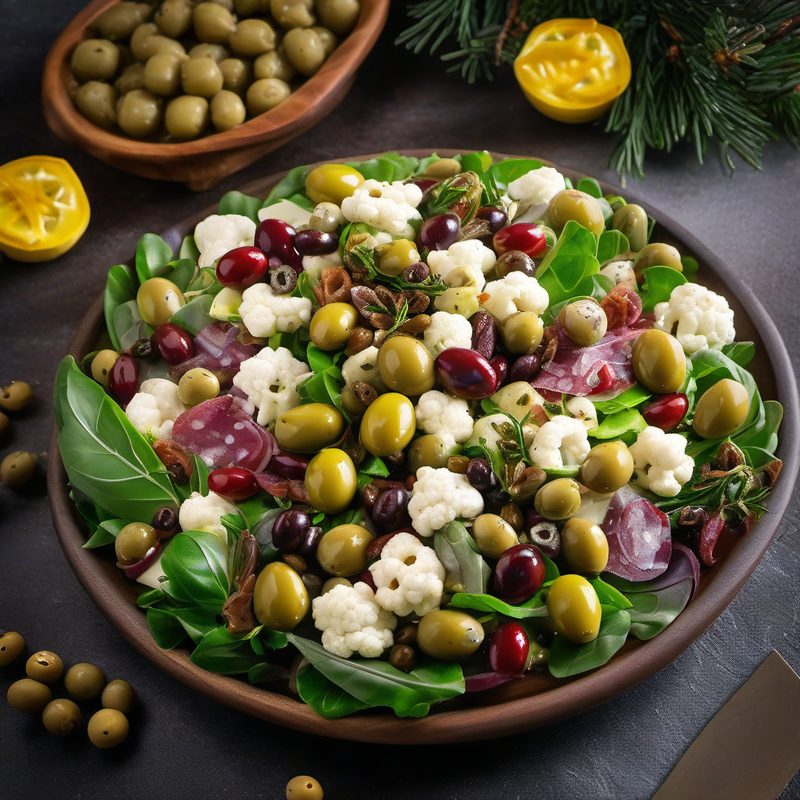
Insalata Rinforzo
Neapolitan Christmas Cauliflower Salad — a bold, briny 'reinforcing' side dish that gets better as it sits.
| Amount | Ingredient |
|---|---|
| 1 | Large head cauliflower (about 2 lbs / 900 g) |
| 100 g (¾ cup) | Pickled mixed vegetables (giardiniera), drained and roughly chopped |
| 50 g (⅓ cup) | Pitted green olives, halved |
| 50 g (⅓ cup) | Pitted black olives (Gaeta or Kalamata) |
| 50 g (3 tbsp) | Capers, drained and rinsed |
| 2 | Anchovy fillets (oil-packed), finely mashed |
| 3 tbsp | Extra-virgin olive oil, plus more for finishing |
| 2 tbsp | Red wine vinegar |
| ½ tsp | Fine sea salt, plus more for blanching water |
| ¼ tsp | Black pepper, freshly ground |
> Note: The name "rinforzo" (reinforcement) refers to how this salad reappears throughout the Neapolitan Christmas feast — served as an antipasto, then replenished alongside the main courses. It actually improves after a day in the fridge.
🥘 Equipment
- Large pot (6-qt / 6 L)
- Colander
- Large mixing bowl
- Small bowl (for dressing)
- Chef's knife and cutting board
- Measuring spoons
- Kitchen towel or salad spinner
📋 Preparation
Step 1: Prepare the Cauliflower
Remove the outer leaves from the cauliflower and trim the core. Break or cut the cauliflower into bite-sized florets — about 1½ to 2 inches (4–5 cm). Rinse thoroughly in cold water and drain.
Why this size? Florets this large hold their texture when tossed with the bold pickled ingredients and won't disintegrate.
Step 2: Blanch the Cauliflower
Fill a large pot with water and bring to a rolling boil. Add salt generously — about 1 tablespoon per quart (4 L) of water — until it tastes like sea water.
Add the cauliflower florets and cook until tender-crisp: the stem should offer slight resistance when pierced with a knife, but the floret should be fully cooked — about 4–6 minutes depending on floret size.
Step 3: Shock and Drain
Immediately drain the cauliflower in a colander and rinse under cold running water to stop the cooking. Shake thoroughly to remove excess water, then spread on a clean kitchen towel or use a salad spinner to dry completely.
Don't skip this: Excess moisture will dilute the dressing and make the salad watery.
Step 4: Prepare the Mix-Ins
While the cauliflower cools, prepare the briny components:
- Drain the giardiniera and roughly chop any larger pieces (cauliflower chunks, carrot slices, celery) into bite-sized pieces.
- Halve the green olives and, if using, the black olives.
- Rinse the capers under cold water to remove excess salt or brine, then drain well.
Step 5: Make the Dressing
In a small bowl, mash the anchovy fillets with the back of a fork until they form a paste. Add the red wine vinegar and whisk to dissolve the anchovy. Slowly drizzle in the olive oil while whisking continuously to form a rough emulsion. Season with salt and pepper.
Step 6: Assemble the Salad
In a large mixing bowl, combine the cooled cauliflower, giardiniera, olives, and capers. Pour the dressing over the top and toss gently but thoroughly — use your hands for the gentlest touch, or a large spatula.
Step 7: Rest and Serve
Let the salad rest at room temperature for at least 15 minutes before serving to allow the flavors to meld. Transfer to a serving platter and drizzle with a final tablespoon of olive oil just before bringing to the table.
Insalata di rinforzo is traditionally served at room temperature, never cold from the fridge — though it stores beautifully.
🧑🍳 Chef's Tips
- The right caper: Salt-packed capers are superior here — they have better texture and a more nuanced flavor than brine-packed. If using salt-packed, soak them in several changes of cold water for 10 minutes, then rinse and squeeze dry.
- Make it a day ahead: This salad was literally invented to be made ahead. The flavors intensify overnight. Store in an airtight container in the fridge, then bring to room temperature 30 minutes before serving.
- Anchovy is not optional: Even if you think you dislike anchovies, don't skip them — they melt into the dressing and provide an underlying savory depth (umami) that makes the salad sing, without tasting remotely fishy.
- Toast some bread: Serve with crusty bread or crostini to sop up the briny dressing at the bottom of the bowl — this is half the experience.
❌ Common Mistakes
| Mistake | Why | Fix |
|---|---|---|
| Overcooked cauliflower | Mushy florets break apart when tossed; texture is lost | Blanch for only 4–6 minutes to tender-crisp |
| Dressing while hot | Warm cauliflower absorbs dressing unevenly and turns soggy | Cool cauliflower completely before dressing |
| Serving ice-cold | The olive oil congeals; flavors are muted | Always bring to room temperature before serving |
| Skipping the anchovy | Flat, one-dimensional dressing with no backbone | Mash the anchovy into paste — it dissolves completely |
| Bland florets | Cauliflower needs assertive seasoning | Salt the blanching water generously; season the dressing boldly |
💡 Variations
- Add heat: Toss in 1–2 peperoncini (pickled hot cherry peppers), stemmed, seeded, and sliced into thin strips — a common Neapolitan addition.
- Swap the pickles: Use pickled cauliflower, carrots, or mostarda di frutta (candied fruit in mustard syrup) for a sweet-spicy twist from nearby regions.
- Herb it up: Add a handful of fresh flat-leaf parsley, roughly chopped, and a few leaves of fresh mint — both are signature herbs of Neapolitan cooking.
- No anchovy? Substitute 1 tablespoon of colatura di alici (anchovy sauce from Cetara) — it's the concentrated essence and adds the same depth.
- Roasted version: For a winter variation, roast the cauliflower at 425°F (220°C) for 20 minutes instead of blanching — the caramelized edges add a nutty sweetness.
❄️ Storage
| Condition | Duration | Notes |
|---|---|---|
| Room temperature | Up to 4 hours | Fine during a meal, no issues |
| Refrigerated (tightly covered) | Up to 5 days | Improves after 24 hours — the "rinforzo" effect |
| Frozen | Not recommended | Cauliflower becomes mushy upon thawing; pickles lose crunch |
To serve from the fridge: let sit at room temperature for 30 minutes, add a fresh splash of olive oil and a squeeze of lemon, and toss gently.
🍷 Wine Pairing
| Wine | Why |
|---|---|
| Falanghina del Sannio | The classic Neapolitan white — citrusy, mineral, with enough body to stand up to the capers and anchovy |
| Greco di Tufo | Fuller-bodied, slightly nutty, with a saline finish that mirrors the briny components |
| Verdicchio dei Castelli di Jesi | Bright acidity and bitter almond notes cut through the olive oil dressing beautifully |
| Fiano di Avellino | Rich honeyed notes balance the aggressive pickled flavors |
🍺 Beer Pairing
| Beer | Why |
|---|---|
| Italian Pilsner (e.g., Moretti La Rossa) | Clean, crisp bitterness cuts through the oil and salt |
| Belgian Witbier | The orange peel and coriander notes complement the pickled vegetables |
| Kölsch | Delicate, refreshing — won't overwhelm the cauliflower |
🥗 Suggested Sides
- Fried pizza dough (Pizza fritta) or grissini — essential for scooping up the salad and dressing
- Baccalà alla napoletana (fried salt cod) — a classic Christmas table companion
- Peperoni imbottiti (stuffed peppers) — sweet peppers contrast with the briny salad
- Caprese salad — fresh tomato and mozzarella lightens an otherwise rich holiday table
📊 Nutrition (per serving, based on 6 servings)
| Calories | Protein | Fat | Carbs | Fiber |
|---|---|---|---|---|
| 145 | 4 g | 11 g | 9 g | 4 g |
❓ FAQ
Why is it called "rinforzo"?
Rinforzo means "reinforcement" or "strengthening." During the multi-course Neapolitan Christmas feast, this salad is brought out early as an antipasto and then replenished ("reinforced") throughout the meal — the host keeps adding fresh batches to the same platter as it's eaten. It's also sometimes called insalata di rinforzo because the bold flavors "strengthen" (whet) the appetite between heavy courses.
Can I use frozen cauliflower?
Fresh is strongly preferred — frozen cauliflower releases too much water upon thawing and turns mushy. If you must use frozen, blanch it for only 2–3 minutes and dry extremely thoroughly.
Do I need to cook the giardiniera?
No — pickled vegetables are used straight from the jar (drained). The salad is a mix of blanched and raw ingredients, and the contrast between tender cauliflower and crunchy pickles is part of the appeal.
Is this a Christmas-specific dish?
It is the classic Christmas Eve and Christmas Day antipasto in Naples and Campania, but it's delicious year-round. Many Neapolitan families make it for Easter as well, and it's a staple of summer buffets because it doesn't wilt or spoil outdoors.
My cauliflower turned out soggy — what went wrong?
Likely one of three things: (1) overcooked — blanch only 4–6 minutes; (2) not dried well before dressing — use a salad spinner or towel; (3) dressed while still warm — always cool completely.
Why do the anchovies need to be mashed into a paste?
Whole anchovy fillets won't distribute evenly through the dressing; mashing them ensures every bite gets that savory depth. If you use anchovy paste from a tube, 1 teaspoon equals about 2 fillets.
🔗 Related Recipes
- Caponata Siciliana — Sweet-and-Sour Eggplant Relish
- Peperonata — Stewed Bell Peppers
- Baccalà alla Napoletana — Neapolitan Fried Salt Cod
- Giardiniera Fatta in Casa — Homemade Pickled Vegetables
🏷️ Search Tags
Recipe from The Italian Kitchen by Vita Milanese — Volume 1 · Pasta Perfetto. Discover all volumes on the ebook page.