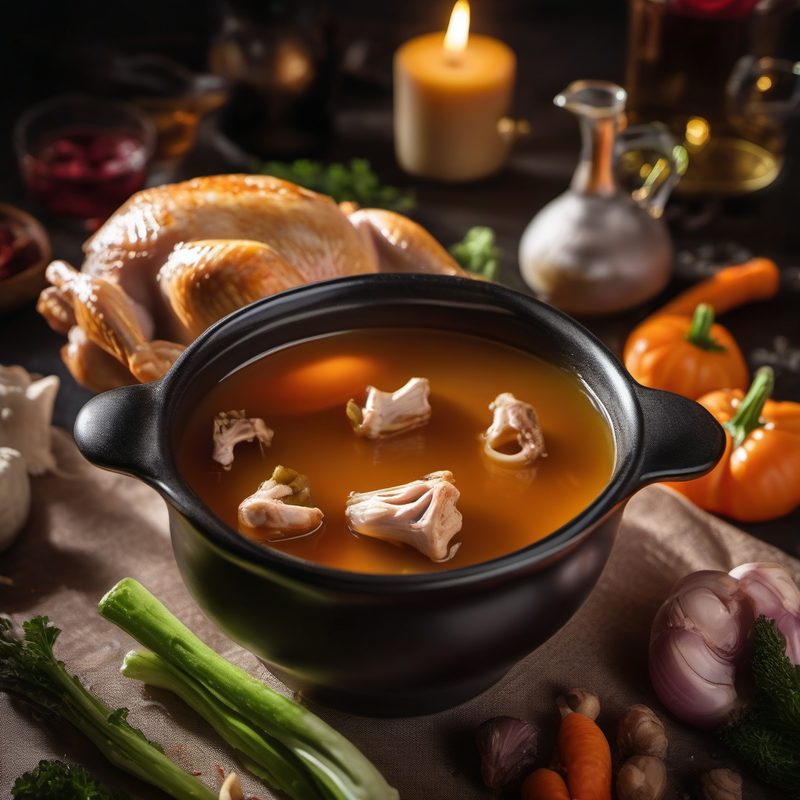
Dark Chicken Broth
A deep, concentrated, umami-packed chicken broth made by roasting bones and vegetables to a dark mahogany before pressure-cooking — this is the serious brodo method that delivers more flavor in one hour than most broths achieve in four. This is not a pale, timid chicken stock. This is brodo scuro — dark broth — built on the Italian technique of aggressively roasting chicken thighs and aromatic vegetables until deeply caramelized, then pressure-cooking them to extract every gram of gelatin and flavor. The result is a broth so dark, so concentrated, and so savory that it can stand on its own as a sipping broth or serve as the foundation for risotto, soup, or sauces. The roasting step, the deglazing, and the post-cook reduction are non-negotiable — they are the difference between a broth and a revelation.
| Amount | Ingredient |
|---|---|
| 1 lb (450 g) | bone-in, skin-on chicken thighs (about 4 thighs) |
| 1 medium | yellow onion, halved (skin on) |
| 1 medium | carrot, cut into large chunks |
| 1 stalk | celery, cut into large chunks |
| 1 tsp | tomato paste (optional, for extra depth) |
| 150 ml (⅔ cup) | hot water (for deglazing) |
| 1.5 L (6⅓ cups) | cold water |
| 1 | bay leaf |
| 6 | black peppercorns |
| 1 tsp | soy sauce (optional, for extra umami) |
| vegetable oil, for rubbing |
Ingredient notes: Bone-in, skin-on chicken thighs are non-negotiable — the skin renders fat that helps the roasting browning, and the bones contribute collagen that gives the broth body. Keep the skin on the onion — it adds deep color and a subtle, sweet roasted flavor that peeled onions cannot replicate. The tomato paste and soy sauce are optional "extra level" additions that push the broth even darker and more savory; they are authentic to Italian home kitchens and well worth including.
- Sheet pan or rimmed baking sheet (with or without a wire rack)
- Instant Pot or other electric pressure cooker (6-quart or larger)
- Fine-mesh strainer
- Large bowl or pot (for collecting strained broth)
- Wooden spoon or spatula (for deglazing)
- Chef's knife and cutting board
- Measuring cups and spoons
- Ladle
- Storage containers (freezer-safe, including ice cube trays)
- Preheat the oven (1 min). Preheat the oven to 210-220°C (410-425°F) with the fan on (convection). If you do not have a convection oven, use 220-230°C (425-450°F).
- Roast the chicken (35 to 45 min). Arrange the chicken thighs skin-side up on a wire rack set inside a rimmed baking sheet — or directly on the baking sheet if you do not have a rack. Roast for 35 to 45 minutes, until the skin is very dark, deep mahogany in color with darkened edges and crisp patches. Do not be afraid of the color — this is the single most important step for developing the broth's deep flavor. The darker the chicken, the darker and more savory the broth.
- Add the vegetables (last 20 min). After the chicken has been roasting for about 20 minutes, add the onion halves (skin on), carrot chunks, and celery stalk to the same baking sheet, scattering them around the chicken. If using tomato paste, rub a thin coating over the chicken thighs and vegetables at this point. Continue roasting for the remaining 20 minutes until the vegetables are softened, browned, and charred in spots, and the chicken skin is very dark.
- Deglaze the tray (2 min). Remove the baking sheet from the oven and transfer the chicken and vegetables to the pressure cooker pot. Place the hot baking sheet on the stovetop over medium heat (or simply work quickly while it is still hot). Pour in 150 ml (⅔ cup) of hot water and scrape up every dark bit stuck to the bottom of the tray using a wooden spoon. Pour this deglazing liquid — which is pure concentrated flavor — into the pressure cooker with the chicken and vegetables.
- Pressure cook (25 min + 15 min natural release). Add 1.5 L (6⅓ cups) of cold water, the bay leaf, and the black peppercorns to the pressure cooker. If using soy sauce, add it now. Close the lid, set the valve to sealing, and cook on HIGH pressure (Soup/Broth setting if available) for 25 minutes. Once the cooking cycle is complete, allow the pressure to release naturally for 15 minutes. Do not use quick release — the natural release time allows the broth to settle and extracts additional gelatin from the bones.
- Strain (5 min). After the natural release, carefully open the lid away from your face to avoid steam. Strain the broth through a fine-mesh strainer into a large bowl or pot, discarding the solids. Press gently on the solids with the back of a ladle to extract every last drop of liquid, but do not press so hard that you push fine solids through the strainer.
- Reduce for concentration (10 to 15 min). Return the strained broth to the pressure cooker (using the Sauté function) or to a regular saucepan. Bring to a vigorous simmer and cook uncovered, stirring occasionally, for 10 to 15 minutes. The broth will darken further, concentrate in flavor, and reduce slightly in volume. The finished broth should be a deep, dark amber with a rich, savory aroma and a silky mouthfeel from the gelatin.
- Cool and store (20 min). Allow the broth to cool to room temperature before refrigerating (place the container in an ice bath to speed cooling). Refrigerate until chilled, then transfer to storage containers.
- Serving Suggestions. Use as the base for risotto (classic Milanese, mushroom, or saffron); serve as a sipping broth in a mug with a pinch of flaky salt and a twist of lemon; use to deglaze pans for pan sauces and gravies; substitute for water or stock in soup, stew, braises, and pasta sauces; or freeze in ice cube trays for single-serving portions to enrich sauces and quick weeknight braises.
- Do not be afraid of the color. Many home cooks pull the chicken too early because they think it looks burnt. Trust the process — chicken skin that is dark mahogany with nearly-black edges is exactly what you need for a deeply flavorful dark broth. Pale chicken makes pale broth.
- Keep the onion skin on. The papery outer skin of the onion contains natural pigments and compounds that contribute a deep amber color and a subtle sweetness that peeled onions cannot provide.
- Deglaze while the tray is still hot. The moment the tray comes out of the oven, pour in the hot water and scrape immediately. Cools-down caramelized fond becomes stubborn and difficult to release.
- Natural release is essential. The 15-minute natural release is not passive time — it is active extraction. During this period, collagen and gelatin continue to dissolve from the bones into the broth. Quick release locks in less body.
- Reduce after straining. Do not skip the final reduction step. The sauté/reduction concentrates flavors, deepens the color, and creates a more intensely savory broth. This is what transforms a good broth into a great brodo scuro.
- Ice cube trays are your best friend. Freeze the broth in ice cube trays, then pop out the cubes and store them in a freezer bag. Each cube is about 1 to 2 tablespoons — perfect for enriching pan sauces, deglazing a pan, or adding a flavor punch to a weeknight pasta dish.
- If you want it darker, use the extras. A smear of tomato paste on the chicken before roasting adds color and umami. A splash of soy sauce stirred in before pressure cooking adds glutamates that deepen the savory notes. Both are optional but transformative.
| Mistake | Why It Hurts | The Fix |
|---|---|---|
| Pulling the chicken too early | Pale chicken makes pale, weak broth with minimal depth — the roasting step is the primary source of flavor | Roast until the skin is very dark mahogany with nearly-black edges, 35 to 45 minutes minimum |
| Using boneless, skinless chicken | Bones and skin are the primary sources of collagen, gelatin, and flavor compounds — without them, the broth is thin and watery | Always use bone-in, skin-on chicken thighs; the skin renders fat that aids browning and the bones provide body |
| Peeling the onion | The onion skin contributes both color and flavor that are lost if the onion is peeled | Cut the onion in half and leave the skin on — it releases natural pigments and sweetness during roasting |
| Skipping the deglazing step | The caramelized fond stuck to the tray is the most concentrated source of flavor in the entire recipe | Always deglaze the hot tray with hot water and scrape up every bit of dark residue |
| Using quick release | Quick release stops the collagen extraction process prematurely, resulting in a broth with less body and mouthfeel | Always allow at least 15 minutes of natural pressure release |
| Skipping the final reduction | Without reduction, the broth is diluted and lacks the concentrated umami and deep color that define brodo scuro | Simmer uncovered for 10-15 minutes after straining to concentrate flavors |
| Not straining finely enough | Bits of bone, skin, and vegetable solids create a cloudy, gritty broth | Use a fine-mesh strainer; for an ultra-clear broth, line the strainer with a double layer of cheesecloth |
| Salting the broth too early | Salt becomes more concentrated during the reduction, making the final broth overly salty | Do not season with salt until the broth is fully reduced and you know the final volume |
- Aromatic Boost: Add 2 strips of lemon zest, 1 star anise, and a 2-inch piece of ginger (smashed) to the pressure cooker for an Asian-inspired broth.
- Herb-Infused: Add 2 sprigs of fresh thyme, 1 sprig of rosemary, and 3 sprigs of flat-leaf parsley to the pressure cooker along with the bay leaf.
- Garlic-Heavy: Add 4 whole garlic cloves (smashed but unpeeled) to the roasting tray with the vegetables for a mellower, sweeter garlic flavor.
- Smoky: Roast the chicken and vegetables over a charcoal grill or on a smoker before transferring to the pressure cooker for a smoky, barbecue-tinged broth.
- Porcini Mushroom: Add ½ oz (15 g) of dried porcini mushrooms (rehydrated in warm water) and their soaking liquid (strained) to the pressure cooker for an intense earthy, mushroomy depth.
- White Wine Deglaze: Replace the 150 ml of hot water with dry white wine for deglazing — the wine adds acidity that balances the richness and extracts even more flavor from the fond.
- Extra-Gelatinous: Add 2 chicken feet (cleaned and split) or 1 pig's trotter to the pressure cooker for an exceptionally silky, gelatin-rich broth.
| Storage Method | Details |
|---|---|
| Refrigerator | Store in an airtight container for up to 5 days. The broth will set into a semi-firm, jelly-like consistency when chilled (this is a sign of good gelatin content — it will liquefy when heated). |
| Freezer (bulk) | Freeze in airtight containers or freezer bags for up to 3 months. Leave 1 inch of headspace (liquid expands when frozen). Thaw overnight in the refrigerator or on the stovetop over low heat. |
| Freezer (portions) | Freeze in ice cube trays, then pop out the cubes and transfer to a freezer bag. Each cube is roughly 1 to 2 tablespoons — perfect for enriching sauces, deglazing pans, or adding to quick weeknight dishes. Label with the date and volume. |
| Reheating | Gently warm on the stovetop over medium heat, or microwave in 30-second bursts. If the broth was frozen solid, add a splash of water and reheat slowly to prevent scorching. The broth will liquefy and return to its original consistency. |
This is a foundational ingredient, not a finished dish — pairings depend on what you make with it. For the broth itself as a sipping experience:
- For sipping broth: A dry, nutty Amontillado Sherry — the oxidative, savory notes mirror the roasted depth of the broth.
- For risotto made with this broth: A crisp, mineral-driven Franciacorta or a Gavi di Gavi — the bubbles and acidity cut through the richness of the risotto.
- For soup made with this broth: A light, unoaked Chardonnay — Chablis or Soave Classico — whose minerality complements the clean, savory broth.
- For pan sauces made with this broth: A Nebbiolo or Barbaresco — the tannins and savory notes of these Piedmontese wines love the concentrated chicken essence.
| Per Serving (1 cup / 240 ml) | |
|---|---|
| Calories | 35 |
| Protein | 5 g |
| Fat | 1 g |
| Carbohydrates | 1 g |
| Fiber | 0 g |
| Sugar | 0 g |
| Sodium | 50 mg (unsalted; varies with optional soy sauce) |
Nutrition values are approximate and based on unsalted broth made with bone-in chicken thighs and vegetables. Actual values will vary based on the fat content of the chicken, the concentration of the reduction, and any optional ingredients (soy sauce, tomato paste).
Can I use chicken breasts instead of thighs?
Chicken breasts lack the fat and bone mass needed for proper broth. The result will be significantly thinner, less flavorful, and lacking in body. Stick to bone-in, skin-on thighs, or add chicken backs and wings if you want to supplement.
Do I need a pressure cooker?
The pressure cooker is essential for the speed and extraction efficiency of this method. In a regular stockpot, simmer the broth for 3 to 4 hours after roasting (covered, at a bare simmer). The color and flavor will be comparable but the yield may be slightly lower due to evaporation.
Why is my broth not jelling in the fridge?
This means there is not enough gelatin, usually because: (1) you used boneless chicken, (2) you used quick release instead of natural release, or (3) you diluted the broth with too much water. Stick to bone-in thighs and the specified liquid amounts for proper gelatin content.
Can I reuse the chicken and vegetables after making broth?
The chicken and vegetables have given most of their flavor to the broth and will be bland and dry. Discard them — do not attempt to eat the spent chicken.
How dark should the broth be?
The finished broth should be a deep, translucent amber — the color of strong black tea or light maple syrup. If your broth is pale or golden, you did not roast the chicken long enough or skipped the final reduction step.
- Classic Chicken Broth (Volume 1)
- Concentrated Risotto Broth (Volume 1)
- Chicken Gravy (Volume 2)
- Saffron Risotto with Dark Chicken Broth (Volume 3)
- Mushroom & Thyme Pan Sauce (Volume 2)
Recipe from "The Italian Kitchen" by Vita Milanese — Volume 2: Sunday Sauce
Recipe from The Italian Kitchen by Vita Milanese — Volume 2 · Sunday Sauce. Discover all volumes on the ebook page.