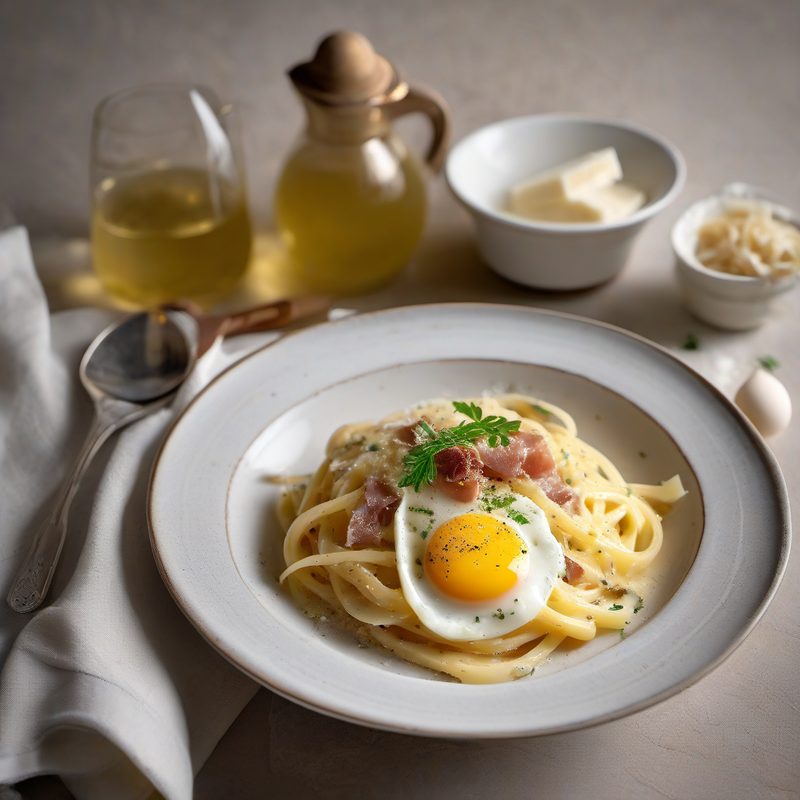
Carbonara Sora Lella
The definitive Roman carbonara as made by the legendary Sora Lella — rich, silky, and piggy, with rigatoni standing up to the luscious guanciale-and-egg emulsion.
What Is Carbonara?
Carbonara is Rome’s iconic pasta dish: rigatoni or spaghetti tossed with crispy guanciale, egg yolks, Pecorino Romano and black pepper — never cream. This version follows the recipe of Sora Lella, the legendary Roman cook, who made it rich, silky and intensely savory. The silky emulsion comes from eggs, cheese and starchy pasta water, not from cream.
| Amount | Ingredient |
|---|---|
| 350 g | Rigatoni (preferably bronze-die) |
| 200 g | Guanciale (cured pork jowl), cut into 1 cm cubes |
| 4 | Large egg yolks |
| 2 | Large whole eggs |
| 150 g | Pecorino Romano, finely grated (about 1½ cups) |
| 2 tsp | Coarsely ground black pepper (plus more for serving) |
| As needed | Fine sea salt (for pasta water only) |
> Note: Carbonara is a technique-driven dish — success hinges on vigorous off-heat tossing to create a creamy emulsion without scrambled eggs. Read the full procedure before starting.
🥘 Equipment
- Large pot (6–8 qt) for pasta
- Large skillet or sauté pan (12-inch / 30 cm)
- Medium mixing bowl
- Colander
- Fine grater or Microplane
- Chef's knife and cutting board
- Tongs or wooden spoon
- Ladle (for pasta water)
📋 Preparation
Before You Begin
- Bring the eggs and Pecorino to room temperature for 15 minutes — cold eggs are more likely to curdle when they hit the hot pasta.
- Grate the Pecorino Romano as finely as possible; pre-grated cheese won't melt into a smooth emulsion.
- Cut the guanciale into uniform 1 cm cubes. Guanciale is softer than pancetta; a sharp knife is essential.
Step 1: Prepare the Egg-Cheese Mixture
In a medium mixing bowl, combine the 4 egg yolks, 2 whole eggs, finely grated Pecorino Romano, and coarsely ground black pepper. Whisk until smooth, uniform, and ribbony — about 30 seconds. Set aside at room temperature.
Why room temperature? A warm egg mixture emulsifies into the hot pasta instantly; a cold one risks shocking the sauce and creating clumps.
Step 2: Render the Guanciale
Place the cubed guanciale in a cold large skillet. Set over medium heat and cook, stirring occasionally, until the fat renders and the guanciale turns golden and crispy — about 6–8 minutes. The fat should be fully translucent and the meat pieces crisp-edged but still tender inside.
Do not rush this step. Low-and-slow rendering extracts the maximum pork flavor and yields the essential fat base for the sauce.
Using a slotted spoon, transfer the crispy guanciale to a small bowl, leaving all the rendered fat in the pan. Remove the skillet from the heat.
Step 3: Cook the Pasta
Bring a large pot of generously salted water to a rolling boil — the water should taste like the sea (about 1½ tablespoons of salt per 4 quarts of water).
Add the rigatoni and cook according to package directions until firmly al dente (about 1 minute less than the suggested cooking time). The pasta will continue to cook in the sauce.
Reserve 1 cup (240 ml) of the starchy pasta water before draining. Drain the rigatoni — do not rinse.
Rigatoni's wide tubes and ridges are ideal for carbonara: the sauce clings inside and out, delivering maximum flavor in every bite.
Step 4: Build the Sauce — The Critical Moment
Working quickly and off the heat is non-negotiable here.
Set the skillet with the rendered guanciale fat over low heat for 15 seconds — just to warm it slightly — then immediately remove it from the heat.
Add the drained rigatoni to the warm (but not hot) skillet. Toss with tongs to coat each piece of pasta in the rendered fat, about 30 seconds.
Key step: Let the pasta cool in the pan for 60–90 seconds, tossing occasionally. The residual heat inside the rigatoni tubes will help temper the pan temperature. If the pan is too hot when the eggs go in, you'll end up with scrambled eggs.
Step 5: Emulsify off Heat
Remove the skillet from the burner entirely. Pour the egg-cheese mixture over the pasta and toss vigorously and continuously with tongs — lift, fold, turn, repeat — for about 45–60 seconds. The residual heat from the pasta and pan will gently cook the eggs into a silky, creamy sauce that coats every piece of rigatoni.
If the sauce looks too thick or clings too tightly, add reserved pasta water 1 tablespoon at a time while tossing, until the sauce achieves a flowing, velvety consistency. You'll likely need about ¼ to ½ cup total.
What you're looking for: The sauce should be glossy, emulsified, and coat each rigatoni like heavy cream — not thin, and certainly not curdled.
Step 6: Finish and Serve
Add the crispy guanciale back to the pan. Toss briefly to distribute.
Divide immediately among warm bowls (cold bowls will seize the sauce). Top with a generous grating of Pecorino Romano and a twist of coarsely ground black pepper.
Serve at once — carbonara waits for no one. The sauce sets and thickens as it cools, and it cannot be reheated without scrambling.
🧑👨👩👧👦 Chef's Tips
- Guanciale is non-negotiable. Sora Lella used guanciale (cured pork jowl), not pancetta or bacon. Pancetta will work in a pinch but lacks the same silky fat-to-meat ratio and distinct pork-forward flavor. Smoked bacon fundamentally changes the dish.
- Bronze-die rigatoni matter. The rough texture from bronze extrusion gives the sauce something to grip. Smooth, Teflon-die pasta won't hold the emulsion as well.
- Freshly grate your Pecorino. Pre-grated cheese contains anti-caking agents (cellulose, potato starch) that prevent smooth melting. Grate from a wedge of genuine Pecorino Romano DOP.
- Use a heavy-bottomed skillet. Cast iron or stainless steel with a thick base holds heat evenly. Thin pans can create hot spots that scramble the eggs.
- The pasta water is liquid gold. The starch in the reserved water is what binds the sauce and keeps it creamy. If you run out, you'll struggle to rescue a broken sauce.
- Work off heat, always. The burner stays off once the pasta hits the pan. The only heat source from that point forward is the thermal mass of the pasta and pan — and that's exactly enough.
❌ Common Mistakes
| Mistake | Why | Fix |
|---|---|---|
| Using spaghetti instead of rigatoni | Traditional Roman carbonara uses rigatoni — the tubes trap sauce and stay al dente longer | Use rigatoni, mezzi rigatoni, or another short tubular pasta |
| Adding eggs to a hot pan | The eggs instantly scramble into dry curds — you get pasta with crumbled egg, not sauce | Always remove the pan from heat before adding the egg mixture |
| Using cream | Many recipes add cream to prevent scrambling, but real carbonara has no cream — the emulsion comes from egg, cheese, fat, and starch | Trust the technique: vigorous tossing off-heat creates the same creamy result |
| Rinsing the pasta | You wash away the starch that binds the sauce | Drain, don't rinse — the starchy coating is essential |
| Pre-grated cheese | Contains anti-caking agents that prevent smooth melting | Grate Pecorino Romano from a wedge |
| Too little pasta water | The sauce thickens into a paste that won't coat the pasta | Add pasta water 1 tbsp at a time until the sauce flows like cream |
| Letting the pasta sit after draining | The starch dries and the pasta clumps together | Drain and add to the pan immediately; if it sits, toss with a splash of pasta water first |
💡 Variations
- Rigatoni alla Carbonara con Cacio e Pepe Fusion: Add an extra 50 g Pecorino and finish with toasted black pepper flakes for a hybrid of Rome's two greatest pasta dishes.
- Carbonara with Mushrooms: Sauté 200 g of wild mushrooms in the guanciale fat before adding the pasta — earthy notes complement the pork beautifully.
- Spicy Carbonara: Add ½ tsp red pepper flakes while rendering the guanciale.
- Gluten-Free: Use a high-quality bronze-die gluten-free rigatoni. Rice-and-corn blends work best and retain a firm bite.
- Lighter Version: Use 3 whole eggs + 1 yolk instead of the traditional ratio, and reduce Pecorino to 100 g. The sauce will be thinner but still satisfying.
❄️ Storage
Carbonara is a last-minute dish and does not keep well. The sauce sets and the eggs lose their creamy emulsion upon reheating. If you must store leftovers, refrigerate in an airtight container for up to 1 day. To reheat: place in a skillet with 1–2 tablespoons of water over very low heat, stirring constantly. The result will be acceptable but inferior to the original. Reheating in a microwave is not recommended.
🍷 Wine Pairing
| Wine | Why |
|---|---|
| Frascati Superiore | The classic Roman white — crisp, mineral, with almond notes that cut through the richness |
| Grechetto | Medium-bodied, floral, with enough structure to stand up to the Pecorino |
| Gavi di Gavi | Elegant, unoaked, with a lively acidity that balances the fatty guanciale |
| Cesanese del Piglio (red) | A light, fruity red from Lazio that won't overpower — try it if you prefer red with carbonara |
🍺 Beer Pairing
| Beer | Why |
|---|---|
| Peroni Nastro Azzurro | Crisp Italian lager — the high carbonation and clean finish cut through the egg-and-cheese richness |
| Pilsner Urquell | Noble hops and firm bitterness balance the pork fat |
| Bière de Garde | Malty, medium-bodied, with enough heft to match the Pecorino |
🥗 Suggested Sides
- Simple Roman salad — puntarelle (catalogna chicory) with anchovy-garlic dressing
- Arugula with shaved Parmigiano and lemon — peppery greens contrast the richness
- Roasted fennel with olive oil and sea salt — anise notes lighten the meal
- Crusty bread (pane di Lariano or ciabatta) — to mop up any remaining sauce
📊 Nutrition (per serving)
| Calories | Protein | Fat | Carbs | Fiber |
|---|---|---|---|---|
| 685 | 32 g | 34 g | 58 g | 3 g |
Note: Nutrition is estimated based on standard ingredient amounts. Actual values vary with specific brands and portion sizes.
❓ FAQ
Why rigatoni and not spaghetti?
Sora Lella served her carbonara with rigatoni, and many traditional Roman trattorias follow suit. The tubes catch and hold the sauce both inside and out, and the sturdy shape stands up to the hearty emulsion better than thin strands. That said, spaghetti alla carbonara is also common — but this recipe honors the Sora Lella original.
Can I use pancetta instead of guanciale?
In a pinch, yes. But guanciale comes from the pork jowl and has a higher fat content and a more intense, porky flavor. Pancetta (cured pork belly) is leaner and slightly smoky. For the authentic Sora Lella experience, seek out guanciale at an Italian deli or specialty grocer.
How do I know if I've scrambled the eggs?
If you see dry, curdled bits of egg clinging to the pasta or floating in the pan, the pan was too hot. There's no fix once the eggs scramble — the dish is compromised. Preventing it is everything: let the pan cool slightly before adding the egg mixture, and toss continuously off heat.
Can I make carbonara with only egg yolks?
The traditional ratio varies. Sora Lella's recipe uses 4 yolks + 2 whole eggs for 350 g of pasta. Using all yolks makes a richer, more decadent sauce. Using more whole eggs makes a lighter one. The 4:2 ratio above strikes a perfect balance.
What if the sauce is too thin?
If the sauce is watery, you added too much pasta water or the pan was too cool. Return the skillet to the lowest possible heat for 20–30 seconds while tossing vigorously — the gentle warmth will help the sauce tighten. Remove from heat immediately and continue tossing.
What's the story behind Sora Lella?
Sora Lella (born Elena Fabrizi, 1915–1993) was a beloved Roman cook who ran a famous trattoria on Tiber Island in Rome. Her no-nonsense cooking epitomized cucina romana — simple, bold, ingredient-driven. Her carbonara became legendary and remains the gold standard in Rome today.
🔗 Related Recipes
- Spaghetti alla Carbonara — The Classic Version
- Cacio e Pepe — Rome's Other Great Pasta
- Gricia (Amatriciana Bianca) — Carbonara's Ancestor
- Penne all'Amatriciana — With Tomato
- Rigatoni con la Pajata — Offal Rigatoni (Roman Classic)
🏷️ Search Tags
Recipe from The Italian Kitchen by Vita Milanese — Volume 1 · Pasta Perfetto. Discover all volumes on the ebook page.