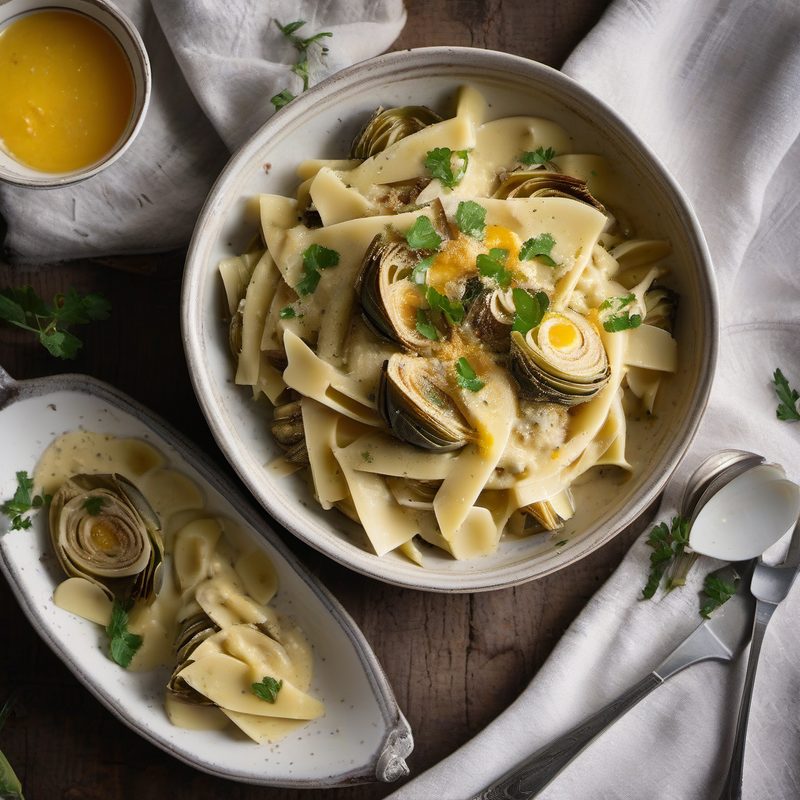
Artichoke Carbonara
A Roman-inspired vegetarian carbonara where tender sautéed artichokes stand in for guanciale, delivering the same silky, egg-enrobed pasta experience with a distinctly spring-like elegance. Earthy, nutty, and utterly satisfying.
| Amount | Ingredient |
|---|---|
| 350 g | Pasta (spaghetti, rigatoni, or mezze maniche) |
| 4 large | Fresh artichokes (or 200 g frozen artichoke hearts, thawed and patted dry) |
| 3 large | Egg yolks |
| 2 large | Whole eggs |
| 100 g | Pecorino Romano, finely grated (plus more for serving) |
| 2 cloves | Garlic, thinly sliced |
| 3 tbsp | Extra-virgin olive oil |
| 1½ tbsp | Kosher salt (for pasta water) |
| 1 tsp | Black pepper, freshly ground (plus more for serving) |
| 1 tbsp | Fresh lemon juice (for artichoke preparation) |
| As needed | Reserved pasta cooking water (about 1½ cups) |
> Note: This is a vegetarian take on carbonara that respects the technique — starchy pasta water, egg yolks, and Pecorino Romano emulsified by residual heat. The artichokes provide a tender, nutty counterpart to the rich sauce without the pork. Timing is everything: work quickly once the pasta is drained.
Use level tablespoons and standard US measuring cups. All produce is medium unless specified.
🥘 Equipment
- Large chef's knife
- Cutting board
- Vegetable peeler or paring knife (for trimming artichokes)
- Large bowl of cold water with lemon juice (for artichoke acidulated bath)
- Paper towels
- Large skillet or sauté pan (12-inch)
- Large pot (6-quart or larger, for pasta)
- Medium mixing bowl (for egg mixture)
- Whisk or fork
- Microplane or finest grater (for Pecorino)
- Colander or spider strainer
- Tongs (for tossing)
- Large serving bowl or the pasta pot itself (for final tossing)
- Measuring cups and spoons
📋 Preparation
Step 1 — Prepare the Artichokes (15 minutes)
If using fresh artichokes: Fill a large bowl with cold water and squeeze in 1 tablespoon of lemon juice. Working one at a time, trim off the stem end (peel the fibrous outer layer if the stems are attached), snap off the tough outer dark-green leaves until you reach the pale, tender inner leaves. Cut off the top third of the artichoke. Halve lengthwise and scoop out the fuzzy choke with a spoon. Slice each artichoke heart lengthwise into ¼-inch (6 mm) slices. Drop immediately into the acidulated water to prevent browning.
If using frozen artichoke hearts: Thaw completely, then pat very dry with paper towels. Halve or quarter any large pieces so they are roughly uniform in size.
The acidulated water prevents enzymatic browning — the lemon in the water keeps the artichokes pale and fresh-looking. If you're working quickly, rub the cut surfaces with a lemon half instead.
Step 2 — Sauté the Artichokes (10 minutes)
Drain the fresh artichoke slices and pat thoroughly dry with paper towels — any excess water will cause sputtering and prevent proper browning.
Heat 3 tablespoons olive oil in a large skillet over medium heat. Add the sliced garlic and cook, stirring, until fragrant but not browned — about 30 seconds.
Add the artichoke slices in a single layer (work in batches if needed to avoid crowding). Cook without moving for 2 minutes to develop a golden-brown sear. Then stir and continue cooking, stirring occasionally, until the artichokes are tender throughout and deeply golden at the edges — 5 to 7 minutes more.
Season lightly with salt and a generous pinch of black pepper. Remove from heat and set aside. Reserve the skillet — you'll use it later.
Crowding the pan causes the artichokes to steam rather than brown. If your skillet isn't large enough to hold all the slices in a single layer, cook them in two batches. The browned edges are where the flavor lives.
Step 3 — Cook the Pasta (10 minutes)
Bring a large pot of water to a rolling boil. Add 1½ tablespoons kosher salt — the water should taste like the sea.
Add the pasta and cook until very al dente (about 1–2 minutes less than the package's al dente time). The pasta will finish cooking in the sauce.
Critical: Reserve at least 1½ cups of starchy pasta water just before draining. Do not drain without reserving this water — it is essential for the emulsion.
Reserve more water than you think you'll need. The starch content varies by pasta brand and you may need extra to achieve the perfect creamy consistency.
Step 4 — Prepare the Egg-and-Cheese Mixture (5 minutes, while pasta cooks)
In a medium mixing bowl, combine 3 egg yolks, 2 whole eggs, 100 g finely grated Pecorino Romano, and 1 teaspoon freshly ground black pepper.
Whisk vigorously until smooth, pale, and uniformly combined — the mixture should be thick and ribbon-like when you lift the whisk. Set aside at room temperature.
Do not refrigerate the egg mixture. Cold eggs won't emulsify when hit with the hot pasta, and you risk scrambling them instead of creating a silky sauce. Room-temperature is non-negotiable.
Step 5 — Combine and Finish (3 minutes)
This is the moment that makes or breaks the dish. Work quickly and decisively.
If using the pasta pot method (recommended for long pasta like spaghetti):
- Drain the pasta (reserving the water), leaving it slightly wet — a few drops of pasta water clinging to the strands is fine.
- Return the pasta to the warm pot off the heat.
- Add the sautéed artichokes and any oil from the skillet. Toss to distribute.
- Pour the egg-and-cheese mixture over the pasta.
- Add ⅓ cup of hot pasta water and toss vigorously with tongs or a wooden spoon — lift, turn, and spin the pasta constantly.
- As you toss, the sauce will transform from a loose, thin liquid to a creamy, velvety emulsion that clings to every strand. If the sauce seems thick, add more pasta water 1 tablespoon at a time until it falls in silky ribbons.
If using the skillet method (good for short pasta like rigatoni):
- Reheat the artichoke skillet over low heat.
- Add the drained pasta directly to the skillet and toss with the artichokes.
- Remove the skillet from the heat.
- Pour the egg-and-cheese mixture over the pasta and add ⅓ cup of hot pasta water. Toss vigorously off the heat until creamy.
The sequence matters: pasta + artichokes first (to distribute evenly), then egg mixture, then pasta water. The starchy water provides the starch molecules that bind the fat from the eggs and cheese with the water into a stable emulsion. The residual heat of the pasta — not direct stove heat — gently cooks the eggs. If you keep the pan on the heat, you'll scramble the eggs.
Step 6 — Serve Immediately (1 minute)
Divide the pasta among warm bowls. Top each serving with a generous grating of extra Pecorino Romano and a final crack of black pepper. Serve at once — carbonara waits for no one.
Warm your bowls beforehand: place them in a 200°F (93°C) oven for 5 minutes, or fill them with hot tap water and dry just before serving. Cold bowls will cause the sauce to seize and tighten.
🧑🍳 Chef's Tips
- Artichoke freshness matters: Fresh artichokes have a sweet, nutty flavor that frozen cannot fully replicate. Look for artichokes that feel heavy for their size and squeak when squeezed — a sign of freshness. If using frozen, choose whole artichoke hearts (not marinated or brined) and pat them exceptionally dry.
- Grate your own Pecorino: Pre-grated cheese contains anti-caking agents (cellulose, potato starch) that prevent proper melting and sabotage the emulsion. Always grate Pecorino Romano fresh from a block on a Microplane or the finest holes of a box grater.
- Don't skimp on the pepper: Freshly ground black pepper is not a garnish — it's a structural flavor element that cuts through the richness of the eggs and cheese. Be generous in the egg mixture and at the table.
- Pasta shape matters: Long pasta like spaghetti or bucatini captures the sauce differently than short shapes like rigatoni or mezze maniche. Both work, but long pasta gives you that classic carbonara twirl. Bronze-drawn pasta (rough surface) holds the sauce better than Teflon-drawn (smooth).
- Work off heat, always: The emulsion forms from residual heat alone. If you return the pot or skillet to the stove at any point after adding the eggs, you will scramble them. Trust the thermal mass of the just-drained pasta.
- Emulsion troubleshooting: If the sauce looks greasy or broken, add another tablespoon of hot pasta water and toss energetically — the extra starch can often rescue a splitting emulsion. If it's too thin, let it rest for 30 seconds — the pasta will continue absorbing moisture.
- Room temperature is critical: Have the egg mixture, cheese, pepper, and pasta water all within arm's reach before you drain the pasta. There is no time to hunt for ingredients once the pasta is hot.
❌ Common Mistakes
| Mistake | Why It Hurts | The Fix |
|---|---|---|
| Refrigerating the egg mixture | Cold eggs won't emulsify and can seize when hit with hot pasta | Keep the egg mixture at room temperature; make it just before draining the pasta |
| Using pre-grated Pecorino | Anti-caking agents prevent smooth melting, causing a gritty, clumpy sauce | Grate Pecorino Romano fresh from a block using a Microplane |
| Overcooking the artichokes | They turn mushy and waterlogged, releasing moisture that thins the sauce | Cook until just tender with golden edges — about 7–9 minutes total |
| Not drying the artichokes thoroughly | Excess water causes sputtering in the pan and prevents browning | Pat artichokes very dry with paper towels before sautéing |
| Draining pasta without reserving water | No starchy water = no emulsion. You'll get a clumpy, greasy mess | Always reserve at least 1½ cups of pasta water before draining |
| Rinsing the cooked pasta | Rinsing washes away surface starch essential for the emulsion | Never rinse pasta. Drain it wet (a few clinging drops are fine) |
| Keeping the pot on the heat when adding eggs | Direct heat scrambles the egg yolks into curds | Remove the pot from the heat before adding the egg mixture |
| Not tossing vigorously enough | The emulsion needs mechanical energy to form — gentle stirring won't cut it | Toss with energy: lift, spin, and fold the pasta for a full 30 seconds |
| Serving in cold bowls | The sauce seizes and tightens immediately | Warm serving bowls in a low oven or with hot tap water |
💡 Variations
| Variation | How To |
|---|---|
| Spring Vegetable Carbonara | Add 1 cup of fresh or frozen peas to the skillet with the artichokes in the last 2 minutes of cooking. The sweetness of the peas complements the nutty artichokes and salty Pecorino. |
| Artichoke Carbonara with Mint | Stir in 2 tablespoons of fresh chopped mint just before serving. The cool, bright mint cuts through the richness and echoes classic Roman artichoke preparations (carciofi alla romana). |
| Crispy Breadcrumb Topping | Toast ½ cup of coarse breadcrumbs in 1 tablespoon of olive oil until golden and crisp. Sprinkle over each serving for a textural contrast that mimics the crunch of guanciale cracklings. |
| Lemony Artichoke Carbonara | Add the zest of 1 lemon to the egg mixture and a squeeze of lemon juice (about 1 tablespoon) along with the pasta water. The acidity brightens the dish and pairs beautifully with the artichokes. |
| Artichoke Carbonara with Ricotta | Stir ¼ cup (60 g) of fresh whole-milk ricotta into the egg mixture for an extra-creamy, slightly milder sauce. Reduce the Pecorino to 80 g to balance the salt. |
| Whole Wheat Version | Substitute whole wheat spaghetti or rigatoni. The nutty, earthy flavor of whole wheat is a natural match for artichokes. You may need slightly more pasta water as whole wheat absorbs more liquid. |
| Spicy Artichoke Carbonara | Add ½ teaspoon of red pepper flakes to the skillet with the garlic. The heat contrasts beautifully with the creamy egg sauce and tender artichokes. |
| Gluten-Free | Use a high-quality bronze-drawn gluten-free pasta (brown rice or chickpea-based). Cook to al dente and proceed with the recipe — gluten-free pasta releases less starch, so you may need slightly more pasta water to achieve the emulsion. |
❄️ Storage & Leftovers
| Method | Details |
|---|---|
| Refrigerator | Store leftovers in an airtight container for up to 1 day. The egg-based sauce does not re-emulsify well, so this dish is best eaten immediately. |
| Reheating | Reheat in a skillet over low heat with 2–3 tablespoons of hot water or milk, tossing gently until warmed through — about 3 minutes. Do not microwave — it will scramble the egg sauce and toughen the pasta. The texture will be less creamy than fresh. |
| Freezer | Not recommended. The egg-and-cheese emulsion breaks upon thawing and reheating, resulting in a grainy, separated sauce. |
🍷 Wine Pairing
| Wine | Why |
|---|---|
| Frascati Superiore (Lazio) | A crisp, slightly nutty white from the Roman hills. Its bright acidity and subtle almond notes cut through the richness of the eggs and cheese while complementing the nutty artichokes. The quintessential Roman pairing. |
| Gavi di Gavi (Piedmont) | Steely and mineral-driven with lemon zest and green apple — the searing acidity slices through the creamy sauce and cleanses the palate between each bite. |
| Verdicchio dei Castelli di Jesi (Marche) | Medium-bodied with notes of citrus, almond, and a characteristic bitter finish. The subtle bitterness mirrors the artichoke's natural character. |
| Falanghina (Campania) | White flowers, pear, and a gentle saline finish. The subtle fruit and bright acid balance the salty Pecorino and rich egg sauce. |
| Pinot Grigio (Alto Adige) | Clean, mineral-driven, and unoaked — won't overpower the delicate artichoke flavor. |
| Soave Classico (Veneto) | Notes of white peach, lemon blossom, and almond. The round, fruity texture complements the creamy sauce without competing. |
| Gruner Veltliner (Austria) | White pepper, citrus, and lentil-like earthiness — the white pepper notes echo the black pepper in the carbonara, while the acidity balances the richness. |
🍺 Beer Pairing
| Beer | Why |
|---|---|
| Italian Pilsner (e.g., Birrificio Italiano Tipopils) | Clean, crisp, and lightly bitter — the noble hop bitterness cuts through the richness while the crackery malt lets the artichoke and cheese flavors take center stage. |
| Belgian Witbier | The coriander and orange peel notes in a classic witbier complement the artichoke's subtle herbal character. The light body and high carbonation refresh the palate. |
| Saison | Fruity, spicy, and highly carbonated — the yeast-driven complexity stands up to the Pecorino while the effervescence cleanses the palate. |
| Vienna Lager | Malty, smooth, and slightly sweet — the caramel notes provide a warming, comforting backdrop to the creamy sauce. |
🥗 Suggested Side Dishes
- A crisp arugula and fennel salad with lemon vinaigrette and shaved Parmigiano — the bitterness and crunch contrast with the creamy pasta
- Sautéed spinach with garlic and a pinch of nutmeg — earthy and simple alongside the richness
- Roasted asparagus with olive oil, sea salt, and lemon zest — bright and clean against the unctuous carbonara
- Grilled radicchio with balsamic glaze — the charred bitterness is a classic Italian counterpoint to rich pasta dishes
- A simple cherry tomato and basil salad with a drizzle of olive oil — fresh acidity to balance the richness
- Warm crusty bread or grissini — for sopping up every last bit of the creamy sauce
📊 Nutrition (per serving, estimated)
| Calories | Protein | Fat | Carbs | Fiber |
|---|---|---|---|---|
| 475 | 21 g | 18 g | 58 g | 5 g |
Nutrition calculated for 4 servings using fresh artichokes, spaghetti, Pecorino Romano, 3 egg yolks + 2 whole eggs, and olive oil.
❓ Frequently Asked Questions
Can I use frozen artichokes instead of fresh?
Absolutely. Use 200 g of frozen artichoke hearts (not marinated or brined). Thaw them completely and pat extremely dry with paper towels before sautéing — excess moisture prevents browning and can thin the sauce. Frozen artichokes are slightly less sweet and nutty than fresh, but the dish remains delicious.
Why does this recipe use both whole eggs and extra yolks?
The whole eggs provide body and structure to the sauce, while the extra yolks (3) add richness, color, and emulsifying power. This ratio — 2 whole eggs + 3 yolks for 350 g of pasta — produces a sauce that is luxurious without being overwhelmingly eggy. It's the same ratio used in many Roman carbonara recipes for 4 servings.
Can I make this dairy-free or vegan?
The Pecorino Romano and eggs are fundamental to the carbonara technique and flavor. A dairy-free or vegan version would require a completely different approach (e.g., a cashew-based sauce with nutritional yeast), which would no longer be carbonara in any meaningful sense. For a dairy-free option, try the Pasta with Artichokes, Lemon, and Breadcrumbs — it shares the artichoke focus but uses a different technique.
Why no cream?
Authentic carbonara — even a vegetarian version — uses no cream. The creamy texture comes entirely from the emulsion of egg yolks, cheese, hot pasta, and starchy water. Adding cream would mute the delicate flavor of the artichokes and the sharpness of the Pecorino. Trust the technique.
My sauce turned out lumpy instead of creamy. What went wrong?
Almost always one of three things: (1) the egg mixture was too cold — it seized on contact with the hot pasta; (2) the pot or pan was still over heat when you added the eggs — direct heat scrambled them; (3) you didn't add enough pasta water — the starch is the glue that binds the emulsion. If you see lumps forming, immediately remove from any heat source (if you haven't already), add a tablespoon of hot pasta water, and whisk or toss vigorously. You may be able to rescue it.
Can I use a different cheese instead of Pecorino Romano?
Pecorino Romano is the traditional choice — its sharp, salty character is essential to the carbonara flavor profile and stands up well to the artichokes. Parmigiano-Reggiano is milder and less salty; a 50/50 blend of the two is a common compromise. Grana Padano is another option but even milder. Avoid pre-shredded blends.
How do I clean fresh artichokes without them turning brown?
Work quickly and drop each trimmed artichoke into a bowl of cold water acidulated with lemon juice (1 tablespoon lemon juice per 4 cups water). The citric acid prevents oxidation (browning). Alternatively, rub the cut surfaces with a cut lemon half as you go. Pat dry just before sautéing.
Can I add guanciale or pancetta to make it a non-vegetarian version?
Yes — simply render 150 g (5 oz) of guanciale or pancetta in the skillet before sautéing the artichokes. Remove the crispy meat, sauté the artichokes in the rendered fat (supplement with olive oil if needed), and proceed. Sprinkle the crispy guanciale over the finished dish. This effectively creates a hybrid: artichoke carbonara with pork.
🔗 Related Recipes
- Spaghetti Cacio e Pepe — page 348 (Roman cheese-and-pepper pasta)
- Pasta with Artichokes and Clams — page 148 (Paccheri with artichokes, clams, and bottarga)
- Tagliatelle with Artichokes — page 156 (Artichokes with creamy tagliatelle)
- Tagliatelle with Artichokes (First Version) — page 12 (Early artichoke pasta variation)
- Pugliese Carbonara — page 259 (Southern Italian carbonara variation)
- Carbonara Supplì — page 260 (Carbonara in fried rice-ball form)
- Spaghetti with Ricotta, Sundried Tomato, and Olive — page 351 (Vegetarian pasta alternative)
- Pasta with Black Kale Cream and Guanciale — page 56 (Another Roman-inspired primi piatti)
🏷️ Search Tags
| Photo | Notes |
|---|---|
| — | No photo available for this recipe. Artichoke carbonara is best photographed in a wide, shallow bowl, the pasta glistening with a golden-cream sauce, tender green artichoke slices tucked among the strands, with a shower of grated Pecorino and a final crack of black pepper. |
Recipe from "The Italian Kitchen" by Vita Milanese — Volume 1: Pasta Perfetto
Recipe from The Italian Kitchen by Vita Milanese — Volume 1 · Pasta Perfetto. Discover all volumes on the ebook page.