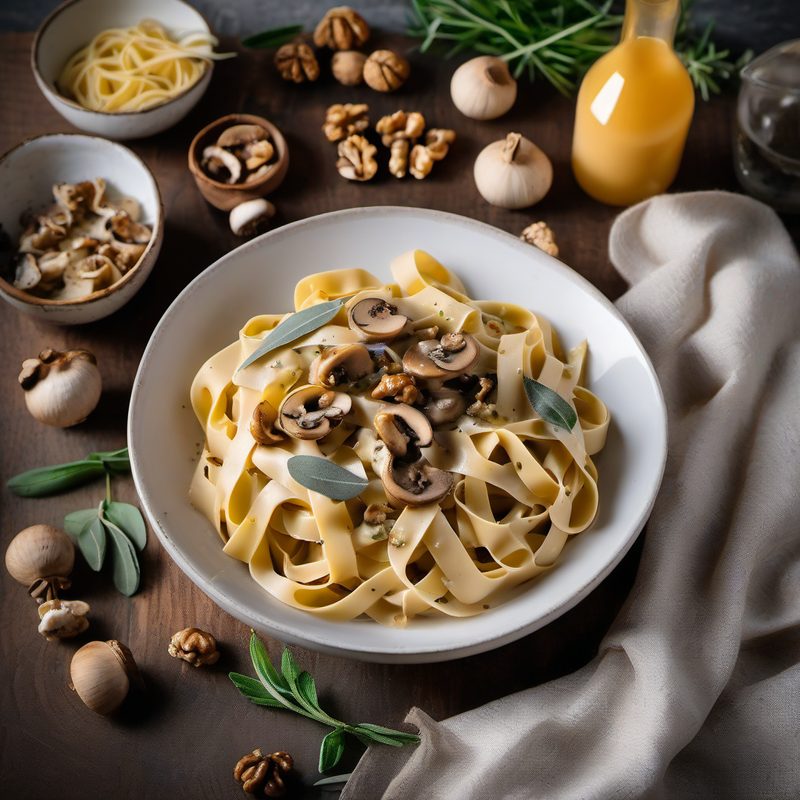
Tagliatelle Mushrooms Sage Walnuts
An earthy, nutty, herb-infused tagliatelle from the forests of northern Italy — where golden-seared wild mushrooms, fragrant sage, and toasted walnuts come together in a buttery, garlicky embrace that clings to every ribbon of fresh egg pasta. Rustic, elegant, and deeply satisfying in under 30 minutes.
| Amount | Ingredient |
|---|---|
| Gluten-free version | Substitute 350 g (12 oz) of gluten-free tagliatelle or fettuccine (brown rice, chickpea, or corn-based). Cook according to package directions and reserve extra pasta water — gluten-free pasta tends to absorb more liquid and may need a looser sauce |
| Vegan version | Omit the Parmesan and butter. Use 3 tablespoons of olive oil (no butter) and finish with a sprinkle of nutritional yeast (2 tablespoons) mixed with ¼ cup (25 g) of toasted breadcrumbs for a savory, nutty, crunchy finish. Alternatively, use a high-quality vegan butter and vegan Parmesan-style cheese. The mushrooms and walnuts provide enough richness and umami to satisfy |
| Add a splash of white wine | After the mushrooms are browned and the garlic is fragrant, deglaze the pan with ¼ cup (60 ml) of dry white wine (Pinot Grigio or Sauvignon Blanc). Scrape up any browned bits from the bottom of the pan and let the wine reduce until almost dry, about 1 minute. The acidity of the wine cuts through the richness of the butter and adds another layer of complexity |
| Swap tagliatelle for pappardelle | Use 350 g (12 oz) of fresh or dried pappardelle — the wider ribbons are even better at catching and holding the chunky mushroom mixture. The cooking time for fresh pappardelle is similar to fresh tagliatelle; dried pappardelle may take slightly longer |
| With lemon zest for brightness | Add the finely grated zest of ½ lemon along with the garlic. The bright, citrusy note lifts the earthy mushrooms and cuts through the richness of the butter and cheese beautifully. Finish each serving with a tiny sprinkle of additional lemon zest |
This is the kind of pasta that tastes like autumn in a bowl — the woodsy aroma of mixed mushrooms sizzling in butter and olive oil, the warm, resinous fragrance of fresh sage leaves crackling in the hot fat, and the rich, toasty crunch of walnuts scattered throughout like hidden treasure. It's a dish born in the trattorias of Lombardy and Piedmont, where foraged porcini, chanterelles, and oystercrown the autumn tables and are treated with the reverence they deserve — simply, with butter, garlic, and herbs, allowing their earthy, umami-laden character to take center stage.
The technique is straightforward but demands attention to detail: the mushrooms must be cooked in a single layer initially, undisturbed, so they release their moisture and then sear to a deep golden brown rather than steaming in their own liquid. The sage leaves are fried just until crisp in the butter-olive oil mixture, infusing the fat with their aromatic oils. The walnuts are toasted in a dry pan to deepen their flavor and bring out their natural sweetness, then roughly chopped so they provide textural contrast in every bite. Everything comes together in a final, swift toss over high heat — the hot pasta, the fragrant mushrooms and sage, the crunchy walnuts, and a generous shower of grated Parmesan — bound together by a splash of starchy pasta water that emulsifies the butter and cheese into a silky, clinging sauce.
This is a primo piatto of extraordinary balance: the richness of the butter and cheese, the nuttiness of the walnuts and toasted sage, the meaty, savory depth of the mushrooms, all lifted by a whisper of garlic and finished with a crack of black pepper. It's proof that the simplest combinations — when each component is treated with care — produce the most memorable results.
> Note: Use fresh tagliatelle if you can find it — it cooks in about 3 minutes and has a tender, silky texture that dried pasta cannot match. If using dried tagliatelle, cook according to package directions and reserve extra pasta water, as dried pasta absorbs more liquid. A mix of mushroom varieties produces the most complex, interesting flavor — cremini, shiitake, oyster, and a handful of dried porcini (rehydrated) will give you a depth far beyond any single variety.
Use level tablespoons and standard US measuring cups. All produce is medium unless specified. For the best flavor, use a mix of at least two or three mushroom varieties — cremini (brown button mushrooms) provide the familiar, earthy mushroom base; shiitake add deep, smoky-umami notes; oyster mushrooms contribute a delicate, almost seafood-like sweetness; and a small handful of dried porcini (rehydrated) delivers an intense, woodsy, brothy punch that elevates the entire dish. Fresh porcini, when in season, are the gold standard — but they are expensive and not always available, so the blend approach is both practical and delicious. Grate the Parmesan on the small holes of a box grater or Microplane — it should be fine and fluffy, melting almost instantly into the hot pasta and creating a creamy, emulsified sauce. Do not use pre-grated cheese, which contains anti-caking agents that prevent smooth melting.
🥘 Equipment
- Large pot (6 qt / 6 L minimum) for pasta
- Large skillet or sauté pan (12-inch / 30 cm), preferably stainless steel or nonstick
- Chef's knife and cutting board
- Small dry skillet or saucepan (for toasting walnuts)
- Microplane or fine grater (for Parmesan)
- Tongs or pasta fork
- Wooden spoon or heat-resistant spatula
- Measuring cups and spoons
- Colander
- Small bowl for rehydrating dried porcini (optional)
📋 Preparation
Step 1 — Prepare the Ingredients (10 minutes)
Prepare the mushrooms: Using a soft brush or a damp paper towel, gently clean 400 g of mixed mushrooms to remove any dirt or grit. Do not rinse them under running water — mushrooms are like sponges and will absorb moisture, making them impossible to sear properly. If the stems are tough or woody (common with shiitake and oyster mushrooms), trim and discard them. Tear or slice the mushrooms into even, bite-sized pieces — about ¼-inch (6 mm) thick for firm mushrooms like cremini, and larger ragged pieces for delicate mushrooms like oyster. Aim for uniform sizes so they cook evenly. Place the prepared mushrooms in a bowl — they should not be crowded.
Why this matters: Mushrooms are composed of over 90% water. If you wash them, they absorb additional moisture and will steam rather than sear in the pan. Dry-cleaning with a brush or paper towel is the only way to ensure they turn golden and crisp-edged rather than gray and watery. The uniform sizing ensures that all pieces reach the same doneness at the same time — thin pieces burn while thick pieces remain raw if you're not careful.
Toast the walnuts: Place 50 g of raw walnuts in a small, dry skillet over medium heat. Cook, shaking the pan frequently or stirring with a wooden spoon, until the walnuts are fragrant and lightly golden — about 3 to 4 minutes. Watch carefully; walnuts go from toasted to burnt very quickly. Immediately transfer the hot walnuts to a cutting board to stop the cooking. Once cool enough to handle, roughly chop them into small, irregular pieces — some should be fine crumbs, others small chunks for textural variety. Set aside.
Prepare the sage and garlic: Pick 12 to 16 fresh sage leaves from the stems. Stack a few leaves at a time and cut them into thin ribbons (chiffonade) — or leave them whole for a more dramatic presentation. Thinly slice 2 garlic cloves into rounds or slivers. Set both aside.
Grate the cheese: Grate 50 g of Parmesan on the small holes of a box grater or Microplane until you have a fluffy mound. Set aside.
The toasted walnuts are the secret textural backbone of this dish. Toasting is non-negotiable — raw walnuts are soft, bitter, and lack the deep, nutty, almost caramelized flavor that toasting unlocks. The heat causes the walnuts' natural oils to release and their sugars to brown, transforming them from pale and bland to golden, aromatic, and crunchy. Chop them unevenly — some larger pieces provide satisfying crunch, while the smaller bits and dust adhere to the pasta and the mushrooms, delivering nutty flavor in every forkful.
Step 2 — Start the Pasta Water (2 minutes)
Bring a large pot of generously salted water (about 1½ tablespoons of kosher salt per 4 quarts / 3.8 L of water) to a rolling boil over high heat.
While the water comes to a boil and the pasta cooks, you will be making the mushroom sauce — the two should finish at roughly the same time. If using fresh tagliatelle (which cooks in 2 to 3 minutes), start the mushroom sauce before adding the pasta to the water. If using dried tagliatelle (which cooks in 8 to 10 minutes), add the pasta to the boiling water after you add the mushrooms to the skillet — the timing will align beautifully.
Step 3 — Sear the Mushrooms (8 to 10 minutes)
Heat the skillet: Place the large skillet over medium-high heat. Add 3 tablespoons of olive oil and 2 tablespoons of butter. Swirl to combine and heat until the butter is melted and the foam begins to subside, about 1 minute. The fat should be hot and shimmering but not smoking.
Add the mushrooms — do not crowd: Add the prepared mushrooms in a single, even layer. If your skillet is not large enough to hold all the mushrooms in a single layer without overlapping, cook them in two batches. Do not stir or move the mushrooms for the first 2 to 3 minutes. Let them sear undisturbed — this is essential for developing deep golden-brown color.
Sear, then stir: After the initial sear, use a wooden spoon or spatula to stir the mushrooms, turning them to expose uncooked surfaces. Continue cooking, stirring occasionally, until the mushrooms have released their moisture, the liquid has evaporated, and the mushrooms are deep golden brown with crisp edges — about 5 to 7 minutes total, depending on the moisture content of your mushrooms.
Why this matters: The single most important rule for cooking mushrooms is to leave them alone. Mushrooms are full of water — when they hit a hot pan, they first release that moisture, which creates steam. If you stir them constantly during this initial phase, they will steam in their own liquid and never develop color or concentrated flavor. Letting them sit undisturbed allows the liquid to evaporate and the surface temperature to rise above the boiling point of water, enabling the Maillard reaction — the browning that creates complex, savory, nutty flavors. The mushrooms will shrink significantly as they lose moisture; this is normal and desirable.
Season: Once the mushrooms are well-browned, season with ½ teaspoon of kosher salt and several grinds of fresh black pepper. Stir to coat.
Step 4 — Add Garlic and Sage (1 minute)
Lower the heat to medium. Add the sliced garlic and sage leaves (or chiffonade) to the skillet with the mushrooms. Cook, stirring constantly, until the garlic is fragrant and just beginning to turn golden at the edges — about 30 to 45 seconds. Do not let the garlic brown or burn, as it will turn bitter. The sage will darken slightly and become aromatic.
Garlic and sage are a classic pairing in northern Italian cooking — the warm, peppery, slightly resinous character of sage complements the earthy, umami-rich mushrooms beautifully, while the garlic provides a subtle, savory backbone. Both should be added late in the cooking process to preserve their freshness and aromatic intensity — garlic that cooks for too long loses its pungency and becomes sweet and jammy, while sage that overcooks becomes harsh and medicinal.
Step 5 — Cook and Combine the Pasta (2 to 3 minutes)
Cook the tagliatelle: Add the 350 g of tagliatelle to the boiling salted water. If using fresh tagliatelle, cook for 2 to 3 minutes until al dente (tender but with a slight resistant bite at the center). If using dried tagliatelle, cook according to package directions, but reduce the suggested time by 1 minute — the pasta will finish cooking in the sauce. Stir occasionally to prevent sticking.
Reserve pasta water: Just before the pasta is done, use a liquid measuring cup to scoop out 1 cup (240 ml) of the starchy pasta water and set aside.
Drain and transfer: Drain the tagliatelle (do not rinse) and transfer it directly to the skillet with the mushroom mixture. Do this while the pasta is still dripping wet — the residual water clinging to the noodles will help create the sauce.
Step 6 — Mantecatura: Finish in the Sauce (1 to 2 minutes)
Toss over heat: Return the skillet to medium heat. Using tongs or two wooden spoons, toss the tagliatelle with the mushrooms, garlic, and sage, lifting and turning to distribute the ingredients evenly.
Add pasta water: Add ⅓ cup (80 ml) of the reserved pasta water and continue tossing. The starch in the water will help bind the sauce to the pasta.
Add the Parmesan: Sprinkle half the grated Parmesan (about 25 g / ¼ cup) over the pasta and toss vigorously. The cheese should melt almost instantly, combining with the butter and starchy water to form a creamy, emulsified sauce that clings to every ribbon of pasta. If the sauce seems too tight or dry, add more pasta water 1 tablespoon at a time until it reaches the desired consistency — loose enough to coat the pasta but not pooling at the bottom of the pan.
Add the walnuts: Add three-quarters of the chopped toasted walnuts and toss gently to incorporate.
Taste and adjust: Taste a strand of tagliatelle and adjust the seasoning with salt and pepper as needed. The Parmesan adds significant saltiness, so taste before adding more salt.
The mantecatura — finishing the pasta in the sauce over heat with a splash of starchy water — is the defining technique of great Italian pasta cooking. The starch from the pasta water emulsifies the fat (butter and olive oil) and the cheese into a stable, silky sauce that clings to every surface of the pasta rather than pooling at the bottom of the bowl. This is what separates a great pasta dish from a merely good one — the sauce should be cohesive, creamy, and intimately wrapped around each strand, not watery or separated.
Step 7 — Plate and Serve (2 minutes)
Plate: Divide the tagliatelle among 4 warm bowls, using tongs to twist the pasta into neat, compact nests. Spoon any remaining mushrooms and sauce from the skillet over the top of each portion.
Garnish: Sprinkle each serving with the remaining chopped toasted walnuts, a generous shower of the remaining grated Parmesan, and a few fresh sage leaves (if you reserved whole leaves for garnish). Finish with a crack of fresh black pepper and, if desired, a final drizzle of good extra-virgin olive oil.
Serve immediately — tagliatelle waits for no one. The sauce will continue to thicken as it cools, and the pasta will absorb more liquid, so this dish is best enjoyed the moment it hits the plate. The contrast between the tender, creamy pasta, the chewy, golden-brown mushrooms, and the crunchy, toasty walnuts is at its peak in the first few minutes.
The final garnish of walnuts and Parmesan is both visual and functional — the reserved walnuts provide a fresh, crunchy contrast to the soft pasta and mushrooms, while the extra Parmesan adds a final burst of salty, umami richness. The whole sage leaves (if you reserved them) add a beautiful visual note and a burst of herbal aroma with every bite.
💡 Chef's Tips
- Use a mix of mushroom varieties for the deepest flavor. A single type of mushroom will work in a pinch, but a blend of cremini (earthy, familiar), shiitake (smoky, umami-rich), oyster (delicate, sweet), and a small handful of dried porcini (intensely woodsy, brothy) creates a symphony of mushroom flavors that no single variety can match. Rehydrate the dried porcini in warm water for 20 minutes, then drain (reserve the soaking liquid — strain it through a coffee filter and add a splash to the skillet for even more mushroom flavor). Chop the rehydrated porcini and add them to the skillet with the fresh mushrooms.
- Do not wash the mushrooms. This cannot be overstated. Mushrooms absorb water like sponges, and wet mushrooms will steam rather than sear, producing gray, rubbery, flavorless results. Use a soft brush or a damp paper towel to gently wipe away any dirt. For very dirty mushrooms, a quick rinse followed by immediate and thorough drying on paper towels is acceptable — but dry-brushing is always preferable.
- Leave the mushrooms alone in the pan. The most common mistake in cooking mushrooms is moving them too much. Let them sit in the hot pan for 2 to 3 minutes before stirring to allow the moisture to evaporate and the browning to begin. Once they release their liquid, that liquid needs to cook off before the actual browning can happen. Patience here is rewarded with deep, golden-brown, intensely flavored mushrooms.
- Cook in batches if necessary. If your skillet cannot hold all the mushrooms in a single, uncrowded layer, cook them in two batches. Overcrowding causes the mushrooms to release more liquid than can evaporate quickly, resulting in steaming rather than searing. A 12-inch (30 cm) skillet can comfortably hold about 200 to 250 g (7 to 9 oz) of mushrooms in a single layer.
- Toast the walnuts — it makes all the difference. Raw walnuts are pale, soft, and slightly bitter. Toasted walnuts are golden, fragrant, crunchy, and sweet. The toasting process takes only 3 to 4 minutes in a dry pan and transforms the flavor of the nuts completely. Watch them carefully — they burn quickly and burnt walnuts are irredeemably bitter.
- Use fresh tagliatelle for the best texture. Fresh egg pasta has a tender, silky, almost luxurious texture that dried pasta cannot replicate. It also releases more starch into the cooking water, which helps create a more emulsified, clinging sauce. If you can buy fresh tagliatelle from a good pasta shop — or make your own — this is the dish to use it for. Dried tagliatelle works beautifully as well, but use a good Italian brand (preferably bronze-die extruded) for the best texture and sauce-holding ability.
- Reserve more pasta water than you think you need. The starchy pasta water is the key to a silky, emulsified sauce. You might not use all of it, but having extra means you can adjust the consistency of the sauce at the very last moment. Starchy water that has cooled becomes too thick and starchy — use it while it's still hot.
- Grate the Parmesan fresh — never use pre-grated. Pre-grated Parmesan is coated with anti-caking agents (cellulose, potato starch) that prevent it from melting smoothly into the sauce. Freshly grated Parmesan, on the other hand, melts almost instantly upon contact with the hot pasta, creating the creamy, emulsified sauce that makes this dish so satisfying.
- Warm your serving bowls. Tagliatelle cools quickly, and a cold bowl accelerates the process. Run the bowls under hot water and dry them, or place them in a low oven (200°F / 95°C) for 5 minutes while the pasta cooks. Warm bowls keep the pasta hot and the sauce fluid.
- Trust the mantecatura. The final toss over heat with pasta water and cheese is not optional — it's the technique that transforms a collection of ingredients into a cohesive, restaurant-quality pasta dish. The heat, the starch, and the tossing action work together to create an emulsion that coats every strand. Do not skip this step.
❌ Common Mistakes
| Mistake | Why It Hurts | The Fix |
|---|---|---|
| Washing the mushrooms | Wet mushrooms steam instead of searing, turning gray and rubbery | Brush mushrooms clean with a soft brush or dry paper towel — never rinse |
| Crowding the pan | Mushrooms release too much liquid at once, steaming instead of browning | Cook in batches if necessary — mushrooms should be in a single, uncrowded layer |
| Moving the mushrooms too soon | Constant stirring prevents browning; mushrooms release water and steam | Leave mushrooms undisturbed for the first 2–3 minutes, then stir occasionally |
| Not toasting the walnuts | Raw walnuts are pale, soft, and slightly bitter | Toast in a dry skillet until fragrant and golden (about 3–4 minutes), watching carefully |
| Burning the garlic | Burnt garlic turns bitter and acrid, ruining the entire dish | Add garlic after mushrooms are browned, cook over medium heat for only 30–45 seconds |
| Overcooking the pasta | Mushy pasta falls apart when tossed; absorbs too much sauce | Cook fresh tagliatelle 2–3 minutes; dried tagliatelle 1 minute less than package al dente |
| Using pre-grated Parmesan | Anti-caking agents prevent smooth melting; sauce turns grainy | Grate Parmesan fresh from a block on the small holes of a box grater or Microplane |
| Skipping the pasta water | No starch to emulsify the sauce; butter and cheese separate instead of coating the pasta | Always reserve at least 1 cup of starchy pasta water before draining |
| Adding all the walnuts to the pan | Walnuts lose their crunch when tossed with hot pasta and sauce | Reserve one-quarter of the toasted walnuts for garnish — fresh, crunchy texture on top |
| Using dried sage | Dried sage has a harsh, medicinal flavor that overwhelms the dish | Use fresh sage leaves only — their warm, resinous, herbal character is essential |
| Serving on cold plates | Pasta cools instantly; butter and cheese solidify; sauce becomes gluey | Warm bowls in the oven or with hot water before serving |
💡 Variations
| Variation | How To |
|---|---|
| Add dried porcini for intense mushroom flavor | Soak 15 g (½ oz) of dried porcini in 1 cup (240 ml) of warm water for 20 minutes. Drain (reserve the liquid), chop the rehydrated porcini, and add them to the skillet with the fresh mushrooms. Strain the soaking liquid through a coffee filter or fine-mesh sieve and add ¼ cup (60 ml) to the skillet at the end — it's liquid gold, packed with concentrated mushroom flavor |
| With cream for a richer sauce | After adding the mushrooms and garlic, stir in ¼ cup (60 ml) of heavy cream and simmer for 1 to 2 minutes until slightly thickened. Proceed with the pasta and cheese as directed. This produces a richer, more decadent version, closer to a fettuccine Alfredo with mushrooms — delicious but less traditional |
| Add fresh thyme or rosemary | Add 1 teaspoon of fresh thyme leaves (stripped from the stems) or ½ teaspoon of finely chopped fresh rosemary with the garlic and sage. Both herbs pair beautifully with mushrooms and walnuts, adding another layer of earthy, aromatic complexity |
| Swap walnuts for pine nuts | Substitute 50 g (⅓ cup) of pine nuts for the walnuts. Toast them in a dry pan (they burn even faster than walnuts — about 2 minutes) and proceed as directed. Pine nuts provide a milder, more buttery nuttiness that some prefer with the delicate flavor of sage |
| Swap walnuts for hazelnuts | Substitute 50 g (⅓ cup) of skinned hazelnuts for the walnuts. Toast until fragrant and the skins begin to flake, then rub off the skins in a clean kitchen towel before chopping. Hazelnuts and sage are a classic pairing in northern Italian cooking — the sweet, rich, almost chocolatey flavor of hazelnuts is beautiful with earthy mushrooms and buttery sage |
| With pancetta or guanciale | Add 100 g (3½ oz) of thinly sliced pancetta or diced guanciale to the skillet before the mushrooms. Cook over medium heat until the fat renders and the meat is crisp, about 5 minutes. Remove with a slotted spoon, leaving the rendered fat in the pan. Cook the mushrooms in the rendered fat (reduce the butter and oil accordingly) and return the crisp pancetta at the end. The smoky, salty, porky richness is a stunning addition |
❄️ Storage & Leftovers
| Method | Details |
|---|---|
| Refrigerator | Store in an airtight container for up to 3 days. The mushrooms will soften and the walnuts will lose their crunch, but the flavors will deepen and meld overnight. Some find the leftovers even more flavorful than the original |
| Reheating | Reheat in a skillet over medium-low heat with a splash of water or broth. Cover and cook for 3–5 minutes, stirring occasionally, until heated through. Add fresh grated Parmesan and extra toasted walnuts after reheating to restore lost texture. Do not microwave — it will make the pasta rubbery and the mushrooms tough |
| Freezing | Freeze in a freezer-safe container for up to 2 months. Thaw overnight in the refrigerator and reheat gently in a skillet. The walnuts will lose all of their crunch and the mushrooms will be softer, but the flavor will still be very good. Add fresh toasted walnuts and Parmesan after reheating |
| Make Ahead | The mushrooms can be cooked through Step 4 up to 2 days ahead, cooled, and refrigerated. Reheat gently in a skillet before proceeding with Step 5. The walnuts can be toasted and chopped up to 5 days ahead and stored in an airtight container at room temperature. The pasta should be cooked fresh on the day of serving |
| Leftover walnuts | Store leftover toasted walnuts in an airtight container at room temperature for up to 2 weeks. They are wonderful sprinkled over salads, roasted vegetables, oatmeal, or yogurt — or simply eaten as a snack |
| Leftover Parmesan | Wrap the remaining Parmesan in parchment paper (not plastic wrap, which suffocates the cheese) and store in the refrigerator for up to 3 weeks. It's perfect for grating over any pasta, risotto, soup, salad, or roasted vegetable |
🍷 Wine Pairing
| Wine | Why |
|---|---|
| Nebbiolo (Piedmont) | The king of northern Italian reds — pale in color but powerful in structure, with notes of rose, cherry, tar, and earth. Its firm tannins and high acidity cut through the butter and cheese, while its complex, ethereal, earthy character mirrors the woodsy depth of the mushrooms. One of the world's great food wines, and a sublime pairing with this dish |
| Barbera d'Alba or Barbera d'Asti (Piedmont) | A more approachable, fruit-forward Piedmontese red — vibrant cherry and blackberry flavors, bright acidity, and soft, approachable tannins. Its natural acidity is a perfect counterpoint to the rich, buttery sauce, while its dark fruit notes echo the savory, umami character of the mushrooms. A versatile, food-loving red that's often excellent value |
| Pinot Nero (Alto Adige or Lombardy) | Northern Italian Pinot Nero (Pinot Noir) is light to medium-bodied with notes of red cherry, wild strawberry, cranberry, and forest floor — the earthy, autumnal character is a natural match for mushrooms and sage. Its bright acidity and silky tannins complement rather than overwhelm the delicate flavors of the dish. Serve slightly cool (55–60°F / 13–15°C) |
| Sangiovese (Tuscany) — Rosso di Montalcino or Chianti Classico | The bright cherry, violet, and dried herb notes of Sangiovese, combined with its brisk acidity and moderate tannins, make it a surprisingly excellent partner for mushroom pasta. The acidity cuts through the butter and cheese, while the herbal notes echo the sage. A Rosso di Montalcino offers a bit more structure and depth than a basic Chianti |
| Langhe Rosso (Piedmont) | A blend of Nebbiolo, Barbera, and sometimes Dolcetto — the best of all worlds. You get the structure and complexity of Nebbiolo with the fruit and acidity of Barbera, all at a more accessible price point. Look for a Langhe Rosso from a quality producer — it's a perfect all-around food wine that pairs beautifully with this dish |
| Gavi di Gavi (Piedmont, white) | A crisp, mineral-driven white from Cortese grapes in Piedmont — notes of green apple, citrus, white flowers, and wet stone. Its bright acidity and clean finish provide a refreshing contrast to the earthy, buttery mushrooms. An excellent choice if you prefer white wine or are serving this as a lighter primo on a warm evening |
| Franciacorta (Lombardy, sparkling) | A traditional-method sparkling wine from Lombardy (Italy's answer to Champagne) — fine bubbles, notes of green apple, pear, citrus, and brioche. The acidity and effervescence cut through the richness of the butter and cheese like a palate cleanser, while the toasty, nutty notes of the wine echo the toasted walnuts. A celebratory and unexpected pairing that works beautifully |
| Grüner Veltliner (Austria, white) | While not Italian, this Austrian white is a classic pairing for mushroom dishes — notes of white pepper, citrus, green bean, and lentil, with crisp acidity and a distinctive, peppery finish. Its savory, food-friendly character and bright acidity are a perfect match for earthy mushrooms, sage, and walnuts |
| A light, unoaked Chardonnay | An unoaked or lightly oaked Chardonnay (from Alto Adige, Friuli, or even a good Chablis from France) with notes of green apple, citrus, and wet stone — the bright acidity and clean, mineral character provide a beautiful counterpoint to the rich, buttery, mushroom-scented pasta |
🥗 Suggested Side Dishes
- Simple arugula and lemon salad — Baby arugula dressed with extra-virgin olive oil, fresh lemon juice, salt, and pepper. The peppery, bright greens cut through the richness of the buttery pasta like a palate cleanser, and the lemon's acidity lifts the earthy mushrooms
- Fennel and orange salad — Thinly sliced raw fennel, segments of blood orange or navel orange, a handful of black olives, and a simple lemon-olive oil dressing. The bright, citrusy, anise-scented salad provides a refreshing contrast to the rich, earthy pasta
- Sautéed Swiss chard or spinach with garlic — Dark leafy greens quickly sautéed with olive oil and garlic until just wilted, finished with a squeeze of lemon. The slight bitterness of the greens balances the richness of the butter and cheese
- Roasted radicchio with balsamic glaze — Radicchio wedges tossed with olive oil, salt, and pepper, roasted at 425°F (220°C) for 10–12 minutes until charred at the edges and slightly wilted, then drizzled with aged balsamic vinegar. The bitter, charred leaves provide a striking contrast to the creamy, savory pasta
- Grilled asparagus with lemon and Parmesan — Asparagus spears grilled or roasted until tender-crisp, finished with a squeeze of lemon and a shaving of Parmesan. A light, bright vegetable side that echoes the pasta's flavors without competing
- Crusty bread with olive oil — A hearty, crusty Italian or sourdough loaf, sliced and served with a dish of good extra-virgin olive oil for dipping. Perfect for sopping up any remaining sauce from the plate
- Sautéed zucchini with mint — Zucchini sliced into half-moons, sautéed in olive oil until golden, and finished with fresh mint, salt, and a squeeze of lemon. Light, herbaceous, and summery — a beautiful companion to the earthy, autumnal pasta
📊 Nutrition (per serving, estimated)
| Calories | Protein | Fat | Carbs | Fiber |
|---|---|---|---|---|
| ~580 | 22 g | 28 g | 65 g | 6 g |
Nutritional values are estimates based on 4 generous servings. The fat content is primarily from the olive oil, butter, walnuts, and Parmesan — all nutrient-dense sources of heart-healthy fats (olive oil provides monounsaturated fat; walnuts provide omega-3 fatty acids; butter and cheese provide saturated fat). Walnuts are particularly rich in alpha-linolenic acid (ALA), a plant-based omega-3, and are among the most antioxidant-dense nuts. Mushrooms are an excellent source of B vitamins (especially riboflavin, niacin, and pantothenic acid), selenium, copper, and potassium — they are one of the few natural dietary sources of vitamin D when exposed to UV light. Cremini and shiitake mushrooms are particularly rich in ergothioneine, a unique antioxidant compound. Parmesan is a concentrated source of calcium and protein — just 50 g (the total for this recipe) provides approximately 500 mg of calcium (half the daily recommended intake) and 18 g of protein, though it is also high in sodium. To reduce the fat content, use only olive oil (omit the butter) and reduce the walnuts to 30 g (about ¼ cup) — approximately 490 calories and 18 g fat per serving. To increase the protein, add 100 g of cooked chicken or pancetta as described in the Variations section — approximately 660 calories and 34 g protein per serving. This is a satisfying, well-balanced primo (first course); as a main course, it serves 4 generously. As a smaller primo for a multi-course Italian meal, it will serve 6 (approximately 385 calories per serving).
❓ Frequently Asked Questions
What is the best mushroom mix for this dish?
A blend of at least three varieties produces the most interesting, complex flavor. A reliable combination: 200 g (7 oz) cremini mushrooms (for the familiar, earthy mushroom base), 100 g (3½ oz) shiitake mushrooms (for deep, smoky umami), and 100 g (3½ oz) oyster mushrooms (for delicate, sweet, almost floral notes). If you can find fresh porcini, use them in place of the cremini — they are the gold standard. A small handful (15 g / ½ oz) of dried porcini, rehydrated and added to any fresh mushroom mix, intensifies the mushroom flavor exponentially and is the single best trick for elevating this dish.
Can I use dried sage instead of fresh?
No — fresh sage is essential. Dried sage has a harsh, medicinal, almost camphor-like flavor that becomes overpowering when cooked. Fresh sage, by contrast, is warm, resinous, and herbaceous, with a subtle peppery note that complements the mushrooms and walnuts beautifully. If you cannot find fresh sage, the best substitute is fresh thyme (use 1 teaspoon of leaves) or fresh rosemary (use ½ teaspoon finely chopped).
Why do my mushrooms turn gray and watery instead of golden and brown?
This is the most common mushroom-cooking problem, and it's almost always caused by one of three mistakes: (1) you washed the mushrooms (they absorb water and steam instead of searing); (2) you overcrowded the pan (too many mushrooms release too much liquid at once, lowering the pan temperature and creating steam); or (3) you stirred them too early and too often (moving the mushrooms prevents them from developing a sear). Fix all three: dry-clean the mushrooms with a brush, cook in batches if necessary, and leave them undisturbed for the first 2 to 3 minutes.
Can I make this dish without butter?
Yes — use 3 tablespoons of olive oil total (omit the butter entirely). The dish will be lighter and more Mediterranean in character, with a slightly less rich, less silky sauce. For a dairy-free version that still has some richness, use a high-quality vegan butter or increase the olive oil to 4 tablespoons and add 1 tablespoon of nutritional yeast (for savory, cheesy depth) along with the Parmesan substitute.
What if I can't find tagliatelle?
Fettuccine is the closest substitute — it is almost identical in shape and thickness, though traditional fettuccine is slightly narrower and made with eggs (like tagliatelle). Pappardelle (wider ribbons) is an excellent substitute that many people actually prefer with chunky mushroom sauces — the wide ribbons catch and hold the mushrooms beautifully. Other good options: linguine, spaghetti, or even paccheri or rigatoni — though the character of the dish changes with shorter pasta shapes.
Can I use pre-chopped or frozen mushrooms?
Pre-chopped fresh mushrooms are acceptable in a pinch, but they are often older and more dried out than whole mushrooms, and they may have been washed (which affects browning). Frozen mushrooms should be avoided entirely — freezing causes the cell walls to rupture, releasing all the moisture when thawed, making it impossible to achieve a proper sear. Always use fresh, whole mushrooms and clean them yourself.
How do I reheat leftover tagliatelle without ruining it?
The best method is in a skillet over medium-low heat. Add a splash of water, broth, or even milk to the pan, add the leftover pasta, cover, and cook for 3 to 5 minutes, stirring occasionally, until heated through. The moisture creates steam that rehydrates the pasta without drying it out. After reheating, add fresh grated Parmesan and fresh toasted walnuts to restore the texture and flavor that was lost during storage. Avoid the microwave — it heats unevenly, makes the pasta rubbery, and turns the mushrooms tough.
Can I add protein to make this a main course?
Absolutely — this dish is wonderful as a vegetarian main, but it also pairs beautifully with protein additions. Cooked chicken breast (sliced and added when tossing), pan-seared shrimp (cooked separately and added at the end), crispy pancetta or guanciale (rendered and used as garnish), or even a soft-cooked egg (placed on top of each serving, the yolk mixing into the pasta as you eat) are all excellent additions that transform this from a primo to a hearty main course.
Is this dish traditionally vegetarian?
Yes — the classic version contains no meat, fish, or animal products other than butter and Parmesan (both derived from cow's milk). The butter can be replaced with olive oil for a dairy-reduced version, and the Parmesan can be replaced with a vegan alternative or nutritional yeast for a fully vegan version. The mushrooms, walnuts, sage, garlic, and olive oil provide enough savory depth and richness that even the vegan version is satisfying and delicious.
What is the best way to store fresh sage?
Fresh sage is more robust than many other fresh herbs and will keep for up to 2 weeks in the refrigerator. Wrap the leaves loosely in a damp paper towel, place in a partially open plastic bag, and store in the crisper drawer. Do not wash the leaves until you are ready to use them — excess moisture accelerates spoilage. If you have leftover sage, it can be frozen: place whole leaves in a single layer on a baking sheet, freeze until solid, then transfer to a freezer bag. Frozen sage will keep for up to 6 months and can be added directly to hot oil or butter from frozen — it will crisp beautifully.
🔗 Related Recipes
- Tagliatelle with Zucchini Flowers (#107) — A delicate, summery tagliatelle with zucchini blossoms, saffron, and a light butter sauce; the floral, elegant counterpart to this earthy, autumnal tagliatelle
- Tagliolini with Speck and Radicchio (#6) — A northern Italian tagliolini with smoky speck and bitter radicchio; another classic of the Alto Adige/Trentino tradition, sharing the butter-and-cheese base with this recipe
- Fettuccine with Porcini and Truffle (#198) — A luxurious fettuccine with fresh porcini mushrooms, butter, and shaved truffle; the indulgent, special-occasion sibling of this more rustic, everyday mushroom tagliatelle
- Pasta with Mushrooms and Cream (#220) — A creamy, decadent pasta with mushrooms and heavy cream; the richer, more indulgent cousin of this lighter, Walnut-studded version
- Pappardelle with Wild Mushrooms and Rosemary (#312) — Wide pappardelle ribbons with a medley of wild mushrooms and fresh rosemary; a similar dish from the same northern Italian tradition, with rosemary standing in for sage
- Risotto with Porcini and Walnuts (#67) — A creamy arborio risotto with porcini mushrooms and toasted walnuts; the risotto counterpart to this tagliatelle, sharing the same earthy, nutty flavor profile
- Penne with Butternut Squash, Sage, and Walnuts (#380) — A baked penne with roasted butternut squash, fried sage, and crunchy walnuts; the sweet, squash-based variation on the sage-and-walnut theme
- Gnocchi with Brown Butter, Sage, and Walnuts (#425) — Pillowy potato gnocchi in nutty brown butter with fried sage and toasted walnuts; the gnocchi version of this classic flavor combination
🏷️ Search Tags
📸 Photo Reference
Photo reference: `vol1_454.png` — An elevated three-quarter overhead shot of four warm ceramic bowls arranged on a rustic wooden table, each filled with a neat, twisted nest of golden egg tagliatelle. Deep golden-brown mushrooms (cremini caps and shiitake slices visible) are scattered throughout the pasta, with a few whole fried sage leaves peeking through the ribbons. A creamy, emulsified pale-gold sauce coats each strand, catching the light softly. Each serving is topped with a generous sprinkle of roughly chopped toasted walnuts and a fine, snow-like shower of freshly grated Parmigiano-Reggiano. A few whole sage leaves and a crack of black pepper finish each bowl. Beside the bowls: a small wooden board with extra toasted walnuts and Parmesan shavings, a small dish of olive oil, a sprig of fresh sage, and a glass of deep ruby Nebbiolo or Barbera. The lighting is warm and golden — late afternoon autumn light from a nearby window, casting soft shadows and gentle highlights on the glossy pasta and the rich brown mushrooms. A linen napkin and heavy fork rest on the table, and a scattering of walnut pieces and a few sage leaves lie on the tabletop near the bowls. The mood is rustic, generous, and deeply autumnal — a celebration of the forest's bounty in a single, soul-warming bowl.
Recipe from "The Italian Kitchen" by Vita Milanese — Volume 1: Pasta Perfetto 🍄
Recipe from The Italian Kitchen by Vita Milanese — Volume 1 · Pasta Perfetto. Discover all volumes on the ebook page.