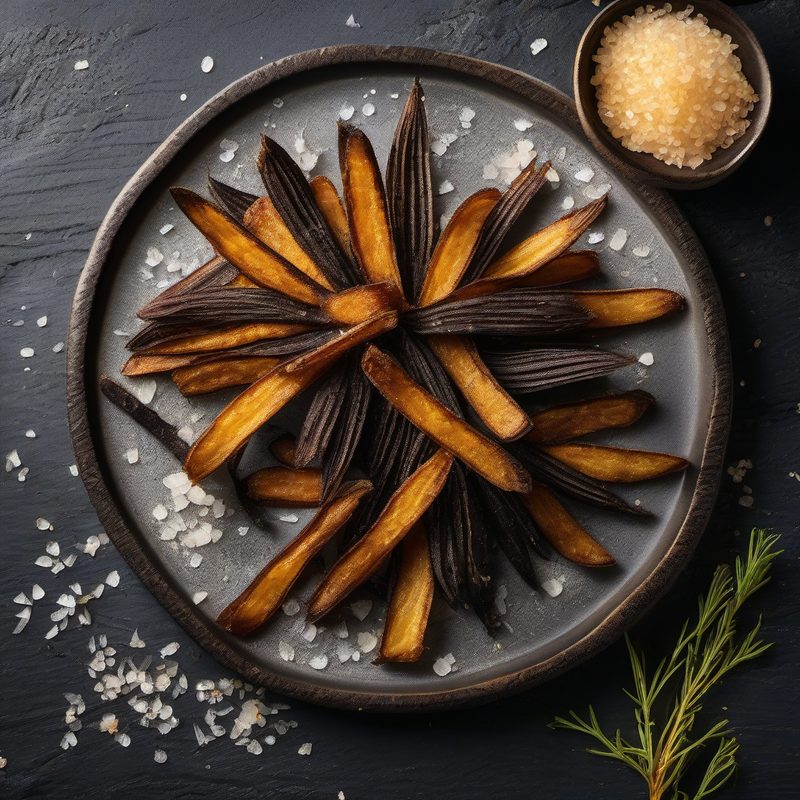
Black Salsify Chips
| Amount | Ingredient |
|---|---|
| Black salsify (scorzonera) | 500 g (1 lb 2 oz) Unpeeled, firm, and straight |
| Lemon juice | 2 tablespoons Freshly squeezed, for acidulated water |
| Extra-virgin olive oil | 3 tablespoons |
| Kosher salt | 1 teaspoon Plus more for finishing |
| Black pepper | ½ teaspoon Freshly ground |
| Flaky sea salt (such as Maldon) | ½ teaspoon For finishing |
🏷 Category
Contorni
👥 Serves
4
⏱ Time
- Prep Time: 25 minutes
- Cook Time: 20–25 minutes
- Total Time: 45–50 minutes
🥘 Special Equipment
- Rimmed baking sheet (half-sheet pan, about 18 × 13 inches)
- Parchment paper
- Vegetable peeler (Y-peeler preferred for salsify)
- Large bowl
- Kitchen towels or paper towels
- Chef's knife and cutting board
- Mandoline slicer (optional, for uniform chips)
- Tongs or offset spatula
- Fine-mesh strainer or colander
🔧 Before You Begin
- Prepare the acidulated water: Fill a large bowl with 1 litre (4 cups) cold water and stir in the 2 tablespoons lemon juice. This bath prevents the peeled salsify from oxidizing (it discolours almost instantly once peeled).
- Position the oven rack: Place one rack in the middle position. Preheat the oven to 200°C (400°F). A properly preheated oven is critical — insufficient heat steams the salsify rather than crisping it.
- Line the baking sheet: Cover the rimmed baking sheet with parchment paper. Do not use foil — the chips can stick, and parchment promotes even browning.
- Peeling safety: Black salsify has thin, dark skin, but the raw peeled vegetable is slick. A Y-peeler offers the best control. Work over the acidulated water bowl so peeled stalks drop directly in.
📏 Key Ratios
| Ratio | Value | Purpose |
|---|---|---|
| Salsify-to-oil | 500 g : 3 tbsp oil | Light, even coating without greasiness |
| Oil-to-surface-area | ~1½ tbsp per baking sheet | Ensures crisping, not frying |
| Salt-to-vegetable | 1 tsp kosher per 500 g | Proper seasoning for contrast with earthy salsify |
> Why this works: Black salsify is roughly 80% water. Roasting at 200°C drives off moisture quickly while the modest oil coating (about 1½ tablespoons per sheet) conducts heat evenly and promotes Maillard browning. The acidulated water bath does double duty: the lemon juice prevents enzymatic browning (oxidation of polyphenols), and the brief soak slightly hydrates the outer layer, which helps create a crisp-tender texture rather than a dried-out one.
📝 Instructions
Step 1: Peel and Soak the Salsify (10 minutes)
- Fill a large bowl with 1 litre cold water and add 2 tablespoons lemon juice. Set aside.
- Wearing rubber gloves (optional — some people find the raw salsify sap mildly irritating), scrub each stalk under running water with a vegetable brush to remove any dirt.
- Using a Y-peeler, peel each stalk from top to bottom, removing all the dark brown-black skin. The flesh underneath is creamy white and will darken quickly — this is normal and is halted by the acidulated water.
- Immediately drop the peeled stalks into the lemon water as you go. Once all stalks are peeled, let them soak for 5 minutes. This firms the flesh slightly and leaches any bitter compounds from the cut surfaces.
Step 2: Cut the Salsify (5 minutes)
- Remove one stalk at a time from the acidulated water. Pat thoroughly dry with kitchen towels or paper towels — excess moisture will cause steaming in the oven.
- For chips (round slices): Use a mandoline slicer set to about 3 mm (⅛ inch) thick, or slice by hand with a sharp chef's knife. Cut on a slight bias for larger, more attractive oval chips.
- For batons (fry-like strips): Cut the stalk crosswise into 6–8 cm (2½–3 inch) lengths, then cut each piece lengthwise into matchsticks about 5 mm (¼ inch) thick.
- Return cut pieces to the acidulated water if you are working in batches. Otherwise, proceed immediately to drying.
Step 3: Season the Salsify (5 minutes)
- Dry the cut salsify pieces very thoroughly — spread them on a clean kitchen towel and pat firmly with another towel on top. Let air-dry for 2–3 minutes if time allows. Any residual moisture will prevent crisping.
- In a large bowl, whisk together 3 tablespoons olive oil, 1 teaspoon kosher salt, and ½ teaspoon black pepper.
- Add the dried salsify and toss with your hands or a rubber spatula until every piece is evenly coated. The oil should form a thin, translucent film on each piece — not puddling at the bottom of the bowl.
Step 4: Arrange on the Baking Sheet (3 minutes)
- Transfer the seasoned salsify to the parchment-lined baking sheet.
- Spread in a single, even layer. Pieces must not overlap or touch — overlapping traps steam and produces soggy chips. Work in two batches if necessary (use two sheets or roast sequentially).
- If making batons, arrange them with a little space between each; if making chips, spread them in a single layer without shingling.
Step 5: Roast (20–25 minutes)
- Place the baking sheet on the middle oven rack and roast for 10 minutes.
- After 10 minutes, remove the sheet from the oven. Using tongs or an offset spatula, flip each piece (or at least stir/turn the batons). This is essential for even browning.
- Return the sheet to the oven, rotating it front-to-back for even heat distribution.
- Roast for another 10–15 minutes, checking at the 20-minute mark. The chips are done when:
- They are golden brown with slightly darker edges.
- They feel crisp and firm when you lift one with tongs (a chip should snap, not bend).
- The salsify has shrunk noticeably and curled slightly at the edges (for chips) or developed a craggy, golden surface (for batons).
- Watch closely in the final 3–5 minutes — salsify can go from golden to burnt very quickly due to its sugar content.
Step 6: Season and Serve (2 minutes)
- Remove the baking sheet from the oven. Immediately sprinkle with flaky sea salt (about ½ teaspoon, or to taste) while the chips are still hot — the salt sticks best to the warm oil coating.
- Let the chips cool on the baking sheet for 2–3 minutes; they will continue to crisp as they cool. Do not cover them or stack them while warm — steam will soften the crust.
- Transfer to a serving bowl or platter. Serve warm or at room temperature.
🍽 Plating & Presentation
- Serving style: Pile the chips in a rustic mound on a warm plate or in a shallow ceramic bowl. For batons, arrange them in a neat log-cabin stack or standing upright in a small glass (like a french-fry cone presentation).
- Garnish: A final light dusting of flaky sea salt and a few cracks of black pepper. A lemon wedge on the side allows diners to brighten the chips with a squeeze of fresh juice — the acidity cuts through the earthy richness.
- Garnish (herb): A scattering of fresh parsley (finely chopped) or chives (snipped) adds colour and a fresh counterpoint to the roasted flavour.
- Recommended tableware: A neutral-toned ceramic or wood board. The dark edges of the salsify chips stand out beautifully against a white or cream plate.
- Visual note: The chips should be a mosaic of golden and deep umber-brown tones, with the thin edges slightly darker than the centres — this graduated colour is the hallmark of properly roasted root-vegetable chips.
💡 Troubleshooting
| Problem | Likely Cause | Solution |
|---|---|---|
| Chips are soggy, not crisp | Insufficient drying before roasting; pieces overcrowded on sheet | Pat salsify bone-dry with towels; spread in a single layer with space between pieces; roast in two batches if needed |
| Chips are browned but limp | Oven temperature too low | Verify oven temperature with an oven thermometer; 200°C is the minimum — 210°C is better for very fresh, moist salsify |
| Edges burnt, centres raw | Pieces cut unevenly | Use a mandoline for consistent thickness (3 mm); cut larger pieces separate and check/remove them early |
| Chips taste bitter | Peel not fully removed; soaking too short | Black salsify skin is slightly bitter — peel thoroughly; soak at least 5 minutes in lemon water |
| White discolouration after roasting | Natural inulin crystallisation on the surface | This is harmless — salsify is rich in inulin, which can form white streaks when roasted. Wipe with a dab of oil if desired, or leave as is |
| Sticking to parchment | Parchment quality or insufficient oil | Use heavy-duty parchment; ensure oil coating is even (not sparse); let chips cool 1 minute before trying to lift |
| Batch too large, chips steam | Overcrowded baking sheet | Halve the batch and roast in two rounds, keeping the first batch warm in a 120°C oven on a wire rack |
🧠 The Science of Salsify Chips
Black salsify (Scorzonera hispanica) is a root vegetable with a unique composition that makes it both challenging and rewarding: it contains inulin (a polymer of fructose, not starch — up to 15% by dry weight) rather than the starch found in potatoes. Inulin has a lower gelatinisation temperature and behaves differently during roasting:
- Moisture management: At ~70°C the cell walls begin to break down, releasing water. By 100°C, evaporation is vigorous. The initial 10-minute roast drives off bulk moisture; flipping exposes the wet underside to heat.
- Maillard vs. caramelisation: Salsify's sugars (fructose from inulin breakdown, plus sucrose) participate in Maillard reactions starting at ~140°C. The inulin itself does not caramelise in the traditional sense — it first hydrolyses to fructose, which then browns. This means the window between golden and burnt is narrow (roughly 3–4°C), which explains the watchfulness required in the final minutes.
- Crispness mechanism: Unlike potato chips, where starch gelatinisation and oil absorption create the crisp matrix, salsify chips rely on cell-wall dehydration and slight pectin breakdown. The result is a crisper, less greasy chip with a more delicate shatter. The inulin crystals that sometimes form on the surface (looking like a faint white bloom) are harmless and actually prized in some preparations for their textural contrast.
🧪 Variations
- Herb-infused oil: Before tossing, infuse the olive oil with 1 crushed garlic clove and 1 sprig rosemary (warm gently for 3 minutes, then cool and strain). The garlic-rosemary notes complement the earthy salsify beautifully.
- Spiced chips: Add ½ teaspoon smoked paprika or ¼ teaspoon cayenne pepper to the oil-and-salt mixture before tossing. A pinch of ground cumin also works well.
- Parmesan salsify chips: After the first 10 minutes of roasting, sprinkle 25 g (¼ cup) finely grated Parmesan over the chips before returning to the oven. The cheese melts and crisps alongside the salsify.
- Truffle finish: Toss the hot, freshly roasted chips with 1 teaspoon white truffle oil (in place of 1 teaspoon of the olive oil in the initial mix) and a sprinkle of flaky salt — an elegant starter or garnish.
- Balsamic glaze: Drizzle the finished chips with a thin ribbon of aged balsamic vinegar or balsamic glaze for a sweet-tangy counterpoint.
- Lemon-herb: Add 1 teaspoon lemon zest and 1 tablespoon finely chopped fresh thyme to the oil mixture for a bright, aromatic chip.
🥗 Suggested Sides
- As a contorno: Serve alongside roasted poultry (chicken, guinea fowl) or grilled fish (sea bass, trout) — the chips' earthy sweetness is a natural partner for simply prepared proteins.
- With a dip: Offer aioli (garlic mayonnaise), lemon-herb yoghurt (Greek yoghurt + lemon + mint), or bagna càuda (warm anchovy-garlic dip from Piedmont).
- On a platter: Arrange the chips as part of a fritto misto with other roasted or fried vegetables (artichokes, zucchini, sage leaves).
- In a salad: Crumble the chips over a bitter green salad (radicchio, endive, arugula) with shaved Parmesan and a lemon vinaigrette — the chips add texture and mute the bitterness.
- As a garnish: Crush the chips into coarse crumbs and sprinkle over roasted cauliflower soup, puréed celeriac, or creamy polenta.
🍷 Suggested Wine Pairing
- White: A crisp, mineral-driven Gavi di Gavi or Vermentino di Sardegna — the acidity and minerality echo the lemon and cut through the earthy richness of the salsify.
- Rosé: A dry Provence-style rosé or a Cerasuolo d'Abruzzo — light enough not to overwhelm, with enough structure to stand up to olive oil and salt.
- Sparkling: Franciacorta Brut or Prosecco Superiore — the bubbles and high acidity are a classic foil for fried/roasted vegetables; the chips' delicate crunch plays off the mousse.
- Red (unconventional): A light, chilled Lambrusco Grasparossa — the slight spritz and berry fruit are surprisingly good with earthy root vegetables, and the chill keeps the pairing refreshing.
- Aperitivo: Serve with a Negroni Sbagliato or an Americano — the bitter-orange notes of the cocktail echo the slight bitterness of the salsify skin (if any remains) and the lemon finish.
📚 Original Source & Background
- Italian name: Chips di scorzonera
- English name: Black Salsify Chips
- Region/Heritage: Northern Italy — black salsify (scorzonera) has been cultivated in Italian gardens since the Renaissance. It is especially beloved in Piedmont and Lombardy, where it appears in bagna càuda and as a winter contorno. The name scorzonera derives from the old Spanish escorzonera ("black snake"), a reference to the vegetable's long, dark, serpentine shape.
- Recipe position: 412 in the cookbook series
- Notes on the ingredient: Black salsify should not be confused with white salsify (Tragopogon porrifolius), which is paler, more delicate in flavour, and lacks the earthy complexity of scorzonera. When selecting, choose firm, straight roots about 20–25 cm long with no soft spots; wrinkled or bendable stalks are past their prime. Peak season is autumn through early spring (October–March).
- Culinary context: While often boiled or puréed in traditional Italian cooking, this chip preparation is a modern contorno — a crisp, simple treatment that highlights the vegetable's natural earthy sweetness without masking it in butter or cream. It is a testament to the Italian philosophy of cucina povera applied to even humble winter roots: few ingredients, careful technique, and deep flavour.
"Crisp, golden, and earthy — a humble winter root transformed into something you cannot stop eating."
Recipe from The Italian Kitchen by Vita Milanese — Volume 1 · Pasta Perfetto. Discover all volumes on the ebook page.