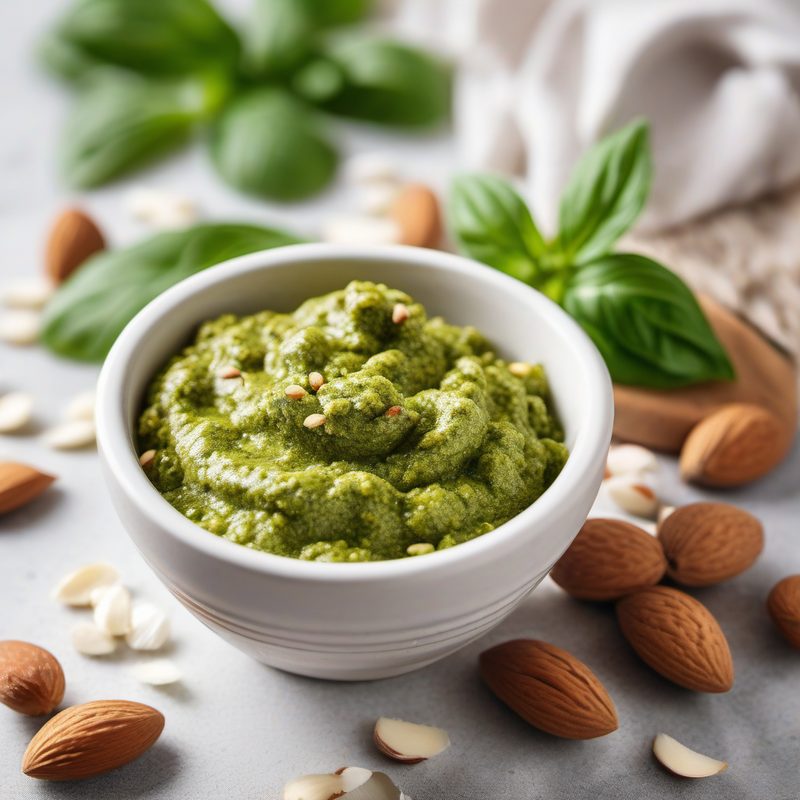
Almond Pesto
A rustic, garlicky Sicilian-style pesto that swaps basil for spring onion greens and pine nuts for blanched almonds — pounded (not blitzed) into a coarse, textured paste that is nutty, herbaceous, and utterly addictive on bread, pasta, or crostini.
| Amount | Ingredient |
|---|---|
| 200 g (1½ cups / 7 oz) | blanched almonds |
| 2 cloves | garlic |
| to taste | kosher salt |
| 4–5 | spring onion greens (the tender green tops) |
| 100–120 ml (⅓–½ cup) | extra-virgin olive oil, plus more for finishing |
This almond pesto is a beautiful lesson in the power of substitution. Where classic Genovese pesto relies on pine nuts and basil, this version — rooted in Sicilian and Southern Italian traditions — uses blanched almonds for their sweeter, creamier nuttiness and spring onion greens (the tender green tops of young onions) for a gentle, grassy heat that never overwhelms. The technique matters as much as the ingredients: pounding the almonds and garlic together by hand in a mortar, then slowly incorporating olive oil, produces a texture that no food processor can replicate — coarse, rustic, with visible flecks of almond and the occasional pop of garlic. This is a pesto that wants to be eaten with good bread, not hidden in a sauce; it is a meze, a spread, a statement. A food processor works in a pinch, but the mortar-and-pestle route is worth every arm-straining second.
Ingredient notes: Use blanched almonds (skins removed) for the cleanest flavor and creamiest texture — unblanched almonds with skins will produce a darker, slightly bitter pesto with a more aggressive texture. If only unblanched almonds are available, blanch them yourself: boil for 60 seconds, drain, and slip off the skins. Spring onion greens (the hollow, dark green tops of scallions or spring onions) are essential — do not substitute with chives (too delicate) or standard scallion whites (too pungent). If spring onions are unavailable, use the green tops of 5–6 scallions, which are close in flavor. The olive oil should be a good-quality, fruity extra-virgin olive oil — this is a raw preparation, and the oil's flavor is front and center. Do not use a cheap or overly bitter oil.
- Mortar and pestle (preferred) or food processor
- Chef's knife and cutting board
- Small skillet (for toasting almonds, optional)
- Rubber spatula
- Measuring cups and spoons
- Serving bowl or airtight container
- Prepare the almonds (2 min). If using raw blanched almonds, toast them lightly in a dry skillet over medium heat, shaking the pan frequently, until fragrant and just beginning to take on color, about 3–4 minutes. Let cool completely. Toasting is optional but recommended — it deepens the almond flavor dramatically. If you prefer a milder, creamier pesto, skip the toasting.
- Pound the almonds and garlic (3 min if using mortar, 1 min if using food processor). Place the cooled almonds and garlic cloves (peeled) in a large mortar with a generous pinch of salt. Pound firmly with the pestle in a circular, grinding motion until the almonds are coarsely crushed and the garlic is broken down into the almond mixture. The texture should be uneven — some fine almond meal, some small almond chunks. Do not over-pound into a paste. If using a food processor, pulse the almonds and garlic with a pinch of salt in 3 to 5 short pulses — do not let the processor run, or the almonds will release their oils and turn into almond butter.
- Add the spring onion greens (2 min). Slice the spring onion greens into thin rounds (about 2 mm thick). Add them to the mortar or food processor. Continue pounding or pulsing until the onion greens are broken down and evenly distributed throughout the almond mixture. The greens will release some moisture, which helps the pesto come together.
- Incorporate the olive oil (2 min). With the pestle in constant motion (or the food processor running), drizzle in the extra-virgin olive oil in a thin, steady stream. Start with 100 ml (⅓ cup) and add more as needed. The pesto should transform from a dry, crumbly mixture into a cohesive, spreadable paste — think the texture of a coarse tapenade, not a smooth hummus. Stop adding oil once the pesto holds together when pressed with a spoon but still has visible texture.
- Season and adjust (1 min). Taste the pesto on a piece of bread. Add salt if needed — the amount of salt required depends on the saltiness of your almonds and your personal preference. If the pesto tastes flat, a tiny squeeze of lemon juice can brighten it without altering the character.
- Serve or store (1 min). Transfer the pesto to a serving bowl. Create a small well in the center with the back of a spoon and drizzle with a generous amount of extra-virgin olive oil — this keeps the surface from oxidizing and adds a final, luscious flourish.
- Toast the almonds for depth. Raw almonds make a perfectly good pesto, but toasted almonds elevate it from good to unforgettable. The toasting process brings out the almond's natural oils and adds a nutty, almost buttery complexity that is the backbone of this recipe.
- Pound, do not purée. The defining characteristic of this pesto is its rustic, irregular texture — visible almond pieces, tiny flecks of garlic, and bits of spring onion green. A smooth paste is a different recipe entirely. If using a food processor, pulse in short bursts and check the texture after every pulse.
- Use a large mortar. A small mortar makes this recipe frustrating — the almonds will fly out, and you will not have enough room to pound effectively. Use the largest mortar you own, or a wide, shallow mortar that gives the pestle room to move.
- Spring onion greens only. The green tops of spring onions or scallions are the soul of this pesto — they provide a gentle, grassy onion flavor that is completely different from the sharp punch of garlic or the pungency of basil. Do not use the white bulbs (too harsh) or chives (too delicate).
- The olive oil quantity is a guide. Different almonds absorb oil differently, and personal preferences for spread consistency vary. Start with 100 ml and add more until the pesto reaches the texture you like — a thick, spoonable paste that is not greasy.
- Let it rest before serving. Like most pestos, this one improves after a 15-minute rest at room temperature, allowing the flavors to meld and the almonds to absorb the oil. Make it ahead of time if you can.
| Mistake | Why It Hurts | The Fix |
|---|---|---|
| Over-processing in a food processor | The almonds release their oils and turn into almond butter — a greasy, pasty texture that cannot be saved | Pulse in short bursts (3–5 pulses max) and check the texture after every pulse |
| Using unblanched almonds (with skins) | The skins add a bitter, astringent note and a fibrous texture that detracts from the creamy, nutty pesto | Blanch the almonds yourself if you cannot find pre-blanched — it takes 60 seconds |
| Skipping the salt | The pesto will taste flat and one-dimensional — salt is essential to wake up the almond and garlic flavors | Add a generous pinch of salt at the beginning (when pounding the almonds and garlic) and adjust at the end |
| Adding all the oil at once | The pesto becomes greasy and separated rather than emulsified, with oil pooling on top | Drizzle the oil in slowly while mixing continuously — this allows the almond meal to absorb the oil evenly |
| Using the white part of the spring onion | The white bulb is too pungent and harsh, overwhelming the delicate almond and garlic flavors | Use only the tender green tops — they are milder, sweeter, and grassier |
| Not toasting the almonds | The pesto lacks depth and complexity — it tastes flat and one-dimensional | Take 3–4 minutes to toast the almonds in a dry skillet. The difference is dramatic |
- Basil Almond Pesto: Add a handful of fresh basil leaves (about 15–20 g) during the pounding phase for a hybrid that bridges Sicilian and Genovese traditions.
- Sun-Dried Tomato Almond Pesto: Add 50 g (about ⅓ cup) of drained, chopped oil-packed sun-dried tomatoes with the onion greens for a sweet, tangy, intensely flavored variation.
- Lemon Almond Pesto: Add 1 teaspoon of finely grated lemon zest and 1 tablespoon of fresh lemon juice at the end for a bright, citrusy version that is spectacular with fish.
- Herb Almond Pesto: Replace half the spring onion greens with fresh parsley, mint, or a combination of both for a greener, more herbaceous pesto.
- Spicy Almond Pesto: Add a small dried red chili (crumbled) or ½ teaspoon red pepper flakes when pounding the almonds and garlic. The heat builds gradually and works beautifully with the creamy almond base.
- Cheesy Almond Pesto: Fold in 30 g (⅓ cup) of finely grated Pecorino Romano or Parmigiano-Reggiano at the end for a savory, umami-bomb version.
- Smoked Almond Pesto: Use smoked almonds (or smoke-roasted almonds) in place of blanched almonds for a deeply smoky, barbecue-adjacent pesto that is incredible on grilled vegetables.
| Storage Method | Details |
|---|---|
| Refrigerator | Store in an airtight container with a thin layer of olive oil on top (to prevent oxidation) for up to 1 week. Bring to room temperature and stir well before serving. The flavor deepens over 24 hours. |
| Freezer | Pack into an ice cube tray, cover with a thin layer of olive oil, and freeze for up to 3 months. Transfer frozen cubes to a zip-top bag. Thaw at room temperature. |
| Surface oxidation | The top layer may darken slightly from exposure to air — this is cosmetic. Press plastic wrap directly onto the surface or maintain a layer of olive oil on top to prevent it. |
This rustic pesto is more of a spread than a sauce, but it pairs beautifully with:
- With bread as a meze: A light, crisp Italian white wine like a Vermentino (Sardinia) or a Pinot Grigio (Friuli). The wine's bright acidity and subtle salinity cleanse the palate between bites of rich, nutty pesto.
- Tossed with pasta: A medium-bodied red with good acidity — a Barbera (Piedmont) or a Chianti (Tuscany). The wine's tart red fruit cuts through the almond richness.
- Spread on crostini: A sparkling Prosecco or Franciacorta — the bubbles and acidity refresh the palate and prepare it for the next bite.
- With grilled fish or chicken: A dry, citrusy Soave (Veneto) or Gavi (Piedmont). The white wine's minerality and acidity complement the pesto without competing.
- Beer alternative: A crisp Italian lager (Peroni, Moretti, or Birra del Borgo) or a Belgian witbier with its gentle citrus notes.
| Per Serving (about 2 tbsp / 30 g) | |
|---|---|
| Calories | 160 |
| Protein | 5 g |
| Fat | 14 g |
| Carbohydrates | 5 g |
| Fiber | 2 g |
Nutrition values are approximate and based on blanched almonds, olive oil, and spring onion greens. Actual values will vary based on almond brand, olive oil absorption, and exact proportions.
Can I make this pesto without a mortar and pestle?
Yes — a food processor works well, but you must use short pulses (3–5 at a time) and check the texture after every pulse. The moment the almonds start to clump together, stop — you are seconds away from almond butter.
What if I cannot find spring onions?
Use the green tops of 5–6 slender scallions (green onions). The flavor is similar, though scallion greens are slightly milder. Do not use chives — they are too thin and delicate to provide the texture and onion backbone this pesto needs.
Can I use roasted almonds instead of blanched almonds?
Yes, but the flavor will be more intense and the texture slightly different. Roasted almonds are drier and will absorb more olive oil, so you may need an extra 1–2 tablespoons of oil.
How do I serve almond pesto?
As a meze with warm pita or crusty bread; tossed with 12 oz (340 g) of hot pasta (orecchiette, fusilli, or linguine) and a splash of pasta water; spread on crostini and topped with a sliver of sun-dried tomato or roasted red pepper; dolloped onto grilled chicken or fish; stirred into couscous or quinoa for a quick grain bowl; or thinned with extra olive oil and lemon juice for a salad dressing.
Can I add cheese to this pesto?
Absolutely — 30 g (⅓ cup) of finely grated Pecorino Romano or Parmigiano-Reggiano added at the end is a classic addition. Omit the cheese if serving with fish or if you want a vegan pesto (simply check that your almonds are not processed on shared equipment with dairy).
- Ricotta and Sun-Dried Tomato Pesto (Volume 2)
- Classic Basil Pesto (Volume 1)
- Crostini with Italian Toppings (Volume 1)
- Pasta with Almond Pesto (Volume 1)
- Grilled Chicken with Herb Pesto (Volume 3)
Recipe from "The Italian Kitchen" by Vita Milanese — Volume 2: Sunday Sauce
Recipe from The Italian Kitchen by Vita Milanese — Volume 2 · Sunday Sauce. Discover all volumes on the ebook page.