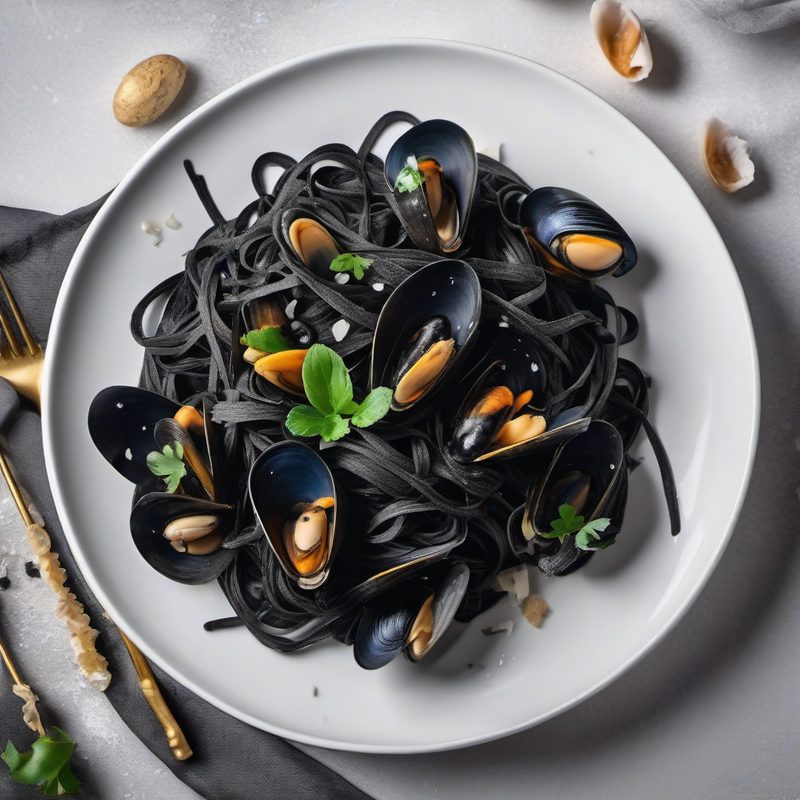
Squid Ink Tagliatelle Mussels
Black-as-night tagliatelle tossed in a briny mussel broth, finished with a luscious pecorino cream and a punchy lard-orange paste — this is coastal Italian decadence on a plate.
| Amount | Ingredient |
|---|---|
| as needed | Salt for pasta water |
| reserved | Lard paste (about 1 tbsp) |
| reserved | Pecorino cream |
| reserved | Mussels (in shells for garnish) |
> Note: Includes fresh pasta-making. The lard paste and pecorino cream can be made while the pasta dough rests.
Fresh Squid Ink Pasta
Lard-Orange Paste
Mussels
Pecorino Cream
To Finish
🥘 Equipment
- Food processor
- Pasta machine or rolling pin
- Large pot (6-qt)
- Large sauté pan (12-inch)
- Fine-mesh strainer
- Large mixing bowl
- Bench scraper
- Chef's knife
- Microplane or fine grater
📋 Preparation
Make the Fresh Pasta
Step 1: Mix the Dough
In a large bowl, combine 00 flour and semolina. Make a well in the center. Crack the eggs into the well and add the squid ink. Using a fork, gradually incorporate the flour into the eggs until a shaggy dough forms.
Step 2: Knead
Turn the dough out onto a clean work surface and knead vigorously for 8–10 minutes until smooth, silky, and uniformly black. Wrap in plastic and let rest at room temperature for 30 minutes.
Resting relaxes the gluten, making the dough easier to roll.
Step 3: Roll and Cut
Divide the dough into 4 portions. Keeping the rest covered, roll one portion through a pasta machine, progressively reducing the thickness setting, until you reach 1 mm thickness (setting 6 or 7 on most machines). Lay the sheets on a lightly floured surface and cut into 7 mm-wide strips (tagliatelle width). Dust with semolina and set aside on a floured tray. Repeat with remaining dough.
Make the Lard-Orange Paste
Step 4: Blend
In a food processor, combine the lardo slices and finely grated orange zest. Pulse, then process for 30 seconds until completely smooth and spreadable. Set aside at room temperature. Reserve about 1 tablespoon for the final garnish.
Cook the Mussels
Step 5: Steam the Mussels
In a large pot, heat the olive oil over medium-high heat. Add the mussels and toss briefly. Pour in the white wine, cover immediately, and steam for 3–4 minutes until all mussels have opened. Discard any that remain closed.
Step 6: Shell and Strain
Remove the mussels from the pot. Shell all but 8–12 of the prettiest ones (leave those in the shell for garnish). Strain the cooking liquid through a fine-mesh strainer lined with cheesecloth or a paper towel to remove any grit. Reserve the liquid.
Make the Pecorino Cream
Step 7: Heat and Whisk
In a small saucepan, warm the heavy cream over medium heat until steaming but not boiling. Whisk in the grated Pecorino Romano and continue whisking until smooth and thickened, about 2 minutes. Strain through a fine-mesh strainer for a silky texture. Keep warm.
Final Assembly
Step 8: Build the Sauce Base
In a large sauté pan over medium heat, add the strained mussel cooking liquid and about 2 tablespoons of the lard-orange paste. Stir until the lard paste melts and emulsifies into the liquid, about 1 minute.
Step 9: Cook the Pasta
Bring a large pot of generously salted water to a boil. Drop the fresh tagliatelle and cook for 2 minutes (fresh pasta cooks very quickly). Reserve 1/2 cup of pasta water, then drain.
Step 10: Toss and Finish
Add the drained tagliatelle and the shelled mussels to the sauté pan. Toss vigorously over medium heat, adding a splash of pasta water if the sauce seems tight. Cook for 30–60 seconds until the pasta is coated and glossy.
Step 11: Plate
Divide among warm bowls. Spoon a generous dollop of pecorino cream onto each portion. Arrange 2–3 shell-on mussels on top. Dot with small dabs of the reserved lard-orange paste. Serve immediately.
🧑🍳 Chef's Tips
- Squid ink source: Look for squid ink in small jars or packets at Italian markets, Whole Foods, or online. It's also called "nero di seppia." Freeze leftover ink in an ice cube tray.
- Lardo substitute: If lardo is unavailable, use the fat cap from a slab of bacon (blanched 30 seconds to soften) or guanciale fat. Standard bacon strips are too lean.
- Pasta water is insurance: Fresh squid ink pasta releases very little starch, so you may need extra pasta water to help the sauce cling. Don't be shy with it.
- Timing is everything: Have the sauce base ready before you drop the pasta — fresh tagliatelle cooks in 2 minutes and waits for nothing.
❌ Common Mistakes
| Mistake | Why | Fix |
|---|---|---|
| Overcooking the mussels | They become rubbery and dry | Steam only until they open (3–4 minutes max) |
| Skipping the lard paste straining | Gritty texture ruins the silkiness | Always strain the mussel liquid through a fine sieve |
| Adding pecorino cream to boiling sauce | It will curdle and split | Keep the pecorino cream warm but not boiling; add to pasta after tossing |
| Rolling pasta too thick | 1mm is essential — thicker pasta won't absorb the sauce properly | Use a pasta machine and trust the settings; test a strip before cutting |
💡 Variations
- Spicy kick: Add 1/2 tsp red pepper flakes when melting the lard paste for a gentle heat.
- Herb finish: Toss in 2 tbsp fresh parsley and 1 tbsp fresh chives, chopped, just before serving.
- No pasta machine? Roll the dough by hand to about 1/16 inch (1.5 mm), then cut into strips with a sharp knife. The texture will be more rustic.
- Swap the seafood: Clams (vongole) or a mix of clams and mussels work beautifully. Adjust steaming time accordingly.
❄️ Storage
This dish is best served immediately — fresh pasta doesn't reheat well. If you have leftover components, store separately: cooked pasta (tossed in olive oil) for 1 day, pecorino cream for 2 days (reheat gently), and shelled mussels for 1 day. The lard paste keeps for up to 1 week in the refrigerator.
🍷 Wine Pairing
| Wine | Why |
|---|---|
| Verdicchio dei Castelli di Jesi | Bright acidity and saline minerality mirror the mussel broth |
| Gavi di Gavi | Crisp, floral, with enough structure for the lard paste |
| Etna Bianco | Volcanic minerality, citrus, and a subtle smokiness |
| Franciacorta Brut | Bubbles cut through the creamy pecorino — celebratory and perfect |
🍺 Beer Pairing
| Beer | Why |
|---|---|
| Italian Pilsner | Clean, crisp bitterness slices through the richness |
| Saison | Spicy, peppery notes complement the orange zest in the lard paste |
| Belgian Witbier | Citrusy and light — echoes the orange without overpowering the seafood |
🥗 Suggested Sides
- Shaved fennel and orange salad with olive oil and sea salt
- Grilled bread rubbed with garlic (bruschetta bianca)
- Sautéed Swiss chard with garlic — the bitterness balances the rich pasta
📊 Nutrition (per serving)
| Calories | Protein | Fat | Carbs | Fiber |
|---|---|---|---|---|
| 720 | 28 g | 38 g | 62 g | 3 g |
Nutrition estimate based on 4 servings (adapted from original 6-serving yield of ~480 cal/serving).
❓ FAQ
Can I use dried pasta instead?
Yes — use 12 oz of dried egg tagliatelle or pappardelle. Boil according to package directions until al dente (about 6–7 minutes). You won't get the squid ink color from dried pasta, but you can add 1 tsp squid ink to the sauce.
Where do I find squid ink?
Italian grocery stores, specialty seafood counters, and online retailers carry it. Look for "nero di seppia" in small glass jars or squeeze packets. One jar (about 1 oz) will make this recipe plus leftovers.
Is lardo the same as bacon?
No — lardo is pure cured pork back fat, rendered and seasoned. It melts into a silky, spreadable paste. Bacon is leaner and smoked, which would overpower the delicate seafood. If you can't find lardo, use the thick fat cap from unsmoked pancetta.
Can I make the pasta ahead?
Fresh squid ink tagliatelle can be made up to 24 hours ahead. Lay the cut strips in loose nests on a semolina-dusted tray, cover loosely with plastic wrap, and refrigerate. Cook directly from the fridge — no need to come to room temperature.
The pecorino cream looks grainy — what went wrong?
The cream was too hot or you added the cheese too quickly. Always heat cream to just below a simmer, then whisk in the pecorino gradually off the heat. Straining fixes minor graininess.
🔗 Related Recipes
- Linguine alle Vongole — White Wine Clam Pasta
- Spaghetti al Nero di Seppia — Classic Sicilian Squid Ink Pasta
- Tagliatelle with Porcini & Parmigiano Cream
- Mussels in White Wine & Saffron Broth
🏷️ Search Tags
Recipe from The Italian Kitchen by Vita Milanese — Volume 1 · Pasta Perfetto. Discover all volumes on the ebook page.