Valencian Paella
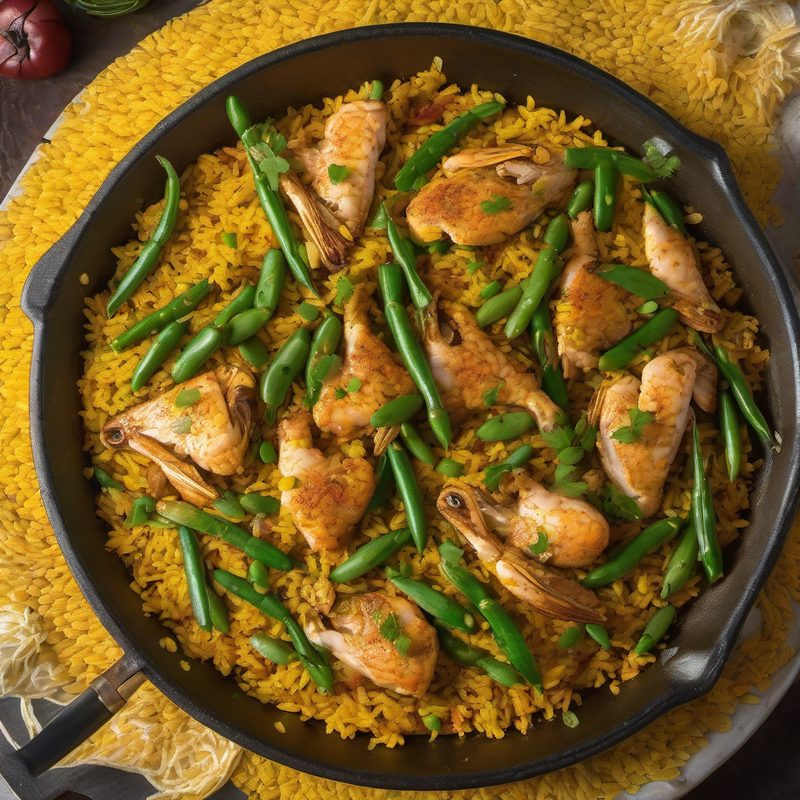
The one and only authentic paella — a golden, saffron-scented rice dish from the heart of Valencia, layered with tender chicken, rabbit, flat green beans, and butter beans, crowned with a crackling crust of caramelized rice on the bottom called socarrat.
This is not seafood paella. This is not "everything-but-the-kitchen-sink" paella. This is Paella Valenciana — the original, the one that Valencian grandmothers have been making for generations over wood fires in the orchard. The proteins are chicken and rabbit (never seafood), the vegetables are flat green beans (tavella) and butter beans (garrofón), and the flavor comes from saffron, paprika, and a good homemade broth — nothing more, nothing less. The defining moment comes at the end: a final blast of high heat that caramelizes the rice on the bottom of the pan into a toasty, nutty crust called socarrat. It's the most prized part of the paella, and once you've tasted it, you'll understand why. This is a recipe for 4 people, cooked in a proper paella pan and served straight from the pan at the table.
> Note: Authentic paella uses Bomba or Calasparra rice, which absorbs more liquid without turning mushy. Do not substitute with long-grain or risotto rice.
If rabbit is unavailable, substitute an additional 8 oz (225 g) of chicken thighs. Canned butter beans (rinsed and drained) can replace dried; add them in Step 5 with the broth to avoid overcooking.
🥘 Equipment
- 14- to 16-inch (35–40 cm) paella pan (or a large, shallow, heavy-bottomed skillet)
- Kitchen shears (for trimming beans)
- Chef's knife and cutting board
- Small bowl (for saffron infusion)
- Wooden spoon or heat-resistant spatula
- Ladle
- Large heat-proof platter (for resting meat)
📋 Preparation
Step 1 — Season and Sear the Meat
Pat the chicken and rabbit pieces dry with paper towels. Season generously on all sides with kosher salt.
Heat 5 tablespoons of olive oil in the paella pan over medium-high heat until shimmering. Add the meat in a single layer — work in batches if necessary to avoid crowding. Cook without moving for 4 to 5 minutes until the bottoms are deep golden brown. Turn the pieces and continue cooking, turning occasionally, for 10 to 15 minutes total until all sides are well browned and the meat is cooked through.
The oil should sizzle vigorously when the meat hits the pan. If it doesn't, the pan isn't hot enough. Proper browning is the foundation of paella flavor — don't rush this step.
Using tongs, transfer the browned meat to a platter and set aside. Leave the oil and browned bits in the pan.
Step 2 — Sauté the Vegetables
Reduce the heat to medium. Add the flat green beans and diced bell pepper to the pan. Cook, stirring occasionally, for 8 to 10 minutes until the beans are bright green and starting to soften, and the peppers have released their moisture and begun to wrinkle.
The beans should be tender but still have a bit of bite — they'll continue cooking later. If the pan looks dry, add a splash of water, not more oil.
Step 3 — Add Tomato and Simmer
Push the vegetables to the sides of the pan. Add the crushed tomatoes to the center and cook, stirring, for 3 to 4 minutes until the tomato has darkened in color and most of its liquid has evaporated. Stir the tomatoes into the vegetables.
Cooking the tomato down concentrates its flavor and removes the raw acidity. You want a thick, jammy paste, not a watery sauce.
Step 4 — Add Broth, Saffron, and Spices
Pour the chicken broth into the pan. Add the soaked and drained butter beans (if using dried), the paprika, the saffron with its soaking water, and the red pepper flakes (if using). Stir gently to combine.
Return the browned meat to the pan, nestling the pieces into the liquid. Bring the broth to a vigorous boil over high heat, then reduce the heat to medium and let it boil gently for 8 to 10 minutes. Taste the broth and adjust salt — it should be well-seasoned, as the rice will absorb it all.
The broth level should reach the top of the rivet where the handle meets the pan — this is the traditional Valencian measure for the correct liquid-to-rice ratio. If it seems low, add a little hot water.
Step 5 — Add the Rice — Do Not Stir After This Point
Sprinkle the rice evenly over the surface of the liquid, spreading it in an even layer with a wooden spoon or spatula. Do not stir after this point — stirring releases starch and turns the paella into a sticky, risotto-like mess.
Increase the heat to high and cook for 7 to 8 minutes at a vigorous boil. The rice should be bubbling energetically across the entire surface — if only the center is bubbling, rotate the pan every 2 minutes for even cooking.
Resist the urge to stir. Trust the process. The rice grains should remain separate and distinct, and the socarrat (the caramelized bottom crust) can only form if the rice is left undisturbed.
Step 6 — Lower Heat and Finish
After 8 minutes at high heat, reduce the heat to medium-low. Continue cooking for another 10 minutes without stirring. The liquid level will drop below the surface of the rice, and you'll hear a gentle crackling sound — that's the socarrat forming on the bottom.
Cook until the liquid is fully absorbed and the rice is tender but still slightly firm to the bite (al dente). If the rice is still chalky and the liquid is gone, sprinkle a few tablespoons of hot water over the surface and continue cooking for another 2 to 3 minutes.
To check for socarrat: gently lift a corner of the rice with a spatula. You should see a deep golden-brown crust on the bottom of the pan. If it's pale, increase the heat to high for the last 60 seconds — watch carefully to avoid burning.
Step 7 — Rest and Serve
Remove the pan from the heat. Cover loosely with a clean kitchen towel or aluminum foil and let rest for 5 minutes. This allows the steam to finish cooking the rice and relaxes the socarrat slightly so it releases from the pan.
Bring the entire pan to the table — paella is always served from the pan. Garnish with fresh rosemary sprigs and serve with lemon wedges on the side.
The socarrat is the most prized part of the paella. Serve by scraping all the way to the bottom so everyone gets some of the crust.
🧑🍳 Chef's Tips
- Use the right rice. Bomba and Calasparra are short-grain Spanish rices that absorb 3 times their volume in liquid (compared to 2× for regular rice). They stay firm and separate through the long cooking process. Do not substitute Arborio (it releases too much starch) or long-grain rice (it turns mushy).
- A real paella pan matters. The wide, shallow shape — never more than 2 inches deep — maximizes surface area for even cooking and socarrat formation. A 14-inch pan serves 4 perfectly. Stainless steel or carbon steel is traditional; avoid nonstick, which prevents the crust from forming.
- Don't skimp on the saffron. Real saffron is expensive because it takes 75,000 crocus flowers to produce one pound. But it's non-negotiable for authentic paella. Crush the threads and steep them in hot water for 10 minutes before adding — this extracts maximum color and flavor. Never use turmeric as a substitute; the flavor is completely wrong.
- Homemade broth is worth the effort. Paella gets its deep flavor from a good chicken broth. Make it with chicken backs, wings, onion, carrot, celery, and a bay leaf — simmer for 2 hours, strain, and you're golden. Store-bought broth works in a pinch but use a low-sodium brand and adjust salt accordingly.
- Socarrat is a controlled burn. The caramelized bottom crust is the soul of paella, but there's a fine line between socarrat and burnt. Listen for the crackling sound — that's the moisture evaporating and the rice toasting. If you smell anything acrid, remove the pan from the heat immediately.
- Let the paella rest. This 5-minute rest is not optional. It allows the rice to finish absorbing steam, the flavors to settle, and the socarrat to release from the pan. Resting uncovered under a towel prevents condensation from dripping onto the rice and making it soggy.
❌ Common Mistakes
| Mistake | Why It Hurts | The Fix |
|---|---|---|
| Stirring the rice after adding it | Releases starch, creating a gummy, risotto-like texture instead of separate, fluffy grains | After you add the rice and spread it evenly, do not touch it again until the paella is done |
| Using the wrong rice | Long-grain or Arborio rice either turns mushy or releases too much starch, ruining the texture | Use Bomba or Calasparra rice — available at Spanish grocers or online |
| Crowding the pan with too much rice in relation to pan size | The rice cooks unevenly; the center stays wet while the edges dry out | Use the traditional rule: 1 cup (200 g) of rice per person for a 14-inch pan. |
| Not browning the meat enough | The paella lacks the deep, savory foundation that only proper browning provides | Brown the meat in batches over medium-high heat; you want deep mahogany, not pale tan |
| Adding too much or too little broth | Too much = soupy paella; too little = undercooked rice with a chalky center | The correct ratio is 3 parts liquid to 1 part Bomba rice by volume. Measure carefully |
| Cooking on too low heat after adding rice | The rice steams instead of absorbing; the socarrat won't form | The first 8 minutes must be at a vigorous boil; the final 10 minutes at medium-low |
💡 Variations
| Variation | How To |
|---|---|
| Mixed Paella (Paella Mixta) | Add 8 oz (225 g) of large shrimp (peeled, tails on) and 8 oz (225 g) of mussels (scrubbed) in the final 10 minutes of cooking. Nestle them into the rice shell-side up. This is the "tourist paella" — not traditional in Valencia but popular everywhere else. |
| Vegetable Paella (Paella de Verduras) | Omit the chicken and rabbit entirely. Add 1 diced zucchini, 1 sliced artichoke heart (in lemon water to prevent browning), and 4 oz (115 g) of trimmed asparagus in Step 2. Use vegetable broth instead of chicken broth. Add 1 cup of canned chickpeas (rinsed and drained) with the broth for protein. |
| Socarrat-Forward Paella | After the resting period, return the pan to high heat for 90 seconds to 2 minutes. Listen carefully — when the crackling becomes loud and persistent, remove immediately. This creates an extra-thick, deeply toasted crust. Serve by breaking the crust into shards and scattering them over each portion. |
| Wood-Fire Paella | Cook the entire paella over a wood fire or charcoal grill. Use a dedicated paella burner ring for stability. The smoky aroma from the fire infuses the rice and gives it an incomparable depth that no stovetop can replicate. |
| Arroz al Horno (Baked Paella) | After adding the rice and broth in Step 5, transfer the pan to a 400°F (200°C) oven and bake, uncovered, for 20 to 25 minutes until the liquid is absorbed and the rice is tender. The oven method is more forgiving and produces even cooking but won't give you the same socarrat as stovetop. |
| With Artichokes | Add 2 fresh artichokes, trimmed, quartered, and tossed in lemon water, to the pan with the vegetables in Step 2. Artichokes are a classic addition in some Valencian households. |
❄️ Storage & Leftovers
| Method | Details |
|---|---|
| Refrigerator | Store in an airtight container for up to 3 days. Paella actually improves overnight as the flavors meld. |
| Reheating | The only way to reheat paella without ruining it: heat a nonstick skillet over medium heat, add a splash of water, add the paella, cover, and steam for 3–4 minutes. Uncover, increase heat to high, and cook for 1 minute to re-crisp the bottom. Do not microwave — it turns the rice to mush and destroys the socarrat. |
| Freezing | Freeze in a single layer on a baking sheet, then transfer to a freezer bag. Keeps for up to 2 months. Thaw overnight in the refrigerator. Reheat in a skillet as described above. Note: the texture of thawed paella will be softer than fresh, but the flavor remains excellent. |
| Socarrat Revival | To restore the bottom crust on leftover paella, press the cold paella into a hot skillet with a thin layer of oil. Cook without moving for 3–4 minutes over medium-high heat until you hear crackling and the bottom is golden and crisp again. |
🍷 Wine Pairing
| Wine | Why |
|---|---|
| Rioja Crianza (Spain) | The classic Valencian pairing. Tempranillo-based with bright red fruit, vanilla, and dill from American oak — the moderate tannins and lively acidity complement the saffron and paprika without overwhelming the delicate rice. Look for Muga, López de Heredia, or La Rioja Alta. |
| Ribera del Duero Crianza | Bigger and more structured than Rioja, with dark cherry and blackberry fruit and a pronounced mineral backbone. The intensity stands up to the browned chicken and rabbit beautifully. |
| Garnacha (Calatayud or Cariñena) | Juicy, berry-forward, with low tannins and a subtle white pepper spice. The fruitiness balances the smoky paprika, and the low tannins won't clash with the saffron. A fantastic value pairing — many excellent bottles under $20. |
| Verdejo (Rueda) | For those who prefer white wine: a crisp, herbaceous Verdejo with notes of fennel and citrus. The bright acidity cuts through the richness of the olive oil and meat, while the herbal character echoes the rosemary garnish. Serve well-chilled. |
| Albariño (Rías Baixas) | Saline, mineral-driven, and intensely aromatic with peach and lemon zest. The saltiness mirrors the sea-breeze character of coastal Valencia, and the crisp finish cleanses the palate between bites of rich, saffron-laced rice. |
🍺 Beer Pairing
| Beer | Why |
|---|---|
| Spanish Lager (Estrella Damm or Cruzcampo) | The canonical paella beer — light, crisp, and highly carbonated. The clean malt profile and low bitterness refresh the palate and don't compete with the saffron and paprika. Estrella Damm is brewed just south of Barcelona and has been enjoyed with paella for over a century. |
| Amber Ale (Spanish-style or American) | Toasty malt flavors mirror the socarrat crust, while moderate hop bitterness cuts through the richness of the olive oil and meat. A well-made amber ale (try a Spanish cerveza tostada like Alhambra Reserva 1925) is a surprisingly perfect match. |
| Saison | Spicy, peppery, and dry with a complex yeast character. The farmhouse funk and lively carbonation pair beautifully with the saffron's floral notes and the charred edges of the socarrat. |
| Blonde Ale | Clean, smooth, and lightly malty — a blonde ale's gentle sweetness and low bitterness let the paella's flavors take center stage without any competition. |
📊 Nutrition (per serving, estimated)
| Calories | Protein | Fat | Carbs | Fiber |
|---|---|---|---|---|
| 480 | 32 g | 18 g | 48 g | 5 g |
Nutrition is an estimate based on standard ingredient quantities using boneless chicken thighs and rabbit, Bomba rice, and olive oil. Actual values will vary based on meat fat content, oil absorption, and specific brands. The socarrat crust does not significantly alter the nutritional profile.
Photo Reference
When styling the photography, capture the paella in its pan on a rustic wooden table: the golden rice studded with chunks of browned chicken and rabbit, bright green bean pieces, and creamy white butter beans visible throughout. The socarrat should be visible at the edges — a deep amber crust pulling away from the pan walls. Garnish with a few sprigs of fresh rosemary. Warm, Mediterranean lighting from the side to highlight the texture of the rice grains. A linen napkin and a small bowl of lemon wedges complete the scene.
Photo reference: `vol1_37.png` — A 14-inch carbon steel paella pan on a weathered wooden table, filled with golden saffron-tinted rice studded with browned chicken, rabbit, flat green beans, and butter beans. The edges show the characteristic amber socarrat crust pulling away from the pan. Garnished with fresh rosemary sprigs and lemon wedges. Warm golden-hour lighting from the left, casting soft shadows. Shot from a slight overhead angle showing the full pan.
Recipe from "The Italian Kitchen" by Vita Milanese — Volume 1: Pasta Perfetto
Recipe from The Italian Kitchen by Vita Milanese — Volume 1 · Pasta Perfetto. Discover all volumes on the ebook page.