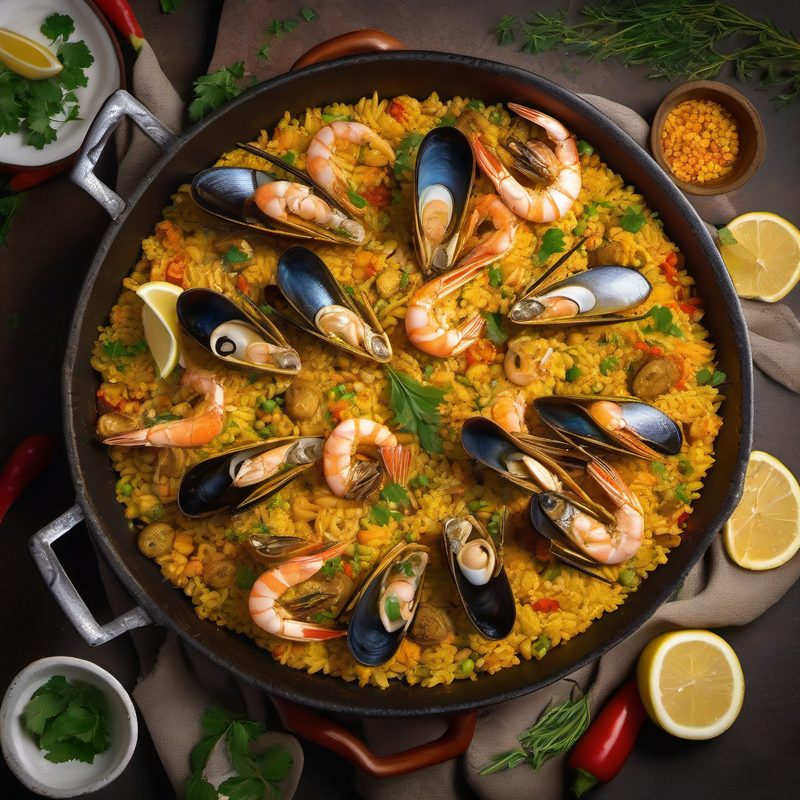
Mixed Paella
A vibrant one-pan Spanish feast loaded with tender chicken, plump shrimp, mussels, and clams—all united by saffron-infused rice with a coveted golden crust on the bottom.
| Amount | Ingredient |
|---|---|
| Adding cold broth to the pan | Shocks the rice, extending cooking time and uneven cooking Keep the broth at a bare simmer and add it hot. |
| Skipping the rest step | Socarrat sticks to the pan; rice is too wet The 5-minute uncovered rest lets steam finish the cooking and releases the crust naturally. |
There's a reason paella is Spain's most famous export: it's a spectacle. A single pan delivers tender browned chicken, sweet shrimp, briny mussels and clams, and rice that's been simmered in a deeply flavored saffron broth until every grain is plump and fragrant. The secret is socarrat—that crackling-crisp crust that forms on the bottom of the pan, the sign of a paella made with patience and pride. This mixed version (paella mixta) brings together chicken and seafood in one glorious dish, and we've adapted it so you can achieve authentic results in a standard American kitchen.
For the Broth
For the Paella
Bomba rice is the gold standard for paella—it absorbs more liquid than regular rice while staying firm. Look for it at Spanish grocers or online. If unavailable, use arborio rice and reduce broth by ½ cup.
🥘 Equipment
- 15-inch paella pan or 14-inch carbon steel skillet
- Chef's knife
- Cutting board
- Wooden spoon or wide spatula
- Box grater
- Fine-mesh strainer
- Large saucepan
📋 Preparation
Step 1: Make the Broth (15 minutes)
In a large saucepan, combine the chicken broth, carrot, celery, onion quarters, parsley, bay leaf, and salt. Bring to a boil over high heat, then reduce to a bare simmer. Cover and keep warm over low heat while you prepare the paella.
Step 2: Sear the Chicken (8 minutes)
Heat a 15-inch paella pan or 14-inch carbon steel skillet over medium-high heat. Add 2 tablespoons of the olive oil and swirl to coat. Pat the chicken pieces dry with paper towels and season lightly with salt and pepper. Add the chicken in a single layer (work in batches if needed) and cook without moving until deep golden brown, 4 to 5 minutes per side. Transfer the chicken to a plate; set aside.
Step 3: Cook the Vegetables (8 minutes)
Reduce heat to medium. Add the remaining 2 tablespoons olive oil to the pan. Add the diced onion and bell pepper; cook, stirring occasionally, until softened and beginning to brown, about 5 minutes. Add the garlic and cook until fragrant, about 30 seconds. Add the grated tomatoes and smoked paprika; cook, stirring constantly, until the tomato darkens and the mixture thickens slightly, about 2 minutes.
Step 4: Toast the Rice and Add Broth (5 minutes)
Add the rice to the pan and stir to coat every grain with the tomato mixture. Cook, stirring, until the rice becomes translucent at the edges, about 1 minute. Crush the saffron threads between your fingers and sprinkle over the rice. Pour in 4½ cups of the warm broth (reserve the rest) and stir gently to distribute everything evenly. Season with ½ teaspoon salt. From this point on, do not stir the rice again—this is essential for developing the socarrat.
Step 5: Cook the Rice (20 minutes)
Bring the broth to a vigorous boil, then reduce heat to medium-low so the liquid maintains a steady, gentle simmer. Cook uncovered without stirring for 15 minutes. Nestle the browned chicken pieces into the rice. Arrange the mussels and clams (hinge-side down) around the pan, and tuck the shrimp between them. Scatter the peas over the top.
Continue cooking without stirring until the rice has absorbed most of the liquid, the grains are tender but still have a slight bite, and the mussels and clams have opened, 5 to 8 minutes more. If the rice looks dry before it's fully cooked, drizzle in a little of the reserved warm broth. Discard any mussels or clams that refuse to open.
Step 6: Develop the Socarrat (3 minutes)
Increase heat to medium-high and listen for a faint crackling sound. Cook without moving the pan until you smell a toasty, nutty aroma—this is the socarrat forming. Watch carefully: the rice should smell toasty, not burnt. This takes 2 to 3 minutes. To check, peek under the edge with a spatula; you're looking for a deep golden-brown crust.
Step 7: Rest and Serve (5 minutes)
Remove the pan from heat, cover loosely with a clean kitchen towel or foil, and let rest for 5 minutes. This allows the remaining steam to finish cooking the rice and makes the socarrat release more easily. Serve directly from the pan at the table, with lemon wedges on the side.
🧑🍳 Chef's Tips
- The right pan matters. A traditional paella pan is wide and shallow, maximizing surface area for even cooking and socarrat development. Carbon steel skillets work beautifully too. Avoid deep pots or nonstick pans—they trap steam and prevent crust formation.
- Don't rinse the rice. Bomba and Calasparra rice should not be rinsed before cooking. The surface starch is essential for the proper creamy-yet-firm texture.
- Grate, don't chop, the tomatoes. Grated tomatoes dissolve into the cooking liquid, creating a silky, evenly distributed base. Chopped tomatoes leave watery pockets.
- Trust the process—no stirring! Once you add the broth, resist every urge to stir. Stirring releases starch and turns the paella into risotto. The socarrat forms only when the rice at the bottom is undisturbed.
❌ Common Mistakes
| Mistake | Why It Hurts | The Fix |
|---|---|---|
| Stirring after adding broth | Releases starch, creating a gummy, risotto-like texture instead of distinct, separate grains | Once the broth goes in, hands off. Shake the pan gently if needed to distribute, but never stir. |
💡 Variations
- Vegetarian Paella: Omit the chicken and seafood. Add 1 cup drained canned chickpeas and 1 cup trimmed green beans (cut into 2-inch lengths) with the broth. Use vegetable broth instead of chicken broth.
- Chicken & Chorizo Paella: Replace the shrimp, mussels, and clams with 6 oz Spanish chorizo, sliced into ¼-inch rounds. Brown the chorizo with the chicken in Step 2.
- Seafood-Only Paella (Paella de Marisco): Omit the chicken entirely. Increase shrimp to 8 oz, mussels to 8 oz, and add 4 oz squid rings in the last 5 minutes of cooking.
- Spicy Paella: Add 1 teaspoon pimentón picante (hot smoked paprika) and a pinch of cayenne pepper with the sweet paprika.
❄️ Storage & Leftovers
| Method | Details |
|---|---|
| Refrigerator | Transfer to an airtight container and refrigerate for up to 2 days. |
| Freezer | Freeze in a single layer on a parchment-lined baking sheet, then transfer to a freezer bag for up to 1 month. |
| Reheating | The best way: spread the paella in a skillet, sprinkle with 2 tablespoons water, cover, and heat over medium-low for 5 to 7 minutes. The microwave works too (covered, 2 minutes at 70% power) but the socarrat won't survive. |
🍷 Wine Pairing
| Wine | Why |
|---|---|
| Albariño (Rías Baixas) | This crisp, mineral-driven white from Galicia cuts through the richness of the seafood and brightens the saffron notes. |
| Verdejo (Rueda) | Herbaceous and zesty, with enough body to stand up to the chicken and chorizo-like savory elements. |
| Garnacha (Spain) | A light-bodied, fruit-forward red served slightly chilled (55°F) — a classic Spanish pairing that complements both the chicken and shellfish without overwhelming. |
| Cava Brut Nature | Spain's answer to Champagne: brisk bubbles and high acidity cleanse the palate between bites of rich rice and briny seafood. |
🍺 Beer Pairing
| Beer | Why |
|---|---|
| Estrella Galicia or Mahou | A crisp Spanish lager is the classic choice—clean, light, and refreshing. |
| Citra IPA | The citrusy hop character mirrors the lemon finish and stands up to the smoky paprika. |
🥗 Suggested Side Dishes
- Simple green salad with sherry vinaigrette
- Pan con tomate (toasted bread rubbed with garlic and ripe tomato)
- Grilled lemon-oregano artichoke hearts
- Roasted Padrón peppers with flaky sea salt
📊 Nutrition (per serving, estimated)
| Calories | Protein | Fat | Carbs | Fiber |
|---|---|---|---|---|
| 585 | 38 g | 18 g | 62 g | 4 g |
❓ Frequently Asked Questions
Can I use a regular skillet instead of a paella pan?
Yes! A 14-inch carbon steel or stainless steel skillet works well. The key is a wide cooking surface—at least 12 inches—so the rice layer is thin and even. Avoid nonstick pans, as they don't develop a proper socarrat.
What if I can't find Bomba rice?
Use arborio rice, but reduce the broth by ½ cup (to 4 cups total) since arborio absorbs less liquid. The texture will be slightly creamier—closer to risotto—but still delicious.
How do I know when the socarrat is ready?
Listen for a gentle crackling sound and smell for a toasty, nutty aroma—like toasted bread. Peek under the edge with a spatula: the crust should be deep golden brown, not dark brown or black. When in doubt, pull it off the heat a minute early; you can always cook it more, but you can't un-burn it.
My mussels and clams didn't open. What went wrong?
They were likely dead before cooking. Discard any that are still closed after 8 minutes of cooking—do not force them open. Always buy shellfish from a trusted source and check that shells are closed (or close when tapped) before cooking.
🔗 Related Recipes
- Arroz con Pollo (Chicken and Rice)
- Fideuà (Catalan Noodle Paella with Seafood)
- Spanish Seafood Stew (Zarzuela)
- Black Rice with Squid and Aioli (Arròs Negre)
🏷️ Search Tags
Recipe from The Italian Kitchen by Vita Milanese — Volume 1 · Pasta Perfetto. Discover all volumes on the ebook page.