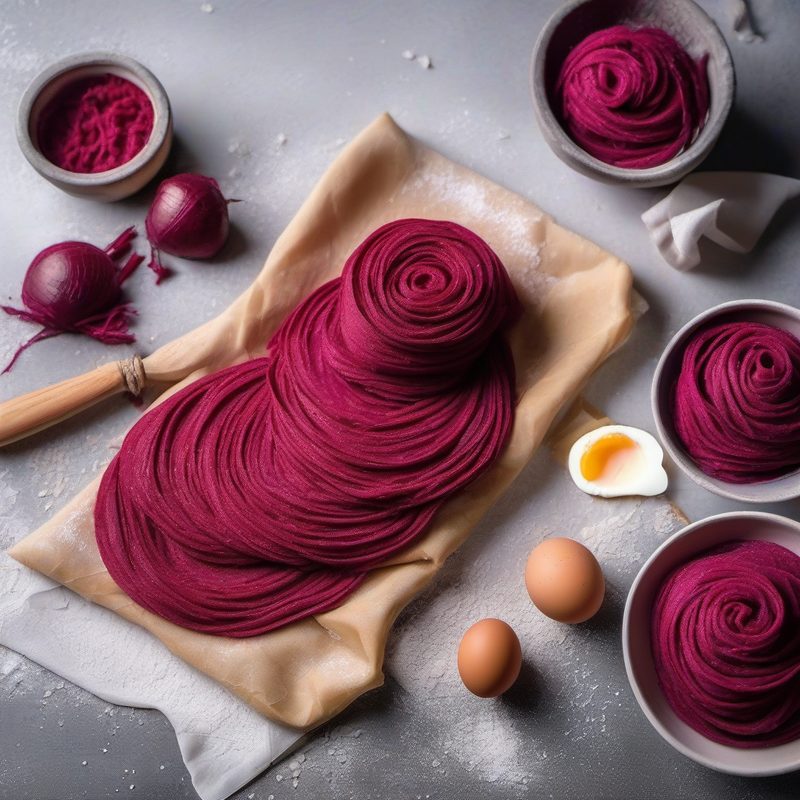
Fresh Beetroot Pasta Dough
A naturally vibrant, jewel-toned fresh pasta dough that turns any pasta shape into a showstopper — the earthy sweetness of roasted beetroot tints the dough a stunning fuchsia pink while adding subtle sweetness and a tender, silky texture that rivals traditional egg pasta.
This is the dough that makes people stop and stare. Roll it into tagliatelle for a rosy ribbon that catches the light, cut it into pappardelle wide enough to showcase the color, or stuff it into ravioli — the gentle beet sweetness pairs beautifully with butter-and-sage sauces, creamy ricotta fillings, or simply a drizzle of good olive oil and Parmigiano. Unlike many vegetable pastas that can be finicky or produce a dull, muddy color, this recipe uses straight beetroot purée — no water, no strain, no dilution — so the color is as intense as the flavor is subtle. The technique is the same as classic fresh egg pasta: a flour well, eggs in the center, beet purée worked in gradually, and a patient 10-minute knead that transforms a speckled pink mess into a smooth, silky, brilliantly colored dough. The 30-minute rest is not negotiable — it relaxes the gluten and deepens the color as the beet pigments evenly distribute through the dough. The result is a pasta that tastes subtly sweet and earthy, with a texture that is tender but resilient, and a color so vivid it looks almost artificial — but it's 100% natural.
> Note: Active work is about 20 minutes. The 30-minute resting period is hands-off. Cook time depends on the shape you cut — fresh tagliatelle cooks in 2–3 minutes, pappardelle in 3–4, filled pasta like ravioli in 3–5.
Use a kitchen scale for best results — pasta dough is a ratios game and volume measurements for flour can vary by 20% or more depending on how you scoop. "00" flour produces the silkiest texture, but all-purpose works beautifully.
🥘 Equipment
- Digital kitchen scale (recommended for accuracy)
- Blender or food processor (for beet purée)
- Fine-mesh sieve or food mill (optional, for extra-smooth purée)
- Large mixing bowl
- Fork or dough scraper
- Clean work surface (marble, wood, or stainless steel)
- Plastic wrap or a clean kitchen towel
- Rolling pin or pasta machine (manual or electric)
- Bench scraper (useful for cleaning the work surface during kneading)
- Pasta drying rack or floured baking sheet (for shaped pasta)
- Sharp knife or pasta cutter for shaping
📋 Preparation
Step 1 — Prepare the Beetroot Purée (5 minutes)
Place the cooked, peeled beetroot chunks (150 g) into a blender or food processor. Pulse until completely smooth, scraping down the sides as needed — about 30 to 45 seconds total. The purée should be the consistency of a thick smoothie, with no visible chunks or fibers.
If your beetroot seems dry (common with older or roasted beets), you may need to add just 1 to 2 teaspoons of water to help the blender catch — but add as little as possible. The less water, the more intense the color and the less flour you'll need to compensate. For the silkiest possible pasta, pass the purée through a fine-mesh sieve or food mill to remove any stubborn fibers. This is optional but recommended if your beets are particularly fibrous.
Step 2 — Make the Flour Well (2 minutes)
On a clean work surface, place the 300 g of flour and form it into a wide, shallow well — think of a volcano crater about 6 inches (15 cm) across with sides about 1½ inches (4 cm) high. The base of the well should be thin enough that you can see the work surface through the flour, but thick enough that the liquid ingredients won't break through.
The well is the traditional Italian method and it works because it lets you gradually incorporate the wet ingredients into the flour without making a paste-covered mess. A well that is too deep or thick-walled will be hard to incorporate; one that is too shallow will let the liquid spill over the sides before you're ready.
Step 3 — Add the Wet Ingredients to the Well (2 minutes)
Crack the 2 eggs into the center of the well. Add the beetroot purée, the olive oil, and the pinch of salt.
Using a fork, gently beat the eggs, beet purée, olive oil, and salt together right in the well, keeping the mixture contained within the flour walls. Once the wet ingredients are homogeneously combined into a deep pink liquid, begin gradually incorporating flour from the inner walls into the liquid — pull small amounts of flour from the edges into the center, whisking with the fork as you go.
Work slowly and deliberately. If the walls of the well break and liquid escapes, don't panic — just push the flour back up around it and continue. The goal is to incorporate enough flour that the mixture becomes a shaggy, cohesive mass that isn't running everywhere.
Step 4 — Form the Dough (1 minute)
Once the mixture is too thick for the fork (it will be a sticky, speckled pink paste), use your hands to begin pulling the remaining flour from the outer edges of the well into the center. Press and fold until all the flour is incorporated and you have a shaggy, rough-looking pink dough — it will be sticky, uneven in color, and may have dry patches. That's exactly right.
Scrape the work surface clean of any dried bits of dough or flour residue (use a bench scraper for this). Wash and dry your hands — you'll need clean hands for the next step.
Step 5 — Knead the Dough (10 minutes)
This is the most important step. With clean, dry hands, begin kneading the dough.
Kneading technique: Push the dough away from you with the heel of your palm, then fold it back over itself. Give it a quarter turn, and repeat. Use a steady, rhythmic motion — push, fold, turn, push, fold, turn. Knead for a full 10 minutes by the clock.
What to expect as you knead:
| Time | What the dough looks and feels like |
|---|---|
| 0–3 min | Sticky, rough, unevenly colored — pink and white streaks visible. Resists your hands slightly |
| 3–6 min | Sticks less to the surface and your hands. Color begins to even out — the pink deepens and the white streaks fade |
| 6–8 min | Smooth, supple, and slightly tacky but not sticky. The color is a uniform, vibrant fuchsia-pink. Bounces back slowly when poked |
| 8–10 min | Silky smooth, elastic, and only faintly tacky. When you press a finger into the dough, it springs back immediately. The dough is a brilliant, even pink throughout |
If the dough feels too dry and crumbly during kneading, wet your fingertips with water (just a few drops) and work them in. If it feels too sticky and wet, dust the work surface very lightly with flour — but go easy; too much extra flour will toughen the pasta.
"The dough tells you when it's ready" is the mantra of every Italian pasta maker. At 10 minutes, you should have a dough that feels like the soft, fleshy part of your palm just below the thumb — supple, resilient, and alive. Under-kneaded dough will tear when rolled out; over-kneaded dough will snap back aggressively. Ten minutes by hand — or 5 to 6 minutes in a stand mixer with the dough hook on medium speed — is the sweet spot.
Step 6 — Rest the Dough (30 minutes, hands-off)
Form the kneaded dough into a smooth, round ball. Flatten it slightly into a thick disc (this makes it easier to roll out later). Wrap tightly in plastic wrap (or place in a sealed container) and let it rest at room temperature for 30 minutes.
Do not skip the rest. During this time, the gluten relaxes (making the dough easier to roll), the starches hydrate fully (creating a more tender texture), and the beet pigment distributes evenly through the dough (deepening and unifying the pink color). After resting, the dough should feel noticeably softer and more pliable than when it went in.
While the dough rests, you can prepare your sauce, set up your pasta machine, or clean your work surface. The dough will keep at room temperature for up to 2 hours if well wrapped — beyond that, refrigerate.
Step 7 — Roll and Cut (10–15 minutes)
If using a pasta machine:
- Cut the rested dough into 4 equal pieces. Keep the pieces you're not working with covered under plastic wrap or a damp towel to prevent drying.
- Flatten one piece into a rough rectangle about ¼ inch (6 mm) thick. Pass it through the widest setting of your pasta machine (usually setting 0 or 1).
- Fold the resulting sheet in thirds (like a letter), rotate 90 degrees, and pass through the widest setting again. Repeat this fold-and-pass 2 to 3 more times — this develops the gluten structure evenly and creates a perfectly rectangular sheet.
- Begin narrowing the machine settings one notch at a time, passing the dough through each setting once. If the dough gets sticky, dust it very lightly with flour. If it gets too long to handle, cut the sheet in half crosswise.
- Continue narrowing until you reach your desired thickness:
- Setting 5 or 6 (about 1.5 mm): For tagliatelle, fettuccine, or pappardelle
- Setting 6 or 7 (about 1 mm): For lasagna sheets or ravioli
- Setting 7 or 8 (about 0.8 mm): For delicate filled pastas like tortellini
If rolling by hand:
Flour the work surface and rolling pin lightly. Roll from the center outward, turning the dough a quarter turn between each roll to maintain a round or oval shape. Roll to about 1/16 inch (1.5 mm) thickness — thin enough that you can see your hand through the dough when held up to the light.
Cutting the pasta:
- Tagliatelle or fettuccine: Lightly flour the rolled sheet, roll it loosely into a cylinder, and slice crosswise into ¼-inch (6 mm) strips. Unfurl immediately before they stick.
- Pappardelle: Cut into ¾-inch (2 cm) wide strips with a knife or pastry wheel.
- Ravioli or filled pasta: Cut into squares or rounds, fill, and seal immediately.
- Dust generously with flour after cutting to prevent sticking. Let cut pasta dry on a floured baking sheet or pasta drying rack for 10–15 minutes before cooking.
Step 8 — Cook the Pasta (2–4 minutes)
Bring a large pot of generously salted water (about 1½ tablespoons kosher salt per 4 quarts / 4 liters of water) to a rolling boil.
Add the fresh pasta and cook until tender but with a slight resistance at the center (al dente). Fresh tagliatelle cooks in 2 to 3 minutes, pappardelle in 3 to 4 minutes, and filled pasta in 3 to 5 minutes. The pasta will float to the surface when nearly done.
Reserve about 1 cup (240 ml) of the starchy pasta water before draining — it's essential for saucing.
Fresh pasta cooks much faster than dried — don't walk away. As soon as the pasta floats and the cut edges are no longer raw white in the center, it's ready. Overcooked fresh pasta turns mushy and loses its delicate texture.
🧑🍳 Chef's Tips
- Weigh your ingredients. Pasta dough is a matter of ratios — 300 g flour to 150 g beet purée to 2 eggs. A scale is not optional if you want consistent results. The same dough with slightly more flour or a different-sized egg can mean the difference between a silky sheet and a crumbly mess.
- Roast your beets for deeper flavor. Boiled beets work fine, but roasted beets (wrapped in foil at 400°F/200°C for 60–90 minutes until tender) concentrate their sweetness and produce a deeper, more complex earthy flavor. Cool completely before puréeing.
- Don't add extra liquid to the purée. The blender needs just enough moisture to catch — if your beets are dry, add 1 teaspoon of water at a time and stop the moment the blades catch. Every extra drop of water means more flour to balance, which dilutes color and toughens texture.
- "00" flour makes a difference. Finely milled "00" flour (common in Italian pasta making) produces the silkiest, most tender dough. All-purpose flour works but the texture will be slightly firmer and less delicate. Do not use bread flour — the higher protein content makes the dough too elastic and hard to roll thin.
- Room-temperature ingredients matter. Cold eggs straight from the fridge make the dough harder to knead and slower to hydrate. Let your eggs sit out for 20 minutes before starting, or submerge them in warm (not hot) water for 5 minutes.
- Dust, dust, dust. Fresh pasta is sticky by nature. Flour your work surface, your rolling pin or machine rollers, and your cut pasta generously. Use fine semolina or rice flour for dusting if you have it — they're less likely to be absorbed than all-purpose flour.
- Let cut pasta dry slightly before cooking. A 10–15 minute rest on a floured surface allows the cut edges to dry just enough that they won't stick together in the boiling water. Toss with additional flour halfway through if needed.
- Cook in batches. Don't crowd the pot — fresh pasta needs room to move. Cook in two batches if you're making a full recipe. The second batch can sit for 15–20 minutes without issue.
- Freeze what you don't cook immediately. Fresh pasta freezes brilliantly. Lay cut shapes in a single layer on a floured baking sheet, freeze until solid (about 1 hour), then transfer to a freezer bag. Cook from frozen — just add 1–2 minutes to the cooking time.
❌ Common Mistakes
| Mistake | Why It Hurts | The Fix |
|---|---|---|
| Adding too much water to the beet purée | Dilutes the color and flavor; forces you to add extra flour, which toughens the dough | Blend with the absolute minimum liquid needed — start with no added water and add 1 tsp at a time only if the blender won't catch |
| Under-kneading the dough | Results in a rough, crumbly dough that tears when rolled and cooks unevenly | Knead for a full 10 minutes by hand or 5–6 minutes with a stand mixer. The dough should be silky, elastic, and spring back when poked |
| Over-kneading the dough | Makes the dough too elastic and tight — it snaps back aggressively when rolled and produces tough, rubbery pasta | If the dough fights you during rolling, let it rest for 10 minutes to relax the gluten. If you've kneaded 12+ minutes by hand, you're fine — it's very hard to over-knead by hand |
| Skipping the 30-minute rest | The dough is tight and hard to roll thin; the beet color remains uneven and streaky | The rest is non-negotiable. It relaxes gluten, hydrates starches, and evens out the color |
| Rolling too thin for the shape | Delicate shapes like pappardelle or tagliatelle fall apart in the cooking water if rolled too thin | For long-cut pastas, stop at setting 5 or 6 on the machine (about 1.5 mm). Reserve settings 7–8 for filled pastas that need thin, delicate wrappers |
| Not dusting cut pasta with enough flour | The cut strands clump together into an unusable mass within minutes | Dust immediately after cutting, toss to separate, and dust again. Use semolina or rice flour for best results — they're less absorbent than all-purpose |
| Overcooking fresh pasta | Fresh pasta turns soft and mushy quickly — it has no dried pasta's structural resistance | Start checking at 90 seconds. Fresh pasta is done when it floats and the raw white core at the cut edge disappears |
| Using watery beets or canned beets | Canned beets are packed in water and produce a watery purée that throws off the flour ratio | Use roasted or boiled fresh beets. If using canned, drain thoroughly, pat dry with paper towels, and reduce the purée slightly in a small saucepan over medium heat (3–4 minutes) before blending |
💡 Variations
| Variation | How To |
|---|---|
| Spinach Pasta (Pasta Verde) | Replace the beet purée with 150 g of blanched, squeezed-dry spinach (from about 300 g fresh) puréed until smooth. Omit the beetroot. Color becomes a deep forest green. Flavor is mild and earthy — excellent with cream sauces, pesto, or butter and sage |
| Squid Ink Pasta (Pasta Nera) | Replace the beet purée with 4–5 g (about 1 tsp) of squid ink (available at specialty stores or online). Add 1 extra egg white for structure. The dough turns a dramatic jet black. Classic pairing: seafood, garlic, white wine, and chili |
| Tomato Pasta (Pasta Rossa) | Replace the beet purée with 100 g of tomato paste (double-concentrated Italian kind, not sauce). Reduce eggs to 1 whole egg + 1 yolk. Color is a warm brick-red. Flavor is slightly acidic and savory — perfect with simple olive oil, garlic, and basil |
| Saffron Pasta (Pasta Gialla) | Steep a generous pinch (about 0.25 g) of saffron threads in 2 tbsp warm water for 10 minutes until the water is deep gold. Replace the beet purée with the saffron water and add 1 extra egg. Color is a rich golden yellow. Classic in Milanese risotto-inspired pasta dishes with saffron, bone marrow, and Parmigiano |
| Herb Pasta | Add ½ cup (packed) of fresh basil, parsley, or a mix to the eggs and blend until smooth before combining with the flour. Reduce beet purée to 100 g or omit entirely. The green-flecked dough pairs beautifully with light vegetable sauces |
| Semolina Variation (Pasta all'uovo con semola) | Replace half the all-purpose/00 flour (150 g) with fine semolina flour. The dough will be slightly more yellow (from the semolina) and have a firmer, more "al dente" bite with a pleasant sandy texture. Uses up to 1 additional tablespoon of water if the dough feels dry |
| Golden Beet Variation | Substitute golden beets for red beets. The color is a pale, sunny yellow-orange rather than fuchsia. Flavor is milder and slightly less sweet. A surprising, elegant alternative when you want color without the dramatic pink |
| Gluten-Free Beet Pasta | Use 300 g of gluten-free pasta flour blend (a mix of rice flour, tapioca starch, and xanthan gum). Add 1 additional egg yolk for structure. The dough will be more fragile and harder to roll — press between two sheets of parchment paper to roll. Cook gently and handle minimally |
| Dairy-Infused Version | Replace the olive oil with 1½ tbsp of melted unsalted butter. The butter adds a richer, more tender crumb. Note that the butter must be cooled slightly — warm butter will cook the eggs |
| Spicy Beet Pasta | Add a pinch of cayenne pepper or ¼ teaspoon of Aleppo pepper flakes (crushed fine) to the flour before making the well. The gentle heat from the pepper contrasts beautifully with the beet's natural sweetness |
❄️ Storage & Make-Ahead
| Method | Details |
|---|---|
| Uncooked dough (resting) | Wrapped tightly in plastic, the dough can sit at room temperature for up to 2 hours, or refrigerated for up to 24 hours. If refrigerated, let the dough sit at room temperature for 20 minutes before rolling — cold dough is tight and hard to work |
| Uncooked, cut pasta (fresh) | Place cut pasta shapes in a single layer on a well-floured baking sheet, cover loosely with plastic wrap, and refrigerate for up to 24 hours. Toss with additional flour before cooking |
| Uncooked, cut pasta (frozen) | Arrange shapes in a single layer on a floured baking sheet. Freeze until solid (about 1 hour), then transfer to a zip-top freezer bag, pressing out as much air as possible. Freeze for up to 1 month. Cook from frozen — add 1–2 minutes to the cooking time |
| Cooked pasta (leftovers) | Fresh beet pasta is best eaten immediately. Leftovers can be refrigerated in an airtight container for up to 1 day. Reheat in a skillet with a splash of pasta water or sauce — the microwave makes it mushy |
| Dried pasta (long-term) | If you fully dry the cut pasta (24–48 hours at room temperature on a drying rack), it will keep in an airtight container for up to 1 month. Note that the vibrant pink color will fade to a paler pinkish-tan over time as the beet pigments oxidize |
🧪 How to Tell When It's Perfect
A successful beetroot pasta dough should pass these tests:
- The Touch Test: The rested dough should feel like the fleshy part of your palm — supple, slightly springy, and only faintly tacky (not sticky). When pressed with a finger, the indentation should spring back within 2 seconds.
- The Windowpane Test: Pinch off a small piece of dough and stretch it gently between both thumbs and forefingers. If it stretches thin enough to see light through without tearing, the gluten is properly developed. If it tears immediately, knead for 2 minutes more and test again.
- The Color Test: The raw dough should be a uniform, vibrant fuchsia-pink throughout — no white streaks or pale patches. The color will fade slightly when cooked (to a softer rose-pink) but should still be distinctly pink.
- The Taste Test: A small piece of raw dough should taste clean and mild — slightly sweet from the beets, with a faint eggy richness and no raw flour flavor. If it tastes bitter or metallic, your beets may be old or the olive oil may be too robust — use a milder oil next time.
- The Cook Test: Cook a single strand or piece. It should be tender but with resistance (al dente), and the pink color should remain vibrant — not bleeding into the water. If the water turns deep red, your beets were too watery or the pasta was not kneaded enough to seal the starch structure.
🍷 Wine Pairing
| Wine | Why |
|---|---|
| Franciacorta Brut Rosé (Lombardy) | A pink sparkling wine for a pink pasta — the fine bubbles and red berry notes mirror the beet's gentle sweetness while the acidity cuts through butter or cream sauces |
| Soave Classico (Veneto) | Crisp, mineral-driven white with notes of almond and white flowers. The clean, dry profile doesn't compete with the beet's earthy sweetness and works beautifully with sage-butter preparations |
| Pinot Nero / Pinot Noir (Alto Adige) | A light-bodied, pale red with bright red cherry and earth notes — a natural echo of the beet's flavor profile. Serve slightly chilled (55°F / 13°C) |
| Vermentino di Sardegna | Bright acidity, saline minerality, and herbal notes. Excellent with beet pasta in simple olive oil or pesto-style sauces |
| Lambrusco di Sorbara (Emilia-Romagna) | Dry, sparkling red with high acidity and vivid red fruit. The bubbles and acidity cut through rich, cheese-laden preparations and the red color plays beautifully with the pink pasta |
🥗 Suggested Side Dishes
- Butter-and-sage sauce — The classic pairing: melt 4 tbsp (60 g) unsalted butter in a skillet over medium heat, add 10–12 fresh sage leaves, and cook until the butter is golden and nutty (beurre noisette). Toss with the cooked pasta, add ½ cup grated Parmigiano, and a splash of pasta water. The nutty, herbaceous butter accentuates the beet's earthy sweetness
- Simple arugula salad with lemon vinaigrette — Peppery arugula tossed with fresh lemon juice, good olive oil, flaky salt, and shaved Parmigiano. The sharp, peppery greens provide contrast to the sweet, tender pasta
- Ricotta and lemon zest filling — For ravioli: mix 1 cup whole-milk ricotta, ¼ cup grated Parmigiano, 1 egg yolk, finely grated zest of 1 lemon, a pinch of nutmeg, and salt and pepper. The creamy, citrusy filling is a classic counterpoint to the earthy beet dough
- Roasted walnuts and gorgonzola — Toss cooked beet pasta with crumbled Gorgonzola dolce, toasted chopped walnuts, and a handful of fresh arugula. The salty, funky cheese and crunchy nuts create a complete autumnal dish
- Poppy seed and butter — The simplest possible dressing: melted butter (or brown butter) tossed with poppy seeds and a pinch of salt. The tiny black seeds against the pink pasta create a striking visual and a delicate nutty crunch
📊 Nutrition (per serving, plain pasta)
| Calories | Protein | Fat | Carbs | Fiber |
|---|---|---|---|---|
| 295 | 10 g | 5 g | 52 g | 3 g |
Nutrition values are estimates based on 4 servings using 300 g all-purpose flour, 2 large eggs, 150 g beetroot, 1 tbsp olive oil, and a pinch of salt. Actual values will vary based on flour type, egg size, and portion size. This is the pasta alone — sauce, cheese, and accompaniments add additional calories. One serving of plain pasta (about ¼ of the recipe) provides a satisfying base for a wide range of sauces and toppings.
❓ Frequently Asked Questions
Can I use raw beetroot instead of cooked?
No — raw beets are too hard and fibrous to purée into the smooth consistency needed for pasta dough. They also contain more water and a different starch structure that would throw off the dough's hydration. Always cook beets first — roasting is best for flavor, boiling is fine for convenience.
Why is my pasta dough not pink enough?
Three possible causes: (1) Your beets were too watery — the purée was diluted and the pink pigment spread too thin. (2) You added too much extra flour during kneading to compensate for stickiness. (3) You used older, less pigmented beets. Use deep red, freshly roasted beets and measure your flour by weight, not volume.
The dough is too sticky — what do I do?
Dust your work surface and hands very lightly with flour, and continue kneading. A little patience goes a long way — many sticky doughs become smooth and manageable after 3–4 more minutes of kneading as the gluten develops and the flour fully hydrates. Only add flour if absolutely necessary, and add it 1 teaspoon at a time.
The dough is too dry and crumbly — what do I do?
This usually means the eggs were small, the beet was dry, or you added too much flour. Wet your fingertips with water (just a few drops) and knead it in. Repeat until the dough comes together. If it's very dry, lightly beat 1 additional egg yolk and work it in 1 teaspoon at a time.
Does the beet flavor come through strongly in the finished pasta?
No — it's surprisingly subtle. The beet adds a gentle, earthy sweetness that you might not identify as "beet" if you didn't know it was there. Most people taste the pink color before they taste the beet. The main role of the beetroot is color, not flavor. The dough's primary flavor notes are egg, flour, and olive oil, with a faint sweet undertone.
Can I make this in a stand mixer?
Yes. Combine all ingredients in the bowl of a stand mixer fitted with the dough hook. Mix on low speed (2 on a KitchenAid) for 3 minutes until a shaggy dough forms, then increase to medium-low (4) and knead for 5–6 minutes. The dough is ready when it cleans the sides of the bowl and is smooth and elastic. Proceed with the 30-minute rest as directed.
Can I freeze the whole dough ball?
Yes. Wrap the rested (but unrolled) dough tightly in plastic wrap, then place in a freezer bag. Freeze for up to 1 month. Thaw overnight in the refrigerator, then let it sit at room temperature for 20 minutes before rolling. The texture will be slightly less silky than fresh, but the color and flavor hold up well.
My pasta turned brown/grey after cooking — what happened?
The vibrant pink color of beetroot is sensitive to heat, pH, and oxidation. If the pasta water was too alkaline (common in hard water areas), the pink pigment (betacyanin) can degrade to a brownish-grey. Add a squeeze of lemon juice to the pasta cooking water to lower the pH and help stabilize the pink color. Also, don't overcook — the longer the pasta boils, the more color leaches out.
Can I use this dough for filled pastas like ravioli?
Absolutely — this is one of the best uses for beet pasta. The pink wrappers with a creamy white filling (ricotta, goat cheese, or burrata) are visually stunning. Roll to setting 7 or 8 (about 1 mm) for delicate wrappers. The beet's faint sweetness is a natural match for cheese-based fillings.
The dye stained my hands and work surface — how do I clean it?
Beet juice stains, but it's not permanent. Clean your work surface immediately with a paste of baking soda and water — let it sit for 5 minutes, then scrub. For your hands, rub them with lemon juice or white vinegar, then wash with soap and warm water. Wear kitchen gloves if you're concerned about staining.
🔗 Related Recipes
- 328 — Pasta all'uovo (Fresh Egg Pasta Dough) — The master recipe from which all variations descend. Learn the basic technique before branching out
- 330 — Pasta fresca agli spinaci (Fresh Spinach Pasta Dough) — The green counterpart to this pink dough; identical technique, different vegetable
- 331 — Pasta fresca al nero di seppia (Fresh Squid Ink Pasta Dough) — The dramatic black version for seafood lovers
- 147 — Tagliatelle al burro e salvia (Tagliatelle with Butter and Sage) — The ideal sauce for showcasing these pink ribbons
- 182 — Ravioli di ricotta e spinaci (Ricotta and Spinach Ravioli) — A classic filling that would be stunning inside pink beet wrappers
- 211 — Pappardelle con ragu di funghi (Pappardelle with Mushroom Ragu) — Earthy mushrooms and sweet beet pasta are a match made in autumn heaven
🏷️ Search Tags
📸 Photo Reference
Photo reference: `vol1_329.png` — A large, rustic wooden work surface dusted with flour, with a single smooth ball of brilliant fuchsia-pink pasta dough resting under a sheet of plastic wrap. In the background, a partially rolled sheet of beet pasta passes through a chrome pasta machine, visible through the rollers as a vibrant pink ribbon emerging from the machine. A small bowl of whole roasted beets and a pile of rough-chopped roasted beet pieces sit to the side. Warm, natural lighting from a nearby window casts soft shadows. Shallow depth of field keeps the foreground dough ball in sharp focus while the background elements blur gently. A small pinch of coarse sea salt and a single egg with its shell cracked nearby complete the mise-en-place composition.
Recipe from "The Italian Kitchen" by Vita Milanese — Volume 1: Pasta Perfetto
Recipe from The Italian Kitchen by Vita Milanese — Volume 1 · Pasta Perfetto. Discover all volumes on the ebook page.