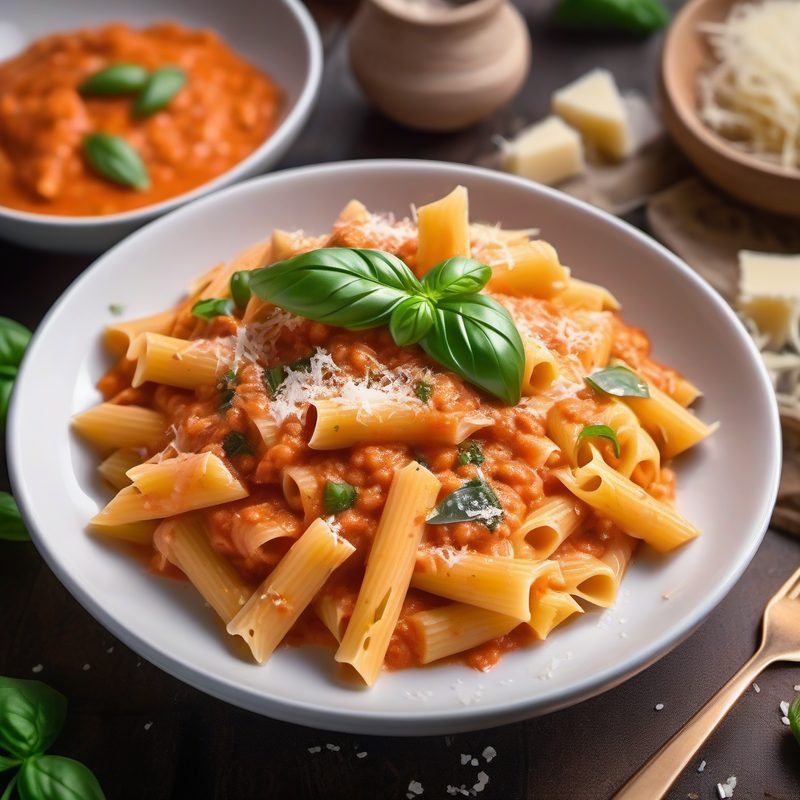
Durum Wheat Pasta Dough
| Amount | Ingredient |
|---|---|
| Calories | ~320 kcal |
| Protein | 11 g |
| Carbohydrates | 60 g |
| Fat | 4 g |
| Fiber | 2 g |
| Sodium | 390 mg |
Durum Wheat Fresh Pasta Dough
> Category: Preparazioni di base (Basic Preparations)
> Servings: 4–6
> Total Time: 50 minutes (15 minutes active, 30 minutes resting)
> Yield: ~600 g dough (enough for 4–6 servings of pasta)
Why This Recipe Works
True pasta di grano duro — pasta made exclusively from durum wheat semolina and water — is the foundation of Southern Italian fresh pasta. Unlike egg-based pasta all'uovo from Emilia-Romagna, this dough relies entirely on the high protein content and coarse granularity of semola di grano duro rimacinata (finely milled durum wheat semolina) for its structure. The result is a firmer, more resilient dough that holds up beautifully to bold sauces and retains a pleasurable al dente bite even when fresh. By using warm water to hydrate the semolina and a brief rest to relax the gluten network, we achieve a supple, silky dough that rolls out effortlessly without cracking or shrinking back.
Keys to Success
- Use semola rimacinata — not regular semolina — for the finest, most pliable dough. The extra-fine milling (rimacinata means "re-milled") produces a flour-like texture that absorbs water evenly and yields a smooth, non-grainy pasta.
- Warm water is essential. Semolina absorbs liquid more slowly than all-purpose flour. Warm water (about 110°F / 43°C) accelerates hydration and relaxes the gluten, making the dough easier to knead and roll.
- Rest the dough for at least 30 minutes. This rest allows the semolina to fully hydrate and the gluten to relax. Without it, the dough will be stiff, brittle, and prone to cracking during rolling.
- Knead thoroughly — 10 full minutes by hand. Semolina dough needs extended work to develop the gluten network that gives fresh pasta its characteristic chew. The dough should go from shaggy and crumbly to smooth and elastic.
- Keep the dough covered. Semolina dough dries out faster than egg dough. Always wrap tightly in plastic or invert a bowl over it during resting.
- Durum wheat semolina rimacinata (400 g): Look for Italian brands such as Caputo, Molino Grassi, or De Cecco labeled semola di grano duro rimacinata. Do not substitute with regular semolina (medium-coarse grind used for couscous) or bread flour — the texture and water absorption will be wrong. Rimacinata is fine enough to feel like fine cornmeal between your fingers.
- Warm water (200 ml / ~200 g): Tap water heated to approximately 110°F / 43°C — warm to the touch but not hot. The ratio of water to semolina (50% hydration by weight) is lower than for egg pasta, producing a stiff, firm dough that is characteristic of Southern Italian pasta.
- Salt (1 tsp / ~6 g): Fine sea salt. Salt strengthens the gluten network and seasons the pasta from within. Do not omit; do not use kosher salt without weighing, as crystal size varies.
- Extra-virgin olive oil (1 tbsp / ~15 ml): A modest amount of oil enriches the dough, adds a hint of fruity flavor, and helps keep the pasta supple during rolling. Use a mild, fruity EVOO — not peppery or bitter.
Equipment Notes
- Work surface: A clean, dry wooden or stone countertop works best. Semolina dough has a low-moisture, non-sticky character and does not require a non-porous surface.
- Bench scraper (raschietto): Indispensable for gathering the crumbly dough during the well-mixing phase and for cleaning the work surface.
- Plastic wrap: Use heavy-duty wrap to seal the dough airtight during resting. A damp kitchen towel under the wrap adds insurance against drying.
- Pasta machine or rolling pin: A manual pasta machine (Imperia, Marcato Atlas) with rollers set to the widest setting for initial passes is ideal. Alternatively, a long, heavy French rolling pin works well for hand-rolled shapes like orecchiette or cavatelli.
Before You Begin
- Set a small bowl of warm water, a kitchen towel, and plastic wrap nearby.
- If using a pasta machine, clamp it securely to the counter.
- Clear and lightly flour (with semolina) your work surface.
- Fill a small saucepan with water and warm it to 110°F / 43°C (comfortably warm to the wrist, like bath water).
Instructions
Step 1: Form the Well
Place the semolina in a mound on a clean work surface. Using your fingertips, create a wide, deep well in the center — the walls should be about 2 inches (5 cm) thick and the well should be large enough to hold all the liquid without overflowing.
Step 2: Combine the Liquids
Pour the warm water into the well. Add the salt and olive oil. Stir gently with a fork or your fingertips to dissolve the salt.
Step 3: Incorporate the Flour
Using a fork, begin drawing small amounts of semolina from the inner walls of the well into the liquid. Work slowly and deliberately, whisking the flour into the water until a thick, paste-like slurry forms in the bottom. Continue drawing flour from the walls — the well will gradually collapse. When the mixture becomes too stiff for the fork, switch to a bench scraper to cut and fold the remaining dry flour into the shaggy mass.
Step 4: Form the Dough
Once all the flour has been incorporated and the dough forms a shaggy, crumbly mass (it will look too dry and cracked — this is correct), begin kneading. Use the heel of your hand to push the dough away from you, fold it back over itself, rotate 45 degrees, and repeat.
Step 5: Knead
Knead for 10 full minutes. During the first 2–3 minutes the dough will feel stiff and surface-cracked. By minute 5 it should begin to smooth out and feel pliable. At 8–10 minutes the dough should be completely smooth, silky, and slightly springy when pressed with a finger. If it feels dry or resists kneading, wet your fingertips with warm water and work it in — do not pour water directly onto the dough.
Step 6: Rest
Shape the dough into a smooth ball. Wrap tightly in plastic wrap and let rest at room temperature for 30 minutes. Do not skip or shorten this rest — it is critical for hydrating the semolina and relaxing the gluten.
Step 7: Roll and Shape
After resting, the dough will be supple and easy to work. Unwrap, divide into 4 equal pieces (about 150 g each), and keep the unused portions covered. Roll out by hand with a rolling pin or pass through a pasta machine according to your desired shape:
- For lasagne or pappardelle: Roll to sheet thickness (about 1/16 inch / 1.5 mm), cut into wide ribbons.
- For orecchiette: Roll dough into ropes about ½ inch (12 mm) thick, cut into small disks, and drag each disk across a gnocchi board or the tines of a fork.
- For cavatelli: Roll into thin ropes (¼ inch / 6 mm), cut into ½-inch (12 mm) pieces, and press/drag along a ridged board.
- For spaghetti alla chitarra: Roll a thin sheet (about 1/32 inch / 1 mm) and cut on a chitarra (guitar-string cutter).
Troubleshooting
| Problem | Cause | Solution |
|---|---|---|
| Dough is too dry and crumbly | Semolina not fully hydrated; humidity too low | Wet fingertips with warm water and knead in gently |
| Dough is sticky | Too much water; semolina absorption varies | Knead in a small dusting of semolina (1–2 tsp at a time) |
| Dough cracks during rolling | Insufficient rest; dough dried out | Wrap and rest another 15 minutes; lightly mist with water |
| Rolled sheets shrink back | Gluten not relaxed enough | Let rolled sheets rest 5 minutes on a floured surface before cutting |
| Pasta turns mushy when boiled | Dough too wet; not enough kneading | Use slightly less water next batch; knead full 10 minutes |
| Pasta turns tough and chewy | Over-kneaded or water too cold | Warm water is essential; knead only until smooth |
Science of Semolina Pasta
Durum wheat (Triticum durum) is the hardest wheat species, with protein content typically between 12–15%. It contains more glutenin and less gliadin than common wheat, producing a gluten network that is strong and elastic but not extensible (it resists stretching). This is why semolina dough requires a higher hydration temperature (warm water) and a longer rest: both conditions allow the glutenin polymers to partially relax and the starch granules to absorb water more fully.
The low hydration ratio (50%) is deliberate: less water means the dough stays firm and holds sharp edges during cutting. When boiled, the dense structure resists overcooking and maintains a distinct al dente texture — the hallmark of well-made pasta di semola.
Variations
Pasta Integrale (Whole-Wheat Semolina Pasta)
Replace 50% of the rimacinata with whole-wheat durum semolina (semola integrale di grano duro). Increase water to 220 ml (220 g), as the bran absorbs more moisture. Knead 2 minutes longer.
Pasta allo Zafferano (Saffron Pasta)
Dissolve a generous pinch (about 20 threads) of saffron in the warm water and let steep 5 minutes before adding to the well. Proceed as directed. Beautiful golden color and subtle floral notes.
Pasta al Pomodoro (Tomato Pasta)
Replace 80 ml of the warm water with 80 ml of tomato passata (strained tomato purée). Reduce water to 120 ml total. The acidity may require an extra 1–2 tbsp of semolina during kneading.
Pasta alle Erbe (Herb Pasta)
Finely chop 3 tbsp of mixed fresh herbs (basil, parsley, oregano) and knead into the dough during the final 2 minutes of kneading.
Make Ahead & Storage
- Fresh (uncooked): Lay shaped pasta in a single layer on a semolina-dusted baking sheet. Cover loosely with plastic wrap and refrigerate for up to 24 hours. Do not stack or the pieces will stick.
- Dried (uncooked): Arrange shaped pasta on drying racks or baking sheets in a single layer, not touching. Air-dry at room temperature for 12–24 hours, turning once, until completely hard and brittle. Store in an airtight container at room temperature for up to 1 month.
- Frozen (uncooked): Freeze shaped pasta in a single layer on a baking sheet until solid (about 1 hour), then transfer to a zip-top freezer bag. Squeeze out air and freeze for up to 3 months. Cook directly from frozen — do not thaw.
- Cooked: Toss cooked pasta with a little olive oil and refrigerate in an airtight container for up to 2 days. Reheat in boiling water for 30 seconds or sauté in a pan with sauce.
Serving Suggestions
- Classic: Toss with simple tomato sauce (sugo al pomodoro) and fresh basil, finished with grated Pecorino Romano.
- Pesto: Pair with Genovese pesto (basil, pine nuts, garlic, Parmigiano-Reggiano, olive oil) — the firm semolina stands up to the bold pesto.
- Cacio e Pepe: Toss alla chitarra strands with rendered pasta water, finely grated Pecorino Romano, and generous cracked black pepper.
- With Vegetables: Serve with sautéed broccoli rabe (cime di rapa), garlic, anchovy, and chili flake for an authentic Pugliese preparation.
- Baked: Use for pasta al forno — layer with béchamel, ragù, and mozzarella, then bake until golden and bubbling.
- In Broth: Drop small shapes like orecchiette or cavatelli into a hot chicken or vegetable broth with greens for a rustic soup.
Nutritional Information (per serving, based on 6 servings)
Nutritional values are estimates; actual values may vary based on specific ingredients used.
Recommended Pairings
- Wine: A crisp, mineral-driven Vermentino di Sardegna or a light, chillable Nero d'Avola rosato.
- Music: The rolling, vocal-driven melodies of La tarantella by Ensemble Micrologus — rhythm that matches the hand-rolling of orecchiette.
"La pasta di grano duro è la firma del Sud — onesta, tenace, piena di carattere."
— Nonna Maria, Matera
Recipe from The Italian Kitchen by Vita Milanese — Volume 1 · Pasta Perfetto. Discover all volumes on the ebook page.