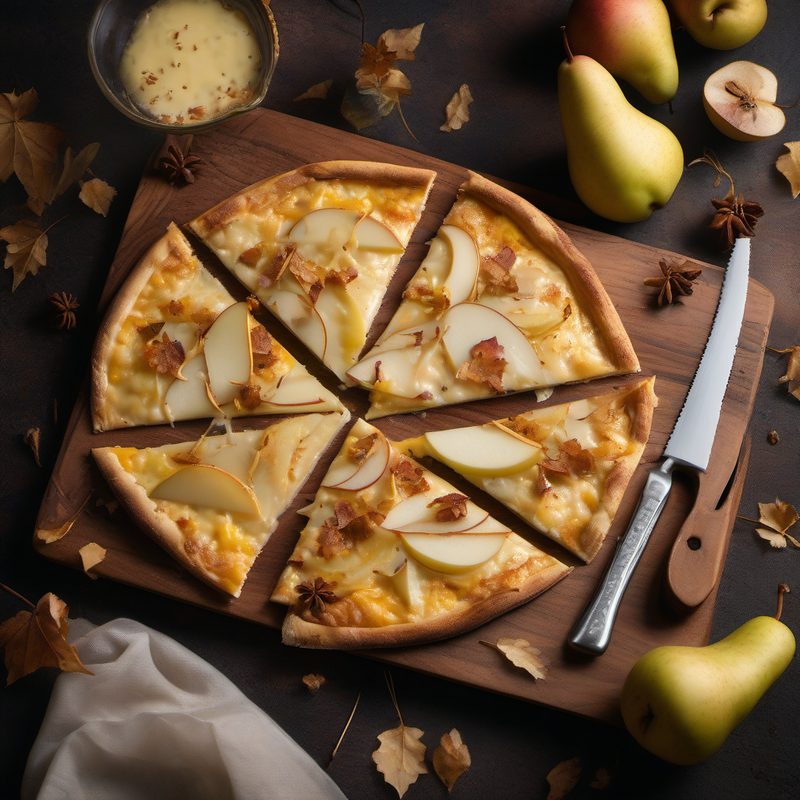
Tarte Flambee Raclette Pears
Category: Pizze, Antipasti
| Amount | Ingredient |
|---|---|
| Calories | ~410 kcal |
| Protein | ~14 g |
| Fat | ~28 g |
| Saturated Fat | ~17 g |
| Carbohydrates | ~28 g |
| Fiber | ~3 g |
| Sugar | ~9 g (mostly from pears and cream) |
| Sodium | ~520 mg (varies with cheese and added salt) |
Servings: 4 (as appetizer) or 2 (as main)
Total Time: 30 minutes (plus dough preparation)
Active Time: 20 minutes
Bake Time: 10–12 minutes
Level of Difficulty: Easy
1. WHY THIS RECIPE WORKS
Tarte flambée — the iconic Alsatian flatbread — gets a Alpine-meets-autumn transformation in this version, where nutty raclette cheese and sweet, tender pears replace the classic crème fraîche-and-lardon topping. The result is a study in contrasts: the crackling-thin crust (see recipe 319 for the dough) provides a shatteringly crisp base, while the raclette melts into creamy, golden-brown pools that cling to each slice of pear and sliver of onion.
Three decisions make this recipe work. First, the cheese. Raclette — a semi-hard Alpine cow's-milk cheese from Switzerland and the French Savoie — is celebrated for its exceptional melting qualities. Unlike Gruyère or Emmental, which can become stringy, raclette softens into a smooth, pourable mass with a distinctively nutty, earthy, and faintly pungent character. Sliced rather than grated, it melts into cohesive sheets that blanket the tart without clumping. Second, the fruit. Ripe but firm pears (Comice, Bosc, or Anjou) contribute a subtle sweetness and a tender bite that counters the raclette's savory richness. They are sliced thin enough to soften during baking but thick enough to retain their shape — about 3 mm (⅛ inch). Third, the cream base. A thin layer of heavy cream seasoned with salt, pepper, and nutmeg serves as the unifying element, carrying the flavors of all the toppings and preventing the dough from drying out before the cheese has fully melted. The cream reduces slightly during baking, concentrating its flavor and helping the cheese adhere to the crust.
Baked at a blistering 250°C (480°F) — the highest temperature most home ovens can sustain — the tarte emerges in under 12 minutes with a blistered, leopard-spotted crust, bubbling cheese, and edges that are audibly crisp.
3. EQUIPMENT
- Large rimmed baking sheet (half-sheet, 46 × 33 cm / 18 × 13 in) or two smaller sheets
- Parchment paper (for lining the baking sheet)
- Rolling pin (tapered French pin ideal for thin dough)
- Chef's knife and cutting board
- Mandoline (optional but recommended for uniformly thin onion and pear slices)
- Small bowl (for mixing the cream base)
- Whisk or fork
- Pastry brush (or spoon for spreading cream)
- Oven thermometer (to verify 250°C / 480°F — critical at high temperatures)
- Instant-read thermometer (optional, for dough water temperature)
- Wire cooling rack
- Bench scraper (optional, for dividing dough)
- Ruler (optional, for checking rolled thickness)
4. PREPARATION (Mise en Place)
- Prepare the dough: Make 1 batch of tarte flambée dough (recipe 319). After the 30-minute rest, divide into 2 equal portions and let rest 5 minutes more. Alternatively, prepare the dough up to 24 hours ahead (see Make-Ahead, section 15).
- Position the oven rack in the lowest position (closest to the heat source) for maximum bottom-heat browning. Place a baking stone or inverted heavy-gauge baking sheet on the rack if you have one — this helps the crust crisp from below.
- Preheat the oven to 250°C (480°F) — or as close as your oven gets. Allow at least 30 minutes of preheat time for the baking surface to come to temperature. Use an oven thermometer to verify.
- Make the cream base: In a small bowl, combine 200 ml heavy cream, ¼ teaspoon salt, ¼ teaspoon black pepper, and ⅛ teaspoon freshly grated nutmeg. Whisk gently to combine. Set aside at room temperature.
- Slice the onion: Halve the peeled onion lengthwise (through the root end). Shave crosswise into paper-thin half-rings — about 1–2 mm (¹⁄₁₆ inch) thick. A mandoline makes this effortless; if slicing by hand, use a very sharp chef's knife. Set aside.
- Slice the pears: Halve each pear lengthwise, core with a melon baller or small spoon, and slice crosswise into 3 mm (⅛ inch) half-moons. Leave the skin on — it adds color and a touch of texture. If you want to prevent browning, toss with a squeeze of lemon juice (¼ lemon per 2 pears), though this is optional.
- Prepare the raclette: If the raclette cheese has a rind (common for wedges), trim it off with a knife. Slice the cheese into thin slabs, about 2–3 mm (¹⁄₁₂–⅛ inch) thick and roughly 5 cm (2 inches) long. Alternatively, cut into 1 cm (⅜ inch) strips. Keep at room temperature.
- Cut parchment to fit your baking sheet(s). Have it ready on the counter.
5. ROLL THE DOUGH
- Lightly flour your work surface — about 1–2 teaspoons of flour is enough. Too much will dry the dough.
- Working with one piece of dough at a time (keep the other covered with a damp towel):
- Flatten the ball into a disk with your palm.
- Starting at the center, roll outward in one direction. Rotate the dough 90 degrees and roll again from the center outward. Repeat, rotating frequently, until the dough is paper-thin — about 2–3 mm (¹⁄₁₂ inch) thick. You should be able to see the outline of your hand through the dough when held up to light.
- Transfer the rolled dough to a parchment-lined baking sheet. It should roughly cover the sheet — about 30 × 35 cm (12 × 14 inches). The shape can be rustic; perfect symmetry is not required.
- Dock the dough all over with a fork (about 20–30 piercings) to prevent large air bubbles from forming during baking.
- Repeat with the second piece of dough on a second parchment-lined sheet, or roll sequentially if using one sheet (keep the first one covered with a clean kitchen towel).
Tip: If the dough resists and springs back while rolling, cover it with a damp towel and let it rest for 5 more minutes. This relaxes the gluten.
6. ASSEMBLE THE TARTES
Work quickly once the tartes are assembled — the cream will begin to soak into the dough if left sitting too long.
- Spread the cream base: Using the back of a spoon or a pastry brush, spread half of the seasoned cream (about 100 ml / ⅓ cup + 1 tbsp) evenly over the first rolled dough, leaving a 1 cm (½ inch) border around the edges uncovered. The cream layer should be thin and even, not pooled.
- Scatter the onion: Distribute half of the sliced onion (about 75 g) evenly over the cream. Do not pile; the onions should form a single, loose layer.
- Arrange the pears: Lay half of the pear slices (from 1 pear) evenly over the onions in a single overlapping layer, fanning them out slightly.
- Top with raclette: Arrange half of the raclette slices (about 100 g) over the pears. Distribute evenly so every bite gets cheese — the cheese will spread as it melts.
- Season with a tiny pinch of flaky salt and a crack of black pepper over the top (optional, since raclette is already salty).
- Repeat the same assembly process with the second tarte.
7. BAKE
- Place the assembled tartes (on their parchment-lined sheets) directly onto the preheated baking stone or inverted baking sheet, or onto the lowest oven rack.
- Bake at 250°C (480°F) for 10–12 minutes, rotating the pan(s) front-to-back halfway through (at about 5–6 minutes) for even browning.
- The tarte is done when:
- The crust is deep golden brown with darker, leopard-spotted patches at the edges
- The raclette cheese is fully melted, bubbling, and browning in spots
- The edges of the pears are slightly caramelized
- The bottom of the crust is crisp and lifts easily from the parchment
- If the cheese is not browning but the crust is done: Switch the oven to broil (or raise to 260°C / 500°F if possible) for the final 1–2 minutes. Watch closely — raclette can burn quickly under direct heat.
8. REST AND SLICE
- Slide the baked tartes (still on parchment) onto wire racks. Let rest for 2–3 minutes before slicing. This brief rest allows the cheese to set slightly, preventing it from sliding off the crust when cut.
- Using a large chef's knife or a pizza cutter, slice each tarte into 6–8 pieces (about 4 pieces per serving for appetizer portions).
9. TO SERVE
- Transfer slices to a warm serving platter or individual plates.
- Optional garnishes:
- A drizzle of honey or aged balsamic vinegar — the sweetness and acidity play beautifully off the raclette
- A scattering of fresh thyme leaves or minced chives for freshness
- A final crack of coarse black pepper
- Serve immediately. Tarte flambée is at its peak within 5 minutes of coming out of the oven — the crust is still audibly crisp, the cheese is molten, and the pears are tender. After 15 minutes, the crust begins to soften from the steam of the toppings.
- Per serving (appetizer, 4 servings): ¼ of a tarte (about 2–3 slices depending on cut) per person.
10. VARIATIONS
- Tarte flambée classique (Alsatian): Replace the raclette and pears with 150 g (generous ½ cup) crème fraîche, 1 large onion (thinly sliced), and 100 g (3½ oz) lardons or thick-cut bacon strips. Omit the nutmeg. The canonical preparation — smoky, creamy, oniony.
- Tarte flambée aux champignons: Replace pears with 150 g (5 oz) mixed wild mushrooms (cremini, shiitake, oyster), thinly sliced and sautéed in butter until golden. Add 1 clove minced garlic to the cream base. Use raclette or substitute with Gruyère.
- Pear & Gorgonzola: Replace raclette with 150 g (5 oz) Gorgonzola dolce, crumbled. The sharp, salty blue cheese creates a more assertive contrast with the sweet pears. Add 30 g (¼ cup) toasted walnuts scattered over the top after baking.
- Tarte flambée with Speck & Pear: Add 80 g (3 oz) thinly sliced speck or prosciutto, draped over the tartes after baking (the residual heat warms the cured meat without cooking it). The salty-smoky element harmonizes with both the raclette and the pears.
- Autumn harvest: Add 50 g (⅓ cup) thinly sliced fennel (raw, shaved on a mandoline) along with the onion. Sprinkle 1 tablespoon fresh sage leaves over the top before baking. Finish with a drizzle of chestnut honey.
- Vegetarian (already vegetarian): This recipe is naturally vegetarian. For a vegan version, substitute the raclette with a high-quality plant-based melting cheese (cashew- or coconut-based) and replace heavy cream with 200 ml full-fat coconut cream + 1 tablespoon nutritional yeast.
11. KEY TECHNIQUES
- Paper-thin rolling: The hallmark of proper tarte flambée. Roll to 2–3 mm (¹⁄₁₂ inch) — thin enough that you can read through it. A thick crust will be doughy rather than crisp.
- Docking (piercing) the dough: Fork-prick the rolled dough thoroughly before adding toppings. This prevents steam bubbles from forming between the dough and the toppings, which would cause the crust to dome and cook unevenly.
- Even cheese distribution: Raclette melts into pools rather than forming a uniform blanket like grated cheese. Place slices evenly so every portion gets cheese — concentrate slightly more toward the center (the edges crisp faster and need less coverage).
- High-heat baking: 250°C (480°F) is the target. If your oven maxes out at 230°C (450°F), increase bake time by 2–3 minutes and expect slightly less leopard spotting. A preheated baking stone or inverted sheet pan beneath the tartes compensates for moderate oven temperatures.
- Rotation at halftime: Rotate the pan(s) at 5–6 minutes. Most ovens have hot spots; rotation ensures even browning and prevents one side from charring while the other side remains pale.
12. COMMON MISTAKES & HOW TO AVOID THEM
| Mistake | Why It Happens | Fix |
|---|---|---|
| Crust is doughy, not crisp | Dough rolled too thick; oven not hot enough | Roll to 2–3 mm maximum; verify oven reaches 250°C / 480°F with an oven thermometer |
| Crust is soggy in the center | Too much cream; toppings too wet; insufficient bottom heat | Use exactly 100 ml cream per tarte; blot onion slices with paper towel if very fresh; preheat baking stone or inverted sheet pan |
| Cheese burns before pears are tender | Raclette slices too thin; oven too hot on top | Keep slices 2–3 mm thick; position rack lower; tent loosely with foil if edges darken too fast |
| Pears release too much liquid | Pears are overripe (mushy); sliced too thick | Use ripe but firm pears — they should yield gently to pressure but not be soft; slice 3 mm maximum |
| Cheese does not melt fully | Raclette slices too thick; oven temperature too low | Slices should be 2–3 mm; verify 250°C; give full 12 minutes before checking |
| Dough tears during rolling | Dough too dry or insufficient rest | Pinch tear closed, cover with damp towel, rest 5 minutes; add 1 tsp water to dough if it feels dry |
| Bottom of crust is pale | Baking sheet not preheated; rack position too high | Preheat baking sheet or stone for 30 minutes; use lowest oven rack |
| Cream curdles or separates | Cream added too long before baking; oven at uneven temperature | Assemble immediately before baking; do not let assembled tarte sit longer than 5 minutes |
13. PLATING & GARNISH
- The platter: Serve on a wooden board or a large white ceramic platter. The contrast between the dark-blotched golden crust, the creamy raclette, and the pale pear slices is visually striking.
- Cutting: A sharp chef's knife gives cleaner edges than a pizza wheel (the cheese can gum up a wheel). Wipe the blade between cuts.
- Garnish ideas:
- Fresh thyme or chives: Sprinkle over the hot tartes immediately after baking — the residual heat releases the herbs' aroma without cooking them.
- Honey drizzle: A thin, artful drizzle of chestnut honey or acacia honey across the top. The floral sweetness echoes the pears and tempers the raclette's pungency.
- Aged balsamic: A few drops of 5–10-year balsamic vinegar per tarte. The acidity cuts through the richness and adds a dark, jewel-like contrast.
- Flaky sea salt: A light finishing salt (Maldon, fleur de sel) enhances the cheese's savory notes.
- Microgreens or arugula: A small handful of peppery arugula or tender microgreens on top adds a fresh, crisp element and a color contrast.
- Portioning:
- As an appetizer (4 servings): Each person gets roughly ¼ of one tarte (2–3 slices of a 12-slice cut).
- As a main course (2 servings): Each person gets one whole tarte (6–8 slices).
- As party finger food: Cut into 16 small squares (4 × 4 grid) and serve on a platter.
14. WINE & BEVERAGE PAIRING
- Alsatian Riesling (dry): The classic match for tarte flambée. A dry, mineral-driven Riesling from Alsace (e.g., Trimbach, Hugel) has the acidity to cut through the raclette's richness and a subtle fruitiness that echoes the pears.
- Gewürztraminer (off-dry): The slightly floral, lychee-toned character of Gewürztraminer pairs surprisingly well with the raclette-pear combination. The wine's hint of sweetness mirrors the pears without clashing with the cheese. Look for an Alsatian example with medium body and low alcohol.
- Pinot Blanc: A lighter, more versatile option. A crisp Pinot Blanc (or Clevner) from Alsace or Alto Adige offers clean orchard-fruit notes and bright acidity that refresh the palate between bites.
- Jura Chardonnay (Savagnin): For adventurous palates — a white wine from the Jura region (under flor, like a vin jaune profile) has oxidative, nutty notes that mirror the raclette's Alpine character. An unusual but rewarding pairing.
- Beer: A Belgian saison or a German hefeweizen. The saison's peppery, slightly funky character complements the nutty raclette, while the hefeweizen's banana-and-clove notes weave around the pears. Alternatively, a crisp pilsner provides a clean, palate-cleansing counterpoint.
- Non-alcoholic: Sparkling water with a squeeze of lemon or elderflower cordial — the acidity and bubbles mimic the cleansing effect of a dry white wine.
15. MAKE-AHEAD & STORAGE
- Dough (make-ahead): Prepare the tarte flambée dough (recipe 319) through the resting step, wrap tightly in plastic, and refrigerate for up to 24 hours. Bring to room temperature for 30 minutes before rolling. The dough can also be frozen (as rolled sheets on parchment, stacked with parchment between layers, sealed in a freezer bag) for up to 3 months — bake directly from frozen, adding 2–3 minutes to the bake time.
- Cream base: The seasoned cream mixture can be prepared up to 8 hours ahead and refrigerated. Stir or whisk briefly before using, as the nutmeg will settle.
- Onion and pear prep: Slice the onion up to 4 hours ahead and refrigerate in an airtight container. Slice the pears no more than 1 hour ahead to prevent browning; toss with lemon juice if slicing further ahead.
- Raclette: Slice the cheese up to 2 hours ahead and keep at room temperature, covered with plastic wrap. Cold cheese takes longer to melt, so room temperature is ideal.
- Assembled but unbaked tartes: Do not assemble in advance. The cream will soak into the dough, resulting in a soggy crust. Assemble immediately before baking.
- Leftover baked tarte: Tarte flambée is best eaten within minutes of baking, but leftovers can be stored. Refrigerate in an airtight container (with parchment between layers if stacked) for up to 2 days.
- Reheating: The only acceptable method is the oven. Place slices on a baking sheet at 200°C (400°F) for 4–5 minutes, until the cheese re-melts and the crust re-crisps. Do not microwave — it turns the crust rubbery and the cheese tough. For a single slice, a toaster oven works well.
- Freezing baked tarte: Freeze individually wrapped slices on a baking sheet until firm, then transfer to a freezer bag. Reheat directly from frozen at 200°C (400°F) for 8–10 minutes. Expect a slightly less crisp crust.
16. ADAPTATIONS
- Gluten-free: Substitute the tarte flambée dough with a gluten-free flatbread or pizza dough (recipe adapt accordingly). Since gluten-free dough is less extensible, use a 1:1 gluten-free flour blend with xanthan gum. Roll between two sheets of parchment paper to compensate for the dough's fragility. Reduce bake temperature to 230°C (450°F) and extend time by 3–5 minutes.
- Lactose-free: Replace heavy cream with 200 ml lactose-free cream or full-fat oat cream (unflavored). Raclette is naturally very low in lactose (aged cheese), but if needed, substitute with a lactose-free Alpine-style cheese or aged Gruyère (which also contains negligible lactose).
- Low-carb / Keto-friendly: Replace the dough with a thin, par-baked almond flour crust (3:1 almond flour to mozzarella ratio). Spread the cream mixture, then proceed with toppings. Bake at 200°C (400°F) for 12–15 minutes. The nutty almond crust complements the Alpine flavors surprisingly well.
- Dairy-free / Vegan: Replace heavy cream with 200 ml unsweetened cashew cream (raw cashews blended with water until smooth, about 3:1 water-to-cashew ratio). Substitute raclette with a nut-based melting cheese (cashew- or macadamia-based, often labeled as "vegan raclette"). The pears, onions, and nutmeg remain unchanged.
- Quick weeknight version: Use store-bought pizza dough (fresh or refrigerated, not pre-baked) rolled thin. Skip the homemade dough. Assembly and baking times remain the same; expect a slightly puffier, less crisp crust.
- Large batch (8 servings): Double all ingredients. Use two baking sheets and bake simultaneously if your oven allows, or bake sequentially (keep the second assembled tarte at room temperature for no more than 15 minutes before baking). If baking two sheets at once, swap their rack positions at the halfway rotation point.
- Individual tartes (galette-style): Divide the dough into 4 pieces instead of 2. Roll each into a 15 cm (6 inch) round, about 3 mm thick. Spread cream, leaving a 2 cm border. Fold the edges over the filling, pleating as you go (like a galette). Bake at the same temperature for 8–10 minutes. These are excellent for parties and require no slicing.
17. COMPOSITION NOTES (for the cook)
Why this combination works:
Tarte flambée with raclette and pears sits at the intersection of three culinary traditions: the Alsatian flatbread tradition (whisper-thin dough, high-heat baking), the Alpine cheese culture (raclette's melting qualities and nutty, earthy profile), and the Northern European affinity for fruit-and-cheese pairings (pear with Alpine cheese is a classic across Switzerland, France, and Italy).
Key ratios to remember:
- Dough : Toppings ≈ 250 g dough : 200 ml cream + 200 g cheese + 300 g pears + 150 g onion — the toppings are generous but not overwhelming; the crust remains the dominant textural element.
- Cream : Cheese ≈ 1:1 by volume — each tarte gets about 100 ml cream for every 100 g of raclette. The cream provides moisture and carries the seasoning; the cheese provides the rich, savory core.
- Pear : Cheese ≈ 1.5:1 by weight — the fruit is present enough to taste in every bite but does not overshadow the cheese. This ratio ensures balance.
The role of each ingredient:
- Tarte flambée dough (recipe 319): An unleavened dough of flour, water, oil, and salt. Unlike pizza dough (which is yeasted and rolled thicker), this dough has no fermentation, resulting in a neutral, cracker-like flavor and a shatteringly crisp texture. Its thinness (2–3 mm) means it bakes through in minutes, matching the quick melting time of the cheese.
- Heavy cream: Serves as both a flavor carrier and a moisture barrier. The fat in the cream (at least 35%) coats the dough, preventing the pear and onion juices from soaking into the crust prematurely. As it bakes, the cream reduces slightly, concentrating its dairy sweetness and helping the toppings adhere.
- Raclette cheese: The defining ingredient. A washed-rind Alpine cheese from the Valais region of Switzerland (and also produced in Savoie, France), raclette is semi-firm, pale yellow, and studded with small holes. Its name comes from the French racler ("to scrape") — referring to the traditional method of melting a half-wheel by the fire and scraping the molten layer onto potatoes. When baked, raclette becomes fluid, creamy, and nutty, with a characteristic pungency that is assertive but not overpowering. Its high fat content (about 30%) ensures smooth melting without the greasy separation that can occur with lower-fat cheeses.
- Pears (Comice, Bosc, or Anjou): These varieties hold their shape during baking better than softer types like Bartlett. Comice pears are exceptionally sweet and buttery; Bosc pears have a firmer texture and honeyed flavor that resists softening; Anjou pears are mild and juicy. The slight graininess of pear flesh provides a textural counterpoint to the creamy cheese and crisp crust. The skin (left on) adds visual appeal and a faint chewiness.
- Onion: Yellow onions, sliced paper-thin, add a subtle pungency that mellows during baking into sweetness. They also provide a structural layer between the cream and the pears, preventing the fruit from sinking into the cream and creating a soggy interface.
- Nutmeg: The aromatic bridge between the dairy (cream and raclette) and the fruit (pears). A small amount of freshly grated nutmeg (never pre-ground) adds a warm, almost floral top note that makes the combination of cream, cheese, and pears taste cohesive rather than merely assembled. Without nutmeg, the flavors sit separately; with it, they unify into a single harmonious taste.
Texture:
The ideal bite of this tarte flambée delivers a sequence of sensations: first, the shattering crack of the thin, blistered crust; then the creamy, almost fluid raclette that coats the tongue; followed by the tender give of the pear slice; and finally the subtle crunch of the onion, which retains a faint resistance even after baking. The cream base should be absorbed into the toppings and dough, leaving no puddle on the plate. The cheese should be molten, not stringy, and the crust should remain crisp for at least 10 minutes after baking.
18. REGIONAL & CULINARY CONTEXT
Tarte flambée — Alsace, France
Tarte flambée (in Alsatian German, Flammekueche or Flammenkuchen; in German, Flammkuchen) is one of the great flatbreads of European cuisine, originating in the Alsace region of northeastern France. Historically, it was a baker's tool: the extremely hot wood-fired ovens used for bread-baking needed a test piece to gauge the temperature. Bakers would spread leftover bread dough with crème fraîche, onions, and lardons and slide it into the oven; if the flatbread blistered and browned in two minutes, the oven was ready for bread. This practical test evolved into a beloved regional specialty, now served in winstubs (Alsatian wine taverns) across Strasbourg, Colmar, and the surrounding wine villages.
Traditional tarte flambée is built on a trinity of ingredients: crème fraîche or fromage blanc (for creaminess), thinly sliced onions (for sweetness and bite), and lardons or diced bacon (for smoke and salt). The dough — unleavened and rolled to 2–3 mm — is the critical fourth element. Baked at 260°C (500°F) or higher, the tarte emerges with a crackling crust, bubbling cream, and caramelized onions in about 10 minutes.
Raclette — Valais, Switzerland / Savoie, France
Raclette cheese has its own rich tradition. Originally from the Swiss canton of Valais, raclette was historically served by shepherds who melted the cheese over an open fire and scraped it onto bread or potatoes. The cheese is made from raw cow's milk, aged for 3–6 months, and washed with brine during aging to develop its characteristic orange rind and pungent, earthy aroma. The traditional raclette meal involves a half-wheel of cheese heated in front of a fire or with a dedicated raclette grill, with the molten layer scraped directly onto boiled potatoes, cornichons, and pickled onions.
The combination of Alsatian flatbread with Alpine raclette and sweet pears is a modern, cross-regional innovation — it brings together two distinct European food cultures (the French-German borderlands of Alsace and the Alpine cheese-making regions of Switzerland and Savoie) in a single dish. The pear, while not traditional in either cuisine, bridges the gap with its natural affinity for Alpine cheeses — a pairing that is exploited in Swiss fondue (where pear is often served alongside) and in Northern Italian cooking (where pear is paired with Gorgonzola and Taleggio).
How this recipe fits into the cookbook:
Positioned in the "Pizze, Antipasti" category, this tarte flambée serves as a more refined, wintry alternative to pizza — similar in format (flatbread + toppings) but distinct in texture (paper-thin crust versus chewy, yeasted pizza dough) and flavor profile (cream-based and Alpine rather than tomato-based and Mediterranean). It is an excellent choice for a dinner party starter, a wine-pairing evening, or an autumn or winter gathering where the combination of melted cheese and seasonal pears feels especially right.
19. NUTRITIONAL INFORMATION (per serving — ¼ of a tarte, appetizer portion)
Values are approximate. Actual values depend on dough hydration, pear ripening, raclette brand, and portion size.
20. RECIPE SUMMARY
- Total ingredients (excluding dough): 6 — heavy cream, onion, pears, raclette cheese, salt, pepper, nutmeg
- Dough component: 1 batch tarte flambée dough (see recipe 319)
- Active time: 20 minutes (including dough rolling and assembly)
- Bake time: 10–12 minutes
- Total project time: ~30 minutes (plus 30 minutes dough resting, plus 30 minutes oven preheat)
- Yield: 2 large tartes, serving 4 as appetizer or 2 as main
- Difficulty: Easy — this is an assembly dish; the only demanding step is rolling the dough paper-thin, which becomes easier with practice
This tarte flambée with raclette and pears is a celebration of counterpoint — the crackling crust against the molten cheese, the sweet pears against the savory raclette, the aromatic nutmeg threading through it all. It takes the classic Alsatian formula and gives it an Alpine-autumn reimagining that is both unexpected and deeply satisfying. Serve with a crisp Riesling, good company, and the understanding that the first bite will scatter crust crumbs everywhere — that is the mark of a properly made tarte flambée.
Bon appétit — Guten Appetit — Buon appetito!
Recipe converted to ATK-style format (20-section adapted for savory tart/flatbread). Original: "Tarte flambée con formaggio da raclette e pere" (Tarte Flambée with Raclette Cheese and Pears), position 345. Category: Pizze, Antipasti. Dough base: Recipe 319 — Pasta per tarte flambée.
Recipe from The Italian Kitchen by Vita Milanese — Volume 1 · Pasta Perfetto. Discover all volumes on the ebook page.