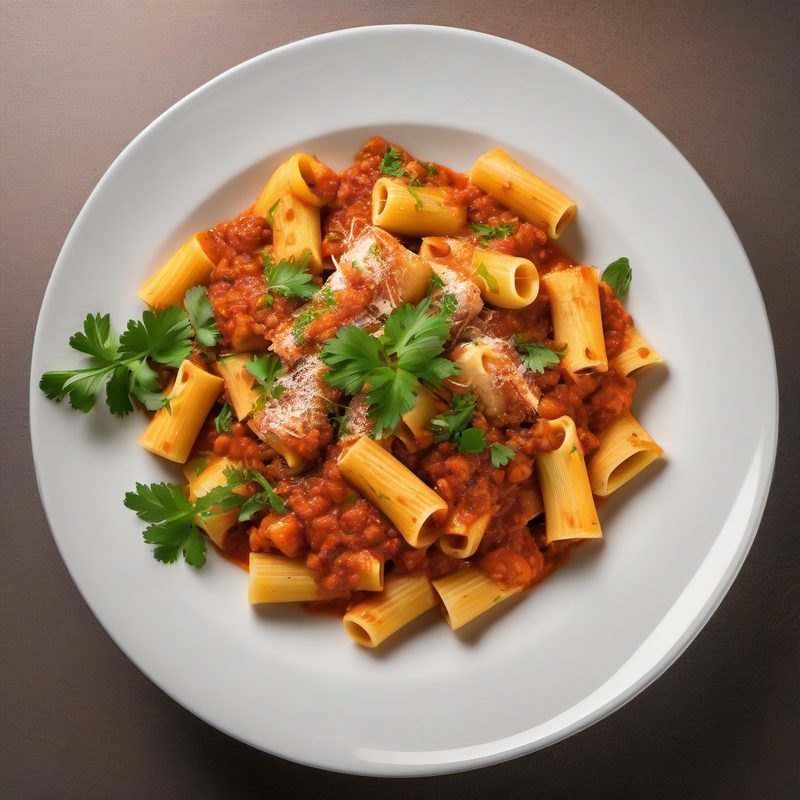
Rigatoni Monkfish Ragu
| Amount | Ingredient |
|---|---|
| Calories | ~585 kcal |
| Fat | 17 g |
| Saturated Fat | 2.5 g |
| Carbohydrates | 72 g |
| Fiber | 5 g |
| Protein | 32 g |
| Sodium | 780 mg |
| Sugars | 7 g |
Rigatoni with Monkfish Ragù — A Pugliese-style Seafood Pasta
Category & Info
- Category: Primi piatti (First Courses)
- Sub-Category: Cucina di mare (Sea Kitchen)
- Traditional Region: Puglia, Campania, and coastal Southern Italy
- Era/Etymology: Rana pescatrice means "fisherman's frog" — so named for the monkfish's wide, frog-like mouth and its habit of lurking on the seafloor. This hearty seafood ragù belongs to the pesce povero (poor fish) tradition: thrifty coastal cooks transformed humble, undervalued catch into substantial pasta sauces. Monkfish, once discarded as unsightly bycatch, is now prized for its sweet, lobster-like flesh and meaty texture that stands up beautifully to long simmering.
- Yield: Serves 4 as a primo piatto
- Active Time: 25 minutes
- Total Time: 40 minutes
- Difficulty: Easy
Why This Recipe Works
Monkfish is the ideal fish for a ragù: its firm, dense flesh holds together during cooking rather than flaking into mush, absorbing flavors while maintaining a satisfying, almost meaty bite. The challenge is balancing the delicate sweetness of the monkfish against the acidity of the tomatoes without either overwhelming the other. We build the sauce in stages — first a gentle soffritto of onion, garlic, and chili in olive oil to establish an aromatic base; then the monkfish is briefly seared to develop color and depth before being joined by white wine, which deglazes the pan and adds a fruity backbone. Crushed tomatoes are added last, cooking just long enough (15 minutes) to meld the flavors while keeping the fish tender, not tough. The key insight: monkfish, unlike lean white fish, contains natural gelatin and a subtle sweetness that mirrors the richness of crustaceans — treating it like a shellfish ragù rather than a delicate fish fillet yields a sauce with remarkable body and depth. A final toss with rigatoni (whose ridges and tubes trap every bit of sauce) and fresh parsley brings the dish to life.
Test Kitchen Discoveries
- Monkfish must be trimmed well: The fillet comes with a tough, translucent membrane and often a central cartilage strip. Removing both is essential — left on, the membrane shrinks during cooking and causes the fish to curl and toughen.
- Dice, don't shred: Cut the monkfish into 1½ cm (½-inch) cubes. Larger than that and the pieces feel chunky; smaller and they disintegrate in the sauce. The ½-inch dice provides a satisfying "ragù" texture — tender chunks that hold their identity.
- Brown the fish before building the sauce: A quick, hot sear (3 minutes) creates a golden crust on the monkfish cubes. This Maillard browning contributes savory depth that would be missing if the fish were merely poached in the tomato sauce.
- Use rigatoni, not long pasta: The generous ridges (rigature) of rigatoni are designed to catch chunky sauces. Long pasta like spaghetti allows the fish pieces to slide off; rigatoni traps every morsel in its tubes.
- Reserve pasta water even for a "dry" ragù: A starchy splash (about ½ cup / 120 ml) at the end loosens the sauce to the perfect clinging consistency without diluting the flavor.
Equipment
- Large pot (6–8 quart / 6–8 L) for pasta
- 12-inch (30 cm) stainless-steel or enameled cast-iron skillet (or large sauté pan)
- Chef's knife
- Cutting board
- Vegetable peeler (optional, for onion)
- Microplane or fine grater (for garlic, if desired)
- Wooden spoon or silicone spatula
- Tongs
- Ladle (for pasta water)
- Measuring cups and spoons
- Colander
- Kitchen scale (digital, accurate to 1 g)
Ingredients
Before You Begin
- Trim the monkfish: Monkfish fillets arrive with a tough, translucent membrane and often a central cartilage strip running through the center. Using a sharp chef's knife, slide the blade just under the membrane at one end and pull it taut — it should peel away in one or two pieces. If you feel a hard, white cartilage strip running lengthwise, cut the fillet in half and trim it out. Rinse the trimmed fillet under cold water and pat very dry with paper towels. (Moisture is the enemy of browning — dry fish = golden crust.)
- Dice the monkfish: Cut the trimmed fillet into 1½ cm (½-inch) cubes. You should have roughly 2½ cups (about 375 g) of neatly diced fish. Place in a bowl, season with ¼ tsp salt and a few grinds of black pepper, and set aside at room temperature while you prepare the other ingredients.
- Prep the aromatics: Finely chop the onion (about 1 cup). Mince the garlic. Seed and mince the chili. Chop the parsley and set aside.
- Measure the wine and tomatoes: Pour 100 ml white wine into a small cup or bowl. Open the crushed tomatoes and measure 400 g.
- Fill the pasta pot: Fill a large pot with 4–5 quarts (3.8–4.7 L) of water and bring to a rolling boil over high heat. Salt generously — about 1½ Tbsp (27 g) fine sea salt — once boiling.
Cooking Instructions
#### Step 1: Sauté the Soffritto (5 minutes)
- Heat 2 tablespoons (30 ml) of the olive oil in a 12-inch (30 cm) skillet over medium heat until shimmering but not smoking.
- Add the chopped onion and ¼ teaspoon salt. Cook, stirring frequently with a wooden spoon, until the onion is softened and translucent but not browned — about 4–5 minutes.
- Add the minced garlic and minced chili. Cook, stirring constantly, until fragrant — about 30 seconds. Do not let the garlic brown, which would turn bitter.
#### Step 2: Sear the Monkfish (3 minutes)
- Push the soffritto to the edges of the skillet. Increase the heat to medium-high.
- Add the diced monkfish in a single layer (work in two batches if your pan is crowded). Let it cook undisturbed for 1½ minutes to develop a golden crust on one side.
- Stir or flip the pieces and cook for another 1½ minutes. The monkfish should be lightly golden on at least two sides, but not fully cooked through — it will finish cooking in the sauce.
#### Step 3: Deglaze with Wine (1 minute)
- Pour the 100 ml white wine into the skillet. It should sizzle and steam immediately.
- Use a wooden spoon to scrape up any browned bits (fond) from the bottom of the pan — these are concentrated flavor.
- Let the wine bubble vigorously until it has reduced by about half and the alcohol aroma has dissipated — roughly 45–60 seconds. The pan should be nearly dry but still moist.
#### Step 4: Simmer the Ragù (15 minutes)
- Reduce the heat to medium-low. Add the 400 g crushed tomatoes to the skillet, stirring to combine with the soffritto, monkfish, and wine.
- Bring the sauce to a gentle simmer — small bubbles should break the surface, not a rolling boil.
- Cook uncovered, stirring occasionally, for 15 minutes. The sauce should thicken slightly and turn a deeper, rustier red. The monkfish will finish cooking through and become tender but still hold its shape.
- Taste the sauce and adjust seasoning: add ¼ to ½ teaspoon salt (depending on your tomatoes) and a generous grind of black pepper.
#### Step 5: Cook the Rigatoni (10–12 minutes, concurrent with Step 4)
- When the ragù has about 10 minutes left, add the 350 g rigatoni to the boiling salted water.
- Cook according to package directions until al dente (typically 1 minute less than the package recommends for packaged pasta). Stir occasionally to prevent sticking.
- Just before draining, reserve 1 cup (240 ml) of the starchy pasta cooking water in a heatproof measuring cup or a ladle.
- Drain the rigatoni in a colander — do not rinse.
#### Step 6: Combine and Finish (2 minutes)
- Add the drained rigatoni directly to the skillet with the monkfish ragù. Set the heat to medium.
- Add ½ cup (120 ml) of the reserved pasta water. Toss vigorously with tongs for 1–2 minutes, allowing the pasta to absorb the sauce and the starch to emulsify with the olive oil into a creamy, clingy coating.
- If the sauce seems too thick or dry, add another splash of pasta water (1–2 tablespoons at a time) and toss until the rigatoni glistens and the sauce flows freely between the tubes.
- Remove from the heat. Drizzle with the remaining 2 tablespoons (30 ml) extra-virgin olive oil.
- Add the chopped parsley and toss once more to distribute evenly.
- Divide among four warmed shallow bowls. Finish each serving with a final drizzle of olive oil, a crack of black pepper, and a light sprinkle of extra parsley.
Serving Suggestions
- Serve immediately as a primo piatto, followed by a second course of grilled vegetables (peperonata or grilled zucchini) or a simple insalata mista.
- For a piatto unico (complete meal), pair with a side of sautéed cicoria or rapini (broccoli rabe) and crusty bread to mop up any remaining sauce.
- A squeeze of fresh lemon juice over each serving brightens the dish and balances the richness of the olive oil and monkfish.
- Wine pairing: A crisp, mineral-driven white from the same southern coastal regions — Falanghina del Sannio, Vermentino di Sardegna, or Greco di Tufo. The wine used in the sauce (Falanghina or Vermentino) is an excellent choice to serve alongside.
Storage & Reheating
- Refrigerator: The ragù sauce (without pasta) can be made up to 2 days in advance. Cool completely, transfer to an airtight container, and refrigerate. The assembled pasta dish is best eaten immediately but can be refrigerated for up to 1 day.
- Reheating: Place leftover pasta in a skillet over medium-low heat with a splash of water or pasta water. Toss gently until heated through, about 3–4 minutes. Add more liquid as needed — the pasta absorbs moisture as it sits. Do not microwave at high power, which toughens the fish.
- Freezing: The ragù sauce freezes well for up to 1 month. Thaw overnight in the refrigerator and reheat gently before tossing with freshly cooked pasta. Do not freeze the assembled pasta dish — the rigatoni texture degrades unacceptably.
- Monkfish note: Reheated monkfish will be slightly firmer than fresh. This is natural; the gelatin structure of monkfish can withstand gentle reheating better than most white fish.
Quality & Timing Notes
- The monkfish must be bone-dry before searing: Pat the diced fish with paper towels immediately before adding it to the pan. Any residual moisture will steam rather than sear, producing pale, soft fish instead of golden, flavorful chunks.
- Pasta water is the bridge: Do not skip reserving the pasta water. The starch emulsifies the olive oil into the tomato sauce, creating a coating that clings to every ridge of the rigatoni. Without it, the sauce and pasta remain separate.
- 15 minutes of simmering is the sweet spot: Less than 12 minutes, and the flavors haven't married; more than 18, and the monkfish begins to toughen and the sauce becomes too concentrated. Set a timer.
- Rigatoni's ridges are intentional: Bronze-die rigatoni has a rough, porous surface that traps sauce far better than Teflon-die pasta. The wide tubes also catch small pieces of monkfish inside — every bite delivers both pasta and fish.
- Timing is flexible: The ragù can be held off-heat, covered, for up to 10 minutes while you finish the pasta. If it thickens too much, thin with a splash of pasta water when you toss.
Chef's Tips
- Choose the right monkfish: Look for monkfish fillets that are pearly white, firm, and free of any ammonia-like smell (which indicates age). Fresh monkfish has a clean, faintly sweet scent of the sea. Fillets should feel dense and springy, not mushy.
- The membrane is not optional to remove: Many fishmongers sell monkfish already trimmed. If they haven't, ask them to do it — or be prepared for a careful 5-minute trimming job. The membrane is inedibly tough and will ruin the texture of the ragù.
- Don't skip the chili: A single small chili provides a gentle warmth that lifts the sauce without making it spicy. It's a classic aglio, olio e peperoncino touch that's essential to the southern Italian character of this dish. If you can't tolerate any heat, omit it and add ¼ teaspoon of sweet paprika for color and subtle depth.
- Use good-quality crushed tomatoes: The sauce has few ingredients, so each one counts. Look for Italian crushed tomatoes (passata) from the San Marzano region or a reputable brand like Mutti, Cento, or La Valle. Avoid "tomato puree" which can be too thick and often contains added sugar or citric acid.
- Toast the chili with the garlic: A quick 30-second bloom in the hot oil releases the capsaicin and volatile aromatics of the chili, infusing the oil before the tomatoes go in. This is the same technique used for aglio, olio e peperoncino — and it makes a significant difference.
- Under-cook the pasta slightly: Cooking the rigatoni 1 minute shy of the package's al dente time ensures it finishes cooking in the sauce during the tossing step, absorbing flavor and releasing additional starch to thicken the sauce.
- Finish with raw olive oil: The final drizzle of high-quality extra-virgin olive oil after the heat is off adds a peppery, grassy note that contrasts with the cooked oil in the soffritto. This is a classic Italian finishing technique.
Common Mistakes
| Problem | Likely Cause | Solution |
|---|---|---|
| Monkfish is tough and rubbery | Overcooked, or the membrane was not removed | Cook the ragù for exactly 15 minutes; remove membrane before dicing |
| Sauce is watery and thin | Too much pasta water added, or tomatoes were too liquid | Use crushed tomatoes (not whole peeled); add pasta water sparingly — start with ½ cup |
| Sauce is too thick / paste-like | Insufficient pasta water, or sauce simmered too long uncovered | Add reserved pasta water 1 tablespoon at a time while tossing until the sauce flows freely |
| Fish pieces have disintegrated | Over-stirred during simmering, or diced too small | Dice monkfish into 1½ cm cubes; stir gently when adding tomatoes; use the 15-minute timer |
| Monkfish has no color (pale and white) | Pan was not hot enough, or fish was wet when added | Pat fish extremely dry; preheat skillet until oil shimmers; cook undisturbed for 1½ minutes per side |
| Sauce tastes flat or one-dimensional | Insufficient salt, or no chili/pepper | Season the soffritto early; taste and adjust salt at the end; freshly ground black pepper is essential |
| Pasta is gummy or mushy | Overcooked, or not tossed immediately with sauce | Cook to al dente (1 min less than package); drain and add to sauce immediately |
| Sauce won't cling to rigatoni | Not enough starch from pasta water, or tossed too gently | Toss vigorously for 1–2 minutes; add 1–2 Tbsp pasta water at a time until the sauce emulsifies |
| Garlic tastes bitter | Garlic was browned in the oil | Cook garlic for only 30 seconds over medium heat; if it turns brown, start over |
| Rigatoni tubes are empty (no sauce inside) | Sauce too thin, or pasta not tossed long enough | Thicken sauce slightly before combining; toss energetically so the sauce is forced into the tubes |
Nutritional Information (per serving)
Note: Nutritional values are estimates based on standard ingredient data; actual values will vary by specific brands and portion sizes.
Recipe History & Lore
Monkfish (Lophius piscatorius) has undergone a remarkable transformation in Italian cuisine. Known as rana pescatrice (fisherman's frog) for its wide, gaping mouth lined with needle-sharp teeth, this bottom-dwelling fish was historically considered pesce povero ("poor fish") — unsightly bycatch that fishermen kept only because they couldn't sell it. The head, disproportionately large and menacing, was often discarded at sea; only the tail fillet made it to shore.
But Italian cooks, particularly along the coasts of Puglia, Campania, and Sicily, recognized what modern chefs celebrate: monkfish tail has a dense, sweet flesh that resembles lobster or langoustine at a fraction of the cost. Its natural gelatin content gives sauces body without the need for long simmering, and its firm texture stands up to bold flavors — garlic, chili, tomatoes, white wine — that would cause delicate fish to fall apart.
The sugo di rana pescatrice tradition emerged in the fishing villages of the Gargano peninsula (Puglia) and the Cilento coast (Campania), where day-boat fishermen would bring in mixed catches. A few fillets of monkfish, too few to sell, would become the evening's ragù — simmered with pomodori, aglio, and peperoncino, then tossed with the day's pasta. It was a meal born of resourcefulness, not luxury.
Today, monkfish is celebrated as one of the Mediterranean's finest eating fish — dubbed "poor man's lobster" in English and aragosta del povero in Italian. This recipe honors its humble origins while showcasing its remarkable culinary potential: a ragù that is at once rustic and refined, coastal and comforting.
Variations
- Rigatoni con Rana Pescatrice e Olive (with Olives): Add ¼ cup (40 g) of pitted Gaeta or Taggiasca olives, roughly chopped, during the last 5 minutes of simmering. Their briny, fruity notes echo the monkfish's natural sweetness.
- Rigatoni con Rana Pescatrice e Capperi (with Capers): Add 1 tablespoon of salted capers (rinsed and roughly chopped) or 2 teaspoons of brined capers (drained) along with the tomatoes. The salty, floral tang cuts through the richness.
- Rigatoni con Rana Pescatrice e Zafferano (with Saffron): Dissolve a generous pinch of saffron threads (about 15–20 strands) in 2 tablespoons of warm white wine before deglazing. The saffron adds a golden hue and an earthy, honeyed aroma that pairs beautifully with the monkfish.
- Spicy Calabrese Version: Replace the single chili with 1 teaspoon of Calabrian chili paste (nduja-style or in oil) added to the soffritto. The smoky, fruity heat of Calabrian chilies is a classic match for robust fish ragùs.
- Rigatoni con Rana Pescatrice e Pomodorini (with Cherry Tomatoes): Substitute 400 g of ripe cherry tomatoes (halved) for the crushed tomatoes. Add them after the wine has reduced and cook for 8–10 minutes, crushing gently with a wooden spoon as they soften. The resulting sauce is brighter and more textured.
- With Pasta di Gragnano: Use a bronze-die rigatoni from Gragnano (the pasta-making town near Naples) for the most authentic result. Gragnano pasta has a rough, porous surface that grips sauce exceptionally well.
- Arrabbiata Variation: Double the chili (use 2 chilies or 1 tsp red pepper flakes) for a genuinely spicy all'arrabbiata version. Add 1 tablespoon of tomato paste with the soffritto for extra depth.
- Seafood Mix (Misto di Mare): Replace half the monkfish with a mix of cleaned calamari (sliced into rings) and peeled shrimp. Add the calamari with the monkfish and the shrimp during the last 5 minutes of simmering to prevent overcooking.
Wine Pairing
| Wine | Why |
|---|---|
| Falanghina del Sannio DOC (Campania) | The classic pairing for Pugliese/Campanian seafood pasta. Bright citrus, white flowers, and a distinctive almond finish. The acidity cuts through the olive oil richness while complementing the monkfish's sweetness. |
| Vermentino di Sardegna DOC (Sardinia) | Saline and mineral-driven with notes of green apple, lime zest, and sea salt. The briny character mirrors the sea-kitchen nature of the dish. A perfect match for the chili and garlic. |
| Greco di Tufo DOCG (Campania) | Full-bodied with stone fruit, herbs, and a slight bitterness on the finish. The body stands up to the tomato ragù without overpowering the fish. |
| Verdicchio dei Castelli di Jesi DOC (Marche) | Crisp, with almond and citrus notes and a distinctive savoury finish. The high acidity and moderate body make it a versatile pairing for tomato-based seafood pasta. |
| Etna Bianco DOC (Sicily) | Carricante-based — steely, mineral, and electric with lemon pith and volcanic ash notes. The salinity and acidity are a revelation with the chili and olive oil. |
| Lugana DOC (Lombardy/Veneto) | Rounder and more textural, with notes of ripe pear, white peach, and almond. The slight creaminess on the palate matches the ragù's body without competing. |
| Franciacorta Brut (sparkling, Lombardy) | The bubbles and bracing acidity cut through the olive oil and provide a palate-cleansing effect between each bite. A celebratory pairing that elevates the humble fish ragù. |
Frequently Asked Questions
Can I use frozen monkfish?
Yes, but with care. Thaw the fillets overnight in the refrigerator (never at room temperature), then pat exceptionally dry before dicing. Frozen-and-thawed monkfish releases more moisture during cooking, so expect a slightly looser sauce. To compensate, simmer the ragù uncovered for an extra 3–5 minutes to reduce and concentrate. Do not refreeze once thawed.
What if I can't find monkfish? What's the best substitute?
Monkfish's firm, sweet flesh is unique, but these alternatives work well:
- Hake (nasello / merluzzo): Less firm but still holds its shape. Dice into 2 cm (¾-inch) pieces and add during the last 10 minutes of simmering to prevent overcooking.
- Sea bass (spigola / branzino): Delicate but flakes easily. Sear whole fillets rather than dicing, then break into chunks after cooking.
- Swordfish (pesce spada): Another firm-fleshed fish that holds up well. Dice identically to monkfish; no adjustment needed.
- Lobster or langoustine tail: The closest flavor profile. Dice into 1½ cm cubes and add with the wine instead of the monkfish.
Why do you sear the monkfish separately? Can I just add it raw to the sauce?
Searing develops the Maillard reaction — browning that creates hundreds of flavor compounds. Raw monkfish added directly to the tomato sauce will be pale, soft, and one-dimensional. The 3-minute sear builds a savory crust that enriches the entire dish. For the best result, sear in batches if necessary (don't crowd the pan).
Is this dish supposed to be spicy?
The single chili provides a gentle, background warmth — not aggressive heat. It should be barely perceptible as heat, functioning more as an aromatic that lifts the other flavors. If you want more spice, double the chili or add ½ teaspoon of red pepper flakes. If you want none, omit the chili entirely and add ¼ teaspoon of sweet paprika for color and a subtle earthy note.
Can I use canned chopped tomatoes instead of crushed?
Yes, but crushed tomatoes are preferred because they have a smoother, more sauce-like consistency. If using whole peeled or chopped tomatoes, crush them by hand or pulse them in a food processor until coarsely puréed before adding. This ensures even consistency and prevents large tomato chunks from dominating the sauce.
Should I serve this as a primo or a main course?
Traditionally, this is a primo piatto — a first course served before a second course of fish or vegetables. However, rigatoni with monkfish ragù is substantial enough to serve as a piatto unico (single-plate meal) for lunch or a light dinner, especially paired with a side salad and crusty bread.
My monkfish came with a reddish/brown spot. Is it safe?
Yes — monkfish fillets sometimes have a reddish-brown blood line or spot near the center. This is normal and safe. Simply trim it away with the tip of your knife before dicing. It has a slightly stronger flavor and darker color that you may prefer to remove for appearance.
Can I make this dairy-free? Does it contain any dairy?
This recipe is entirely dairy-free as written. There is no butter, cream, or cheese in the traditional preparation. The richness comes from olive oil and the natural gelatin in the monkfish. For a strict dairy-free meal, ensure the pasta is egg-free (most dried pasta is, but check the label).
The sauce tastes too acidic. How do I fix it?
Add ¼ teaspoon of sugar or a pinch of baking soda to the simmering sauce. The sugar rounds out harsh acidity without adding sweetness; the baking soda chemically neutralizes it. Start with a tiny amount, stir, taste, and repeat. Better yet, use high-quality San Marzano tomatoes which are naturally lower in acidity.
Related Recipes
- Linguine con Vongole e Bottarga — page 391 (Linguine with Clams and Bottarga)
- Spaghetti con le Cozze e Pomodorini — page 389 (Spaghetti with Mussels and Cherry Tomatoes)
- Spaghetti allo Scoglio — page 473 (Spaghetti with Mixed Seafood)
- Linguine al Sugo di Mare — page 414 (Seafood Linguine Genovese)
- Spaghetti con le Sarde — page 399 (Spaghetti with Sardines and Wild Fennel)
- Pasta con le Sarde alla Trapanese — page 414 (Trapani-style Pasta with Sardines)
- Penne alla Carrozza Siciliana — page 416 (Sicilian Breaded Penne with Seafood)
Search Tags
| Photo | Notes |
|---|---|
| — | No photo available for this recipe. For best presentation: serve in a warmed shallow bowl, twirling the rigatoni into a loose nest in the center. The sauce should pool slightly around the edges — a deep, rusty red punctuated by pale golden chunks of monkfish and bright green flecks of parsley. Drizzle a thin ribbon of raw extra-virgin olive oil over the top and finish with a final crack of black pepper and a few whole parsley leaves for contrast. The sauce should glisten, not pool — proof of a perfect pasta-tossed emulsion. |
Recipe from "The Italian Kitchen" by Vita Milanese — Volume 1: Pasta Perfetto
Recipe from The Italian Kitchen by Vita Milanese — Volume 1 · Pasta Perfetto. Discover all volumes on the ebook page.