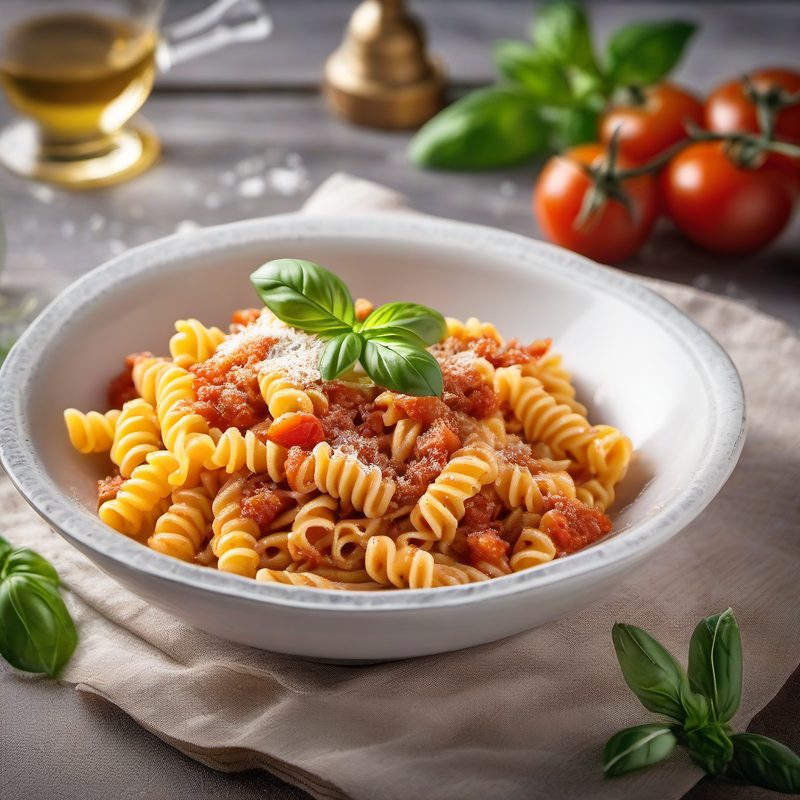
Fusilli Ladra
| Amount | Ingredient |
|---|---|
| Calories | ~485 kcal |
| Total Fat | 19 g |
| Saturated Fat | 4.5 g |
| Cholesterol | 10 mg |
| Sodium | 720 mg |
| Total Carbohydrates | 62 g |
| Dietary Fiber | 4 g |
| Sugars | 7 g |
| Protein | 15 g |
1. Recipe Title
Fusilli alla Ladra — Thief's Simple Tomato Pasta with Garlic, Chili, and Basil
2. Headnote (Why This Recipe Works)
Fusilli alla ladra — "thief's pasta" — is a Roman-born weekday rescue dish built from pantry scraps. The story goes that a hungry cook, with nothing but dried pasta, tinned tomatoes, garlic, and a few stingy basil leaves, raided his own cupboard to produce a satisfying meal in the time it took to boil water. The result is neither timid nor fancy: a bold, rusty-red sauce punched up with garlic and peperoncino, barely clinging to the corkscrews of fusilli. Because there is no onion, carrot, or celery (the standard Italian soffritto), the tomato speaks clearly, the chili bites cleanly, and the pasta itself — released starch into the sauce — provides the only body the dish needs. A shower of salty Parmesan at the finish bridges the acidity and heat, making every forkful craveable. This is cucina povera at its most cunning: few ingredients, high reward, and ready in under 30 minutes.
3. Why This Recipe Works (Expanded)
- No soffritto, no problem. Unlike a classic sugo, this sauce relies on garlic and chili alone — the tomato is the star, not a background player. Crushing the garlic with the flat of a knife and cooking it gently in olive oil infuses the oil without scorching, which would turn the dish bitter.
- Starch is the secret thickener. Undercooking the fusilli by 1 minute and finishing it in the simmering sauce lets the pasta release its starch directly into the liquid. The sauce tightens and clings to every spiral without needing cream, butter, or a roux.
- Chili heat is adjustable. A single small dried peperoncino (or ¼ teaspoon red pepper flakes) gives a gentle warmth that lingers; for serious heat, add a second. The chili is bloomed in the oil at the start, which coaxes out its volatile compounds more effectively than adding it later.
- Parmesan bridges acid and fat. The salty, funky crystals of Parmigiano-Reggiano tame the tomato's acidity and reinforce the savory depth (umami) of the dish, allowing the olive oil to feel rich rather than greasy.
- Timing is everything. The sauce simmers for exactly the duration of the pasta cook — about 15 minutes — which is long enough to marry flavors but short enough to preserve the tomato's bright, fresh character.
4. Yield / Serves
Serves 4 as a primo (first course) or Serves 3 as a main course.
5. Total Time / Active Time
| Time Component | Duration |
|---|---|
| Active Time | 10 minutes |
| Total Time | 25 minutes |
| Inactive (Simmer) | 15 minutes |
6. Category / Course
- Course: Primo piatto (First course) / Light Main
- Cuisine: Italian (Roman / Lazio tradition)
- Dietary: Vegetarian (contains dairy)
8. Before You Begin / Equipment Notes
- Pasta water is liquid gold. Salt the boiling water aggressively — about 1½ tablespoons of kosher salt per 4 quarts (or 7 g fine salt per litre). Reserve at least 1 cup of the starchy cooking water before draining; it's the only "stock" this sauce knows.
- Do not rinse the pasta. The starch coating the exterior helps the sauce adhere and contributes body.
- Grate your own Parmesan. Pre-grated cheese contains anti-caking agents that prevent smooth melting. Use a Microplane or the finest holes of a box grater for a fluffy, quick-melting powder.
- Tomato choice matters. Passata (smooth tomato purée) can substitute for crushed tomatoes, but look for one with no added herbs or garlic. Whole peeled tomatoes crushed by hand also work; they yield a chunkier sauce.
9. Key Equipment
- Large pot (6–8 quart / 6–8 L) for pasta
- Large skillet or sauté pan (12-inch / 30 cm) for sauce
- Microplane or fine rasp grater (for Parmesan)
- Chef's knife and cutting board
- Wooden spoon or silicone spatula
- Measuring spoons
- Ladle or heatproof measuring cup (for reserving pasta water)
- Colander or spider skimmer
- Fusilli: The spiral shape captures every bit of the thin sauce. If unavailable, casarecce, gemelli, or cavatappi are excellent substitutes. Avoid long-strand pastas (spaghetti, linguine) — the sauce is too loose to cling properly.
- Crushed tomatoes: Look for the least processed brand you can find. Italian DOP San Marzano tomatoes, crushed, offer a naturally sweet, low-acid base. If using whole peeled tomatoes, crush them with your hands or a potato masher right in the can.
- Peperoncino: Calabrian dried peperoncino is ideal — fruity and moderately spicy. Regular red pepper flakes from a jar work, but they tend to be hotter and dustier. Store whole dried chiles in a sealed jar in a dark cabinet; they keep their heat for about a year.
- Olive oil: A fruity, medium-intensity extra-virgin olive oil is best. Save your fancy finishing oil for drizzling at the end; the heat of cooking will mute its nuance anyway.
11. Preparation / Mise en Place
- Garlic: Smash each clove with the flat of a chef's knife to loosen the skin. Peel, then roughly chop. (Do not use a garlic press — you want small, irregular pieces that fry gently, not a paste.)
- Chili: If using a dried peperoncino, crumble it into small pieces (discard most of the seeds for less heat). If using flakes, set aside.
- Basil: Pick the leaves from the stems, stack them, and tear each leaf crosswise into 3–4 pieces. Tearing instead of cutting prevents bruising and blackening.
- Parmesan: Grate finely and set aside in a small bowl. Weigh or measure after grating.
- Tomatoes: If using whole peeled tomatoes, open the can and crush them by hand, one by one, over a bowl. Otherwise, open the can of crushed tomatoes.
- Pasta water: Fill the large pot with 4–5 quarts (4–5 L) of water and bring to a rolling boil. Salt generously.
12. Step-by-Step Instructions
Step 1 — Bloom the aromatics
Set a large skillet or sauté pan over medium-low heat. Add 3 tablespoons (45 ml) of the olive oil. When the oil shimmers (after about 30 seconds), add the chopped garlic and crumbled peperoncino. Cook gently, stirring constantly, until the garlic is fragrant and very pale gold — about 90 seconds to 2 minutes. Do not let it brown; browned garlic turns bitter and will dominate the sauce.
Step 2 — Build the sauce
Add the crushed tomatoes (or hand-crushed whole tomatoes) to the pan. Raise the heat to medium and bring to a gentle simmer. Reduce heat to maintain a steady, lazy bubble — not a violent boil. Add a pinch of salt (about ¼ teaspoon). Cook, stirring occasionally, for 15 minutes. The sauce will darken slightly and reduce by about one-quarter.
Step 3 — Cook the pasta
About 5 minutes after the sauce begins simmering, add the fusilli to the boiling salted water. Cook according to the package directions until al dente, typically 10–12 minutes. Set a timer for 1 minute less than the package suggests — you want the pasta slightly underdone because it will finish cooking in the sauce.
Step 4 — Reserve pasta water
Just before draining, ladle out 1 cup (240 ml) of the starchy pasta cooking water and set aside.
Step 5 — Finish pasta in sauce
Drain the fusilli (do not rinse). Transfer the pasta directly to the skillet with the simmering tomato sauce. Add the remaining 1 tablespoon (15 ml) olive oil and about ¼ cup (60 ml) of the reserved pasta water. Increase heat to medium-high and toss vigorously with tongs or a wooden spoon for 1–2 minutes, until the sauce coats each spiral and has thickened slightly. If the sauce seems too tight, add another splash of pasta water; if too loose, cook 30 seconds longer.
Step 6 — Finish with cheese and basil
Remove the skillet from the heat. Add the grated Parmesan and torn basil leaves. Toss once more to combine, letting the residual heat melt the cheese into the sauce. Taste and adjust salt — the cheese adds some salt, so you may need very little.
Step 7 — Plate and serve
Divide among warmed shallow bowls or plates. Drizzle each portion with a thread of your best extra-virgin olive oil. Garnish with a few small basil leaves (or a light sprinkling of additional grated Parmesan). Grind a crack of black pepper over the top and serve immediately.
13. Visual Guide (Process Photos / Key Doneness Cues)
| Stage | Visual / Aromatic Cue |
|---|---|
| Garlic in oil | Pale gold, fragrant — not brown, not raw |
| Sauce at 5 min | Bubbling lazily; oil may separate slightly around the edges |
| Sauce at 15 min | Reduced by ~25%; reddish-orange; oil pools on surface |
| Pasta + sauce | Fusilli are glossy-coated; no pool of liquid remains at bottom |
| Finished dish | Sauce clings tightly; no gap between pasta and pan when tilted |
14. Troubleshooting
| Problem | Likely Cause | Solution |
|---|---|---|
| Sauce is watery, slides off pasta | Not enough pasta starch; or sauce under-reduced | Add 2–3 more tablespoons reserved pasta water and toss over high heat for 1 more minute |
| Garlic is bitter | Garlic was browned (burned) | Start over — there is no fix. Next time, cook garlic on medium-low and stir constantly |
| Sauce tastes flat or dull | Under-salted; or no umami | Add a splash more pasta water (it's salty) and/or an extra teaspoon of grated Parmesan |
| Too spicy / not spicy enough | Chili quantity was off | Cool with extra cheese and olive oil if too hot; add more chili at the blooming stage if too mild |
| Pasta clumps together | Not enough water; or pasta was rinsed | Next time: use more water; never rinse. For now: toss with a little olive oil |
| Sauce is too acidic | Tomatoes were harsh; cheese was skimpy | Stir in a pinch of sugar or a small knob of butter, plus more Parmesan |
15. Variations
- Fusilli alla Ladra with Tuna: Drain one 150 g (5 oz) can of oil-packed tuna. After the sauce has simmered for 12 minutes, flake the tuna into the pan and simmer 3 more minutes before adding pasta. Omit the Parmesan or use Pecorino Romano for a more assertive finish.
- Fusilli alla Ladra with Capers & Olives (alla Ladra puttanesca-style): Add 2 tablespoons rinsed salt-packed capers and ¼ cup (40 g) pitted black olives (Taggiasca or Gaeta) to the garlic oil before adding tomatoes. Hold the Parmesan and garnish with fresh parsley instead of basil.
- Herb Variation (Ladra alle erbe): Replace basil with a mix of fresh oregano and parsley. Add 1 teaspoon dried oregano with the tomatoes.
- Vegan Fusilli alla Ladra: Omit the Parmesan. After tossing the pasta with sauce, stir in 2 tablespoons of nutritional yeast and 1 tablespoon of extra-virgin olive oil for umami and richness.
- Peperoncino-Heavy Ladra (Ladra arrabbiata): Double the chili and add ½ teaspoon smoked paprika with the garlic. Serve with a drizzle of chili-infused olive oil at the table.
16. Make Ahead / Leftovers
- Sauce (make ahead): The tomato-garlic-chili base can be made up to 3 days in advance and refrigerated in an airtight container. Reheat gently in a skillet, adding a splash of water to loosen, then proceed with cooking and saucing the pasta fresh.
- Leftover pasta: Store in a covered container in the refrigerator for up to 2 days. The pasta will absorb some sauce and soften. To revive, reheat in a nonstick skillet over medium heat with a splash of water or olive oil, tossing until hot. Alternatively, turn leftovers into a frittata: whisk 4 eggs, fold in the cold pasta, and cook in a well-oiled skillet until set.
- Not suitable for freezing. The pasta releases starch unevenly when thawed, producing a gummy, broken texture.
17. Science of the Recipe / Technique Insight
Why finishing pasta in the sauce matters more here than in other recipes
Most tomato pasta recipes call for draining the pasta and spooning sauce over it. Fusilli alla ladra inverts that: the pasta finishes cooking in the sauce. This technique, known in Italian cooking as risottare la pasta (literally "to risotto the pasta"), exploits two physical principles:
- Starch migration. As the undercooked fusilli jostles and tumbles in the simmering sauce, the rough surface of bronze-die-extruded pasta abrades slightly, releasing starch granules into the liquid. These starch molecules swell and gelatinize in the hot water, creating a thin, silky matrix that binds the oil-in-water emulsion of the sauce. The result is a sauce that clings tightly — the same mechanism that makes a risotto creamy without cream.
- Starch + fat = stable emulsion. The extra tablespoon of olive oil added at the finishing stage combines with the free starch to form a temporary emulsion. Because this recipe has no dairy (besides the cheese added off-heat), the starch-oil emulsion is the sole structural backbone of the sauce. This is why the reserved pasta water — essentially a dilute starch solution — is indispensable. Adding it to the skillet provides both the liquid needed for the emulsion and additional starch to stabilize it.
Why garlic is crushed, not minced
A garlic press or fine mince destroys more cell walls than a rough chop, releasing allicin more aggressively. In a sauce that simmers only 15 minutes, that rush of allicin can make the garlic taste harsh and raw at first, then fade to nothing. Crushing the cloves with the knife and chopping coarsely leaves most cell walls intact initially; the pieces release their flavor steadily as they cook, yielding a mellow, persistent garlic presence throughout the sauce.
Peperoncino bloom temperature
Capsaicin (the compound responsible for chili heat) is fat-soluble and dissolves efficiently in warm olive oil. Heating the crumbled chili in oil at 160–180°F (71–82°C) for 90 seconds extracts the maximum pungency without degrading the chili's fruity, floral notes — temperatures above 400°F (204°C) would volatilise those aromatics. This is why the chili goes in with the garlic over medium-low heat, not later when the sauce is boiling.
18. Nutrition Information (per serving, serves 4)
Note: Values are estimates. Actual nutrition depends on specific brands of tomatoes, olive oil, and cheese used.
19. Recipe Source / Notes
- Origin: Home-style Roman cuisine (cucina romana casalinga). The name alla ladra ("thief-style") is apocryphal — it likely emerged in mid-20th-century home kitchens as a self-deprecating nickname for a meal thrown together from what was "stolen" from the pantry.
- Inspiration / References: Adapted from traditional family recipes of Lazio. The technique of finishing pasta in the sauce (risottatura) is standard across Roman primi. Fatto in Casa da Noi (2020) and La Cucina Romana (Zanichelli, 1998) were consulted for technique and history.
- Chef's Notes: Do not skimp on the pasta water — it is the only liquid that ever touches the sauce besides the tomatoes. Many versions of this recipe exist across Italy; this version favours a sauce that is slightly looser than a classic all'amatriciana but thicker than a simple pomodoro. The balance of garlic, chili, and basil should be tuned to your own palate over repeated cooks; this is the sort of recipe that improves with muscle memory.
- Recommended Pairing: A simple, unoaked red wine such as Barbera d'Alba, Montepulciano d'Abruzzo, or a young Chianti Classico. For a white, try a Verdicchio dei Castelli di Jesi. Still water (non-carbonated), as a Roman would serve it.
- Date documented: July 2026
"Una pasta rubata — ma rubata bene." — A stolen pasta, but well stolen.
Recipe from The Italian Kitchen by Vita Milanese — Volume 1 · Pasta Perfetto. Discover all volumes on the ebook page.