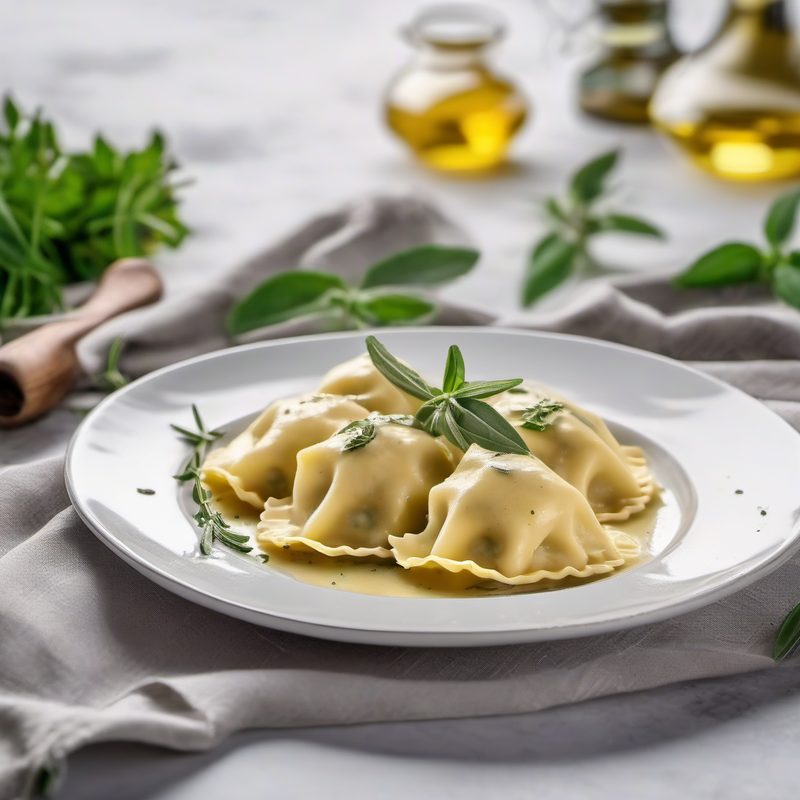
Chicken Ravioli Sage Butter
Handmade pasta parcels stuffed with a rich, slow-braised chicken filling, sauced simply with nutty browned butter and fragrant sage — rustic elegance that rewards a Sunday afternoon in the kitchen.
| Amount | Ingredient |
|---|---|
| 3 tbsp (42 g) | Unsalted butter |
| 10–12 large | Fresh sage leaves |
| ¼ cup (25 g) | Parmigiano-Reggiano, finely grated (for serving) |
| 1½ tbsp | Kosher salt (for pasta water) |
| Fresh sage leaves | For garnish |
This is ravioli the old-fashioned way: a labor of love that turns a single spring chicken and a handful of vegetables into something far greater than the sum of its parts. The pasta dough — just flour, eggs, and salt — comes together in minutes and rests while you build the filling. Celery, onion, and carrot are diced fine and sautéed with garlic and woodsy herbs until softened; then the chicken pieces go in, browning on all sides before a splash of beer and a long, gentle braise. After an hour the meat is fall-apart tender, ready to be shredded and mixed back with its cooking juices, the softened vegetables, and a generous grating of Parmigiano-Reggiano. The filling is rich, savory, and deeply chicken-y — a far cry from the bland, bouncy stuff that comes in supermarket packs. A quick boil, a toss in sage-spiked browned butter, and dinner is served.
For the Pasta Dough
For the Filling
For Finishing
Use level tablespoons and standard US measuring cups. All produce is medium unless specified.
🥘 Equipment
- Large pot (8-quart or larger) for braising and boiling pasta
- Large skillet or sauté pan (12-inch) with lid
- Chef's knife and cutting board
- Rolling pin or pasta machine
- Bench scraper or pastry wheel
- Baking sheet lined with parchment paper (for filled ravioli)
- Microplane or box grater (for Parmigiano)
- Measuring cups and spoons
- Tongs or pasta spider
- Ladle or heatproof measuring cup
- Large bowl
- Slotted spoon or spider skimmer
- Fine-mesh strainer
- Kitchen twine (optional, for trussing chicken)
📋 Preparation
Step 1 — Make the Pasta Dough (10 minutes + 30 minutes rest)
On a clean work surface or in a large bowl, mound the flour and create a well in the center. Crack the eggs into the well and add the salt.
Using a fork, beat the eggs gently, gradually incorporating flour from the walls of the well. When the mixture becomes too stiff to stir with the fork, use your hands to bring the dough together. Knead for 8–10 minutes until the dough is smooth, elastic, and no longer sticky — it should spring back when gently pressed with a finger.
Wrap tightly in plastic wrap and let rest at room temperature for 30 minutes. This relaxes the gluten, making the dough easier to roll thin later.
Step 2 — Build the Filling Base (15 minutes)
While the dough rests, prepare the filling. In a large pot or Dutch oven, heat the olive oil over medium heat until shimmering.
Add the finely diced celery, onion, and carrot (the soffritto). Cook, stirring frequently, until the vegetables have softened but not taken on any color, about 5 minutes.
Add the garlic, thyme, and rosemary and cook, stirring constantly, until fragrant, about 30 seconds.
Step 3 — Brown the Chicken (10 minutes)
Push the vegetables to the sides of the pot. Pat the chicken pieces dry with paper towels and season generously with salt and pepper.
Increase the heat to medium-high and add the chicken pieces in a single layer (work in batches if necessary — crowding will steam rather than brown). Cook without moving until the skin is deep golden brown, about 4 minutes per side.
Transfer the browned chicken to a plate. The vegetables will have darkened slightly; this is good — they've picked up the browned bits.
Step 4 — Braise the Chicken (1 hour)
Pour the beer into the pot and scrape up any browned bits from the bottom with a wooden spoon. Let it bubble and reduce slightly, about 1 minute.
Return the chicken pieces to the pot along with any accumulated juices from the plate. Nestle them into the vegetables. The liquid should come about a third of the way up the chicken pieces — add a splash of water if needed.
Reduce the heat to low, cover tightly, and cook until the meat is fall-apart tender and pulls easily from the bone, about 1 hour. Check once or twice to ensure the pot isn't dry; add a tablespoon or two of water if needed.
Step 5 — Shred the Filling (15 minutes, concurrent with Step 6)
When the chicken is tender, remove the pieces to a cutting board. Let cool just until you can handle them.
While the chicken cools, strain the cooking liquid and vegetables through a fine-mesh strainer set over a bowl. Reserve both the solids (vegetables) and the liquid. Return the liquid to the pot and simmer over medium-high heat until reduced by half and slightly syrupy, about 5 minutes.
Remove the chicken meat from the bones, discarding skin and bones. Shred the meat into small, fine pieces using two forks.
In a large bowl, combine the shredded chicken, the reserved vegetables, the reduced cooking liquid, and the Parmigiano-Reggiano. Mix thoroughly. Taste and adjust seasoning with salt and pepper. The mixture should be moist and cohesive, not dry or soupy.
Let the filling cool completely to room temperature — you can speed this up by spreading it on a plate and refrigerating for 15 minutes.
Step 6 — Roll the Pasta and Form Ravioli (30 minutes)
Divide the rested dough into 4 equal pieces. Keep the pieces you're not working with covered under a damp towel or plastic wrap.
On a lightly floured surface, flatten one piece into a rough rectangle with your palm. Run it through a pasta machine at the widest setting, then fold it in thirds (like a letter) and run through again. Repeat this folding step once more — it helps create a silky, uniform sheet.
Continue rolling through progressively narrower settings, dusting with flour as needed, until the sheet is about 2–3 mm thick (setting 6 or 7 on most machines). The dough should be thin enough to see your hand through, but sturdy enough not to tear.
Lay the sheet on a lightly floured surface. Place rounded teaspoons (about 1 heaping tablespoon / 15 g each) of the cooled filling along the dough at 2-inch intervals, forming two rows.
Brush a thin line of water between the mounds of filling. Fold the other half of the dough over to cover the filling. Press firmly around each mound, pushing out air pockets — trapped air causes ravioli to burst during cooking.
Cut between the ravioli with a pastry wheel or sharp knife. Press the edges of each raviolo with the tines of a fork to seal. Transfer to a parchment-lined baking sheet dusted with semolina or flour. Repeat with remaining dough and filling.
You should have about 40 ravioli. Refrigerate, uncovered, for at least 15 minutes — this firms the pasta and helps it hold its shape during cooking.
Step 7 — Cook the Ravioli (3–4 minutes)
Bring a large pot of generously salted water (about 1½ tablespoons kosher salt per 4 quarts of water) to a rolling boil over high heat.
Working in batches to avoid crowding, gently drop the ravioli into the boiling water. They will sink to the bottom and float to the surface as they cook.
Cook the ravioli until they float to the surface and the pasta is tender but still firm to the bite, about 3–4 minutes from when they start floating. Use a slotted spoon or spider skimmer to transfer them directly to the waiting sauce — do not drain them in a colander, as this can cause them to stick and tear.
Reserve about ½ cup of the pasta cooking water before you finish.
Step 8 — Finish with Sage Butter (2 minutes, concurrent with Step 7)
While the ravioli cook (or just before), place a large skillet over medium heat. Add the butter and let it melt, swirling occasionally.
When the butter foams and begins to turn a light, nutty golden-brown — about 2 minutes — add the fresh sage leaves. Fry the sage in the butter for about 30 seconds, until the leaves are crisp and the butter is fragrant. Watch closely: the butter can go from golden to burnt in seconds.
Remove from heat immediately. If the ravioli aren't ready yet, set the pan aside — the residual heat will keep the butter warm without burning it.
Step 9 — Toss and Serve (2 minutes)
Add the cooked ravioli to the skillet with the sage butter. Toss gently — a spoon and a gentle shake of the pan is better than tongs, which can tear the delicate pasta — until every raviolo is glistening with the nutty butter.
Add a splash of the reserved pasta cooking water (1–2 tablespoons) if the pan seems dry; it emulsifies with the butter to create a silky, clinging sauce.
Divide among four warm shallow bowls. Spoon any remaining sage butter from the pan over the top. Garnish with the crisp fried sage leaves, a generous shower of Parmigiano-Reggiano, and a crack of black pepper. Serve immediately.
🧑🍳 Chef's Tips
- The chicken matters: A spring chicken (poussin) is ideal — it's young, tender, and has a mild, delicate flavor that won't overwhelm the pasta. A small regular chicken (3–4 lb) works too; increase the braise time by 20–30 minutes and shred thoroughly.
- Don't skip the soffritto: The finely diced celery, onion, and carrot aren't just flavor — they add moisture and texture to the filling. Dice them small and even so they cook at the same rate as the chicken.
- Cool the filling completely: Warm filling makes the pasta dough sticky and hard to seal. Spread the filling on a plate and refrigerate for 15–20 minutes before using.
- Seal tight, no air: Press every bit of air out around each mound of filling before cutting. Trapped air expands during boiling and will burst your ravioli open, releasing the filling into the water.
- Beer selection: Use a light, crisp lager or pilsner — nothing hoppy or bitter. The beer adds a subtle malty sweetness that complements the chicken without being assertive. A dry white wine (Pinot Grigio, Sauvignon Blanc) is a perfect substitute.
- Fresh sage is non-negotiable: Dried sage is a completely different creature — it's musty and one-dimensional. Fresh sage leaves turn crisp and nutty when fried in butter, adding texture as well as flavor. Look for leaves that are bright green and fragrant.
- Brown the butter to the right shade: You want a light, nutty amber — the color of hazelnuts. Pale butter tastes flat; burnt butter tastes bitter. Swirl the pan constantly and pull it off the heat the moment you smell that toasty, nutty aroma.
- Working in batches: If you can't fit all the ravioli in one batch, cook them in two or three batches. Overcrowding the pot lowers the water temperature and the ravioli may stick together or cook unevenly.
❌ Common Mistakes
| Mistake | Why It Hurts | The Fix |
|---|---|---|
| Overcooking the ravioli | Delicate fresh pasta turns mushy and falls apart in seconds | Cook just until they float + 1 minute — 3–4 minutes total; test one for doneness |
| Sealing air inside ravioli | Trapped air expands during cooking and bursts the pasta open | Press every bit of air out before sealing; use the handle of a chopstick to nudge air toward the edge |
| Soggy, under-browned chicken | Crowding the pot steams the chicken instead of browning it | Brown in a single layer; work in two batches if needed; pat the chicken very dry before seasoning |
| Burnt sage butter | Sage and butter go from perfect to acrid in seconds | Keep the heat at medium, swirl constantly, and pull from heat the moment the butter is golden and smells nutty |
| Using warm filling | Warm filling makes the dough tacky, hard to seal, and prone to tearing | Cool the filling completely — spread on a plate and refrigerate 15–20 minutes |
| Overworking or under-kneading the dough | Under-kneaded dough tears when rolled thin; over-kneaded (with too much bench flour) becomes dry and crumbly | Knead 8–10 minutes until smooth and elastic; dust sparingly; the dough should feel supple, not dry |
| Rolling the pasta too thick | Thick pasta overwhelms the delicate filling and feels doughy and heavy | Roll to 2–3 mm thick — thin enough to see your hand through but sturdy enough to hold filling |
| Not reserving pasta water | The starchy water is what turns the butter into a silky sauce that clings to the ravioli | Always reserve at least ½ cup of pasta cooking water before finishing the sauce |
| Draining ravioli in a colander | The weight of the pile can cause them to stick together and tear | Use a slotted spoon or spider and transfer directly to the sauce pan |
💡 Variations
| Variation | How To |
|---|---|
| Swap the Herb | Replace sage with fresh thyme sprigs, rosemary, or a bay leaf in the brown butter — or go with basil for a brighter, sweeter profile |
| Add Lemon | Finish the sage butter with 1 tablespoon of fresh lemon juice and 1 teaspoon of lemon zest for brightness that cuts through the richness |
| Make it Mushroom | Add 4 oz (115 g) finely chopped cremini mushrooms to the soffritto and cook until their moisture evaporates — a deeply earthy twist |
| Sage & Walnut Butter | Add ¼ cup (30 g) toasted, roughly chopped walnuts to the sage butter for a nutty crunch that plays beautifully with the brown butter |
| Go Creamy | After tossing with sage butter, stir in ¼ cup (60 ml) heavy cream and an extra ¼ cup (25 g) Parmigiano — a richer, more indulgent finish |
| Swap the Protein | Use rabbit or guinea fowl in place of the spring chicken; the braising method is identical and the flavor is wonderfully gamey |
| Use Wine Instead of Beer | Substitute dry white wine (Pinot Grigio, Sauvignon Blanc) for a brighter, more acidic braising liquid that pairs elegantly with sage |
| Add Pancetta | Dice 3 oz (85 g) pancetta and render it with the soffritto for a smoky, porky depth that enriches the filling |
| Spicy Twist | Add a pinch of red pepper flakes or a small dried chili to the sage butter for gentle heat that contrasts with the rich chicken filling |
| Vegetarian Version | Replace chicken with 1 lb (450 g) mixed wild mushrooms (porcini, chanterelles, cremini) — sear them hard until deeply browned, then proceed with the beer braise (reduce liquid to ¼ cup since mushrooms release their own moisture) |
❄️ Storage & Leftovers
| Method | Details |
|---|---|
| Refrigerator (filled ravioli) | Uncooked ravioli can be refrigerated on a parchment-lined baking sheet, covered loosely with plastic wrap, for up to 24 hours. Dust generously with semolina or flour so they don't stick |
| Freezer (uncooked ravioli) | Freeze in a single layer on a parchment-lined baking sheet until solid (about 1 hour), then transfer to a zip-top freezer bag. Cook from frozen directly in boiling water — add 1–2 minutes to the cook time. Keeps for up to 3 months |
| Refrigerator (cooked) | Store cooked ravioli in an airtight container for up to 2 days. The pasta will continue to absorb the butter and soften |
| Reheating | Reheat gently in a skillet over medium-low heat with a splash of pasta water or broth and a bit of fresh butter, tossing until warmed through. Add a few fresh sage leaves to revive the flavor. Microwaving is not recommended — the ravioli will become rubbery |
| Filling only | The chicken filling can be made up to 2 days ahead and refrigerated. Bring to room temperature before filling pasta. It also freezes well for up to 3 months — thaw overnight in the refrigerator |
🍷 Wine Pairing
| Wine | Why |
|---|---|
| Pinot Noir (Alto Adige or Valle d'Aosta) | Light-bodied, red-fruited, and earthy — the bright acidity cuts through the brown butter while the earthy notes echo the sage and braised chicken |
| Chardonnay (unoaked, e.g., Chablis or Gavi) | Lean, mineral-driven white with good acidity — won't compete with the delicate chicken filling and cuts through the butter sauce's richness |
| Franciacorta Brut | Sparkling wine from Lombardy with fine bubbles and a crisp, clean finish — the effervescence scrubs the palate clean between each rich, buttery bite |
| Verdicchio dei Castelli di Jesi | A white with almond and citrus notes, good structure, and a pleasantly bitter finish — the slight bitterness mirrors the sage beautifully |
| Barbera d'Alba or Barbera d'Asti | Bright, juicy red with low tannins and high acidity — the red fruit and herbal notes pair beautifully with sage butter and chicken |
| Soave Classico (Garganega) | Floral, almond-toned white with a clean, mineral finish — subtle enough not to overpower the delicate ravioli but with enough structure to stand up to the butter |
| Dry Riesling (Alto Adige or Clare Valley) | Aromatic, high-acid, and steely — the citrus and petrol notes add an unexpected but delightful dimension to the sage-and-brown-butter combination |
🍺 Beer Pairing
| Beer | Why |
|---|---|
| Italian Pilsner (e.g., Birrificio Italiano Tipopils) | Crisp, clean, and moderately hoppy — the bitterness cuts through the butter, and the carbonation is a palate cleanser between rich bites |
| Belgian Saison | Fruity, peppery, and dry with high carbonation — the spiciness echoes the sage and black pepper, and the effervescence lightens the rich filling |
| Helles Lager | Malt-forward, smooth, and gently bready — the soft sweetness complements the brown butter without competing with the sage or chicken |
| Kölsch | Delicate, slightly fruity, and crisp — a bridge between white wine and beer that's light enough for the ravioli's delicate flavors |
| English Bitter | Low-carbonation, nutty, and gently hoppy — the malt character echoes the browned butter, and the low alcohol keeps things balanced |
🥗 Suggested Side Dishes
- Arugula salad with shaved Parmigiano and lemon vinaigrette — Peppery arugula, paper-thin shavings of Parmigiano, lemon juice, extra-virgin olive oil, flaky salt — bright and sharp, a perfect counterpoint to the rich, buttery ravioli
- Sautéed spinach with garlic — Wilted in olive oil with a clove of garlic until just tender; a squeeze of lemon at the end keeps it bright
- Roasted cherry tomatoes with balsamic — Halved cherry tomatoes, olive oil, salt, roasted at 400°F (200°C) for 15 minutes, finished with a drizzle of aged balsamic vinegar — the acidity and sweetness balance the sage butter
- Fennel and orange salad — Thinly shaved fennel, segments of orange, black olives, olive oil, and a pinch of chili flakes — bright, anise-scented, and refreshing
- Crusty sourdough bread — To mop up every last drop of sage butter from the bottom of the bowl
- Grilled asparagus with lemon zest — Tossed in olive oil, grilled until charred, finished with lemon zest and flaky salt — a simple, elegant side that's ready in minutes
- Roasted beets with goat cheese — A sweet, earthy, creamy side that stands up to the ravioli without overwhelming it
📊 Nutrition (per serving, estimated)
| Calories | Protein | Fat | Carbs | Fiber |
|---|---|---|---|---|
| 480 | 28 g | 18 g | 48 g | 4 g |
Nutrition is an estimate based on 4 servings using fresh pasta dough, braised spring chicken, vegetables, Parmigiano-Reggiano, butter, sage, and beer. Actual values will vary with brands and substitutions.
❓ Frequently Asked Questions
Can I use wonton wrappers instead of making fresh pasta?
Yes, in a pinch — but the texture will be different. Fresh egg pasta is tender and slightly chewy; wonton wrappers are thinner and more delicate. If using wonton wrappers, place a rounded teaspoon of filling in the center of each wrapper, brush the edges with water, press to seal, and cook for only 2–3 minutes. The dish won't have the same rustic, handmade character, but it's a perfectly good weeknight shortcut.
Can I use a whole chicken instead of a spring chicken?
Absolutely. A 3–4 lb (1.4–1.8 kg) chicken works beautifully; just increase the braise time to 1½ hours. The meat will be just as tender. You'll also have more filling — enough for about 50–55 ravioli. The remaining filling freezes well for another batch.
Can I skip the beer?
Yes — substitute the beer with an equal amount of dry white wine (Pinot Grigio or Sauvignon Blanc) or chicken broth. White wine adds bright acidity; broth keeps the filling savory and clean without any alcoholic character. If using broth, add ½ teaspoon of white wine vinegar or lemon juice at the end for brightness.
Do I need a pasta machine?
A rolling pin works, but a pasta machine makes rolling to 2–3 mm vastly easier and more consistent. If rolling by hand, divide the dough into 6 smaller pieces instead of 4, roll each to a thin, even rectangle on a well-floured surface, and rotate frequently to maintain an even shape.
Can I make the ravioli in advance for a dinner party?
Yes — and you should. The filled ravioli can be refrigerated on a parchment-lined baking sheet (generously dusted with semolina or flour) for up to 24 hours before cooking. For longer storage, freeze them in a single layer, then transfer to a zip-top bag. Cook from frozen — just add an extra 1–2 minutes to the boil.
My ravioli are bursting open in the water. What went wrong?
Two likely causes: (1) air trapped inside — you must press every bit of air out around the filling before sealing; (2) the seal wasn't tight enough — run your finger firmly around the edge, and crimp with fork tines for insurance. Also make sure the water is at a gentle rolling boil, not a violent one.
The filling came out dry. How do I fix it?
Add a splash of the reduced braising liquid, a drizzle of olive oil, or an extra tablespoon of melted butter, and mix thoroughly. The filling should be moist and cohesive — think the texture of a well-seasoned chicken salad. If it's too wet, add a tablespoon of breadcrumbs or an extra sprinkle of Parmigiano.
What's the best way to serve these for a crowd?
Cook the ravioli in batches and toss each batch with the sage butter in a warm serving platter. Keep the platter in a low oven (200°F / 90°C) while you cook the remaining batches. Don't layer them too deep or the weight will crush the bottom layer. Fry fresh sage for each batch so the garnish stays crisp.
Can I add cheese to the sage butter?
Absolutely. After tossing the ravioli in sage butter, add ¼ cup (25 g) of finely grated Parmigiano-Reggiano and toss off the heat until it melts into the butter, creating a kind of sage butter cacio e pepe hybrid. Add a splash of pasta water to keep the sauce emulsified.
Is this a first course or a main dish?
In Italy, this would be a primo (first course) — about 8–10 ravioli per person, followed by a meat or fish secondo. For an American dinner table with a salad and bread alongside, 10–12 ravioli per person makes a satisfying main. One batch makes about 40 ravioli, which serves 4 as a main or 6 as a modest first course.
🔗 Related Recipes
- Tortelli di Zucca (Butternut Squash Ravioli with Sage Butter)
- Ravioli Ricotta e Spinaci (Ricotta and Spinach Ravioli)
- Gnocchi di Patate al Burro e Salvia (Potato Gnocchi with Sage Butter)
- Pasta al Burro e Parmigiano (Pasta with Butter and Parmigiano)
- Cannelloni di Carne (Meat-Filled Cannelloni)
- Pappardelle al Ragu di Pollo (Pappardelle with Chicken Ragu)
- Tagliatelle al Tartufo (Tagliatelle with Truffle Butter)
🏷️ Search Tags
Photo reference: `vol1_75.png` — An overhead shot of golden chicken ravioli in a wide, shallow ceramic bowl, each parcel glistening with nutty brown butter and studded with crisp, dark green fried sage leaves, a generous shower of grated Parmigiano-Reggiano, warm ambient lighting on a rustic wooden table with a linen napkin and a glass of Pinot Noir.
Recipe from "The Italian Kitchen" by Vita Milanese — Volume 1: Pasta Perfetto
Recipe from The Italian Kitchen by Vita Milanese — Volume 1 · Pasta Perfetto. Discover all volumes on the ebook page.