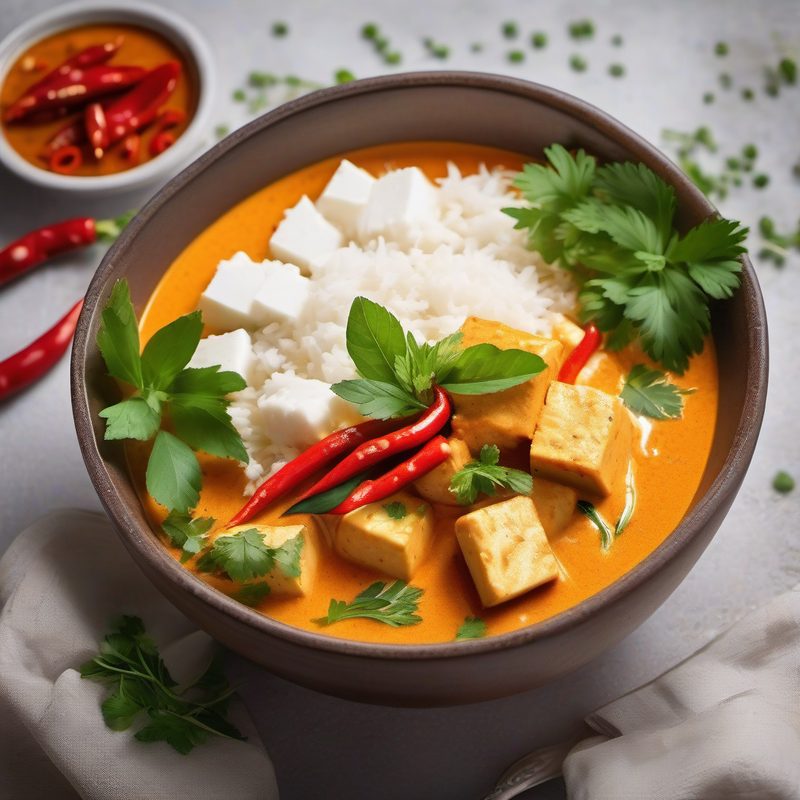
Red Curry Silken Tofu
Category: Piatti unici (One-Dish Meals), Cucina thai (Thai Cuisine)
| Amount | Ingredient |
|---|---|
| Steamed jasmine rice | As needed |
| Fresh Thai basil sprigs | 4 For garnish |
| Lime wedges | 4 For squeezing at the table |
| Red chili slices (optional) | 1 fresh bird's eye chili, thinly sliced For heat-seekers |
Servings: 4
Total Time: 35 minutes
Active Time: 25 minutes
Level of Difficulty: Easy
1. WHY THIS RECIPE WORKS
Thai red curry (gaeng phet) is a symphony of aromatic heat and creamy richness, traditionally built by frying a potent curry paste in coconut cream until deeply fragrant before adding the remaining liquid. Our version highlights silken tofu — an unconventional but brilliant protein choice that absorbs the curry's complex flavors while contributing its own velvety, custard-like texture. By first separating the thick coconut cream from the top of the can and rendering it until the oil breaks, we create a rich frying medium that blooms the aromatics of the red curry paste far more effectively than ordinary oil. The tofu is added at the very end and simmered just long enough to warm through — any longer and the delicate curd would break apart. A quick mix of vegetables (bell pepper for sweetness, snow peas for crunch, bamboo shoots for earthy texture) provides contrast without overwhelming the tofu's gentle presence. Finished with a hit of lime juice, a whisper of sugar, and fresh Thai basil, this curry is a complete one-dish meal that tastes far more complex than its short ingredient list and 35-minute timeline suggest. Serve with steamed jasmine rice to catch every last drop of the fragrant sauce.
Curry
For Serving
3. EQUIPMENT
- Wok (preferred) or large straight-sided skillet (30 cm / 12 in diameter minimum)
- Chef's knife and cutting board
- Measuring spoons and cups
- Wooden spoon or heat-resistant silicone spatula
- Wide, shallow serving bowl or platter
- Medium saucepan (for rice)
- Colander (for rinsing bamboo shoots)
- Paper towels or clean kitchen towel (for patting tofu)
- Small offset spatula or fish spatula (for handling tofu gently)
4. PREPARATION
- Open the coconut milk can without shaking: Carefully spoon the thick cream that has risen to the top into a small bowl. You will need about 3–4 tablespoons for frying the paste. Reserve the remaining watery liquid separately.
- Prepare the vegetables: Slice the bell pepper into thin strips (~3 cm long, ½ cm wide). Trim the snow peas and cut them on the bias into 2 cm pieces. Drain and rinse the bamboo shoots, then slice into thin matchsticks.
- Prepare the tofu: Gently remove the silken tofu from its package. Place it on a paper-towel-lined plate or cutting board. Pat the top gently with more paper towels to remove excess moisture. Cut into 2 cm (¾ in) cubes using a sharp knife — slice cleanly; do not saw.
- Prepare the aromatics: Pick the Thai basil leaves from the stems. Reserve whole leaves; do not chop or tear. Cut the lime in half.
- Prepare the rice: Rinse the jasmine rice in cold water until the water runs clear (3–4 rinses). Cook according to package directions or in a rice cooker.
5. FRY THE CURRY PASTE
Set a wok or large skillet over medium heat. Add the reserved thick coconut cream (the top 3–4 tablespoons from the can). Cook, stirring constantly with a wooden spoon, until the cream begins to bubble and the oil visibly separates from the solids — this takes 1–2 minutes. The mixture should look slightly grainy and glossy. Do not let it brown or scorch.
Add the red curry paste to the sizzling coconut cream. Stir vigorously to combine, breaking up the paste into the cream. Cook, stirring constantly, until the paste is deeply fragrant, darkened by 1–2 shades, and the oil starts to separate from the paste again, about 2 minutes. This step is critical — under-frying the paste leaves the curry tasting raw and harsh.
6. BUILD THE CURRY SAUCE
Pour in the remaining watery coconut milk from the can (about 300 ml). Stir to combine, scraping the bottom of the wok to incorporate any bits of paste that have stuck. Bring to a gentle simmer over medium heat, then reduce heat to medium-low. Let the sauce simmer, uncovered, for 3 minutes, stirring occasionally, allowing the flavors to meld and the sauce to thicken slightly.
Taste and adjust: Taste the sauce at this point — it should be aromatic and moderately spicy. If you prefer a milder curry, use 2 tablespoons of paste next time; for a spicier version, use 3 tablespoons or add sliced bird's eye chili with the vegetables.
7. COOK THE VEGETABLES
Add the bell pepper strips, snow peas, and bamboo shoots to the simmering curry sauce. Stir gently to coat the vegetables in the sauce. Cook, stirring occasionally, until the bell pepper is just tender-crisp and the snow peas have turned bright green, about 3 minutes. The vegetables should retain some bite — they will continue to soften slightly when the tofu is added.
8. ADD THE TOFU
Reduce heat to low. Gently slide the cubed silken tofu into the curry sauce. Do not stir vigorously — the tofu is extremely delicate and will break into small curds if handled roughly. Instead, use a spatula to gently nudge the tofu pieces into the sauce, spooning the curry liquid over the top to coat each piece. Simmer gently, uncovered, just until the tofu is heated through, 2–3 minutes. The tofu should be warm but not falling apart; over-simmering turns silken tofu into a watery, broken mess.
9. FINISH & SEASON
Add the soy sauce, sugar, and fresh lime juice to the curry. Stir very gently — just enough to incorporate. Taste and adjust seasoning: add a pinch of salt if needed (some curry pastes are saltier than others), more sugar if you prefer a touch more sweetness, or another squeeze of lime for brightness.
Remove the wok from heat. Scatter the Thai basil leaves over the surface and gently fold them into the curry with a single, gentle turn of the spatula — the residual heat will wilt the leaves without losing their fragrance.
10. TO SERVE
Divide the steamed jasmine rice among four warmed shallow bowls. Spoon the red curry with tofu and vegetables over the rice, ensuring each serving gets a generous amount of sauce. Top each bowl with a sprig of fresh Thai basil and a lime wedge. For those who want extra heat, offer sliced bird's eye chili on the side. Serve immediately — this curry does not improve with sitting.
11. VARIATIONS
- Red Curry with Tofu and Sweet Potato: Replace the bell pepper and snow peas with 250 g peeled sweet potato, cut into 2 cm cubes. Add the sweet potato to the simmering curry sauce (step 6) and cook for 8–10 minutes before proceeding with the tofu. The natural sweetness of the potato balances the spicy curry beautifully.
- Red Curry with Crispy Tofu: For those who prefer a firmer texture, replace silken tofu with 400 g extra-firm tofu. Press the tofu for 20 minutes, cut into 2 cm cubes, and pan-fry in 2 tablespoons neutral oil over medium-high heat until golden on all sides (6–8 minutes). Add to the curry at the end as directed. Note: this version lacks the silky contrast that defines the original.
- Red Curry with Shrimp (Gaeng Phet Goong): Omit the tofu and vegetables. Add 300 g peeled and deveined large shrimp (16–20 count) in step 8. Cook just until pink, 2–3 minutes. Follow the same seasoning and garnish.
- Red Curry with Chicken (Gaeng Phet Gai): Omit the tofu. Thinly slice 300 g boneless, skinless chicken thigh. Add to the simmering sauce in step 7 and cook 5–6 minutes until cooked through, then add the vegetables and proceed.
- Pumpkin Red Curry: Replace all vegetables with 300 g kabocha or butternut squash, cut into 3 cm cubes. Simmer in the curry sauce for 12–15 minutes (covered) until tender, then add the tofu.
- Extra-Vegetable Load: Add 100 g Thai eggplant (quartered) or 100 g green beans (halved) along with the other vegetables. Cook 2 minutes longer.
- Creamier Curry: Add 2 tablespoons unsweetened coconut cream (the canned type) or 1 tablespoon almond butter stirred in at the end for extra richness.
12. MAKE AHEAD & STORAGE
Red curry with silken tofu is best eaten the day it is made. The tofu breaks down and the vegetables lose their texture upon reheating. However, the curry sauce base can be made ahead:
- Make ahead (sauce only): Prepare the curry through step 6 (the simmered sauce with vegetables). Let cool completely, then transfer to an airtight container. Refrigerate for up to 3 days or freeze for up to 2 months.
- To finish: Reheat the sauce gently in a wok over medium-low heat until simmering. Add the fresh tofu and proceed with steps 8–10. Do not freeze the sauce once the tofu has been added — the thawed tofu will be spongy and watery.
- Storage (fully assembled): Refrigerate leftovers in an airtight container for up to 1 day. The texture of the tofu will degrade noticeably. To reheat, warm gently in a small saucepan over low heat, stirring as little as possible. Do not microwave — it will explode the tofu.
- Rice storage: Cooked jasmine rice can be refrigerated for up to 3 days in an airtight container. Reheat in the microwave with a damp paper towel or in a steamer.
13. KEYS TO SUCCESS
- Do not shake the coconut milk can — the cream layer must be intact so you can separate it for frying. Shaking emulsifies the cream back into the liquid, and you lose the rich frying medium that makes the curry deeply flavorful.
- Fry the curry paste until fragrant and darkened — 2 minutes of constant stirring in the coconut cream is non-negotiable. This blooms the spices and removes the raw, aggressive edge that store-bought pastes often have.
- Handle silken tofu with extreme care — it is more custard than curd. Cut it with a sharp knife (dull blades crush it), add it last, and barely stir. The goal is intact cubes that melt on the tongue, not a curried soup of tofu bits.
- Add Thai basil off the heat — the residual heat is enough to wilt the leaves. Adding them over active heat turns them black and destroys their volatile oils.
- Serve immediately — red curry is at its peak the moment it's finished. The sauce thickens as it cools, the tofu weeps liquid, and the basil blackens. Rice absorbs the sauce, so plate and eat right away.
14. COMMON MISTAKES & HOW TO AVOID THEM
| Mistake | Why It Happens | Fix |
|---|---|---|
| Tofu breaks into small pieces | Stirred too vigorously or added too early | Gently nudge rather than stir; add tofu last and simmer just 2–3 minutes |
| Curry tastes raw and harsh | Curry paste not fried long enough | Fry paste in coconut cream for a full 2 minutes until darkened and fragrant |
| Curry is watery and thin | Coconut cream not separated; sauce not simmered | Use the thick cream for frying; simmer curry for 3 minutes before adding vegetables |
| Sauce is greasy | Over-rendering the coconut cream; too much oil | Cook cream just until oil separates, not until smoking; skip the extra oil unless the cream layer is thin |
| Thai basil turns black | Added to hot, actively simmering curry | Remove from heat before adding basil; let residual heat wilt it |
| Tofu has off-putting texture | Silken tofu confused with firm tofu; overcooked | Use only silken (soft) tofu; cook just to warm through, 2–3 minutes max |
| Curry is too salty | Soy sauce plus salty curry paste | Taste before seasoning; use low-sodium soy sauce; add salt only at the end after tasting |
| Vegetables are mushy | Cooked too long in the sauce | Cook bell pepper and snow peas only 3 minutes until tender-crisp |
15. PLATING & GARNISH
- Use wide, shallow bowls rather than deep soup bowls — the curry should spread out, showing off the tofu cubes, vegetables, and sauce against the white rice.
- Spoon the rice into a tidy mound on one side of the bowl, then ladle the curry next to it rather than on top. This keeps the rice grains separate and fluffy.
- Arrange the tofu cubes face-up so their creamy white color contrasts with the deep red-orange curry sauce.
- Lay the Thai basil sprig across the center of the dish; do not chop or shred it.
- Place a lime wedge on the rim of each bowl — not buried in the curry — so it is easily accessible.
- For a restaurant touch, drizzle 1 teaspoon of coconut cream (from a fresh can) over the surface of the curry just before serving. The white swirl against the red sauce is visually striking.
- Serve with a small extra dish of sliced bird's eye chilies in fish sauce (prik nam pla) for those who want to dial up the heat; this is the traditional Thai table condiment.
16. TEA PAIRING
Red curry's bold, aromatic heat calls for teas that can stand up to its intensity without being overwhelmed:
- Jasmine-scented green tea: The floral notes of jasmine complement the aromatic profile of the red curry paste (galangal, lemongrass, kaffir lime). The light, clean finish of green tea cuts through the richness of the coconut milk. Brew at 80°C / 175°F for 2–3 minutes. Serve hot.
- Oolong tea (Tieguanyin / Iron Goddess): A medium-oxidized oolong with floral and slightly creamy notes mirrors the coconut's body while its clean finish refreshes the palate between bites. Brew at 90°C / 195°F for 3–4 minutes.
- Thai iced tea (cha yen): The classic pairing — strong brewed Ceylon tea, sweetened with condensed milk and poured over ice. The sweetness, creaminess, and cold temperature are a perfect counterbalance to the spicy, hot curry. Make it at home: steep 3 tablespoons Thai tea mix in 500 ml boiling water for 5 minutes, strain, stir in 2 tablespoons sweetened condensed milk and 1 tablespoon sugar, and serve over ice.
- Pu-erh tea (shou / ripe): The earthy, deep, slightly funky character of aged pu-erh is an unexpected but excellent match for the fermented funk of shrimp paste (a key ingredient in authentic red curry paste). Brew at 95°C / 205°F, rinse the leaves once, then steep for 30 seconds.
- Iced lemongrass or ginger infusion: For a non-caffeinated option, a cold-brewed lemongrass and ginger herbal tea echoes the aromatics in the curry paste. Steep 2 tablespoons fresh lemongrass slices and 1 tablespoon fresh ginger slices in 500 ml cold water overnight in the refrigerator.
Note: Avoid delicate white teas, floral tisanes, or fruit infusions — they will be completely lost against the curry's intensity.
17. COMPOSITION NOTES (for the cook)
This recipe is a study in contrasts: the rich, fatty coconut milk against the lean, delicate tofu; the spicy, aromatic curry paste against the cooling, herbal Thai basil; the crunchy vegetables against the silky tofu. The ratio of sauce to solids is deliberately generous — this is a saucy curry meant to be spooned over rice, not a dry stir-fry.
Key ratios to remember:
- Coconut milk : Curry paste = about 6–8 : 1 (by weight) — enough paste to be assertive but not overwhelming
- Tofu : Vegetables = roughly 2 : 1 (by weight) — tofu is the star, vegetables support
- Liquid : Solids = about 1.5 : 1 (by volume) — the sauce should coat the solids generously
- Curry paste : Coconut cream (for frying) = about 1 : 1 (by volume) — just enough cream to fry the paste without excess fat
The choice of silken (not firm) tofu is deliberate. Silken tofu has a moisture content of about 88–90%, compared to 78–80% for firm tofu. This high moisture content means the tofu doesn't absorb much of the curry sauce itself; instead, it serves as a smooth, cooling counterpoint to the spicy sauce. Each spoonful should contain a piece of tofu, a bite of vegetable, and plenty of sauce-soaked rice.
If you use homemade red curry paste (which contains fresh galangal, lemongrass, kaffir lime zest, shallots, garlic, chilies, and shrimp paste), the flavor will be significantly brighter and more complex than any store-bought version. Store-bought pastes vary widely in salt and heat — Mae Ploy is very salty and moderately spicy, Maesri is more balanced, and Thai Kitchen is mild and less salty. Adjust your seasoning accordingly.
18. THAI CULINARY CONTEXT
Red curry (gaeng phet, แกงเผ็ด — literally "spicy curry") is one of Thailand's three canonical curry families alongside green curry (gaeng khiao wan) and yellow curry (gaeng kari). The red color comes from dried red chilies (typically prik chee fah — spur chilies) that are rehydrated and ground into the paste along with galangal, lemongrass, kaffir lime zest, shallots, garlic, coriander root, cumin seeds, white peppercorns, and shrimp paste (kapi).
Unlike Indian curries, which typically build flavor by first toasting whole spices and then creating a masala, Thai curries start with a pre-made wet paste that is fried in coconut cream — a technique that leverages the natural fat and emulsifiers in coconut milk to bloom the aromatics. The principle is similar to an Italian soffritto or a French mirepoix, but done with a purpose-made spice paste in a fatty dairy substitute.
Silken tofu (tofu hua / เต้าหู้หลอด) is less common in authentic Thai red curry than chicken, shrimp, or beef, but it has become a popular modern interpretation, particularly in Thai-Vietnamese fusion cooking and urban Thai restaurants catering to vegetarian and flexitarian diners. The natural affinity between coconut milk and tofu mirrors the Thai palate's love for contrasting textures — neung (soft) alongside krop (crispy).
In Thailand, this curry would be served at lunch or dinner as part of a khao kaeng (curry and rice) meal — a single-plate affair eaten with a spoon and fork, not chopsticks. It would rarely stand alone; a typical Thai meal adds a fried dish, a salad (yam), and a dipping sauce (nam prik) alongside the curry. But in the Italian piatto unico tradition that inspires this volume's structure, the curry stands alone as a complete one-dish meal.
19. ADAPTATIONS
- Vegetarian: This recipe is already vegetarian. Verify your red curry paste does not contain shrimp paste (kapi) — many store-bought brands do. Use a vegetarian/vegan red curry paste (check labels) or make your own.
- Vegan: The recipe is already vegan as written (provided the curry paste is vegan). Coconut milk, silken tofu, soy sauce, and vegetables are all plant-based.
- Gluten-free: Use tamari or a certified gluten-free soy sauce. Most red curry pastes are naturally gluten-free, but check labels for any wheat-based additives.
- Nut-free: This recipe is nut-free as written. Skip the almond butter variation in the variations section.
- Soy-free: Substitute soy sauce with 1 tablespoon light miso dissolved in 2 tablespoons hot water, or use coconut aminos. The flavor profile will shift but remain delicious. Note that silken tofu is typically made from soybeans; chickpea-based silken tofu exists but is hard to find.
- Low-carb / Keto: Serve the curry over cauliflower rice (processed raw cauliflower florets to rice size, sautéed in 1 teaspoon coconut oil for 3–4 minutes) instead of jasmine rice. The curry itself is naturally low-carb — the sugar adds only about 1 g carbohydrate per serving.
- Low-fat: Use lite coconut milk (reduce to 300 ml) and increase the simmer time in step 6 to 5 minutes to thicken. The flavor will be noticeably less rich and the sauce thinner; consider adding 1 tablespoon cornstarch slurry (1:2 with water) to restore body.
- Large batch (8–10 servings): Double all ingredients. Use two cans of coconut milk and separate the cream from both. Fry the curry paste in two batches if your wok isn't wide enough — overcrowding prevents proper blooming. Add 2–3 minutes to the simmer time in step 6. Use two pans for the tofu if needed to avoid overcrowding. Cook the vegetables in batches to maintain tender-crisp texture.
- Spicier version: Use 3 tablespoons curry paste and add 1–2 fresh bird's eye chilies, thinly sliced, along with the vegetables. Alternatively, serve with a side of prik nam pla (sliced bird's eye chilies in fish sauce or soy sauce).
- Milder version: Use only 1½ tablespoons curry paste and add 2 tablespoons unsweetened coconut cream at the end to mellow the heat.
- Quick weeknight version (20 minutes): Use 1½ tablespoons pre-minced red curry paste (sold in jars), skip the fresh vegetables and use 1½ cups frozen stir-fry vegetable mix (no need to thaw), and use medium-firm tofu instead of silken (less delicate, can be stirred more assertively). The sauce will be thinner and less layered, but dinner is on the table in 20 minutes.
- Slow-cooker adaptation: Prepare the curry paste frying and sauce-building steps (5–6) in a wok on the stovetop. Transfer the sauce to a slow cooker. Add the vegetables. Cook on low for 2 hours (no need for longer; coconut milk can separate and curdle with extended heat). Add the tofu 15 minutes before serving. Cook on low until warmed through. This is not recommended — the slow cooker dulls the bright aromatics — but works in a pinch.
Khop khun ka! (Thank you — in Thai, spoken by a female cook)
Position: Recipe 343 of 03_cookbook, Volume 1
Recipe from The Italian Kitchen by Vita Milanese — Volume 1 · Pasta Perfetto. Discover all volumes on the ebook page.