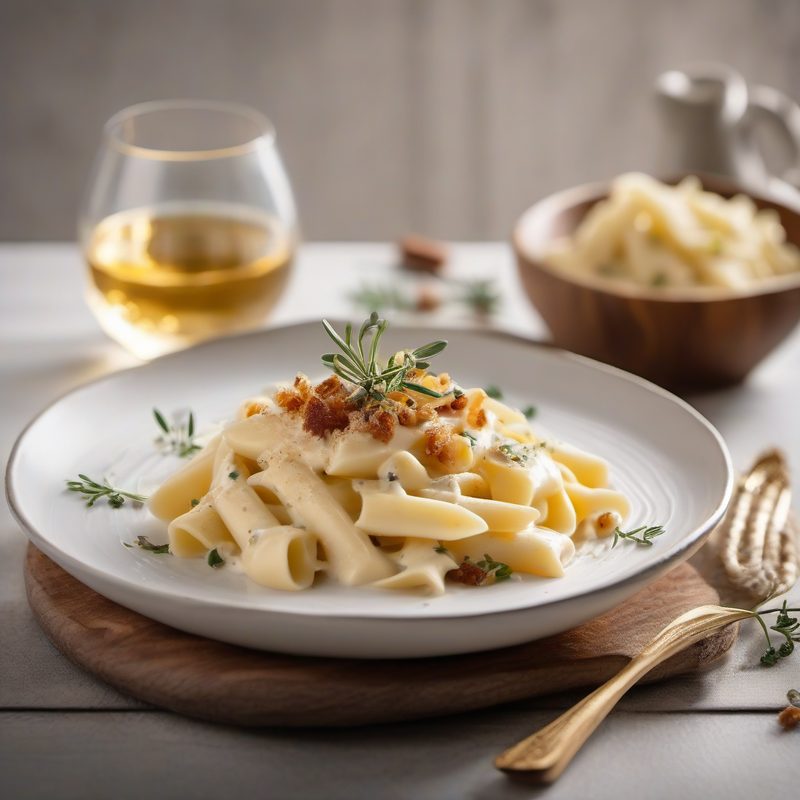
Pasta Potato Cream Brie Guanciale
Silky potato cream, a velvety brie fondue, and crispy guanciale come together in a pasta dish that's greater than the sum of its simple parts — an exercise in layering flavors and textures that transforms everyday ingredients into something memorable.
| Amount | Ingredient |
|---|---|
| 12 oz (340 g) | Dried short pasta (rigatoni, penne, or mezze maniche) |
| 1½ tbsp | Kosher salt (for pasta water) |
| ½ cup (120 ml) | Reserved pasta cooking water |
| 2 tbsp | Reserved guanciale fat (from rendering) |
| 2 tbsp | Fresh chives, thinly sliced (for garnish) |
Pasta con Crema di Patate, Brie e Guanciale
This is pasta technique as architecture: three separate components built in parallel, then assembled at the last minute. First, a potato cream — onion softened in olive oil, sliced potatoes simmered in vegetable broth until tender, then blitzed into a silky purée. Second, a brie fondue — milk heated just below a simmer, cubes of brie stirred in until they melt into a luscious, creamy sauce, then blended for an impossibly smooth finish. Third, guanciale — the cured pork cheek, with its peppercorn-dotted rind, sliced into strips and rendered slowly from a cold pan until deep golden and shatteringly crisp. The assembly is where the magic happens: the pasta water and reserved guanciale fat bind the potato cream to the noodles, the brie fondue is spooned on top like a sauce blanket, and the crispy guanciale provides textural contrast in every bite. At roughly 580 calories per generous serving, it's indulgence with purpose — every element earning its place on the plate.
For the Potato Cream
For the Brie Fondue
For the Guanciale
For the Pasta and Assembly
Use level tablespoons and standard US measuring cups. All produce is medium unless specified.
🥘 Equipment
- Large chef's knife
- Cutting board
- Large saucepan or Dutch oven (4-quart, for potato cream)
- Immersion blender or counter blender
- Small saucepan (for brie fondue)
- Whisk
- Large skillet or sauté pan (12-inch, for guanciale)
- Large pot (6-quart or larger, for pasta)
- Slotted spoon or spider strainer
- Wooden spoon or silicone spatula
- Paper towels
- Measuring cups and spoons
- Colander
- Kitchen shears or small sharp knife (for removing guanciale rind)
📋 Preparation
Step 1 — Make the Potato Cream (15 minutes)
Heat the olive oil in a large saucepan over medium heat. Add the finely diced onion and cook, stirring occasionally, until softened and translucent — about 5 minutes. Do not let it brown.
Add the sliced potatoes and vegetable broth. The broth should just barely cover the potatoes — add a splash of water if needed. Season with ½ teaspoon salt and ¼ teaspoon pepper.
Bring to a simmer over medium-high heat, then reduce the heat to medium-low, cover, and cook until the potatoes are very tender and fall apart when pierced with a fork — about 10 minutes.
Remove from heat. Using an immersion blender (or carefully transferring to a counter blender), purée the mixture until completely smooth and velvety. The consistency should be thick enough to coat the back of a spoon but not pasty. If it's too thick, add warm broth 1 tablespoon at a time and blend again. Cover and set aside.
The smoother the purée, the more luxurious the final dish. Take an extra 30 seconds to make sure there are no lumps.
Step 2 — Make the Brie Fondue (10 minutes)
In a small saucepan, warm the milk over medium heat until it reaches about 80°C / 175°F — steaming with small bubbles forming around the edges but not boiling. This takes about 3 minutes.
Reduce the heat to low. Add the brie cubes (with rind removed) and stir gently and continuously with a whisk or silicone spatula until the brie is fully melted and the mixture is smooth — about 3 to 4 minutes.
Remove from heat. Using an immersion blender or transferring to a counter blender, blend until luxuriously smooth. Season with a pinch of salt and pepper.
Transfer the brie fondue to a small bowl or liquid measuring cup. Cover and set aside. It will thicken slightly as it cools — that's fine; it will loosen when spooned over the hot pasta.
The key is low heat and constant stirring. High heat will cause the brie's proteins to seize and the fondue to turn grainy. Patience rewards you with liquid velvet.
Step 3 — Render the Guanciale (8 minutes)
Place the guanciale on a cutting board. Using a small sharp knife, carefully trim away and discard the peppercorn-coated rind — it's tough and won't render. Cut the guanciale crosswise into ¼-inch thick strips (batons about 1½ inches long).
Place the guanciale strips in a cold 12-inch skillet — do not preheat the pan. Set the skillet over medium heat and cook, stirring occasionally, until the fat renders and the meat turns deep golden brown and crisp — about 5 to 6 minutes. The cold-start method ensures the fat renders fully before the meat burns.
Use a slotted spoon to transfer the crispy guanciale to a paper-towel-lined plate. Reserve the rendered fat in the skillet — there should be about 2 to 3 tablespoons. Set aside.
Starting the guanciale in a cold pan is essential. A hot pan would sear the outside before the fat has a chance to render, leaving you with greasy, chewy meat instead of crisp, dry bits.
Step 4 — Cook the Pasta (10 minutes)
While the guanciale renders, bring a large pot of water to a rolling boil. Add 1½ tablespoons kosher salt — the water should taste like the sea.
Add the pasta and cook according to package directions until al dente — typically 9 to 11 minutes for most short pasta shapes.
Reserve 1 cup of the starchy pasta cooking water before draining. Drain the pasta well (do not rinse).
Step 5 — Assemble and Finish (3 minutes)
Reheat the potato cream in its saucepan over medium-low heat, stirring occasionally. Stir in 2 tablespoons of the reserved guanciale fat — this enriches the cream and infuses it with porky flavor.
Add the drained pasta directly to the potato cream. Add ¼ cup of the reserved pasta water and toss vigorously with a wooden spoon or silicone spatula until the pasta is evenly coated and the cream has loosened to a nappe consistency. If the sauce seems tight, add more pasta water 1 tablespoon at a time, tossing after each addition.
Divide the pasta among warm bowls. Spoon the brie fondue generously over each portion — about 3 to 4 tablespoons per serving. Top with the crispy guanciale and a shower of sliced chives. Serve immediately.
The pasta should be glossy and well-coated before the brie goes on — think of the brie fondue as a sauce blanket rather than a mixing component. The contrast between the earthy potato cream, the tangy brie, and the salty crunch of guanciale is what makes this dish sing.
🧑🍳 Chef's Tips
- Choose the right potato. Yukon Golds are ideal — they're naturally creamy and waxy enough to produce a silky purée without becoming gluey. Russets work well too but require more careful blending (they can turn gummy if overworked).
- Remove the brie rind. The white bloomy rind doesn't melt smoothly and will leave chewy bits in your fondue. Chill the brie for 10 minutes before cubing — it's much easier to cut cleanly when firm.
- Don't rush the guanciale. Low and slow in a cold pan is the only way. If you're impatient, the fat won't render fully and the meat will be chewy. If you're patient, you'll be rewarded with shatteringly crisp bits that stay crunchy even on top of hot pasta.
- Save that fat. The guanciale fat is liquid gold — don't discard it. Stirring it into the potato cream adds depth and binds the sauce to the pasta. Leftover fat keeps indefinitely in the fridge and is incredible for roasting vegetables or frying eggs.
- Warm the bowls. This dish cools quickly once plated. Warm your serving bowls in a 200°F oven for 5 minutes or fill them with hot water while the pasta cooks.
- Taste your guanciale before seasoning. Guanciale is cured and quite salty — the rendered fat will carry that salt into the potato cream, so go easy on additional salt until the very end.
❌ Common Mistakes
| Mistake | Why It Hurts | The Fix |
|---|---|---|
| Overcooking the brie fondue | High heat causes the cheese proteins to seize, turning the fondue grainy and stringy instead of silky. | Heat the milk to 80°C (steaming, not boiling), then stir in the brie over low heat. Off heat immediately once melted. |
| Leaving the guanciale rind on | The rind doesn't render and leaves tough, inedible pieces in the finished dish. | Trim the rind away before cutting the guanciale. |
| Blending the potato cream when too hot | The blender can explode from steam pressure or create a dangerously hot splatter. | Let the potato mixture cool for 2 minutes before blending. Remove the center cap of a counter blender and cover with a kitchen towel. |
| Using water instead of broth for the potatoes | Water produces a flat, one-dimensional potato cream with no depth. | Vegetable broth adds a savory backbone that complements the rich brie and salty guanciale. |
| Adding pasta water too aggressively | Too much liquid turns the potato cream into a soup that pools at the bottom of the bowl. | Add pasta water 1 tablespoon at a time, tossing after each addition. Stop when the pasta is glossy and the cream coats without running. |
| Skipping the reserved guanciale fat | The potato cream stays lean and separates from the pasta instead of coating it. | The fat emulsifies with the potato cream and starch, creating a sauce that clings. Don't skip it. |
💡 Variations
| Variation | How To |
|---|---|
| Swap the Cheese | Replace brie with Camembert, Taleggio, or a soft-ripened goat cheese. Each will change the character — Camembert is mildest, Taleggio is pungent, goat cheese adds tang. |
| Herb Swap | Replace chives with snipped fresh tarragon, basil ribbons, or flat-leaf parsley. Tarragon's anise note is lovely with brie. |
| Add Vegetables | Sauté 6 oz of sliced cremini mushrooms with the onion in Step 1, or stir 1 cup of blanched asparagus tips into the finished dish alongside the guanciale. |
| Make it Vegetarian | Omit the guanciale. Add 1 tablespoon of butter and a splash of olive oil to the skillet, then toast ½ cup of panko breadcrumbs with salt and pepper until golden for a crispy topping. Add 1 teaspoon of smoked paprika to the potato cream for a hint of the missing smokiness. |
| Spicy Kick | Stir ½ teaspoon of red pepper flakes into the potato cream along with the guanciale fat. The heat cuts through the richness of the brie. |
| Richer Version | Replace half the milk in the brie fondue with heavy cream. The fondue will be even more luscious and spoonable. |
| Truffle Finish | Drizzle a few drops of truffle oil over each serving just before serving. Earthy truffle and earthy potato cream are a perfect match. |
❄️ Storage & Leftovers
| Method | Details |
|---|---|
| Refrigerator | Store components separately (pasta with potato cream, brie fondue, guanciale) in airtight containers for up to 2 days. The potato cream will absorb into the pasta overnight, softening it. |
| Reheating | The pasta will be softer on reheating — this is best treated as a pasta bake the next day. Transfer to a baking dish, dot with the brie fondue, cover with foil, and bake at 350°F for 15 minutes. Uncover, top with guanciale, and bake 5 more minutes until hot. |
| Freezer (Brie Fondue Only) | Brie fondue freezes surprisingly well. Pour into a freezer-safe container and freeze for up to 1 month. Thaw overnight in the fridge and reheat gently over low heat, whisking to re-emulsify. |
🍷 Wine Pairing
| Wine | Why |
|---|---|
| Soave Classico (Veneto) | A crisp, medium-bodied white with almond and lemon zest notes. Its bright acidity cuts through the richness of the brie and potato cream, while its subtle nuttiness echoes the guanciale. |
| Verdicchio dei Castelli di Jesi | Mineral-driven with a saline finish that mirrors the saltiness of the guanciale. The lemon-curd fruitiness complements the creamy brie without overwhelming it. |
| Gavi di Gavi (Piedmont) | A steely, elegant white from Cortese grapes. Its mouthwatering acidity and subtle green-apple flavors refresh the palate between bites of rich, creamy pasta. |
| Chardonnay (Unoaked) | A clean, unoaked Chardonnay (from Chablis, Alto Adige, or Oregon) provides enough body to stand up to the brie while its acidity keeps the dish from feeling heavy. |
| Pinot Nero / Pinot Noir (Light) | If you prefer red, go for a light, chilled Pinot Nero from Alto Adige or a basic Bourgogne Rouge. Serve slightly cool (55°F) to emphasize bright red fruit and acidity over tannin. |
🥗 Suggested Side Dishes
- Simple arugula salad with lemon vinaigrette and shaved Parmigiano-Reggiano — the peppery greens and bright acidity balance the richness
- Sautéed broccolini with garlic and red pepper flakes — the slight bitterness cuts through the creamy sauce
- Grilled asparagus with lemon zest and olive oil
- Fennel and orange salad with black olives — the licorice notes and citrus are a surprising but perfect match for brie
- Roasted cherry tomatoes with fresh thyme — a burst of acidity and sweetness in every other bite
- Crusty sourdough or ciabatta — because you won't want to leave a drop of sauce behind
📊 Nutrition (per serving, estimated)
| Calories | Protein | Fat | Carbs | Fiber |
|---|---|---|---|---|
| 585 | 22 g | 28 g | 58 g | 4 g |
❓ Frequently Asked Questions
Can I use a different potato variety?
Yes, but adjust your expectations. Yukon Golds produce the silkiest, most luxurious cream. Russets work but need careful blending — overworking them releases too much starch and can make the cream gluey. Red or waxy potatoes won't break down as smoothly; they'll produce a slightly grainy cream that's still delicious but less elegant.
Does the brie need to be at room temperature?
Cold brie is easier to cube (chill it for 10 minutes before cutting) but the melting step works fine either way. The key is low heat and constant stirring — the brie will melt into the warm milk regardless of starting temperature.
What if I don't have an immersion blender?
A counter blender works perfectly for both the potato cream and the brie fondue. For the potato cream, let it cool for 2 minutes, then transfer to the blender in batches (fill no more than halfway). Remove the center cap from the lid and cover with a folded kitchen towel to let steam escape. For the brie fondue, the blender isn't strictly necessary — you can whisk it vigorously until smooth, but the blender guarantees a velvety texture.
Can I use bacon instead of guanciale?
Bacon works in a pinch but changes the dish significantly. Bacon is smoked and often sweet-cured, which introduces flavors that compete with the delicate brie and potato cream. Pancetta is a much better substitute — it's unsmoked cured pork belly that behaves similarly to guanciale. If using bacon, choose a low-sugar, thick-cut variety and cook it slightly longer to ensure it's truly crisp.
The guanciale fat splattered everywhere. What did I do wrong?
You likely started with a hot pan rather than a cold one. The cold-start method allows the fat to render gently before any moisture in the meat turns to steam and causes splattering. Also, cut the guanciale into uniform strips so they render evenly.
Can I make the potato cream and brie fondue ahead of time?
Yes. Both can be made up to 24 hours in advance and refrigerated separately. Reheat the potato cream gently over medium-low heat, adding a splash of broth to loosen it. Reheat the brie fondue over low heat, whisking constantly — add a splash of milk if it's too thick.
My brie fondue turned grainy. Can I fix it?
Sometimes. If the brie was overheated and the proteins seized, try blending it with an immersion blender — this can re-emulsify a slightly grainy fondue. If it's very grainy, whisk in 1 tablespoon of cold milk or cream while blending. If it's truly broken (oily and separated), unfortunately it can't be saved — start over with gentle heat next time.
🔗 Related Recipes
- Ricotta Gnocchi with Peas, Pecorino, and Guanciale — page 42
- Pasta alla Gricia (Guanciale, Pecorino, and Black Pepper)
- Carbonara with Brie and Asparagus
- Creamy Fava Bean Pasta — page 41
- Penne with Gorgonzola Cream and Toasted Walnuts
- Pasta del Carcerato (Prison-Style Pasta with Caciocavallo and Guanciale) — page 44
🏷️ Search Tags
| Photo | Notes |
|---|---|
| `vol1_47.png` | A wide, shallow bowl of short pasta glistening in a pale golden potato cream, artfully drizzled with creamy white brie fondue and scattered with irregular shards of crispy deep-golden guanciale. Fresh green chive batons provide color contrast. Rustic cream-colored ceramic bowl, warm golden-hour lighting, shallow depth of field with steam rising. |
Recipe from "The Italian Kitchen" by Vita Milanese — Volume 1: Pasta Perfetto
Recipe from The Italian Kitchen by Vita Milanese — Volume 1 · Pasta Perfetto. Discover all volumes on the ebook page.