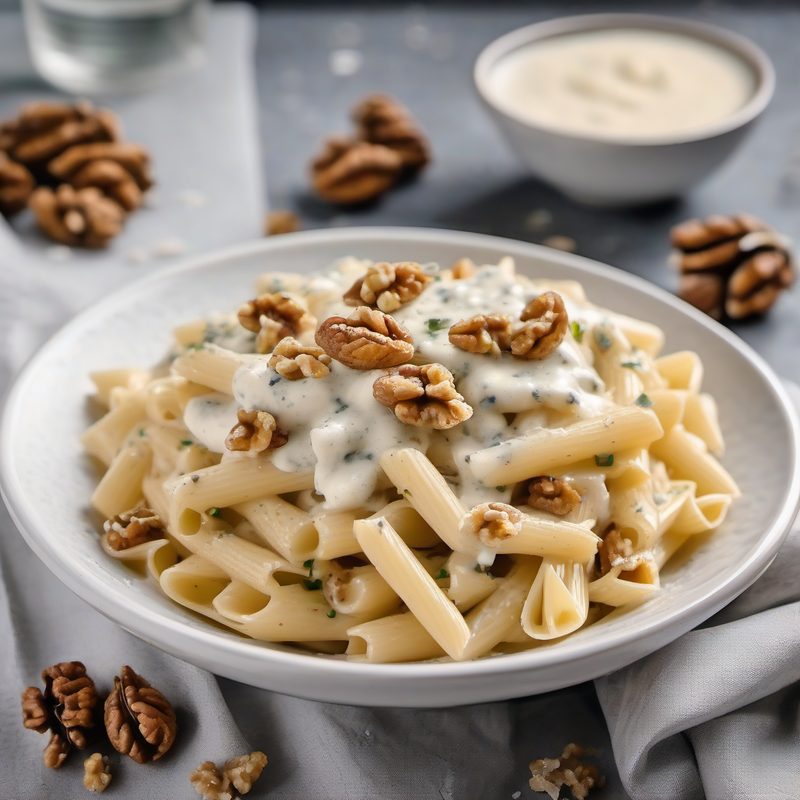
Fettuccine Alfredo
A perfect nest of golden, hand-cut fettuccine sits in a pool of silky, emulsified butter-and-cheese sauce — nothing but fresh pasta, butter, Parmigiano-Reggiano, and a splash of starchy pasta water, transformed by technique into one of Rome's most iconic and imitated dishes.
What Is Fettuccine Alfredo?
Fettuccine Alfredo is a Roman pasta dish of golden, hand-cut fettuccine in a silky sauce made from only three ingredients: butter, Parmigiano-Reggiano and starchy pasta water. Tossing hot pasta with butter and grated cheese until it emulsifies creates the creamy texture — the original contains no cream. It is best served immediately, straight from the pan.
| Amount | Ingredient |
|---|---|
| 6 tbsp (80 g) | Unsalted butter, softened, cut into ½-inch (12 mm) pieces |
| ¾ cup (80 g) | Parmigiano-Reggiano, finely grated (plus more for serving) |
| Fine sea salt | |
| Freshly ground black pepper |
There are few dishes in the Italian repertoire as deceptively simple as fettuccine Alfredo — and few as frequently misunderstood. The version that became famous in America (heavy cream, garlic, countless additions) bears almost no resemblance to the original Roman creation: a purely alchemical emulsion of high-quality butter, aged Parmigiano-Reggiano, and the impossibly starchy water from cooking fresh egg pasta. No cream. No garlic. No parsley. Just technique, temperature, and the vigorous wrist-work of a confident cook. The fresh fettuccine — made from just flour and eggs — is rolled thin, cut into elegant ribbons, boiled for barely two minutes, and then tossed in a warm bowl with melting butter and showered with grated Parmigiano. The key is the pasta water: its abundant starch, released from the fresh egg noodles, binds the butter and cheese into a creamy, clingy sauce that coats every strand. The result is rich without being heavy, luxurious without being complicated — the kind of pasta that makes you close your eyes on the first bite. It demands the best butter you can find, a genuine Parmigiano-Reggiano (not the green-can stuff), and the patience to make your own pasta. But in return, it offers a purity of flavor that explains why, after more than a century, this Roman classic endures.
The fresh pasta dough requires 30 minutes of resting time, during which the gluten relaxes and the dough becomes supple enough to roll thin. The actual cooking and assembly take only 5 minutes — the entire dish goes from cutting board to table in under 10 once the dough is ready. This is a dish of patience rewarded by speed.
For the Fresh Fettuccine
For the Sauce
Use the best unsalted butter you can find — European-style (82% butterfat or higher) makes a noticeably richer, creamier emulsion. Parmigiano-Reggiano must be grated from a wedge just before using; pre-grated cheese contains anti-caking agents that prevent smooth emulsification. The eggs should be at room temperature (about 70°F / 21°C) for the dough — cold eggs tighten the gluten and make the pasta tougher to roll.
🥘 Equipment
- Kitchen scale (preferred for accuracy, especially for flour)
- Large wooden cutting board or clean countertop for kneading
- Chef's knife and cutting board
- Bench scraper (useful for cleaning the work surface and dividing dough)
- Large pot (6 to 8 qt / 6 to 8 L) for pasta
- Pasta machine (manual or electric, optional but highly recommended)
- Rolling pin (if working by hand)
- Large, wide, warm bowl for tossing (ceramic or stainless steel — warm it first)
- Colander or spider strainer
- Tongs
- Measuring cups and spoons
- Microplane or fine grater (for the Parmigiano)
- Plastic wrap or a damp kitchen towel (for resting the dough)
- Pasta drying rack or lightly floured baking sheet (for the cut fettuccine)
📋 Preparation
Step 1 — Make the Fresh Pasta Dough (15 minutes)
On a clean countertop or large wooden board, mound the flour and create a wide, deep well in the center — the well should be large enough to hold all the eggs without overflowing (about 5 inches / 12 cm across and 2 inches / 5 cm deep).
Crack the eggs into the center of the well. Add a small pinch of fine sea salt (about ¼ teaspoon). Using a fork, gently beat the eggs, gradually pulling flour from the inner walls of the well into the eggs — work in small increments, being careful not to breach the outer wall of the flour ring. As the mixture thickens, incorporate more flour until a shaggy, ragged dough forms and the eggs are no longer liquid.
When the dough is too stiff to mix with the fork, use your hands to bring it together, pressing and folding until all the flour is incorporated. The dough will be quite stiff and slightly dry — this is correct. Scrape the counter clean with a bench scraper and discard any dried bits of flour.
This is the classic "fontana" (fountain) method for fresh egg pasta. The well must be deep and its walls strong — a collapsed well means eggs running across the counter and a messy cleanup. Work slowly and deliberately; rushing at this stage creates lumps that take extra kneading to smooth out. A stand mixer with a dough hook can be used instead (mix on low speed for 3 to 4 minutes), but hand-kneading gives better tactile feedback for judging hydration.
Step 2 — Knead the Dough (8 to 10 minutes)
Knead the dough by pushing it away from you with the heel of your hand, folding it back over itself, giving it a quarter-turn, and repeating. This classic French-style kneading develops the gluten network that gives fresh pasta its characteristic tender-yet-springy texture.
The dough will start rough, shaggy, and slightly dry-looking. After 3 to 4 minutes, it will begin to smooth out and become more cohesive. After 8 to 10 minutes of continuous kneading, it should be completely smooth, silky, and slightly firm — it should feel like a soft earlobe when pressed, and it should spring back slowly when poked. If the dough feels dry and cracks at the edges when folded, mist it lightly with water (about ½ teaspoon at a time) and knead until absorbed. If it feels sticky, dust lightly with flour.
Shape the dough into a ball, then flatten it into a disk about 1 inch (2.5 cm) thick — this shape will roll out more evenly than a ball.
Proper kneading is essential for fresh pasta. Under-kneaded dough tears when rolled thin; over-kneaded dough becomes tough and rubbery. The 8-to-10-minute mark is the sweet spot: the dough should feel supple, smooth, and slightly elastic. If you're using a stand mixer with a dough hook, knead on medium-low speed for 6 to 8 minutes — the dough should pull away from the sides of the bowl and form a clean ball around the hook.
Step 3 — Rest the Dough (30 minutes, inactive)
Wrap the dough disk tightly in plastic wrap or cover it with an inverted bowl (the bowl must be large enough to not touch the dough). Let it rest at room temperature for 30 minutes.
During this rest, the gluten relaxes, the flour fully hydrates, and the dough becomes significantly more pliable — a well-rested dough rolls thin without springing back.
This rest is non-negotiable. Dough that has not rested will fight you at every turn of the rolling pin or pasta machine — it will spring back, tear, and refuse to reach the thinness needed for delicate fettuccine. If the room is warm (above 80°F / 27°C), rest for 25 minutes; if cool (below 65°F / 18°C), rest for 40 minutes. The dough should be cool to the touch but not chilled.
Step 4 — Roll the Pasta (10 minutes)
If using a pasta machine (recommended):
Divide the rested dough into 4 equal pieces. Work with one piece at a time, keeping the remaining pieces covered with plastic wrap or a damp towel to prevent drying.
Flatten one piece with your palm into a rough rectangle about ¼ inch (6 mm) thick — this shape feeds more cleanly into the machine than an oval.
Set the pasta machine to its widest setting (usually #1 or #0). Feed the dough through. Fold the strip in thirds (like a letter), rotate it 90 degrees, and feed it through again at the same setting. Repeat this folding-and-feeding process 3 to 4 times to build an even, rectangular sheet.
Without folding, feed the dough through the machine once at each progressively narrower setting, without skipping settings:
- Two passes at the second-widest setting
- One pass at each subsequent setting until you reach setting #6 (or the second-narrowest setting on a 7- or 9-setting machine)
The final sheet should be thin enough to see your hand through — about ¹⁄₁₆ inch (1.5 mm) thick. Lay the sheet on a lightly floured surface and cut into 12-inch (30 cm) lengths. Transfer to a floured baking sheet or drying rack. Repeat with the remaining dough pieces.
If rolling by hand:
On a lightly floured surface, roll the dough from the center outward, rotating and flipping frequently, until you can see your hand through the sheet. This takes practice and a strong, even pressure — aim for a circle or oval about ¹⁄₁₆ inch (1.5 mm) thick. Dust with flour as needed to prevent sticking.
The folding-and-feeding passes at the widest setting (sometimes called "laminating") are crucial for producing a smooth, even sheet with no air bubbles or thin spots. If the edges of the pasta sheet are ragged or cracked, trim them with a knife or pizza cutter before moving to thinner settings — ragged edges become weak points that can tear. If the sheet sticks to the machine rollers, dust it very lightly with flour; if it starts to feel tacky, let it dry for 30 seconds before the next pass.
Step 5 — Cut the Fettuccine (5 minutes)
Switch the pasta machine to the fettuccine cutter attachment (about ¼ inch / 6 mm wide). Feed each rolled sheet through the cutter, supporting the emerging ribbons with your hand to prevent tangling.
If cutting by hand, lightly flour the rolled sheet, then loosely roll it up into a loose cylinder (like a jelly roll). Using a sharp chef's knife, cut crosswise into ¼-inch (6 mm) wide strips. Immediately unroll and separate the strands, tossing them lightly with flour to prevent sticking.
Spread the cut fettuccine in a single layer on a lightly floured baking sheet or pasta drying rack. Do not let the strands touch each other — they will stick together as they dry. The fettuccine can be cooked immediately or left to dry at room temperature for up to 1 hour. If drying longer, toss with additional flour and refrigerate for up to 24 hours.
Fresh fettuccine cooks much faster than dried — just 2 to 3 minutes in boiling water. The thin, delicate ribbons need careful handling to avoid clumping. If the cut pasta seems sticky, dust generously with flour and let it air-dry for 10 to 15 minutes before cooking. For perfectly even strands, trim the ends of the rolled sheet square before cutting — this eliminates the tapered ends that cook unevenly.
Step 6 — Cook the Fettuccine (3 minutes)
Bring a large pot of generously salted water (about 1½ tablespoons kosher salt per 4 quarts / 4 liters of water) to a rolling boil over high heat.
While the water comes to a boil, prepare the sauce components:
Warm a large, wide serving bowl by filling it with hot tap water for 30 seconds, then drying it thoroughly. Place the softened butter pieces in the warm bowl — the residual heat will begin to melt them gently.
Drop the fresh fettuccine into the boiling water. Stir gently with tongs or a wooden spoon to separate the strands — fresh pasta tends to sink and stick to the bottom of the pot. Cook for 2 to 3 minutes. The pasta is done when it is tender but still has a faint white core when bitten (the very center should show just a hairline of white — this means the pasta is perfectly al dente and will finish cooking in the bowl).
Fresh egg pasta floats to the surface when it's nearly done. Begin checking at the 90-second mark: fish out a strand, let it cool for 5 seconds, and bite it. It should be tender with a slight resistance at the center — what Italians call al dente. The cooking water for fresh pasta should taste pleasantly salty, like the sea. Undersalting produces flat pasta that no amount of cheese can fix.
Step 7 — Sauce and Serve (2 minutes)
Using tongs or a spider strainer, lift the fettuccine directly from the pot into the warm bowl with the butter. Reserve about 1 cup (240 ml) of pasta cooking water before draining.
Working quickly and confidently, toss the hot pasta with the melting butter using tongs — lift, flip, and turn the pasta repeatedly for about 30 seconds. The heat from the pasta will fully melt the butter. Add about ½ cup (120 ml) of the reserved pasta water and continue tossing.
Sprinkle the grated Parmigiano-Reggiano over the pasta in three additions, tossing vigorously between each addition. As you toss, the cheese will melt into the butter-and-water mixture, transforming from a granular mass into a silky, emulsified cream that coats every strand. This should take about 45 to 60 seconds of continuous tossing.
If the sauce looks too thick and clumpy rather than creamy and flowing, add more pasta water 1 tablespoon at a time and toss until the sauce relaxes into a smooth, glossy emulsion. If it looks thin or watery, add another tablespoon of Parmigiano and toss — the cheese will thicken and bind the sauce.
Season with a generous grind of fresh black pepper (about ½ teaspoon) and toss once more. Taste a strand — it should be coated in a velvety, cheesy-buttery sauce that clings to the pasta rather than pooling at the bottom of the bowl. Adjust salt only if needed (the cheese and pasta water provide considerable salinity).
Serve immediately in warmed bowls, twirling each portion into a neat nest. Top each serving with a generous shower of additional grated Parmigiano-Reggiano and an extra grind of fresh black pepper.
The technique here is everything: the hot pasta must go into the butter immediately — every second of delay means less heat to melt the butter and melt the cheese. Toss with authority: a gentle stir won't emulsify the sauce. You need the vigorous, lifting, flipping motion that incorporates air and creates the creamy emulsion. If the sauce breaks (turns greasy and separates), add a tablespoon of cold water and toss vigorously — the temperature shock can re-emulsify the sauce. This is not a forgiving dish to reheat, so serve it the moment it's ready and eat it immediately.
🧑🍳 Chef's Tips
- Use fresh pasta — it's not optional. Fettuccine Alfredo was invented for fresh egg pasta, and dried pasta simply doesn't release enough starch to create the proper emulsion. If you absolutely cannot make fresh pasta, use the highest-quality dried egg fettuccine you can find (like De Cecco or Rustichella d'Abruzzo) and cook it in less water than usual (about 3 quarts / 3 liters instead of 4) to concentrate the starch. Reserve a full cup of cooking water.
- Warm the serving bowl thoroughly. This is the single most important preparation step. A cold bowl saps heat from the pasta instantly, and without sufficient heat the butter won't stay melted, the cheese won't melt, and the emulsion will never form. Fill the bowl with boiling water for 30 seconds, dump, and dry — the bowl should be almost too hot to touch comfortably.
- Grate Parmigiano-Reggiano from a wedge, just before using. Pre-grated cheese is coated with cellulose or potato starch to prevent caking — these additives prevent the cheese from melting smoothly into the sauce. You need the real thing: a genuine Parmigiano-Reggiano wedge with the rind stamp. Finely grate it on a Microplane or the fine side of a box grater. The finer the grate, the more quickly and evenly it melts.
- Use European-style butter for a richer emulsion. Standard American butter (80% butterfat) works, but European-style butter (82 to 84% butterfat) contains less water and produces a noticeably silkier, more stable sauce. Plugrà, Lurpak, Kerrygold, or Président are widely available. Let it soften to room temperature before starting.
- Don't overdry the cut pasta. Fresh fettuccine should be cooked within an hour of cutting for the best texture. If left to dry completely, it becomes brittle and loses the tender, silky character that makes fresh pasta special. If you must make it ahead, refrigerate the cut, floured pasta in a sealed container for up to 24 hours — but expect a slightly firmer, less delicate result.
- Reserve more pasta water than you think you need. The starch content of fresh pasta water is the key to the emulsion — it acts as a binder between the butter fat and the cheese proteins. Save at least 1 cup (240 ml). If the sauce breaks or looks greasy, a splash of this starchy water can bring it back.
- Work at the table if possible. The classic Roman presentation involves bringing the warm bowl, the just-drained pasta, the butter, and the cheese to the table and tossing everything in front of the guests. The theater is part of the experience, and the immediacy ensures the pasta is at its absolute peak.
- Pepper is not optional. Freshly ground black pepper provides the aromatic, slightly spicy counterpoint that cuts through the rich butter-and-cheese sauce. Don't be shy — a generous grind is traditional and essential.
❌ Common Mistakes
| Mistake | Why It Hurts | The Fix |
|---|---|---|
| Using dried pasta instead of fresh | Dried pasta releases far less starch into the cooking water; without sufficient starch, the butter and cheese cannot emulsify properly and the sauce separates into a greasy puddle | Use fresh egg pasta — homemade or high-quality store-bought. If using dried, concentrate the starch by cooking in less water (3 qt / 3 L) and reserve a full cup of cooking water |
| Adding cream | This is the most common deviation from the authentic recipe — cream dilutes the pure butter-and-cheese flavor and makes the sauce heavy instead of luscious. Classic Alfredo has no cream whatsoever | Omit the cream entirely. Trust the emulsion: hot pasta water + butter + Parmigiano vigorously tossed creates a sauce that is creamy without a drop of cream |
| Using cold butter straight from the fridge | Cold butter doesn't melt evenly on contact with the pasta, leading to uneven coating and a greasy, broken sauce | Cut the butter into small pieces and let it come to room temperature (about 30 minutes). Place it in the warmed serving bowl so it softens further before the pasta arrives |
| Skimping on the Parmigiano-Reggiano | The cheese provides both flavor and structure — too little results in a thin, watery sauce that doesn't cling to the pasta | Use the full 80 g (about ¾ cup, finely grated). The cheese-to-pasta ratio in authentic Alfredo is generous — this is not a dish for penny-pinching |
| Tossing gently instead of vigorously | The emulsion requires mechanical action — gentle stirring won't incorporate air and won't break the cheese into the butter-water mixture | Toss with authority: lift, flip, and turn the pasta continuously for a full 60 to 90 seconds. The motion should be similar to tossing a salad, but faster and more forceful |
| Letting the pasta sit before saucing | Every second of delay means lost heat. The butter needs the pasta's residual heat to melt, and the cheese needs the butter's heat to melt — a chain that breaks if the pasta cools | Set your timing so the pasta goes directly from the pot into the butter in the warm bowl. Have everything ready — cheese grated, bowl warmed, pepper ground — before you drop the pasta |
| Oversalting the pasta water | The Parmigiano-Reggiano is already salty; overly salty pasta water plus salty cheese can make the dish inedible | Use 1½ tablespoons kosher salt per 4 quarts of water — this is the standard, and it's enough. If using fine table salt, reduce to 1 tablespoon |
| Serving on cold plates | The sauce begins to set and cool the moment it hits a cold surface. Within a minute, the creamy emulsion turns gluey and the pasta clumps | Warm the serving bowls by filling them with hot water for 30 seconds, then drying. Stack them or cover to retain heat |
| Reheating leftovers | Fettuccine Alfredo does not reheat well — the emulsion breaks, the cheese turns grainy, and the pasta becomes soft | Make only as much as you'll eat in one sitting. If you must have leftovers, reheat in a nonstick skillet over medium-low heat with a splash of water or milk, tossing constantly — it will never regain its original silkiness |
| Using pre-grated cheese from a bag | Cellulose and anti-caking coatings prevent the cheese from melting smoothly into the sauce. The result is a grainy, clumpy sauce instead of a silky emulsion | Always grate Parmigiano-Reggiano from a wedge, just before using, on a Microplane or fine grater |
💡 Variations
| Variation | How To |
|---|---|
| Alfredo with Truffle (Alfredo al Tartufo) | Shave ¼ oz (7 g) of fresh black truffle over each serving just before bringing to the table. Alternatively, add 1 teaspoon of white truffle oil to the butter in the warm bowl before adding the pasta — the earthy, musky aroma elevates the simple butter-and-cheese base to something special-occasion worthy |
| Fettuccine al Burro e Salvia (Butter and Sage) | Melt the butter in a small skillet with 8 to 10 fresh sage leaves over medium heat until the butter foams and the sage becomes crisp (about 2 minutes). Pour the sage butter over the pasta before adding the Parmigiano. The sage's herbal, slightly peppery aroma complements the nutty cheese beautifully |
| Add Toasted Pine Nuts | Toast ¼ cup (35 g) pine nuts in a dry skillet over medium heat until golden and fragrant (3 to 4 minutes). Sprinkle over each serving for a nutty crunch that contrasts with the silky pasta |
| Fettuccine Alfredo with Prosciutto | Tear 4 oz (120 g) of prosciutto di Parma into ribbons and add to the warm bowl along with the butter — the residual heat will warm the prosciutto without cooking it. The salty, savory ham adds a second layer of umami that works beautifully with the Parmigiano |
| Lemon-Infused Alfredo | Add the finely grated zest of ½ an organic lemon to the butter in the warm bowl, and finish each serving with a squeeze of fresh lemon juice and extra black pepper. The bright citrus cuts through the richness and adds a fresh, unexpected lift |
| Alfredo with Peas (Alfredo con Piselli) | Add ½ cup (80 g) of frozen peas (thawed) to the pasta water in the final 30 seconds of cooking, then drain together. The sweet little peas add color, texture, and a pop of sweetness that complements the savory sauce |
| Pink Pepper Alfredo (Alfredo al Pepe Rosa) | Replace the black pepper with 1½ teaspoons of pink peppercorns, lightly crushed in a mortar. Pink peppercorns are fruitier, milder, and slightly sweet — they create a stunning visual contrast against the white-gold sauce and a more delicate aromatic profile |
| Gluten-Free Alfredo | Use homemade gluten-free fresh pasta (made with a blend of gluten-free flour, eggs, and xanthan gum) or high-quality dried gluten-free tagliatelle. The sauce itself is naturally gluten-free — the emulsion relies on starch from the pasta water, not the flour, so any starchy gluten-free pasta water will work |
| Alfredo con Gamberi (with Shrimp) | Sauté 8 oz (225 g) of peeled, deveined shrimp in 1 tablespoon of butter over high heat until just cooked through (about 2 minutes per side). Toss into the pasta along with the Parmigiano. The sweet shrimp and the rich cheese sauce are a classic Roman pairing |
| Carbonara-Adjacent Alfredo | Beat 2 egg yolks with ¼ cup (25 g) of additional Parmigiano. After tossing the pasta with butter and cheese, quickly stir in the egg yolk mixture off the heat — the residual heat cooks the yolks into an even richer, more custard-like sauce. This crosses into carbonara territory but creates a spectacularly luscious result |
❄️ Storage & Leftovers
| Method | Details |
|---|---|
| Refrigerator | Fettuccine Alfredo does not store gracefully — the emulsion breaks as it cools, leaving separated butter fat and clumpy cheese. If you must store leftovers, transfer to an airtight container and refrigerate for up to 2 days. The texture will be significantly compromised |
| Reheating (Skillet) | Reheat in a nonstick skillet over medium-low heat with a splash of water, milk, or cream (about 2 tablespoons per serving). Toss constantly with tongs for 2 to 3 minutes until warmed through. The sauce will re-emulsify partially but will never be as silky as the original |
| Reheating (Microwave) | Not recommended — the microwave heats unevenly, breaking the emulsion completely and turning the cheese grainy. If you must, microwave at 50% power in 30-second intervals, stirring between each, with a splash of milk |
| Freezing | Freezing is not recommended. The butter-fat emulsion shatters upon thawing, and the fresh pasta becomes mushy. The only component that freezes well is the raw, cut fettuccine (tossed in flour, in a sealed bag, for up to 1 month — cook directly from frozen, adding 30 seconds to the cooking time) |
| Raw Pasta Make-Ahead | The fresh fettuccine can be made up to 24 hours in advance. Cut and toss generously with farina 00 or semolina flour, spread in a single layer on a floured baking sheet, cover loosely with plastic wrap, and refrigerate. Cook directly from the refrigerator — do not bring to room temperature |
| Pasta Dough Make-Ahead | The fresh pasta dough can be wrapped tightly in plastic wrap and refrigerated for up to 24 hours. Let it sit at room temperature for 20 minutes before rolling (cold dough is stiff and harder to stretch). The dough can also be frozen for up to 1 month; thaw overnight in the refrigerator |
| Grated Parmigiano Make-Ahead | Grate the Parmigiano up to 1 day in advance and store it in an airtight container in the refrigerator. Bring to room temperature for 15 minutes before using. Do not grate more than 24 hours ahead — the cheese loses volatile aromatics over time |
🍷 Wine Pairing
| Wine | Why |
|---|---|
| Frascati Superiore (Lazio) | The classic Roman white for a classic Roman pasta. Made from Malvasia and Trebbiano grapes grown in the hills southeast of Rome, this straw-yellow wine offers notes of white peach, almond blossom, lemon zest, and a distinctive bitter-almond finish. Its medium body and bright acidity cut through the rich butter-and-cheese sauce without overwhelming the delicate pasta, while its subtle nuttiness echoes the aged Parmigiano-Reggiano. Serve well-chilled (48–50°F / 9–10°C) — the perfect temperature contrast for a hot, creamy pasta |
| Gavi di Gavi (Piedmont) | A crisp, mineral-driven white from the Cortese grape with notes of green apple, pear, citrus zest, and crushed stone. The bright, cleansing acidity provides a palate-cleansing counterpoint to the richness of the Alfredo sauce, while the subtle floral and almond notes harmonize with the nutty Parmigiano. A beautifully balanced pairing — the wine refreshes the palate between each creamy, cheesy bite |
| Soave Classico (Veneto) | A dry, elegant white from the Garganega grape — notes of white peach, bitter almond, lemon zest, and a distinctive saline-mineral finish. The bright acidity and almond note directly complement the butter and Parmigiano, while the saline finish refreshes the palate. A restrained, classic pairing that lets the pasta remain the star |
| Verdicchio dei Castelli di Jesi (Marche) | A white of remarkable structure and longevity — notes of lemon curd, green almond, chamomile, fennel, and crushed oyster shell. The wine's pronounced bitterness (a characteristic note of Verdicchio) acts as a palate cleanser against the creamy sauce, while its medium-plus body stands up to the rich butter and cheese without being overwhelmed. A surprising but superb match |
| Champagne or Franciacorta (Sparkling) | A brut-method sparkling wine — the tiny bubbles and high acidity cut through the richness of the Alfredo sauce like a knife through butter. The toasty, brioche notes in aged Franciacorta or Champagne echo the nutty, browned-butter character of the sauce. This pairing is unexpectedly luxurious: the fizz provides a textural contrast to the silky pasta, making each bite feel lighter and brighter than it is |
🥗 Suggested Side Dishes
- Simple arugula salad with lemon vinaigrette — Tender baby arugula tossed with a bright vinaigrette (3 parts extra-virgin olive oil, 1 part fresh lemon juice, a pinch of salt and pepper) and shaved Parmigiano-Reggiano. The peppery arugula and bright acidity cut through the rich Alfredo sauce and reset the palate for the next bite
- Roasted asparagus with olive oil and sea salt — Thin asparagus spears, trimmed, tossed with olive oil and flaky salt, roasted at 425°F (220°C) for 8 to 10 minutes until tender and lightly charred. The clean, grassy flavor of asparagus is a natural counterpoint to the creamy pasta
- Crusty bread with herbed olive oil — Warm, crusty ciabatta or sourdough served with a dish of extra-virgin olive oil infused with a sprig of fresh rosemary and a pinch of flaky salt. Essential for sopping up any remaining sauce from the bowl
- Fennel and orange salad — Thinly shaved raw fennel bulb tossed with orange supremes, a splash of white wine vinegar, extra-virgin olive oil, and a few black olives. The crisp, anise-flavored fennel and bright citrus provide a refreshing, palate-cleansing contrast to the rich pasta
- Grilled lemon-dressed zucchini — Zucchini sliced lengthwise into ¼-inch (6 mm) planks, grilled or griddled over high heat for 2 to 3 minutes per side until charred and tender, then dressed with lemon juice, olive oil, salt, and fresh mint. The charred, smoky flavor and bright lemon cut through the richness of the Alfredo
📊 Nutrition (per serving, estimated)
| Calories | Protein | Fat | Carbs | Fiber |
|---|---|---|---|---|
| ~665 | 24 g | 32 g | 72 g | 3 g |
Nutritional values are estimates based on 4 servings with 400 g fresh pasta dough (farina 00 and 4 eggs), 80 g unsalted butter, 80 g Parmigiano-Reggiano, plus an additional 20 g Parmigiano for garnish. Actual values will vary based on specific brands, the size of your eggs, and the exact amount of butter and cheese absorbed. Fresh egg pasta contains more protein and fat than dried pasta due to the eggs. This is a rich, indulgent main course; if serving as a primo (first course) in a larger meal, it will serve 6 with smaller portions (approximately 445 calories per serving). The fat content is primarily from butter and cheese — this is not a low-fat dish, and it's not meant to be. For a lighter version, reduce the butter to 4 tablespoons (60 g) and use ½ cup (50 g) of Parmigiano, though the texture and richness will be noticeably diminished.
❓ Frequently Asked Questions
What is the difference between Fettuccine Alfredo and Fettuccine al Burro?
Fettuccine al Burro (fettuccine with butter) is a simpler, less emulsified version — pasta tossed with melted butter and a modest sprinkling of Parmigiano. Fettuccine Alfredo is the evolved, more technical version: it uses a higher ratio of cheese to pasta, relies on vigorous tossing with starchy pasta water to create a full emulsion, and produces a creamy, clingy sauce rather than just melted butter coating the noodles. The difference is technique and proportion — Alfredo is al burro turned up to eleven.
Is it true that Fettuccine Alfredo isn't a real Italian dish?
This is a common misconception. Fettuccine Alfredo is absolutely a real Italian dish — it was invented in Rome in 1914 by Alfredo di Lelio at his restaurant on Via della Scrofa (now Il Vero Alfredo — "The Real Alfredo"). The story goes that Alfredo created the dish for his pregnant wife, who had lost her appetite; the simple, rich pasta restored her desire to eat. American tourists (including Mary Pickford and Douglas Fairbanks) fell in love with it and brought the idea home, where it was adapted with cream, garlic, and chicken — versions that are indeed not Italian. But the original, creamless fettuccine Alfredo is a genuine Roman tradition.
Can I use all-purpose flour instead of farina 00?
Yes. Farina 00 is an Italian finely milled, low-protein flour (about 8 to 9% protein) that produces tender, silky pasta. All-purpose flour (about 10 to 11% protein) works well but produces a slightly firmer, more elastic pasta. For a closer match to farina 00, use a blend of 75% all-purpose flour and 25% cake flour (which has lower protein). Do not use bread flour — its high protein content (12 to 14%) produces tough, rubbery pasta.
My sauce is clumpy and greasy instead of creamy — what went wrong?
The most likely culprit is insufficient tossing or insufficient starchy pasta water. The emulsion needs mechanical action (vigorous tossing) and a binder (starch from the pasta water) to bring the butter and cheese together. If the sauce is clumpy: add 1 to 2 tablespoons of hot pasta water and toss vigorously for 30 seconds. If the sauce is greasy: the butter and cheese are separated — add 1 tablespoon of cold water and toss immediately; the temperature shock can force re-emulsification. If neither works, transfer the pasta to a warm skillet over low heat, add ¼ cup of pasta water, and toss continuously — the gentle, even heat can salvage a broken sauce.
Why did my fresh pasta turn out tough and chewy?
Three possible reasons: (1) The dough was over-kneaded — 8 to 10 minutes is the maximum for hand-kneading, and the dough should be smooth but not tight. (2) The dough was rolled too thick — it should be thin enough to see your hand through. (3) The flour was too high in protein — use farina 00 or all-purpose, not bread flour.
Do I need a pasta machine?
A pasta machine makes rolling and cutting dramatically easier and more consistent, but it is not strictly necessary. With a long rolling pin, patience, and even pressure, you can roll fresh pasta by hand to the required thinness. It takes practice and about 15 minutes of rolling per batch, but many Italian home cooks do it this way. The fettuccine can be cut by hand with a sharp knife as described in Step 5.
Can I use salted butter?
You can, but reduce or omit the salt in the pasta water and in the final seasoning. European-style unsalted butter is preferred because it lets you control the salt level independently — the Parmigiano provides considerable saltiness on its own. If using salted butter, taste before adding any additional salt.
The pasta water I reserved is only mildly starchy — why?
Fresh egg pasta releases less starch into the cooking water than dried pasta (dried pasta sheds surface starch as it hydrates, while fresh pasta's starch is bound within the egg-and-flour structure). To compensate, cook the fettuccine in slightly less water than usual (about 3 quarts / 3 liters instead of 4) to concentrate the starch. You can also stir a heaping teaspoon of farina 00 or all-purpose flour into the reserved pasta water to boost its starch content — a trick used by many Roman trattorias.
What if I can't find farina 00?
All-purpose flour is an excellent substitute. The texture will be slightly firmer — the difference is noticeable only in a side-by-side comparison. Do not use self-rising flour (which contains leavening agents) or whole wheat flour (which makes heavy, dense pasta). For an even closer match, seek out "00" flour at Italian markets, specialty grocers, or online.
My fresh pasta stuck together while cooking — what happened?
The most common cause is insufficient flour on the cut fettuccine before cooking. Each strand should be lightly coated in flour (farina 00 or semolina) and separated. If left sitting too long before cooking, the moisture in the pasta causes the strands to fuse. To prevent this: toss the cut fettuccine with additional flour every 10 minutes if not cooking immediately, and drop the pasta into the boiling water in small batches, stirring immediately with tongs to separate.
🔗 Related Recipes
- Carbonara (Spaghetti alla Carbonara) (page 127)
- Cacio e Pepe (Spaghetti Cacio e Pepe) (page 128)
- Gricia (Pasta alla Gricia) (page 129)
- Amatriciana (Bucatini all'Amatriciana) (page 130)
- Pasta with Butter and Sage (Pasta al Burro e Salvia) (page 110)
- Tagliatelle with Porcini Mushrooms (Tagliatelle ai Funghi Porcini) (page 106)
- Pasta Primavera (Pasta Primavera) (page 125)
- Lasagna Bolognese (Lasagne alla Bolognese) (page 52)
🏷️ Search Tags
📸 Photo Reference
Photo reference: `vol1_126.png` — A top-down or slightly elevated overhead shot of four shallow white ceramic bowls arranged on a rustic wooden table. In each bowl, a perfect nest of golden, hand-cut fettuccine is twirled at the center, coated in a silky, glossy butter-and-Parmigiano emulsion that clings to every strand. The sauce is pale gold and creamy, with tiny specks of black pepper visible throughout. A final shower of freshly grated Parmigiano-Reggiano sits on top of each nest, some flakes melting into the still-hot pasta. Beside the bowls: a whole wedge of Parmigiano-Reggiano with its rind stamp visible, a Microplane grater, and a small wooden board with a few extra grates of cheese. A white linen napkin, a heavy fork, and a glass of chilled Frascati Superiore complete the setting. Soft, warm natural light from a window on the left casts gentle shadows and highlights the glossy sauce and the golden strands of pasta. The overall mood is warm, inviting, and deeply comforting — the kind of table that makes you want to sit down immediately.
Recipe from "The Italian Kitchen" by Vita Milanese — Volume 1: Pasta Perfetto
Recipe from The Italian Kitchen by Vita Milanese — Volume 1 · Pasta Perfetto. Discover all volumes on the ebook page.