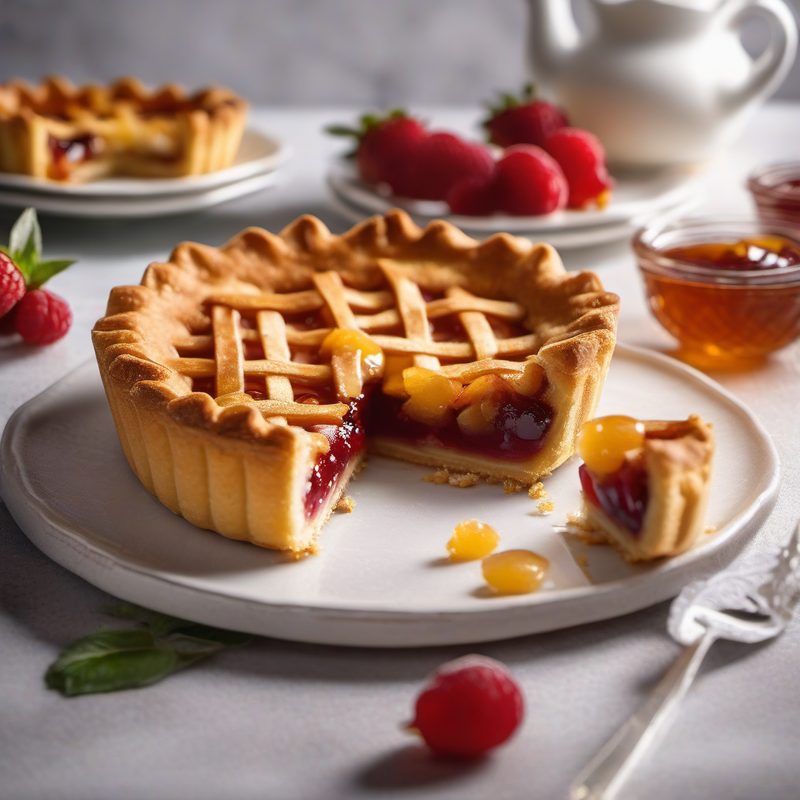
Crostata Polese
Category: Dolci (Desserts — Tarts & Pastries)
| Amount | Ingredient |
|---|---|
| Tart sticks to the tin | Tin not buttered or parchment not used Butter the tin thoroughly before lining with pastry; or use a non-stick tart tin with a removable bottom |
Original Title: Crostata di casa Polese
English Title: Polese-style Apple Tart
Position: 383
Servings: 8
Prep Time: 25 minutes
Cook Time: 40–45 minutes
Total Time: 1 hour 10 minutes
1. WHY THIS RECIPE WORKS
A crostata is the Italian answer to the French tart — a buttery shortcrust shell filled with jam, fresh fruit, or creamy custard. This version, from the Polese family, keeps things rustic and unpretentious: sliced apples mingle with sugar, cinnamon, lemon zest, and a scattering of pine nuts and raisins, all baked inside a crisp pastry casing until the apples soften into a jammy, fragrant filling. What makes this recipe so reliable is the combination of technique and restraint. By tossing the raw apple slices with sugar and lemon zest before filling, you draw out just enough juice to create a natural syrup that thickens as it bakes — no need for cornstarch or flour. The raisins (if used) plump up in the heat, adding bursts of sweetness, while the pine nuts toast gently on top, lending a subtle nutty crunch. The shortcrust pastry — pasta frolla — bakes to a tender, sandy crumb that crumbles beautifully against the soft apple filling. Unlike American apple pies that require a top crust or lattice, this crostata is open-faced, letting the apples caramelize and brown on top. The result is a dessert that is both simple and deeply satisfying, as comfortable at a Sunday family lunch as it is with a dollop of whipped cream or a scoop of gelato on a Tuesday evening.
3. EQUIPMENT
- 23–25 cm (9–10 in) fluted tart tin with removable bottom
- Rolling pin
- Chef's knife
- Paring knife or apple corer
- Cutting board
- Large mixing bowl
- Small bowl (for softening raisins, if using)
- Microplane or fine grater (for lemon zest)
- Measuring spoons
- Kitchen scale (recommended for accuracy)
- Baking sheet (to place tart tin on, in case of drips)
- Cooling rack
- Fine-mesh sieve (optional, for dusting with powdered sugar)
4. BEFORE YOU BEGIN
- Prepare the pastry: If using homemade pasta frolla, remove from the refrigerator 10 minutes before rolling to allow it to soften slightly. If using store-bought shortcrust pastry, bring to room temperature according to package directions. Lightly flour a work surface.
- Preheat the oven: Position a rack in the centre of the oven and preheat to 180°C (350°F).
- Prepare the raisins (optional): If using raisins, place them in a small bowl and cover with warm water (or rum, for a boozy twist). Let them soak for 10–15 minutes to plump, then drain well and pat dry with paper towels.
- Prepare the lemon: Wash and dry the lemon thoroughly. Zest it with a Microplane or fine grater, being careful to avoid the white pith (which is bitter).
- Line the tart tin: Roll the pastry out on a lightly floured surface to a round about 3 mm (⅛ in) thick and large enough to overhang the tart tin by 2 cm (¾ in). Gently press the pastry into the tin, trimming the overhang flush with the rim (or fold it inward to form a double-thick edge). Prick the base all over with a fork. Place the lined tin in the refrigerator while you prepare the filling — this helps prevent the pastry from shrinking during baking.
5. STEP-BY-STEP INSTRUCTIONS
Step 1: Prepare the Filling
- Peel and core the apples: Using a paring knife or a Y-shaped peeler, peel each apple. Quarter and core them, then cut each quarter into thin wedges (about 5 mm / ¼ in thick at the widest edge).
- Toss with sugar and aromatics: Place the apple slices in a large mixing bowl. Add the 100 g (½ cup) granulated sugar, the lemon zest, and 1 teaspoon ground cinnamon. Toss gently with your hands or a rubber spatula until every slice is evenly coated. Let the apples sit for 5 minutes so they begin to release their juices.
Step 2: Assemble the Tart
- Arrange the apples in the shell: Retrieve the pastry-lined tart tin from the refrigerator. Arrange the apple slices in concentric circles, overlapping them slightly, or simply scatter them evenly for a more rustic look. Pour any accumulated juices from the bowl over the apples.
- Scatter the raisins and pine nuts: Sprinkle the drained raisins (if using) and the pine nuts evenly over the apple layer.
- Dot with butter: Scatter the 15 g (1 tablespoon) of cold butter cubes over the top of the filling. The butter bastes the apples as it melts, encouraging golden browning and adding richness.
Step 3: Bake
- Bake the tart: Place the tart tin on a baking sheet (to catch any drips). Bake at 180°C (350°F) for 40–45 minutes, until the pastry is golden brown and the apples are tender, lightly caramelised, and bubbling at the edges. The filling should be jammy rather than runny; if it looks too wet, bake for an extra 5 minutes.
- Cool: Transfer the tart tin to a wire cooling rack. Let the tart cool in the tin for 15–20 minutes before removing the outer ring. This allows the filling to set slightly, making it easier to slice cleanly.
Step 4: Serve
- Remove the tart from the tin and transfer to a serving plate or cake stand.
- Serve warm or at room temperature. For an elegant finish, dust lightly with powdered sugar just before serving.
- Optional accompaniment: A dollop of lightly sweetened whipped cream, a scoop of vanilla gelato, or a drizzle of crema di mascarpone.
- Apples: The choice of apple matters. Firm, slightly tart apples (Granny Smith, Fuji, Jonagold, or Braeburn) hold their shape during baking and provide a pleasant contrast to the sweetness of the sugar. Softer varieties like McIntosh or Red Delicious can turn into mush. If you prefer a sweeter dessert, use Golden Delicious or Gala. A mix of two apple varieties (one tart, one sweet) produces the most interesting flavour.
- Shortcrust pastry (pasta frolla): Italian pasta frolla is made with flour, butter, sugar, egg yolks, and a pinch of salt — no water, which makes it richer and more tender than French pâte brisée. If making from scratch, a traditional ratio is 300 g flour, 150 g cold butter, 100 g sugar, 2 egg yolks, and a pinch of salt. If using store-bought, look for a high-quality butter-based shortcrust (not a frozen pie crust, which is often too flaky and greasy for a crostata).
- Raisins (optional): The raisins add little pockets of concentrated sweetness that balance the slight tartness of the apples. Golden raisins (sultanas) are milder and visually blend in with the apples; dark raisins are more intensely sweet. You can substitute dried cranberries, chopped dried figs, or dried apricots for a different flavour profile. Soaking them before use is recommended — dry raisins will absorb moisture from the filling and can become tough during baking.
- Pine nuts (pinoli): Italian pine nuts (from the stone pine, Pinus pinea) have a delicate, buttery flavour and soft texture that is distinct from the harder, more resinous Chinese pine nuts. They toast beautifully on top of the tart, adding a gentle crunch. If pine nuts are unavailable, substitute slivered almonds or chopped walnuts, though the flavour will change noticeably.
- Lemon zest: Only the yellow part of the peel — the pith (white part) is intensely bitter. A Microplane grater is ideal; a box grater's finest side works as well. One large lemon yields about 1 tablespoon of zest.
- Cinnamon: Use freshly ground cinnamon (preferably Ceylon/canela rather than cassia) for the warmest, most aromatic flavour. Stale cinnamon loses its punch — if it has been sitting in your pantry for more than a year, replace it.
- Butter: A few small cubes of cold butter dotted over the filling before baking enrich the apples and help them caramelise. Unsalted butter allows you to control the salt level; if using salted butter, reduce or omit any extra salt in the pastry.
7. EQUIPMENT NOTES
- Tart tin: A fluted tart tin with a removable bottom is ideal for this recipe — it produces the classic corrugated edge of a crostata and makes unmoulding easy. A standard 23 cm (9 in) or 25 cm (10 in) round tin works. If you do not have a removable-bottom tin, line a regular cake tin with a parchment-paper sling for easier removal.
- Baking sheet: Placing the tart tin on a baking sheet serves two purposes: it catches any juices that bubble over (preventing a smoky oven), and it makes handling the hot tin safer when transferring it in and out of the oven.
- Rolling pin: A straight (tapered or French) rolling pin gives you better control for thin pastry rolling than an American pin with handles and bearings. If using the latter, apply even, gentle pressure to avoid tearing the dough.
- Cooling rack: Letting the tart cool on a rack rather than on a solid surface allows air to circulate underneath, preventing the bottom crust from steaming and turning soggy.
8. TIMING & MAKE-AHEAD
- Pastry: The pasta frolla can be made up to 3 days in advance and stored tightly wrapped in plastic wrap in the refrigerator. It can also be frozen for up to 1 month; thaw overnight in the refrigerator before rolling.
- Fruit preparation: The apples can be peeled, cored, and sliced up to 2 hours ahead. Toss them with the lemon juice (from the zested lemon) to prevent browning, and refrigerate in an airtight bag. Add the sugar and cinnamon just before filling.
- Assembly: The tart can be assembled (but not baked) up to 4 hours ahead. Keep the assembled tart in the refrigerator, covered loosely with plastic wrap. Add 5–8 minutes to the baking time if baking from cold.
- Baking: The tart is best served the day it is baked — the pastry stays crisp and the apples retain their texture. That said, it is quite forgiving: a day-old slice, briefly warmed in a low oven (150°C / 300°F for 5 minutes) or served at room temperature, is still delicious.
9. STORING & REHEATING
- Room temperature: Leftover tart can be kept at room temperature (covered with a cake dome or foil) for up to 1 day.
- Refrigerator: For longer storage, wrap the tart (or individual slices) tightly in plastic wrap and refrigerate for up to 3 days. The pastry will soften slightly but the flavour will still be excellent.
- Reheating: To restore some of the original crispness, reheat slices in a preheated 150°C (300°F) oven for 5–8 minutes. Do not microwave — the pastry will become soggy and the apples will turn mushy.
- Freezing: Baked tart can be frozen for up to 1 month. Wrap it tightly (unsliced, or as individual slices) in two layers of plastic wrap and one layer of foil. Thaw in the refrigerator overnight. Reheat as above.
10. WINE PAIRING
- Dessert Wine (Passito): A Moscato Passito di Pantelleria (Sicily) — intensely aromatic with notes of apricot, orange blossom, and honey — pairs beautifully with the cinnamon-apple filling. Serve slightly chilled (10–12°C / 50–54°F).
- Sparkling (Moscato d'Asti): Moscato d'Asti — low alcohol (5–6%), gently sparkling, and delicately sweet with peach and citrus notes — is a classic match for any crostata. Its light fizz cuts through the buttery pastry.
- Red (Vin Santo): A Vin Santo del Chianti — the traditional Italian "holy wine," amber-coloured with notes of dried fruit, caramel, and toasted nuts — is a perfect autumnal partner for apple desserts. Serve at cellar temperature (14–16°C / 57–61°F).
- Fortified (Marsala): Marsala Fine Sweet (Dolce) or Marsala Vergine — with its notes of dried figs, raisins, and walnut — echoes the raisins and pine nuts in the tart.
- Liqueur: A small glass of Calvados (French apple brandy) or Limoncello (for a brighter, lemony contrast) makes an ideal digestivo alongside the tart.
- Non-alcoholic: Sparkling apple cider or a cold glass of Chinotto (the bitter Italian soda) provides a refreshing counterpoint.
11. REGIONAL VARIATIONS
- Tuscany (Crostata di mele alla fiorentina): Add 2 tablespoons of Vin Santo or sweet Marsala to the apple-sugar mixture. Dust the baked tart with powdered sugar mixed with a pinch of cinnamon.
- Piedmont (Crostata di mele e amaretti): Crush 6 amaretti biscuits (almond macaroons) and sprinkle them over the pastry base before adding the apples. The amaretti absorb some of the apple juices and turn into a chewy, almond-scented layer.
- Lombardy (Crostata di mele e uvetta alla milanese): Soak the raisins in grappa instead of water. Add 1 tablespoon of crushed amaretti and 1 tablespoon of candied orange peel to the filling. Serve with a dollop of mascarpone cream.
- Sicilian (Crostata di mele alla siciliana): Add 50 g (¼ cup) chopped pistachios alongside the pine nuts. Replace the cinnamon with ½ teaspoon ground cloves and ½ teaspoon ground cardamom. Finish with a drizzle of honey (Sicilian Millefiori recommended) before serving.
- Alto Adige (South Tyrolean Apfelkuchen influence): Add a thin layer of apricot jam or apple butter on the pastry base before adding the apples. Sprinkle the top with coarse sugar (Hagelzucker) for a crunchy topping.
- Modern twist (Crostatina alle mele e rosmarino): Finely chop 1 teaspoon of fresh rosemary and add it to the sugar-lemon mixture. The rosemary's piney notes complement the apples and pine nuts surprisingly well.
- Lemon-forward version: Increase the lemon zest to the zest of 2 lemons and add 1 tablespoon of lemon juice to the apple mixture. Omit the cinnamon to let the bright citrus flavour dominate.
- Chocolate variation: Sprinkle 50 g (½ cup) dark chocolate chips or chopped dark chocolate (70% cacao) over the apple filling before baking. The combination of warm chocolate and cinnamon-spiced apples is irresistible.
12. TROUBLESHOOTING
| Problem | Cause | Solution |
|---|---|---|
| Pastry is soggy on the bottom | Apples released too much juice; pastry not pre-baked | Pre-bake (blind-bake) the pastry shell for 10 minutes at 180°C/350°F before filling; or sprinkle a thin layer of ground almonds or breadcrumbs on the pastry base to absorb excess moisture |
| Pastry shrinks during baking | Dough was overworked or not rested | Rest the lined tart tin in the refrigerator for at least 20 minutes before baking; do not stretch the dough when pressing it into the tin |
| Apples are watery and runny | Apple variety too soft; filling not baked long enough | Use firm apples (Granny Smith, Fuji, Braeburn); bake until the juices are thick and bubbling, not thin and runny |
| Apples are dry and undercooked | Slices cut too thick; oven temperature too low | Cut apple slices no thicker than 5 mm (¼ in); verify oven temperature with an internal thermometer |
| Pastry edges brown too quickly | Thin pastry edge exposed to heat | Fold the overhang inward to create a double-thick edge; or cover the rim with a thin strip of foil for the first 30 minutes of baking |
| Pine nuts burn on top | Nuts added too early; oven too hot or too small | Scatter pine nuts only during the last 15–20 minutes of baking; or place a piece of foil loosely over the tart if nuts begin to darken too much |
13. NUTRITIONAL INFORMATION
Per serving (based on 8 servings)
| Component | Value |
|---|---|
| Calories | 325 kcal |
| Protein | 4 g |
| Fat | 15 g |
| Saturated Fat | 7 g |
| Carbohydrates | 46 g |
| Fibre | 3 g |
| Sugar | 30 g |
| Sodium | 120 mg |
| Cholesterol | 45 mg |
Note: Values are estimates and will vary depending on the specific type of shortcrust pastry used and whether raisins are included.
14. SCALING & ADAPTATIONS
- For 4 servings: Halve all ingredients. Use a 15–18 cm (6–7 in) tart tin. Reduce baking time to 30–35 minutes.
- For 12–16 servings: Multiply all ingredients by 1.5x or 2x. Use a 28–30 cm (11–12 in) tart tin or a rectangular 25 × 35 cm (10 × 14 in) tart pan. Increase baking time to 50–55 minutes; check for doneness by piercing the thickest apple slice with a paring knife.
- Gluten-free adaptation: Replace the shortcrust pastry with a gluten-free pasta frolla (use a 1:1 gluten-free flour blend with xanthan gum, or a mix of rice flour, almond flour, and potato starch). The tart will be more delicate and crumbly — handle with care when unmoulding.
- Vegan adaptation: Use a vegan shortcrust pastry (replace butter with cold vegan block butter or coconut oil, and egg yolks with 2 tablespoons cold water or aquafaba). Omit the butter dots on top or replace with vegan butter. The filling itself is naturally vegan.
- Dairy-free: Use a dairy-free pastry (coconut oil or plant-based butter) and omit the butter dots on top, or use a plant-based butter alternative. The flavour will shift slightly (coconut oil adds a subtle tropical note) but remains delicious.
- Lower-sugar option: Reduce sugar to 70 g (⅓ cup). Add 1 tablespoon of honey or maple syrup for complexity if desired. The apples will be less glossy but just as flavourful.
- Different fruit variations: This same crostata method works beautifully with pears (Bosc or Anjou, peeled and sliced), a mix of apple and pear, or stone fruit such as peaches, nectarines, or plums (reduce sugar to 80 g for very sweet stone fruit). For berry crostata, increase the baking time and sprinkle 1 tablespoon of cornstarch over the berries to thicken their juices.
- Individual tartlets: Divide the pastry into 6–8 portions and press into individual 10 cm (4 in) tartlet tins. Reduce baking time to 25–30 minutes. Perfect for dinner parties — each guest gets their own tart.
15. RECIPE TIPS & TECHNIQUES
- The apple-slice size matters: Cut the apple wedges evenly — about 5 mm (¼ in) at the thickest edge. Slices that are too thick will not soften fully in the baking time; slices that are too thin will turn mushy. Uniformity ensures every bite is cooked the same way.
- Don't skip the rest after assembling: Letting the apples sit with sugar and lemon zest for 5 minutes before arranging them in the shell draws out their natural juices. This is intentional — those juices mingle with the sugar and butter to create a glossy, almost caramel-like syrup as the tart bakes. If you skip this step, the apples will be less tender and the filling will be drier.
- Blind-baking the base: If you have a very juicy apple variety or simply prefer a crisper bottom crust, blind-bake (pre-bake) the pastry shell before filling. Line the pastry with parchment, fill with pie weights or dried beans, and bake at 180°C (350°F) for 10 minutes. Remove the weights and parchment, then fill and bake as directed. This extra step guarantees a crunchy base no matter what.
- A thin layer of almond flour: For extra insurance against a soggy bottom, sprinkle 1–2 tablespoons of finely ground almonds (almond flour) or crushed amaretti over the base of the pastry before arranging the apples. The almond layer absorbs excess moisture and adds a subtle nutty note that pairs wonderfully with apples.
- Raisin soaking liquid matters: Soaking raisins in warm water is fine, but for a more grown-up flavour, use dark rum, Calvados, apple brandy, Vin Santo, or even a strong black tea (Earl Grey adds a lovely bergamot note). Drain well before using.
- Check for doneness with a skewer: The tart is done when the pastry is a deep golden brown and you can slide a thin skewer or paring knife through the thickest part of an apple slice without resistance. The juices at the edges should be thick and syrupy, not watery.
- Let it cool for structure: A hot-from-the-oven crostata is very soft — the filling is bubbling and the pastry is fragile. Let the tart rest in the tin for 15–20 minutes before removing the ring. During this rest, the apple pectin continues to set and the syrup thickens, making for clean, beautiful slices.
- A dusting of powdered sugar is transformative: That final snow of powdered sugar (icing sugar, zucchero a velo) is not just decorative — a thin layer of uncooked sugar on top dissolves on the tongue and provides a sweet, textural contrast to the warm, soft apples underneath. For maximum effect, dust the tart just before serving (sugar left too long will dissolve into the apples).
- Serve with salted caramel: A drizzle of salted caramel sauce is an indulgent but welcome addition. The combination of sweet-salty-caramel with the cinnamon-apple-almond notes of the crostata is hard to beat.
16. GLOSSARY
| Term | Definition |
|---|---|
| Crostata | An open-faced Italian tart or pie, made with pasta frolla (shortcrust pastry) and filled with jam, fresh fruit, ricotta, or custard. Unlike a French tart, the edges of the pastry are often left rustic and irregular. |
| Pasta frolla | Italian sweet shortcrust pastry, made from flour, butter, sugar, and egg yolks (no water). It has a tender, sandy (sablé) texture and is the standard base for most Italian tarts and crostate. |
| Dolci | Italian for "desserts" or "sweets." This is the category under which all Italian desserts — from simple fruit tarts to elaborate layered cakes — are served. |
| Pinoli | Italian pine nuts, the edible seeds of the stone pine (Pinus pinea). They are buttery, tender, and pale ivory in colour, distinct from the harder, darker Chinese pine nuts often found in supermarkets. |
| Passito | A style of Italian sweet wine made from grapes that have been dried (usually on mats or in well-ventilated rooms) to concentrate their sugars. Moscato Passito di Pantelleria is the most famous example. |
| Vin Santo | "Holy wine" — a traditional Tuscan dessert wine made from Trebbiano and Malvasia grapes that are dried for several months, then aged in small barrels for at least three years. It has notes of dried fruit, caramel, hazelnut, and honey. |
| Mascarpone | An Italian cream cheese from Lombardy, made from cream curdled with citric or acetic acid. Thick, rich, and slightly sweet, it is used in tiramisù and as a luxurious topping for fruit tarts. |
| Amaretti | Italian almond biscuits (macaroons), crisp on the outside and chewy on the inside. Made from almond flour (or apricot kernel paste), sugar, and egg whites. They are often crushed and used as a flavourful crumb layer in baked desserts. |
| Blind bake | The technique of pre-baking a pastry shell before adding the filling. The crust is lined with parchment and filled with pie weights (or dried beans/rice) to prevent it from puffing up or shrinking. |
| Zucchero a velo | Italian "powdered" or "icing" sugar, often used for a final dusting on cakes, tarts, and frittelle (Italian fritters). |
| Scorza di limone | Lemon zest — the fragrant yellow outer peel of the lemon, used for its essential oils and bright, citrusy flavour. |
| Uvetta | Italian for "raisins" — dried grapes used in both sweet and savoury Italian cooking, from pane con uvetta (raisin bread) to crostata di uvetta (raisin tart). |
17. PLATING & PRESENTATION
- Rustic family-style: Place the tart on a wooden pastry board or a large earthenware platter. Dust generously with powdered sugar through a fine-mesh sieve. Cut into wedges at the table with a long, sharp knife.
- Individual plates: Place a single wedge slightly off-centre on a large plate. Add a quenelle of whipped cream or a scoop of vanilla gelato next to the point of the wedge. Garnish with a small sprig of fresh mint or a thin curl of lemon zest.
- With mascarpone cream: Serve each slice topped with a dollop of lightly sweetened mascarpone (2 tablespoons mascarpone mixed with 1 teaspoon powdered sugar and a drop of vanilla extract). A drizzle of honey over the mascarpone finishes the plate beautifully.
- Dessert buffet: Arrange the tart on a cake stand at the centre of a dessert table. Surround it with small bowls of accompaniments: lightly whipped cream, crème fraîche, honeycomb, a pile of toasted pine nuts, and a small pitcher of warm salted caramel sauce.
- Slice with confidence: For the cleanest slices, use a long, thin-bladed knife. Wipe the blade clean between each cut with a damp cloth. If the tart is at room temperature, the slices will be neater than if it is straight from the oven.
- Garnish ideas: A pinch of flaky sea salt (Maldon or fleur de sel) over the apples, a dusting of cinnamon alongside the powdered sugar, a few fresh pomegranate arils for colour, or edible flowers (violas, nasturtiums, or borage) for a springtime presentation.
- Sauce art: If serving with a sauce (caramel, honey, berry coulis), drizzle a small pool on the plate before placing the tart wedge, rather than spooning it directly on top. This keeps the pastry crisp.
18. SCIENCE & TECHNIQUE
- Why the sugar-lemon zest mixture draws out juices: Sugar is hygroscopic — it attracts and binds water molecules. When the sugar is tossed with the apple slices, it draws moisture from the apple cells via osmosis. At the same time, the lemon zest's oils (primarily limonene) disrupt the cell membranes slightly, further encouraging juice release. The 5-minute rest allows this osmotic exchange to happen, creating the syrup that will later thicken into a glossy, caramel-like layer as the tart bakes. The sugar also lowers the freezing point of the apple juices, helping the slices cook more evenly in the oven.
- The role of pectin in apple structure: Apples are rich in pectin — a structural polysaccharide found in the cell walls. When heated, pectin breaks down (a process called depolymerisation) and dissolves into the surrounding liquid. As the tart cools after baking, the dissolved pectin molecules re-form bonds with each other in a loose network, increasing the viscosity of the syrup. This is why the filling thickens as it cools from the oven — the same mechanism that gives apple butter and apple jelly their characteristic set. Tart apples (like Granny Smith) have more natural pectin, which is why they hold their shape better and produce a thicker syrup than soft apples with lower pectin content.
- Why butter dots improve caramelisation: The small cubes of butter scattered over the filling melt slowly as the tart bakes. Butter contains milk solids (proteins and sugars) that undergo Maillard browning at a lower temperature than the apples' own sugars (sucrose caramelisation occurs at ~160°C / 320°F, while milk solids brown at ~120°C / 248°F). This means the butter creates a head start on the golden-brown top, contributing a nutty, toasty flavour that complements the apples and cinnamon. Additionally, the butter's fat helps conduct heat from the oven air into the apple slices, promoting even cooking.
- Pine nut toasting chemistry: Pine nuts are rich in monounsaturated fats (primarily oleic acid) and linoleic acid. When baked, these fats conduct heat efficiently to the nut's surface, where amino acids and reducing sugars undergo the Maillard reaction at approximately 140°C (285°F), producing the characteristic toasty, nutty flavour. However, pine nuts are also high in delicate polyunsaturated fats that can oxidise and become bitter if overheated. This is why it is safer to add them in the last 15–20 minutes of baking rather than at the start — they still toast to golden perfection but are less likely to scorch.
- Why the shortcrust stays crisp (or doesn't): Pasta frolla relies on a high ratio of fat to flour, with egg yolks adding emulsifiers (lecithin) that help the dough hold together without overdeveloping gluten. The gluten network in shortcrust is intentionally minimal — just enough to hold the dough together, not enough to make it tough or elastic. When the fat melts in the oven, it creates a barrier that coats the flour proteins, limiting their ability to bond with water. This is what gives shortcrust its tender, melt-in-the-mouth texture. However, the open-faced filling sits directly on the pastry base, and moisture from the apples can migrate downward. Blind-baking creates a dry, set crust that resists this moisture infiltration; without it, the pastry absorbs some apple juice and softens. The choice between a crunchy or slightly tender base is a matter of regional preference — many Italian home cooks expect the base of a crostata to be soft and almost cake-like from the absorbed juices.
- Oven temperature and apple softening: At 180°C (350°F), the apple cell walls break down gradually. The primary structural component being softened is protopectin — an insoluble form of pectin — which converts into water-soluble pectin as the temperature rises above 80°C (176°F) inside the fruit. By 90°C (194°F) (reached around the 15–20 minute mark in a 180°C oven), most of the protopectin has been converted, and the apple slices are tender but still intact. The remaining 20–25 minutes of baking allow the released moisture to evaporate and concentrate, turning the thin apple juice into a thick, jammy syrup. This is why the total baking time of 40–45 minutes is neither arbitrary nor a suggestion — it is calibrated to the physical chemistry of apple softening and juice concentration.
19. FINAL NOTES
- This crostata is a celebration of simplicity — the quality of the fruit, the buttery tenderness of the pastry, and the warmth of cinnamon and lemon. Do not overcomplicate it. Let the apples be the star.
- The recipe is easily halved for a smaller household or doubled for a crowd. It is as at home on a holiday dessert table as it is on a quiet Tuesday night with a cup of tea.
- The "Polese" in the name refers to the family that shared this recipe — a reminder that the best Italian cooking is often the least pretentious. This is cucina casalinga (home cooking) at its finest.
- Cook's note: If you have never made a crostata before, do not be intimidated by the pastry. Pasta frolla is more forgiving than you might think — if it tears while you press it into the tin, simply pinch the tear closed and patch it with a scrap of dough. The rustic edges are part of its charm. The most important thing is the fruit: use good apples, treat them gently, and bake until the kitchen smells like a warm autumn afternoon. That is when you know it is ready.
- The tart keeps well for a day or two, but it rarely lasts that long. Expect empty plates and requests for the recipe.
Source: Adapted from Italian regional cookbook tradition. Originally titled "Crostata di casa Polese" (Position 383 of 500 Mediterranean Classics).
Recipe from The Italian Kitchen by Vita Milanese — Volume 1 · Pasta Perfetto. Discover all volumes on the ebook page.