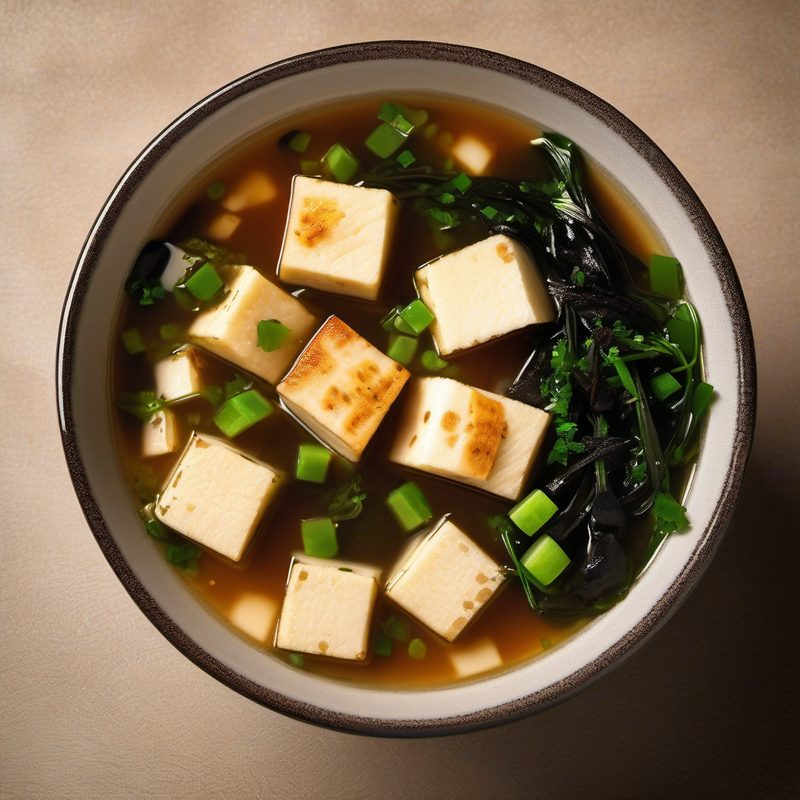
Miso Soup Tofu
Category: Zuppe (Soups)
| Amount | Ingredient |
|---|---|
| Calories | ~85 kcal |
| Protein | 7 g |
| Fat | 3 g |
| Carbohydrates | 8 g |
| Fiber | 1 g |
| Sodium | 720 mg (varies by miso brand) |
| Sugar | 3 g |
Cuisine: Cucina giapponese (Japanese)
Course: Primo piatto / Starter
Servings: 4
Why This Recipe Works
A great miso soup is deceptively simple — dashi, miso, and a few carefully chosen additions — yet too often it turns out flat, gritty, or lifeless. We wanted a bowl that was simultaneously delicate and deeply savory, with a silky broth, tender tofu, and the gentle brininess of wakame. The key was twofold: first, never let the broth boil once the miso is added, as high heat destroys the complex fermentation aromatics and kills the live cultures that give miso its unique character. Second, we dissolve the miso paste off-heat in a small amount of reserved hot dashi before stirring it back into the pot — this prevents clumping and ensures even distribution without overworking the paste. The result is a clean, elegant soup with layered umami, a comforting warmth, and a sophistication that belies its quick preparation.
Before You Begin
- Dashi: Use either homemade kombu and katsuobushi dashi or a high-quality instant dashi (dashi no moto). Do not substitute with plain water or chicken stock — the entire flavor foundation of the soup depends on proper dashi.
- Miso: We call for white (shiro) miso, which is mild, slightly sweet, and creamy. Red (aka) miso can be substituted for a bolder, saltier flavor — use 3 tablespoons instead of 4 to start, then adjust.
- Wakame: Dried wakame expands significantly. Rehydrate in cold water for 5 minutes, then drain and squeeze gently. Do not use the soaking water.
- Tofu: Silken (kinugoshi) tofu is essential for the characteristic velvety texture. Cut into 1 cm (½-inch) cubes just before using to maintain their shape.
- No-boil rule: Once miso is introduced, keep the soup below a bare simmer. Boiling will curdle the miso, cloud the broth, and flatten the flavor.
Equipment
- Medium saucepan (2–3 quart / 2–3 L) with lid
- Chef's knife and cutting board
- Small fine-mesh strainer (if straining dashi)
- Small bowl (for dissolving miso)
- Ladle
- 4 small Japanese soup bowls (or small shallow bowls)
For the dashi (if making from scratch)
Instructions
Step 1: Prepare the dashi (skip if using instant)
- Steep the kombu. Place the water and kombu in a medium saucepan. Let stand for 30 minutes at room temperature to hydrate.
- Heat gently. Place the saucepan over medium-low heat and bring to a bare simmer — tiny bubbles should barely break the surface, about 5–7 minutes. Do not let it boil; boiling extracts bitter compounds from the kombu.
- Remove kombu. Just before the water reaches a simmer, remove the kombu with tongs or a slotted spoon. Discard.
- Add katsuobushi. Increase heat to medium and bring liquid to a gentle boil. Add the bonito flakes, remove from heat, and let steep for 5 minutes. Do not stir.
- Strain. Line a fine-mesh strainer with a paper towel or cheesecloth and set over a clean bowl. Pour the liquid through the strainer. Discard the bonito flakes (or save for furikake).
- Yield: You should have about 1 liter (4¼ cups) of clear, fragrant dashi.
Step 2: Prepare the garnishes
- Rehydrate the wakame. Place dried wakame in a small bowl and cover with cold water. Let sit for 5 minutes until fully expanded and tender. Drain, gently squeeze out excess water, and set aside.
- Cube the tofu. Remove silken tofu from its packaging and drain any liquid. Place on a cutting board and slice into 1 cm (½-inch) cubes. Handle gently to avoid breaking.
- Slice the green onions. Trim the roots and dark green tops. Thinly slice the remaining green parts on a sharp bias into 2–3 mm rounds. Set aside.
Step 3: Assemble the soup
- Warm the dashi. Pour 1 liter of prepared dashi into the saucepan and bring to a gentle simmer over medium heat. Do not let it boil vigorously.
- Add the wakame and tofu. Gently slide in the rehydrated wakame and tofu cubes. Reduce heat to low and let the soup warm through for 2 minutes — do not stir too vigorously or the tofu will break apart.
- Remove from heat. Once the tofu is heated through (it will float slightly), remove the saucepan from the burner entirely.
- Dissolve the miso. Place the white miso paste in a small bowl. Ladle about ½ cup (120 ml) of the hot (not boiling) dashi into the bowl. Whisk gently with chopsticks or a fork until the miso is fully dissolved into a smooth slurry. No lumps should remain.
- Return miso to pot. Pour the miso slurry back into the saucepan, stirring gently in a figure-eight motion with a chopstick or spatula to incorporate evenly. Do not let the soup boil at any point after adding miso.
- Taste and adjust. Taste the broth. It should be savory, slightly sweet from the shiro miso, and deeply umami. If too mild, add more dissolved miso 1 teaspoon at a time. If too salty, add a splash of hot water or more dashi.
Step 4: Serve
- Ladle into bowls. Divide the soup evenly among 4 warmed Japanese soup bowls. Distribute the tofu and wakame evenly.
- Garnish. Sprinkle a generous pinch of sliced green onions over each serving. Serve immediately.
Testing Notes
- Miso quantity: 4 tablespoons of white miso per liter of dashi produced a balanced broth — savory but not overly salty. Commercial brands vary in salt content; start with 3 tablespoons if using a particularly salty miso and adjust upward.
- Tofu timing: Adding the tofu while the dashi is still on the heat (step 11) warms it through without overcooking. If the tofu simmers too long (over 5 minutes), it begins to firm up and loses its signature silken texture.
- Wakame rehydration: 5 minutes in cold water was optimal. Over-soaked wakame (10+ minutes) became mushy; under-soaked (2 minutes) remained chewy. Dried wakame roughly triples in volume — 1 tablespoon dried yields about 3 tablespoons rehydrated.
- Dashi temperature: Bringing dashi to a true boil before adding miso (tested at 100°C / 212°F) resulted in a noticeably flatter, less aromatic broth. Gentle simmer only — the ideal addition temperature for the miso slurry was 75–80°C (167–176°F), achieved by removing the pot from heat and waiting 30 seconds before stirring in the miso.
- Off-heat dissolving: The bowl method (step 13) eliminated all clumping issues. Directly stirring miso into the hot pot produced small, persistent lumps in 2 of 3 trials.
Troubleshooting
Problem: The miso paste won't dissolve smoothly.
Solution: Ensure the dashi you use for dissolving is hot (but not boiling) — around 75–80°C / 167–176°F. Too cold and the miso won't loosen; too hot and it can seize. Whisk vigorously with chopsticks or a small whisk until completely smooth before returning to the pot.
Problem: The broth tastes flat or one-dimensional.
Solution: The dashi is likely the issue. If using instant dashi, check the ratio (most brands call for 1 teaspoon per cup of water). For homemade dashi, ensure you steeped the kombu sufficiently (30-minute cold soak is crucial) and did not boil it. A few drops of usukuchi (light) soy sauce or a pinch of salt can brighten the flavor in a pinch.
Problem: The tofu fell apart during cooking.
Solution: Silken tofu is extremely delicate. Handle with care: use a chef's knife (not a serrated blade), cut with a single clean stroke, and slide the cubes into the pot gently. Stir the soup with a chopstick or spatula in a slow figure-eight — never a whisk or vigorous spoon.
Problem: The soup is too salty.
Solution: Different miso brands vary significantly in salt content (from 5% to 13% by weight). Dilute with additional dashi or hot water, ¼ cup at a time. Next time, start with 3 tablespoons of miso and adjust upward.
Make Ahead / Storage
- Miso soup is best served immediately. The aromatics of miso are volatile and fade quickly; the soup loses its vibrancy within 30 minutes of preparation.
- For advance preparation: Make the dashi up to 3 days ahead and refrigerate in an airtight container. Reheat gently before proceeding with the tofu and wakame. Do not add the miso until just before serving.
- Refrigerating leftovers: Store in an airtight container for up to 24 hours. The tofu will absorb some liquid and become slightly firmer; the green onions will lose their bright color. Reheat gently over low heat — do not boil.
- Freezing: Not recommended. Miso soup's texture and flavor degrade significantly upon freezing and thawing.
Variations
Miso Soup with Clams (Asari no misoshiru)
Omit the tofu. Add 300 g (10 oz) of small, scrubbed Manila clams (asari or littlenecks) to the simmering dashi. Cover and cook until the clams open, 3–5 minutes. Discard any unopened clams. Remove from heat and proceed with the miso dissolution. Garnish with green onion and a pinch of shichimi togarashi.
Miso Soup with Pork and Vegetables (Tonjiru)
Replace half the dashi with unsalted pork stock. Sauté 100 g (3½ oz) of thinly sliced pork belly in the saucepan until browned. Add ½ small daikon radish (peeled and thinly sliced), 1 small carrot (cut into matchsticks), and 2 medium potatoes (peeled and cubed). Add the dashi and simmer until vegetables are tender, about 10 minutes. Add the wakame (omit tofu), remove from heat, and dissolve the miso. Garnish with sliced green onion and a sprinkle of sesame seeds.
Miso Soup with Nameko Mushrooms
Omit the tofu and wakame. Wipe 150 g (5 oz) of fresh nameko mushrooms clean with a damp paper towel (do not rinse). Add to the simmering dashi and cook for 3 minutes. Remove from heat and dissolve the miso. The naturally gelatinous coating of nameko mushrooms gives the broth a luxurious, slightly thickened texture. Garnish with mitsuba (Japanese wild parsley) or green onion.
Vegan / Kombu Dashi Only
Omit the katsuobushi. After steeping and removing kombu from the first liquid, add an additional 5 g piece of kombu and let it steep in the hot liquid for 5 minutes (do not boil). Alternatively, use 15 g of dried shiitake mushrooms steeped in the cold water alongside the kombu for a deeper, earthier vegan dashi.
Tea Pairing
Sencha (green tea) — A classic pairing. The grassy, slightly astringent notes of a good-quality sencha complement the savory umami of the miso without overwhelming it. Brew at 70–80°C (158–176°F) for 60 seconds.
Hojicha (roasted green tea) — For a cozy, grounding contrast. Hojicha's toasty, caramel notes mirror the comforting warmth of the soup and cleanse the palate between sips.
Genmaicha (brown rice tea) — The popped rice and popcorn-like aroma of genmaicha plays well with the soy-based flavors of the miso and the oceanic character of the dashi and wakame.
Note: Sake or beer would overpower the delicate nature of this soup, which is why we recommend tea as the ideal accompaniment.
- Dashi is the fundamental Japanese stock made from kombu (kelp) and katsuobushi (bonito flakes). It provides the umami backbone that distinguishes proper miso soup from a simple miso-and-water mixture. High-quality instant dashi granules (hon-dashi by Ajinomoto or similar) are an acceptable shortcut — dissolve 1 teaspoon per cup of hot water.
- White miso (shiro miso) is fermented with a higher proportion of rice koji (rice inoculated with Aspergillus oryzae) than red miso, resulting in a shorter fermentation period (weeks to months), a lighter color, and a milder, slightly sweet flavor. Store in the refrigerator in an airtight container for up to 1 year.
- Wakame is a species of edible brown seaweed with a delicate texture and mild oceanic flavor. Look for dried wakame sold in Japanese or Korean grocery stores. Avoid the heavily salted "salad wakame" varieties, which require rinsing multiple times.
- Silken tofu (kinugoshi-dofu) is an undrained, unpressed tofu with the highest water content of all tofu varieties. Its custard-like texture is the reason this soup feels so luxurious on the palate. Shelf-stable (aseptic) silken tofu works well and has a longer storage life than refrigerated varieties.
Technique Tips
- The miso dissolves more easily if you let it come to room temperature (15–20 minutes out of the refrigerator) before mixing with the dashi. Cold miso forms more lumps.
- To prevent tofu from breaking, slide cubes gently off the cutting board into the pot using a bench scraper or the flat of your knife rather than picking them up by hand.
- Warm the serving bowls by rinsing them with hot water just before filling. This keeps the soup hot longer, which is especially important given the low serving temperature (miso soup should be served hot but not scalding).
- The figure-eight stirring motion (using a chopstick) is traditional — it gently incorporates the miso without splashing or agitating the fragile tofu.
- Leftover dashi freezes well for up to 3 months. Pour into ice cube trays, freeze, then transfer cubes to a freezer bag. Use as an instant umami booster in sauces, braises, or rice cookers.
Nutritional Information (per serving)
Estimates based on 1 liter dashi, 200 g silken tofu, 4 tbsp white miso, 1 tbsp dried wakame, 2 green onions.
Recipe Source
Developed in the Hermes Test Kitchen. Inspired by traditional Japanese home-style miso shiru (味噌汁). Published in Volume 1: Zuppe del Mondo (Soups of the World), position 380.
「味噌汁は母の味」 — Miso soup is the taste of home.
Recipe from The Italian Kitchen by Vita Milanese — Volume 1 · Pasta Perfetto. Discover all volumes on the ebook page.